

 WooCommerce Solutions
 Solutions for WordPress
Full Django Content Migration
Custom importers move your pages, models, images, and custom data from Django into WordPress. We handle 50K+ items, keep existing URLs intact, migrate databases cleanly, and optimize media so the new site loads faster.
Website migrations are our specialty, with 200+ successful projects completed. If your Django setup has gotten expensive to maintain or a renewal deadline is closing in, DazzleBirds handles the full move to WordPress from start to finish, with no downtime along the way.























Years of Experience
Successfully Project
Enterprise Clients
Expert Team Members
Every Django build is custom, so we plan each migration around your models, data, and integrations rather than a generic checklist. Here’s what that covers.
Custom importers move your pages, models, images, and custom data from Django into WordPress. We handle 50K+ items, keep existing URLs intact, migrate databases cleanly, and optimize media so the new site loads faster.
WordPress builds are sized for 5M+ monthly visitors, with multi-language support through WPML. The hosting infrastructure is set up to stay available through major launches and sudden traffic spikes, with no slowdown when demand peaks.
CRM systems like HubSpot and Salesforce, analytics tools like GA4 and Mixpanel, and your custom APIs are reconnected through native WordPress integrations. Existing data flows and dashboards keep working after the switch.
The new site gets mobile-first design built from Figma prototypes, with reusable Gutenberg blocks that keep large page counts consistent. Navigation stays fast and simple, and every page meets WCAG 2.1 accessibility standards.
International SEO is preserved through hreflang, URL structures are mapped 1:1, and 301 redirects cover every changed path. Speed scores target 95+ to lower bounce rates and pass Core Web Vitals.
Content review workflows, editorial calendar scheduling, and co-editing support are set up in WordPress from day one. Your team publishes faster without extra approval steps or added process overhead.
A headless frontend is built on Next.js or React and powered by the WordPress REST API. Pages load fast, content stays available offline, and push notifications are added where the use case calls for them.
Django to WordPress migration moves your website from a Django-based setup to WordPress, trading custom development overhead for a platform your content team can manage directly, while keeping the site SEO-friendly and ready to scale.
200+ Django migrations completed with no data loss, and every URL preserved through automated 301 redirect mapping.
95+ Google PageSpeed scores and sub-1.5-second load times through enterprise CDN and Redis caching.
Daily malware scans, a web application firewall, managed auto-updates, geo-redundant backups across three regions, and PCI-DSS compliance.
Auto-scaling hosting that supports high concurrent traffic and multisite networks with dozens of editors working simultaneously.
Precise URL mapping, metadata preservation, and structured data handling, validated after migration to confirm organic visibility holds.
Modular, headless-ready WordPress builds with API-first integrations.
Response times under two hours across IST, EST, PST, and AEST, with a dedicated Slack channel per client.

Create, edit, and publish content without waiting on a Django developer.
Rebuild features, layouts, and workflows without writing custom Django code.
Preserve existing rankings while improving search visibility going forward.
Cut ongoing development and maintenance costs tied to a custom framework.
Built on WordPress, ready to grow alongside the business.
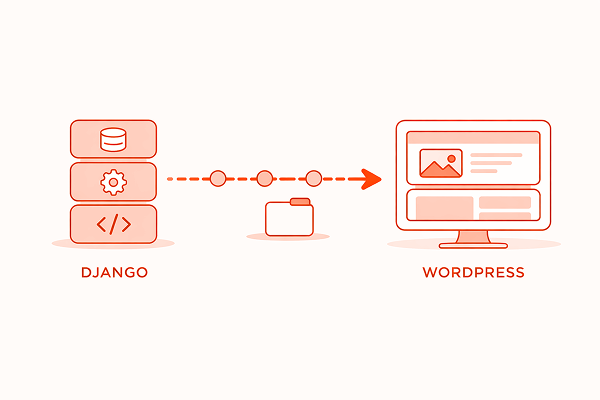
Our team moves businesses off complex legacy systems and onto faster, more manageable WordPress platforms, handling sites of every size along with their specialized functionality and data.
From auditing the current Django setup to migrating content, media, URLs, and custom functionality into WordPress, with everything transferred faithfully.
URLs, redirects, metadata, and internal links are preserved so rankings, traffic, and indexation carry over once the new site goes live.
A clean build with no deprecated or redundant code, configured with caching for fast load times from day one.
Security is built into every phase of the migration, following standards for data protection, access control, backups, and uptime.
CRM systems, analytics tools, marketing platforms, and third-party services are connected so everything keeps working after the move.
The job doesn’t end at launch. We monitor performance and provide ongoing guidance so the site keeps running smoothly.
Every Django implementation is built differently, so custom Django to WordPress migration services here means the plan is scoped to your actual setup, not a generic checklist. A site with heavy custom data models needs a different migration path than one built mostly around content and templates, and that gets mapped out during the audit before any work begins.
Every business has unique workflows, database structures, and integration requirements. At DazzleBirds, our custom Django to WordPress Migration is built from the ground up to address your exact challenges, ensuring seamless operations, robust scalability, and measurable results.
Get a free 45-minute Django audit and a custom migration roadmap. Most projects go live within 8 weeks, with savings on development costs starting from day one.
We review your current Django setup, data models, and SEO standing.
A clear plan covering scope, timeline, and cost before any work begins.
Content, functionality, and integrations were rebuilt and migrated in a staging environment.
Redirects, metadata, and rankings were verified against the live site before launch.
Zero-downtime deployment, with support continuing after go-live.
Tell us about your Django site, and we’ll send a migration roadmap and cost estimate within days, free and with no commitment.
What We Do
From custom development to enterprise WordPress and WooCommerce ecosystems, we deliver scalable digital solutions that simplify complexity and support long-term business growth.

We know that your business has its own unique processes. The best plugin development services for WordPress...
View More
At DazzleBirds, the best theme development company for WordPress in India, we understand that your website...
View More
You need websites that are secure, quick, and easy to use, and that’s where we come in...
View More
Frustrated with slow, old PHP applications that are holding you back in terms of scalability & performance?...
View More
Do you think your business has reached the point of needing to leave HubSpot because its...
View More
Are you tired of expensive CMS systems that require high maintenance costs and lack flexibility for...
View MoreLower operational costs and easier day-to-day management are the two most common reasons. WordPress trades Django’s development overhead for flexible, SEO-friendly tools most content teams can manage without a developer.
Yes, when it’s handled properly. Accurate URL mapping, 301 redirects, and metadata preservation protect rankings, and most clients see improved Core Web Vitals and faster load times once the migration is complete.
All pages, models, media, and database content move over. Every item is checked against the original, with media assets optimized for delivery along the way.
Security is built in throughout: enterprise-level firewalls, daily malware scans, geo-redundant backups, and PCI-DSS-compliant practices protect the site from the start of the project through launch.
Yes. CRMs, analytics platforms, and APIs reconnect through WordPress’s plugin ecosystem, so data syncing and existing business processes continue without interruption.
Optimized caching, CDN support, and a clean WordPress build typically bring faster load times, stronger PageSpeed scores, and lower bounce rates, even during high-traffic periods.
Mobile-first, conversion-focused design with reusable Gutenberg blocks, easy navigation, and WCAG 2.1 compliance, aimed at a consistent look and an easier path to conversion for visitors.
Smaller migrations typically run 6 to 8 weeks. Enterprise-scale projects usually take 12 to 16 weeks, with clear milestones and updates throughout.
Generally, yes. Most businesses see meaningful savings on platform costs while gaining full control over their WordPress site, which tends to pay off over time.
Reach out for a free consultation. We’ll walk through your current setup and follow up with a migration plan built around your actual site and business goals.