Ten years ago, a B2B purchase almost always started with a phone call. Today it starts with a search bar.
That shift is not a minor trend; it is a full rewrite of how buyers evaluate suppliers and make purchasing decisions. B2B buyer expectations have moved so far toward consumer e-commerce that procurement teams now judge a supplier’s website with the same eye they use for Amazon or Shopify. If checking stock, requesting a quote, or reordering a part takes more than a few clicks, buyers notice, and they remember.
Part of this is generational, as millennials and Gen Z professionals now sit in procurement and purchasing roles and grew up buying everything online. Part of it is structural, since remote work and leaner purchasing departments have pushed more research and decision-making online before a sales rep is ever contacted. And part of it is simply exposure. Once a buyer experiences a fast, transparent checkout in their personal life, a clunky phone-and-email ordering process at work feels like a step backward.
This article breaks down why B2B buyer expectations have changed, what buyers expect at each stage of the purchasing journey, the technologies that make those expectations achievable, and the mistakes that quietly push buyers toward competitors, drawing on recent research from Gartner, McKinsey, and Salesforce.
Why B2B Buyer Expectations Have Changed
A few forces are driving this shift at the same time, and they reinforce each other.
Digital transformation changed the default. A decade ago, digital ordering was the exception for most manufacturers, wholesalers, and distributors. Now it is the baseline buyers expect before they even consider a vendor’s product quality or pricing.
The consumerization of B2B is real. Buyers do not mentally separate how they shop for themselves from how they buy for their company. If a supplier’s portal cannot show real-time pricing or order status the way a retail app can, that gap is felt immediately, even for industrial parts rather than consumer goods.
A new generation controls the buying process. Millennial and Gen Z buyers now make up a large share of procurement teams, and Salesforce’s State of the Connected Customer research has found that a majority of millennial B2B buyers prefer self-service research tools over speaking with a sales rep, often completing most of the buying process online before a supplier is contacted at all.
Buyers research across many channels before ever reaching out. McKinsey’s B2B Pulse research shows buyers now use an average of roughly ten interaction channels during a purchase journey, up from about five in 2016, checking a website, requesting pricing, reading reviews, and messaging a rep before ever placing an order.
Self-service is now a stated preference, not a workaround. Gartner’s 2025 sales research found that a majority of B2B buyers, over 60 percent in recent surveys, say they prefer a rep-free buying experience, and a large share actively avoid suppliers who send irrelevant outreach. Buyers are not avoiding salespeople because they dislike them. They are avoiding friction.
Remote purchasing has become normal, even for large orders. McKinsey’s research shows the share of B2B buyers comfortable spending $500,000 or more through remote or self-service channels has grown significantly in just a few years, a trend once unlikely for high-value industrial purchases.
Put together, these forces mean speed and convenience are no longer nice extras. They are baseline requirements for staying in consideration.
The Modern B2B Buying Journey
The B2B purchasing process has always had multiple stages, but digital commerce has changed what happens at each one, and how much happens before a supplier even knows a prospect exists.
| Buying Stage |
What Happens |
What Buyers Expect |
| Need identification |
Internal stakeholders recognize a gap or requirement |
Clear, easy-to-find information that helps frame the problem |
| Online research |
Buyers search, read reviews, and compare vendors |
Fast-loading websites, detailed product data, transparent pricing |
| Product comparison |
Specifications, certifications, and use cases are reviewed |
Accurate technical data, comparison tools, downloadable specs |
| Vendor evaluation |
Buyers assess reliability, reputation, and support quality |
Case studies, reviews, clear service level information |
| Technical validation |
IT, engineering, or compliance teams verify fit |
Integration details, security documentation, sample data |
| Approval process |
Internal stakeholders sign off on the purchase |
Quotes and pricing that are easy to share internally |
| Purchase |
The order is placed |
Simple checkout, flexible payment terms, order confirmation |
| After-sales support |
Delivery, invoicing, and support begin |
Order tracking, responsive support, easy reordering |
Notice how much of this journey now happens without a salesperson in the room. Gartner’s research consistently shows a large majority of the buying journey is self-directed, meaning a supplier’s digital experience is often doing the persuading long before a human conversation happens.
What Modern B2B Buyers Expect
Self-Service Purchasing
Buyers want to research, price, and order without waiting on a rep. A well-built B2B customer portal typically includes account management, saved carts, order history, one-click repeat ordering, and 24/7 access. For businesses that place frequent, predictable orders, this is not a convenience; it is the difference between staying loyal and looking elsewhere.
Personalized Experiences
Generic pricing and catalogs feel out of step with how buyers expect to be treated. Modern buyers expect customer-specific pricing tied to their account, product catalogs that reflect what they are approved to buy, recommendations based on purchase history, and role-based permissions so different employees at the same company see only what applies to them. Recent surveys have found that a large share of B2B buyers now expect a personalized purchasing experience comparable to what they get from major consumer retailers.
Fast Digital Experiences
Speed directly affects whether a buyer completes an order or abandons it. This includes strong Core Web Vitals performance, mobile optimization, on-site search that returns accurate results for part numbers and SKUs, intuitive navigation, and a checkout that does not require unnecessary steps. A slow or clunky mobile experience is often the first thing that pushes a buyer to check a competitor’s site instead.
Pricing Transparency
Hidden or hard-to-access pricing is one of the fastest ways to lose a buyer’s trust. Buyers expect visible contract pricing tied to their account, automatic volume and bulk discounts, instant quotations instead of multi-day back-and-forth, and clear visibility into tax and total landed cost before checkout. Ambiguity here pushes buyers to request a quote from a competitor instead of committing.
Real-Time Inventory
Nothing frustrates a B2B buyer faster than placing an order only to learn afterward that the item is backordered. Buyers expect live stock visibility, warehouse-level availability, accurate delivery estimates, and inventory data synchronized across every sales channel. This kind of visibility is now treated as a baseline requirement rather than a premium feature.
Flexible Payments
B2B purchasing has always run on different payment norms than consumer retail, and digital commerce has to reflect that. Buyers expect purchase order support, net payment terms, credit account options, invoicing, and multiple payment methods within the same checkout flow. A storefront that only accepts credit cards is a mismatch for how most procurement departments operate.
Omnichannel Experience
Buyers move fluidly between channels and expect continuity, not a reset every time they switch, whether that is mobile, desktop, a sales rep, a customer portal, email, phone, or a marketplace listing. McKinsey’s research is direct on this point: companies with strong omnichannel B2B strategies retain meaningfully more customers than those without one, because buyers switch suppliers quickly when the experience feels disconnected.
Faster Order Fulfillment
Placing the order is only half the experience. Buyers expect real-time tracking, proactive shipping updates, support for split shipments, and full transparency into order status without having to call and ask, an expectation shaped heavily by consumer e-commerce.
AI-Powered Buying Experience
AI is increasingly part of the B2B buying journey, but it is worth being precise about its role. AI-powered search helps buyers find the right SKU faster, recommendation engines surface relevant products based on order history, chat assistants answer routine questions instantly, and predictive tools anticipate reorder timing. Recent Gartner buyer research found a large share of B2B buyers are already using generative AI tools during a purchase, primarily to research vendors and products, though most still want to validate AI-generated insights with a human sales rep at key decision points. AI enhances the buying process by removing friction from research and routine tasks. It does not replace the trust and judgment human relationships still provide at critical moments.
Technologies That Enable Modern B2B Buyer Expectations
Meeting these expectations is not about adding a single feature. It is about connecting systems so the buyer experience feels seamless from the outside, even when the underlying infrastructure is complex.
WooCommerce, when configured for B2B, provides a flexible foundation for customer-specific pricing, role-based access, and self-service ordering, without locking a business into a rigid platform.
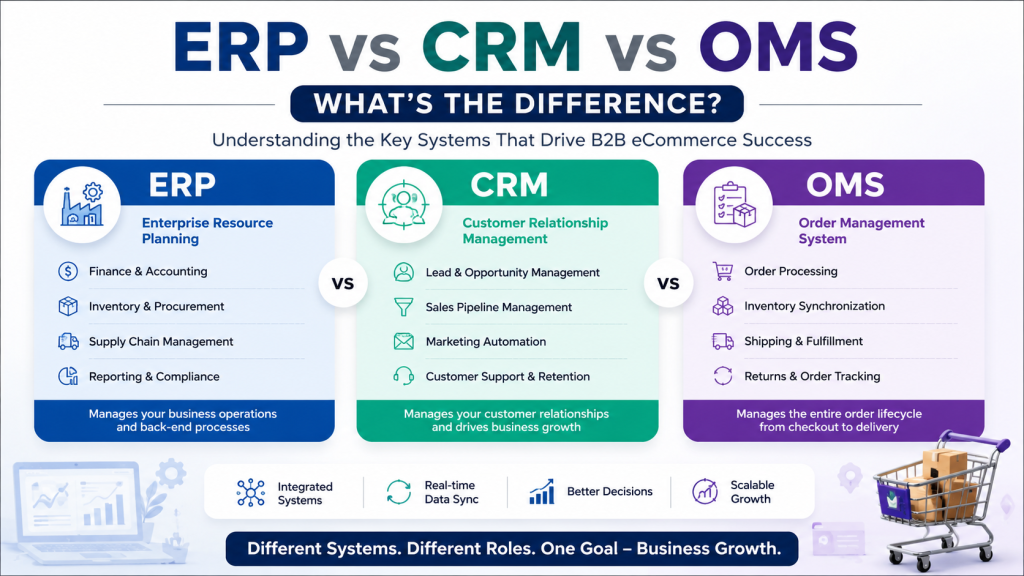
ERP integration keeps pricing, inventory, and order data synchronized between the storefront and back-office systems, which is what makes real-time inventory and accurate order status possible.
CRM integration gives sales reps visibility into what a buyer has already done online, so a human conversation picks up where self-service research left off.
Product Information Management (PIM) keeps product data and documentation consistent across every channel a buyer might use to research.
Inventory management systems prevent the overselling and stockout surprises that quietly erode buyer trust.
Customer portals give buyers a single place to manage orders, view pricing, and reorder without contacting a rep for routine tasks.
Workflow automation removes manual steps from quoting and order processing, shortening the time between research and purchase.
APIs connect all of the above so data moves in real time rather than through manual exports.
B2B-specific plugins and extensions add functionality like tiered pricing and quote workflows that general e-commerce platforms do not handle well by default.
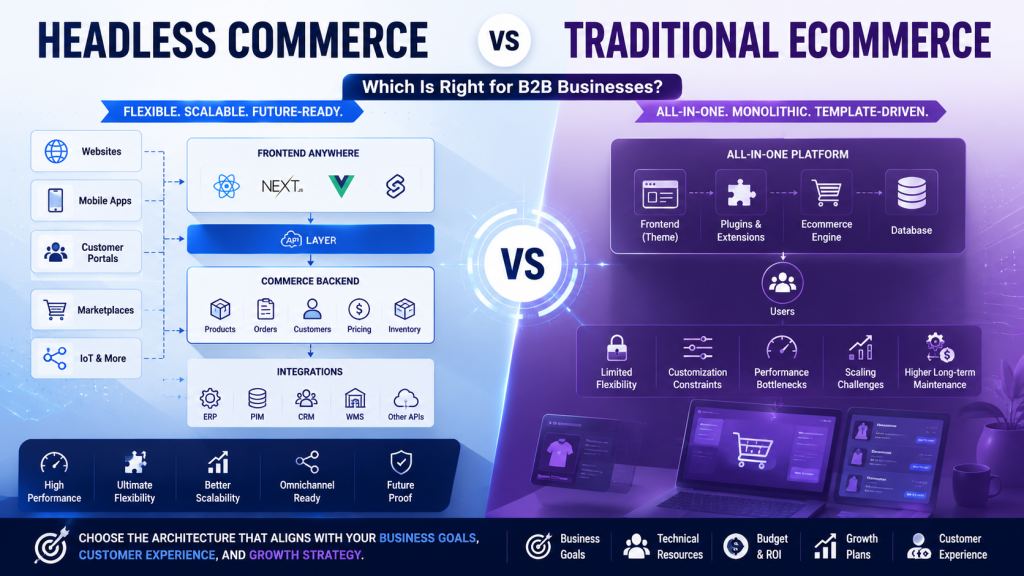
Headless commerce separates the front-end buyer experience from back-end systems, giving businesses flexibility to build fast, tailored experiences.
Common Mistakes Businesses Still Make
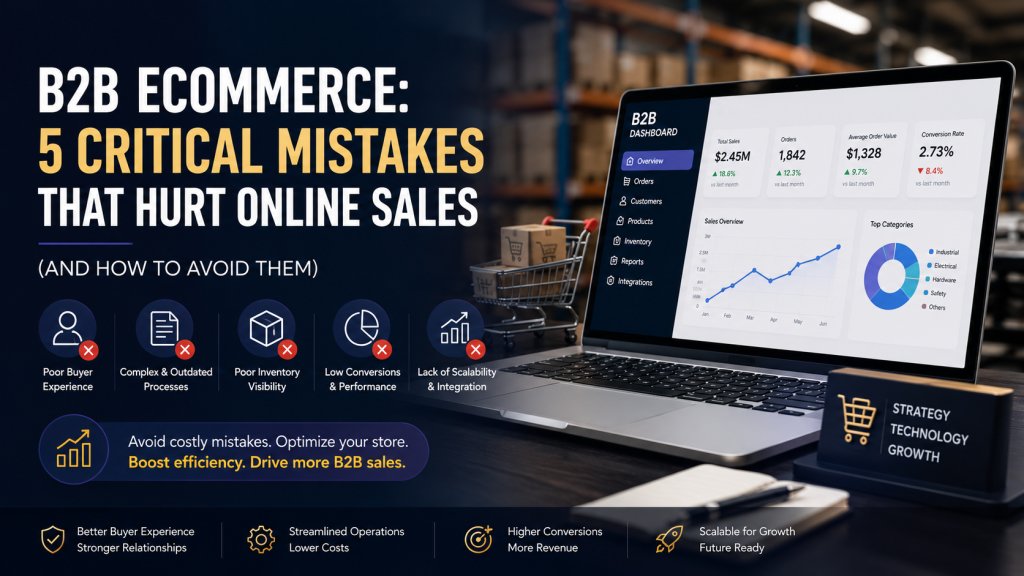
Even with all of this technology available, many B2B organizations still operate with real gaps between what buyers expect and what they deliver.
Outdated e-commerce websites signal to buyers that a supplier has not kept pace, raising doubts about the rest of the business.
Manual ordering processes, like emailing a purchase order and waiting for confirmation, feel slow compared to a few clicks in a portal.
Poor on-site search frustrates buyers who know exactly what part number they need but cannot find it.
Slow website performance costs conversions, particularly on mobile, where patience is thinnest.
No personalization means every buyer sees the same catalog and pricing, regardless of contract terms or purchase history.
No customer portal forces buyers back to phone and email for tasks that should take seconds online.
Inventory inaccuracies create the kind of after-the-fact disappointment that damages trust quickly.
Weak mobile experiences are a growing liability as more research and purchasing happens from phones.
Disconnected systems, where the website, ERP, and CRM do not talk to each other, create the exact friction McKinsey’s omnichannel research shows buyers will not tolerate.
Poor communication after purchase leaves buyers guessing about order status, undermining confidence in reordering.
Each of these mistakes is fixable, but only once a business recognizes that digital experience is now part of the product, not a side project.
Best Practices for Meeting Modern Buyer Expectations
Improving the digital buying experience does not require rebuilding everything at once. A few consistent practices make the biggest difference.
Start by mapping the buyer journey honestly to identify where friction actually occurs, rather than guessing. Personalize the experience wherever contract pricing, account history, or role-based access can be applied. Simplify the purchasing path so repeat orders take as few steps as possible. Automate repetitive workflows like quoting and approvals. Integrate ERP and CRM systems so data stays consistent everywhere a buyer interacts with the business. Invest in search that understands part numbers, SKUs, and industry terminology. Optimize for mobile usability, since a growing share of B2B research now happens on phones. Track buyer behavior on the site to see where people hesitate or drop off. Finally, treat this as ongoing work. Continuously reviewing analytics and buyer feedback is what separates businesses that stay ahead of shifting expectations from those that fall behind.
What the Data Says About B2B Buyer Behavior
The research from major analyst firms paints a consistent picture. Gartner’s 2025 sales survey found that a majority of B2B buyers prefer a rep-free buying experience, reserving direct contact with sales reps for moments that require judgment or negotiation. McKinsey’s B2B Pulse research shows buyers now use roughly ten interaction channels on average during a purchase and that companies with strong omnichannel strategies retain far more customers than those without one. The same research shows a growing share of buyers are comfortable placing high-value orders, sometimes exceeding $500,000, without ever meeting a supplier representative in person. Salesforce’s connected customer research shows a majority of millennial B2B buyers now favor self-service research over speaking with a rep. And recent Gartner buyer research shows a large share of B2B buyers are already using generative AI tools during purchasing, even as most still want human validation at key decision points.
Taken together, these findings support a simple conclusion. Buyers are not just tolerating digital B2B commerce, they are actively choosing it whenever the experience is good enough to trust.
Traditional B2B Buying vs Modern Digital B2B Buying
| Factor |
Traditional B2B Buying |
Modern Digital B2B Buying |
| Research |
Phone calls, catalogs, trade shows |
Self-directed online research across multiple channels |
| Ordering |
Email, fax, or phone orders |
Self-service portals with instant ordering |
| Pricing |
Requested manually, often delayed |
Instant, account-specific, and transparent |
| Customer Support |
Reactive, rep-dependent |
Proactive, supported by portals and automation |
| Inventory |
Limited visibility, frequent surprises |
Real-time stock and delivery visibility |
| Payment |
Manual invoicing, limited options |
Flexible terms, multiple payment methods |
| Personalization |
Generic pricing and catalogs |
Customer-specific pricing and recommendations |
| Order Tracking |
Manual status checks by phone or email |
Real-time tracking and automated updates |
| Speed |
Slow, multi-step approval and ordering |
Fast, streamlined, often same-day processing |
| Customer Experience |
Fragmented across disconnected touchpoints |
Consistent across web, mobile, portal, and rep interactions |
Conclusion
B2B buyer expectations have shifted permanently, not temporarily. Buyers now expect the same speed, transparency, and self-service convenience they experience as consumers, and they are willing to switch suppliers when that experience is missing. The businesses managing this shift well are not necessarily the largest players in their industry; they are the ones that have connected e-commerce, ERP, CRM, and fulfillment systems into a buying experience that feels effortless from the outside.
This does not mean the human side of B2B sales is disappearing. Research consistently shows buyers still want expert guidance at critical decision points. What has changed is when that guidance is delivered, since sales reps are increasingly stepping in after self-service research has already narrowed the field, not before it.
If your organization has not recently evaluated whether its digital buying experience matches what modern buyers now expect, that assessment is worth prioritizing. The gap between a supplier that feels current and one that feels behind is often smaller to close than businesses assume, but it only shrinks once someone looks honestly at where the friction actually lives.
FAQs
B2B buyer expectations refer to the digital experiences businesses expect, including self-service ordering, personalized pricing, transparent information, fast websites, and seamless purchasing across multiple channels.
B2B buyer expectations are changing because digital transformation and consumer-like online experiences have increased demand for faster, more convenient, and personalized purchasing journeys in business commerce.
Businesses can meet modern B2B buyer expectations by offering self-service portals, personalized pricing, real-time inventory, ERP integration, mobile-friendly e-commerce, and efficient customer support.
Personalization improves the B2B buying experience by delivering customer-specific pricing, tailored product recommendations, customized catalogs, and relevant content that simplifies purchasing and builds long-term relationships.
Modern B2B buyer expectations are supported by WooCommerce, ERP and CRM integrations, AI-powered search, inventory management systems, automation tools, and customer portals that streamline digital commerce experiences.


 WooCommerce Solutions
 Solutions for WordPress