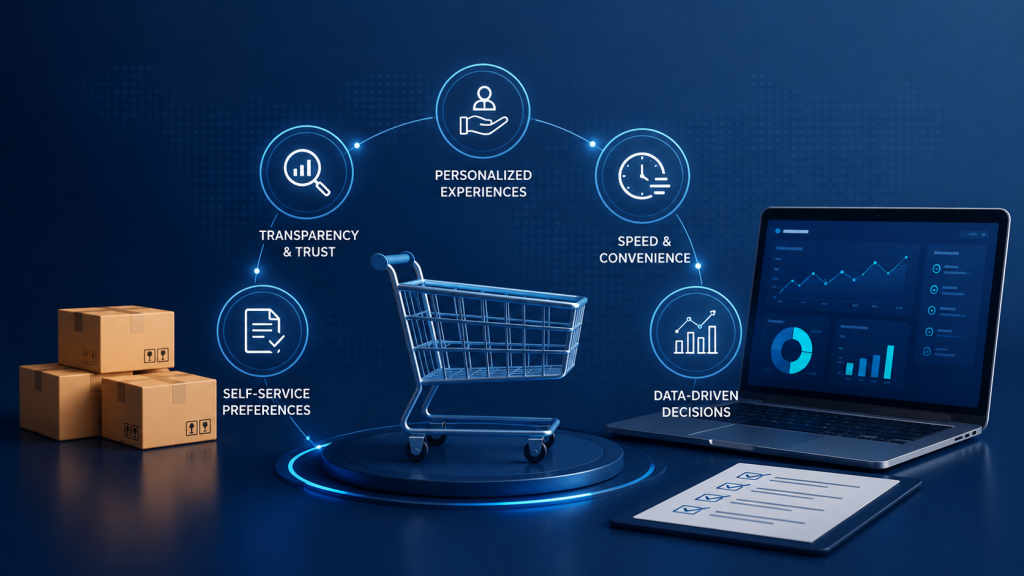
B2B buying has changed more in the last five years than in the previous twenty. Procurement teams now expect the same speed, clarity, and self-service they get as consumers, and they are far less patient with clunky ordering processes, static pricing, or sales reps who cannot answer a question in real time. That shift in expectation, more than any single piece of technology, is what defines B2B e-commerce trends in 2026.
This year is a meaningful checkpoint for digital commerce. AI has moved from experimental pilot programs into daily operations. Automation has expanded beyond simple order confirmations into full workflow orchestration. Business systems that used to live in silos, ERP, CRM, inventory, and the storefront, are being connected in ways that used to require custom development and now increasingly come out of the box.
For B2B business owners, ecommerce managers, IT leaders, and WooCommerce store owners, understanding the future of B2B ecommerce is no longer optional. Buyers are comparing every vendor interaction against the best digital experience they have had anywhere, not just against competitors in the same industry. This article breaks down the ten trends most likely to shape enterprise e-commerce trends this year and beyond, along with practical guidance on how to prepare.

Trend 1: AI-Powered Buying Experiences
AI in B2B e-commerce has moved past chatbots that answer basic FAQs. It now touches product discovery, pricing, and the entire path to purchase.
Key applications include:
- AI-driven product recommendations that account for a buyer’s purchase history, contract terms, and industry, not just generic “customers also bought” logic.
- Intelligent search that understands part numbers, technical specifications, and natural-language queries, reducing the friction of navigating large catalogs.
- Predictive ordering that flags when a customer is likely due for a reorder based on historical consumption patterns.
- AI assistants embedded in the storefront that can answer product questions, check stock, or help a buyer compare SKUs without escalating to a sales rep.
- Personalized buying experiences that adjust catalog views, pricing, and promotions based on account tier or purchasing role.
The business case is straightforward. Buyers find what they need faster, and sales teams spend less time on repetitive questions and more time on complex, high-value conversations. For companies exploring WooCommerce ERP integration for B2B, AI recommendation engines work best when they draw on accurate, real-time product and pricing data rather than static exports.
Trend 2: Headless and Composable Commerce
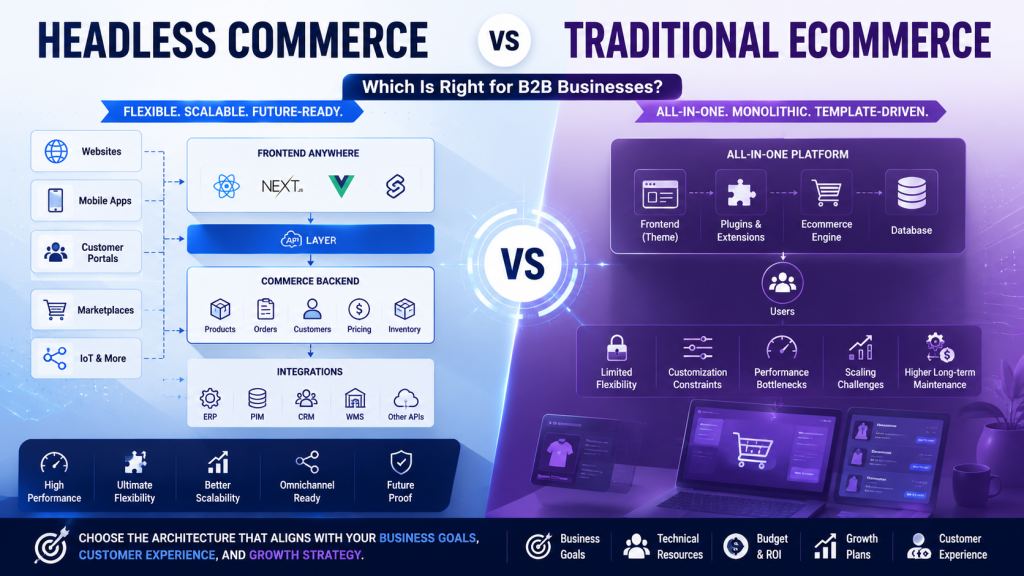
Composable commerce is one of the more consequential enterprise e-commerce trends because it changes how quickly a business can adapt. Rather than relying on a single monolithic platform for everything, businesses assemble best-of-breed components, search, payments, CMS, and commerce logic, connected through APIs.
The appeal comes down to a few core advantages:
- API-first architecture that lets development teams update the front end without touching backend logic.
- Flexibility to swap individual components as needs change, instead of replatforming the entire stack.
- Faster innovation, since front-end teams are no longer blocked by backend release cycles.
- Omnichannel experiences across web storefronts, marketplaces, mobile apps, and internal sales tools, all pulling from the same commerce engine.
- Long-term scalability that supports growth without the performance ceilings common in older, tightly coupled platforms.
Enterprises with complex catalogs, multiple sales channels, or unique workflows are the ones adopting composable architecture fastest, since the flexibility pays off most when requirements are genuinely non-standard. Readers weighing their options may find it useful to compare headless commerce vs. traditional e-commerce before committing to a platform direction.
Trend 3: ERP and Ecommerce Integration
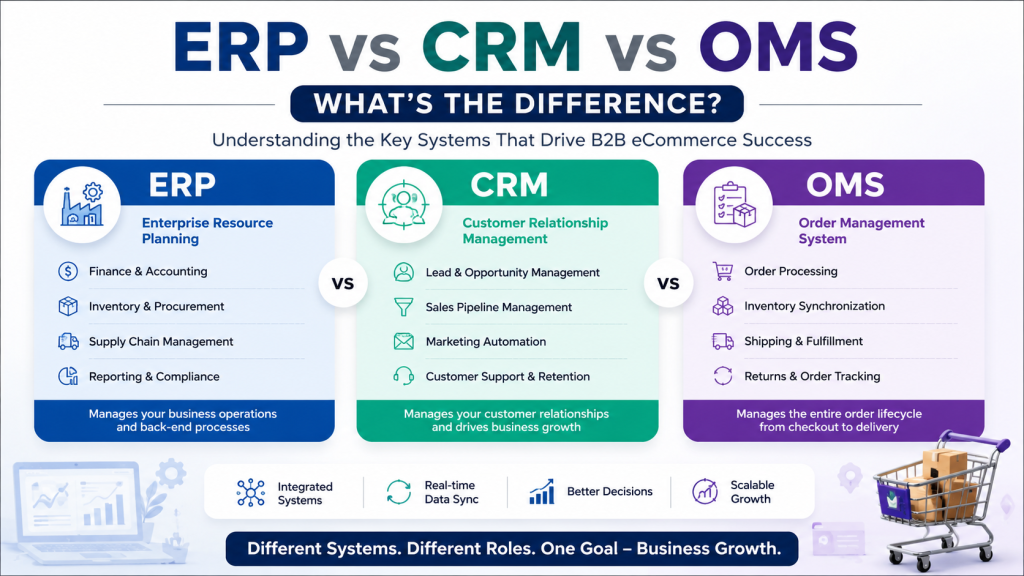
Disconnected systems remain one of the most common reasons B2B e-commerce projects underperform. When the storefront does not talk to the ERP, businesses end up with mismatched inventory counts, delayed order processing, and pricing errors that erode trust.
Well-executed integration delivers:
- Real-time inventory visibility, so buyers never order something that is actually out of stock.
- Customer-specific pricing that reflects contract terms automatically, instead of requiring manual quote adjustments.
- Order synchronization between the storefront and back-office systems, reducing duplicate data entry.
- Reduced manual processes, freeing staff from re-keying orders between systems.
- Unified business operations, where finance, fulfillment, and sales all work from the same source of truth.
This is precisely the kind of foundational work that determines whether the other trends on this list are even achievable. AI recommendations and hyper-personalization depend on accurate data flowing from connected systems. Businesses running WooCommerce at scale often reach a point where “Why B2B WooCommerce Stores Break at Scale” becomes a real concern, and integration gaps are frequently at the root of it.
Trend 4: Hyper-Personalization
B2B personalization has matured well beyond inserting a customer’s name into an email subject line. It now shapes what a buyer sees the moment they log in.
This includes:
- Dynamic catalogs that show only the products and categories relevant to a specific account.
- Customer-specific pricing reflecting negotiated contracts, volume tiers, or regional agreements.
- Personalized promotions targeted to purchasing patterns rather than broad, one-size-fits-all discounts.
- AI segmentation that groups accounts by behavior and needs, not just industry classification.
- Account-based experiences where multiple buyers within the same organization see a consistent, role-appropriate view.
Personalization has become a genuine competitive advantage because B2B buyers increasingly compare their digital experience to the best consumer platforms they use personally. A generic, one-size-fits-all storefront now reads as outdated rather than neutral.
Trend 5: Self-Service B2B Portals
Buyers want control over their own account without waiting on a phone call or email response. Self-service portals have become a baseline expectation rather than a differentiator.
Common self-service capabilities include:
- Online ordering with saved carts, reorder templates, and bulk upload tools.
- Quote requests that can be submitted, tracked, and approved digitally.
- Invoice downloads available on demand, without contacting accounts receivable.
- Order tracking that shows real-time shipping status.
- Account management tools that let buyers manage users, permissions, and payment methods themselves.
Procurement teams increasingly measure vendors by how much friction exists outside of business hours. A portal that works at 9 p.m. on a Sunday, when a buyer is catching up on approvals, is doing real commercial work.
Trend 6: Automation Across Commerce Operations
Ecommerce automation has expanded well past order confirmation emails. It now touches nearly every operational step between a click and a delivered shipment.
Areas seeing the most automation include:
- Order automation that routes, approves, and processes orders without manual intervention.
- Inventory automation that adjusts stock levels and reorder points based on demand signals.
- Shipping workflows that select carriers and generate labels automatically based on preset rules, an area covered in more depth in WooCommerce Shipping Rules.
- Customer communication that sends timely, relevant updates without requiring staff to trigger them manually.
- Workflow optimization that removes repetitive tasks from staff schedules entirely.
The benefit is not simply speed. Automated processes reduce the human error that creeps into manual, repetitive work, and they free staff to focus on exceptions and relationship-building instead of routine data entry. Businesses looking to tighten this further often start with WooCommerce order fulfillment as a first step.
Trend 7: Mobile-First B2B Commerce
Mobile usage in B2B has grown steadily as procurement roles have become less desk-bound. Field sales reps, warehouse managers, and traveling executives all need commerce tools that work well on a phone or tablet.
This trend shows up in a few practical ways:
- Mobile purchasing that lets buyers place and manage orders from anywhere.
- Field sales teams using mobile tools to check inventory, place orders, and access account history during in-person visits.
- Responsive portals that maintain full functionality on smaller screens, not a stripped-down version of the desktop experience.
- Mobile approvals that let managers sign off on purchase requests without being at a desktop.
- Anywhere access that keeps procurement moving even when the primary decision-maker is traveling.
Mobile accessibility supports modern procurement precisely because approval chains rarely wait for someone to be back in the office. A platform that only works well on desktop introduces delay into every multi-step approval process.
Trend 8: Data-Driven Decision Making
Commerce analytics have become a strategic asset rather than a monthly reporting exercise. Businesses that treat data as an operational input, not just a retrospective summary, tend to make faster and better-informed decisions.
Key applications include:
- Commerce analytics that surface conversion trends, cart abandonment, and pricing sensitivity.
- Customer behavior insights that reveal how different account types actually navigate the buying journey.
- Demand forecasting that helps plan inventory and staffing ahead of predictable cycles.
- Conversion optimization driven by testing rather than guesswork.
- Inventory planning informed by real sales velocity instead of static reorder points.
Analytics only deliver value when the underlying data is trustworthy, which circles back to the importance of solid ERP and e-commerce integration. Businesses auditing their technical foundation may find an Enterprise WooCommerce Technical Audit Guide useful before investing heavily in advanced analytics tooling.
Trend 9: Security and Compliance
Security has shifted from a background IT concern to a visible business differentiator. B2B buyers, particularly in regulated industries, now ask pointed questions about data protection before signing a contract.
Core priorities include:
- Secure transactions, protected end-to-end across payment and order data.
- Data protection practices that meet the expectations of enterprise procurement and legal teams.
- Compliance requirements tied to industry regulations, data residency, and accessibility standards.
- Customer trust, built cumulatively through consistent, transparent security practices.
- Access control that ensures the right people within an account see the right information, and nothing more.
Security lapses are costly in both direct and reputational terms, and enterprise buyers increasingly treat a vendor’s security posture as part of the purchasing decision itself, not a separate conversation handled later by legal.
Trend 10: AI Agents in B2B Commerce
AI agents represent the newest and least mature trend on this list, and it is worth being honest about where the technology actually stands. Current capabilities are real but bounded, and the most useful deployments today are narrow and well-supervised rather than fully autonomous.
Practical current and emerging uses include the following:
- AI sales assistants that support reps with account research, follow-up drafting, and answering routine product questions.
- Procurement support that helps buyers compare options or generate requisition requests faster.
- Customer service automation that resolves common issues before they require a human agent.
- Internal productivity tools that summarize account activity or flag accounts needing attention.
- Workflow assistants that handle multi-step tasks, like generating a quote from a set of inputs, with human review built in.
The realistic picture for 2026 is incremental progress rather than a wholesale replacement of sales and procurement teams. Businesses that treat AI agents as capable assistants, with clear human oversight, tend to get more consistent results than those expecting full autonomy.
Comparison Table: 10 B2B Ecommerce Trends at a Glance
| Trend |
Business Impact |
Primary Benefit |
Adoption Priority |
| AI-Powered Buying Experiences |
Faster discovery, fewer repetitive sales inquiries |
Improved conversion and efficiency |
High |
| Headless and Composable Commerce |
Greater flexibility for complex catalogs and channels |
Long-term scalability |
Medium to High |
| ERP and Ecommerce Integration |
Accurate inventory, pricing, and order data |
Operational reliability |
High |
| Hyper-Personalization |
Stronger account relationships and relevance |
Competitive differentiation |
Medium |
| Self-Service B2B Portals |
Reduced support load, faster buyer self-resolution |
Buyer convenience |
High |
| Automation Across Operations |
Fewer errors, lower manual workload |
Operational efficiency |
High |
| Mobile-First B2B Commerce |
Support for field and remote procurement roles |
Accessibility |
Medium |
| Data-Driven Decision Making |
Better forecasting and planning |
Informed strategy |
Medium to High |
| Security and Compliance |
Reduced risk, stronger buyer trust |
Risk mitigation |
High |
| AI Agents in B2B Commerce |
Early productivity gains for sales and service teams |
Emerging efficiency |
Medium |
Key Takeaways
- B2B buyers now expect consumer-grade digital experiences, and 2026 is a milestone year for that expectation becoming the norm rather than the exception.
- AI’s most valuable current role is augmenting search, recommendations, and support, not replacing human judgment.
- Composable and headless architectures give enterprises the flexibility to adapt without full replatforming.
- Clean, connected data from ERP integration underpins nearly every other trend on this list, from personalization to analytics.
- Self-service, mobile access, and automation are no longer optional convenience features; they are baseline buyer expectations.
- Security and compliance have become visible factors in vendor selection, not background IT concerns.
- AI agents show real promise but remain best used as supervised assistants rather than autonomous decision-makers in 2026.
Future Outlook
Looking beyond this year, a few directions seem like reasonable extrapolations of trends already in motion rather than speculative leaps.
Autonomous procurement, where routine reordering happens with minimal human input, is likely to expand gradually as businesses build confidence in the underlying data and rules. Predictive commerce, where systems anticipate buyer needs before an order is placed, will likely become more common as demand forecasting tools mature. Supply chains are likely to keep getting smarter as connected systems provide better visibility across the full order lifecycle.
AI-assisted decision-making will probably keep expanding into planning, pricing, and inventory management, building on the automation and analytics trends already underway. None of this points to a sudden transformation. It points to continued, steady digital transformation built on the same foundations of integration, data quality, and automation already shaping B2B e-commerce in 2026.
How Businesses Can Prepare
Businesses that want to stay ahead of these trends can start with a few concrete steps:
- Modernize e-commerce infrastructure so the platform can support integration, personalization, and future growth without constant workarounds.
- Integrate ERP and business systems to ensure inventory, pricing, and order data stay accurate across every channel.
- Improve data quality, since AI, personalization, and analytics are only as good as the data feeding them.
- Invest in automation strategically, prioritizing the workflows with the highest error rates or manual burden first.
- Strengthen security proactively, rather than reacting after a buyer raises concerns during a sales cycle.
- Optimize customer experience across devices, recognizing that buyers now compare B2B portals to their favorite consumer apps.
- Continuously monitor analytics to catch friction points early and adjust before they affect revenue.
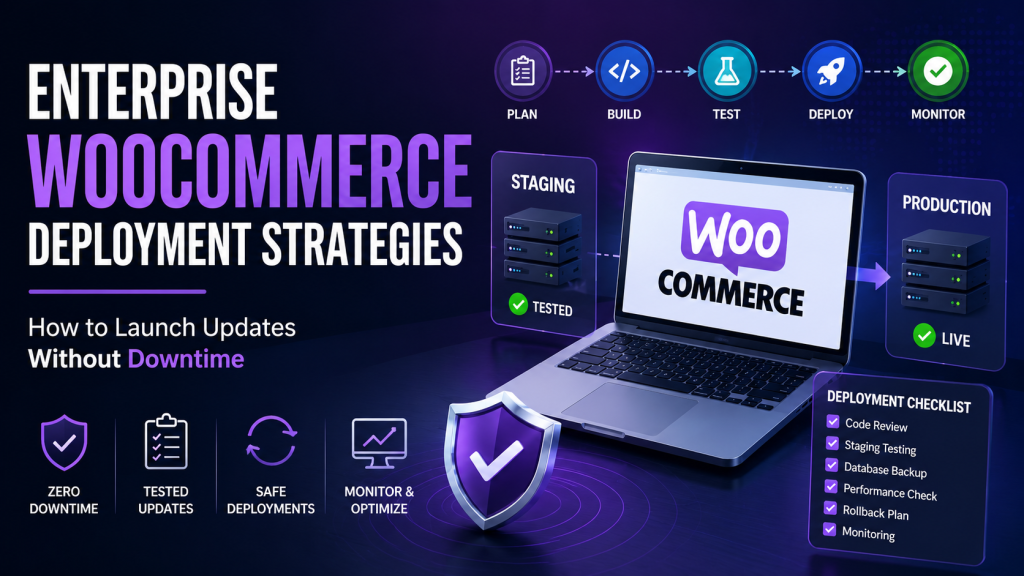
For WooCommerce-based businesses, this often means confronting accumulated WooCommerce Technical Debt before adding new capabilities and thinking carefully about WooCommerce Deployment Strategies that support growth without downtime. Getting WooCommerce Inventory Management right is often the most immediate, practical starting point, since so many other trends depend on accurate stock data.
Conclusion
The future of B2B ecommerce trends in 2026 is being shaped by a consistent theme: buyers want speed, accuracy, and relevance, and businesses that deliver those through connected systems, thoughtful automation, and realistic AI adoption will be better positioned for long-term growth. None of the ten trends covered here work in isolation. AI-powered experiences depend on clean data from ERP integration. Personalization depends on the same connected systems. Automation and self-service both reduce friction that used to require manual staff intervention.
Businesses that treat 2026 as a checkpoint, rather than a finish line, and that invest steadily in infrastructure, data quality, and customer experience, will be the ones best prepared for whatever comes next in digital commerce. Dazzlebirds works with enterprise and growing B2B businesses on exactly this kind of foundational work, from ERP integration to platform modernization, and is glad to be a resource as these trends continue to develop.
FAQs
The biggest B2B ecommerce trends in 2026 include AI-powered buying experiences, hyper-personalization, headless and composable commerce, ERP integration, self-service customer portals, workflow automation, mobile-first purchasing, data-driven decision-making, stronger cybersecurity, and AI agents supporting sales and operations.
AI and automation help B2B businesses improve customer experiences, streamline operations, reduce manual tasks, personalize product recommendations, automate order processing, and provide faster support. These technologies enable companies to scale efficiently while meeting growing buyer expectations.
Modern B2B buyers expect digital experiences similar to consumer shopping. They prefer self-service portals, personalized pricing, real-time inventory visibility, fast purchasing processes, and mobile-friendly platforms, making digital convenience a key competitive advantage.
Businesses can prepare by modernizing their ecommerce platforms, integrating ERP and CRM systems, adopting AI and automation where they add value, improving data quality, strengthening cybersecurity, and using analytics to make informed business decisions.
Headless commerce is gaining popularity because it separates the frontend from the backend, allowing businesses to deliver faster, more flexible, and personalized digital experiences across multiple channels while integrating more easily with enterprise systems.


 WooCommerce Solutions
 Solutions for WordPress