B2B e-commerce has changed faster in the last five years than in the previous fifteen. Buyers now expect the same speed, personalization, and convenience they get from consumer platforms, even when ordering industrial parts or placing a bulk order for a distribution warehouse.
That shift has put pressure on the systems behind the scenes. The architecture you choose today decides how easily you can add a customer portal next year, launch a regional storefront, or connect a new ERP without rebuilding your entire store.
This is why the debate around headless commerce vs traditional e-commerce has moved from a developer conversation to a boardroom one. Enterprise teams, IT managers, and e-commerce directors are being asked to justify architecture decisions in terms of revenue, scalability, and customer experience.
This guide walks through what each architecture actually does, how requests flow through each system, where the real tradeoffs sit, and how to decide which model fits your business now and where you are headed.
What Is Traditional Ecommerce?
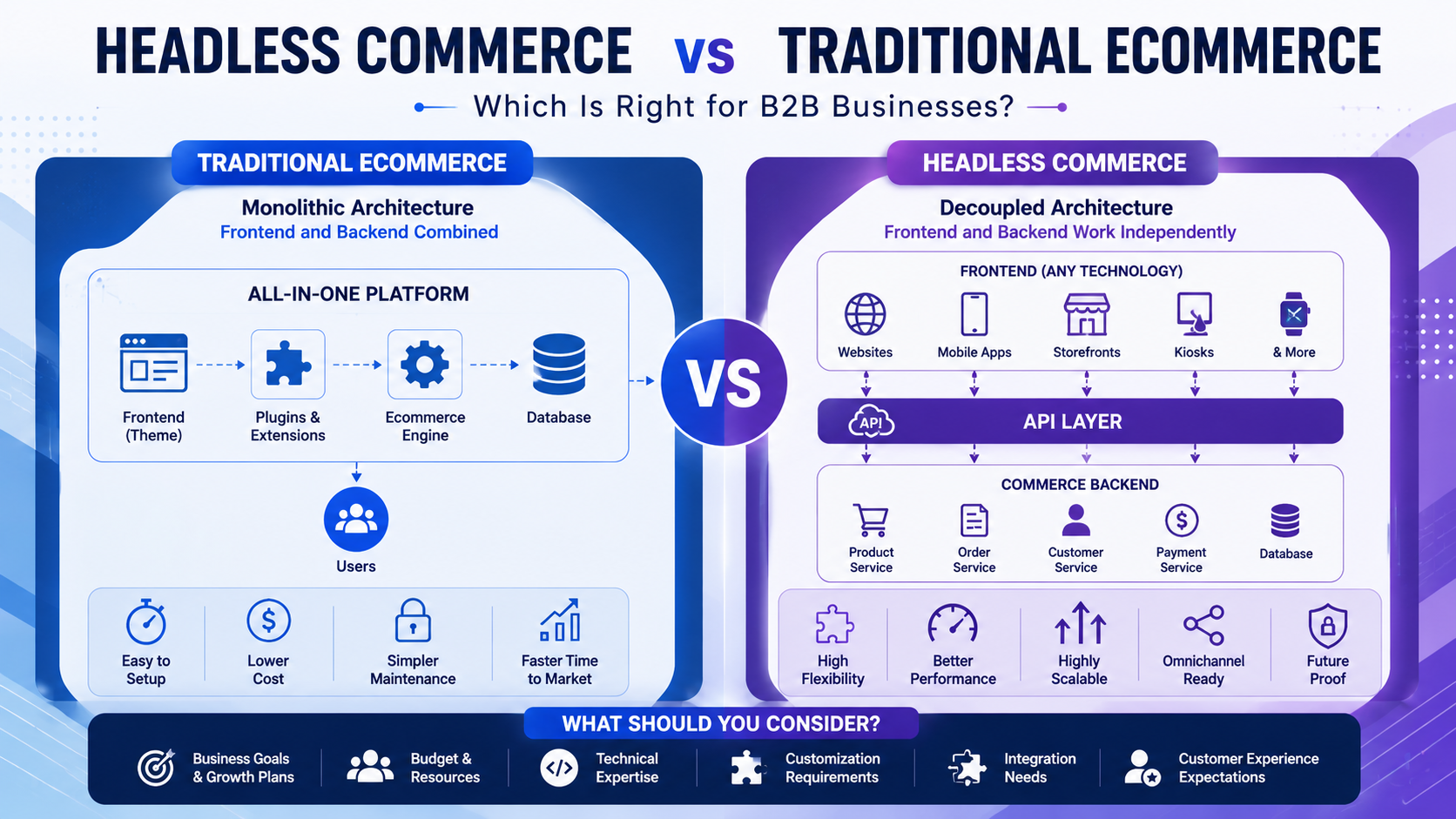
Traditional e-commerce, often called monolithic e-commerce, is a single connected system where the frontend, backend, and database all live inside one application. The theme controls how pages look, plugins add functionality, and the platform manages everything from product data to checkout in one place.
When a customer visits a store, the request goes to the server, the platform pulls data from the database, renders the page using the theme, and sends the finished HTML back to the browser. Everything happens inside one codebase, which is why traditional platforms like WooCommerce, Shopify, and Magento are so widely used.
Advantages
- Faster implementation since themes and plugins handle most of the heavy lifting
- Lower upfront development cost
- Easier maintenance for smaller internal teams
- A large plugin ecosystem that covers most common business needs out of the box
Limitations
- Frontend and backend are tied together, which limits design flexibility
- Scaling traffic or catalog size often means scaling the entire application, not just the part that needs it
- Performance can suffer as plugins and customizations accumulate
- Delivering the same experience across a website, app, and kiosk usually means duplicating logic
Picture the architecture as a single building with the storefront, the warehouse, and the checkout counter all under one roof. It works well until you need a second location, a drive-through, or a delivery service, and suddenly the single-building model starts to limit you.
This is the starting point for most of the headless commerce vs traditional e-commerce discussion. The question is not whether the building works today, but whether it can expand as the business does.
What Is Headless Commerce?
Headless commerce separates the frontend, the part your customers see, from the backend, the part that handles products, pricing, and orders. The two communicate through APIs instead of being built into the same application.
This means your commerce engine can stay in place while your frontend is built in React, Next.js, or Vue, and the same backend can also power a mobile app, a customer portal, an IoT device, or a digital kiosk without rewriting the commerce logic each time.
A headless CMS often sits alongside the commerce backend to manage content like blog posts, landing pages, and product storytelling, which then gets pulled into the frontend through the same API layer.
Data flows in a loop: the frontend requests data through an API, the backend processes the request against the database, and the response comes back as structured data (usually JSON) that the frontend renders however it chooses. This separation is what gives headless commerce its flexibility and also what makes it more demanding to build and maintain.
Traditional Ecommerce Architecture Explained
A traditional e-commerce stack has four core layers working together:
- Frontend: the theme and templates that render what the customer sees
- Backend: the commerce engine that manages products, orders, and business logic
- Database: stores customer data, product catalogs, and transaction history
- Plugins: extend functionality for payments, shipping, tax, and integrations
The request lifecycle looks like this: a customer clicks a product, the server receives the request, the backend queries the database, the theme renders the response, and the browser displays the finished page. Every step happens inside the same application, which keeps things simple but also tightly coupled.
Headless Commerce Architecture Explained
Headless architecture is built around an API-first model, where every part of the system exposes its functionality through APIs instead of rendering pages directly.
The typical components include:
- Commerce backend: manages products, pricing, inventory, and orders
- Frontend applications: separate apps for web, mobile, or in-store displays
- Headless CMS: manages content independently of the commerce logic
- Middleware: connects and translates data between systems
- API gateway: manages, secures, and routes API traffic
- Authentication layer: handles secure access across all connected apps
- Microservices: smaller, independent services for functions like search, pricing, or recommendations
When a customer performs an action, the frontend sends a request through the API gateway, which routes it to the correct microservice or backend system. Middleware often sits in between to translate data formats or combine responses from systems like an ERP and a PIM before sending one clean response back to the frontend.
This separation is what allows enterprise teams to update the backend, swap a frontend, or add a new sales channel without touching the rest of the system.
Headless Commerce vs Traditional Ecommerce
Here is a direct comparison across the factors that matter most to enterprise B2B teams.
| Factor |
Traditional Ecommerce |
Headless Commerce |
| Architecture |
Monolithic, tightly coupled |
Decoupled, API-first |
| Performance |
Good for standard catalogs |
Higher potential, needs optimization |
| Scalability |
Limited by whole-app scaling |
Scales components independently |
| Flexibility |
Restricted by theme structure |
High, custom frontend freedom |
| Development complexity |
Lower |
Higher |
| Cost |
Lower upfront |
Higher upfront, better long-term ROI at scale |
| Maintenance |
Simpler for small teams |
Requires dedicated technical resources |
| Security |
Centralized, easier to patch |
Distributed, needs API-level security |
| SEO |
Straightforward with SSR by default |
Strong, but requires SSR or SSG setup |
| Core Web Vitals |
Moderate |
Can be excellent with proper implementation |
| Omnichannel support |
Limited |
Built for multiple channels |
| Personalization |
Basic to moderate |
Advanced, real-time capable |
| ERP integrations |
Possible but often rigid |
Native through APIs |
| PIM integrations |
Limited |
Strong, purpose-built |
| CRM integrations |
Plugin-dependent |
API-native |
| Third-party APIs |
Constrained by platform |
Flexible and extensible |
| Multi-store management |
Difficult at scale |
Efficient with shared backend |
| Time to market |
Faster |
Slower initially, faster for future launches |
Traditional e-commerce wins on speed and simplicity. You can launch in weeks, not months, and a small team can manage it without specialized skills. But that simplicity comes with a ceiling.
Headless commerce trades a longer setup for long-term flexibility. Once the API layer exists, adding a new storefront, app, or integration becomes an extension of existing infrastructure rather than a rebuild. For B2B businesses juggling ERP data, custom pricing tiers, and multiple regional stores, that difference becomes significant within the first year or two of growth.
When Traditional Ecommerce Is the Better Choice
Traditional e-commerce still makes sense for a large share of businesses, particularly when:
- The company is small to mid-sized with a limited technology budget
- The product catalog is standard and does not require heavy customization
- The business needs to launch quickly, often within weeks
- The internal team is small and cannot support ongoing API development
- Customer experience needs are met by existing themes and plugins
If your current WooCommerce store is starting to show cracks under this kind of growth, it is worth reading about why B2B WooCommerce stores break at scale before assuming a full architecture change is the answer.
When Headless Commerce Makes Sense
Headless commerce becomes the stronger investment when a business has outgrown the constraints of a single connected system. Common signals include:
- Managing large or complex product catalogs across multiple categories
- Running multiple storefronts for different regions, brands, or customer types
- Offering customer portals with account-specific pricing and order history
- Supporting mobile apps alongside the main website
- Building true omnichannel experiences across web, app, and in-person touchpoints
- Expanding internationally with different currencies, languages, and tax rules
- Needing deep ERP integration or PIM integration for accurate, real-time product data
- Designing highly custom buyer journeys for different account tiers
- Handling high traffic volumes that strain a monolithic setup
If several of these apply to your business, the conversation shifts from “should we go headless” to “how do we plan the transition without disrupting operations.”
Common Challenges of Headless Commerce
Headless architecture solves real problems, but it introduces new ones that teams need to plan for.
- Higher development costs: custom frontends and integrations take more time and specialized talent. Scope the first phase around your highest-impact channel rather than every channel at once.
- API dependency: if an API goes down, connected experiences can break. Build fallback states and monitor API health continuously.
- Infrastructure complexity: more moving parts means more to manage. Invest in clear documentation and a services map from day one.
- Deployment workflows: multiple applications need coordinated releases, which is where solid WooCommerce deployment strategies for enterprise teams matter most.
- Version management: APIs change, and breaking changes can affect every connected frontend. Version your APIs and communicate changes early.
- Monitoring: problems can hide across disconnected systems. Centralize logging and set alerts across all services.
- Content governance: multiple teams publishing to multiple frontends can create inconsistency. Define clear content ownership and approval workflows.
- Developer dependency: non-technical staff cannot easily change frontend layouts. Pair a headless CMS with a visual editing layer where possible.
SEO Considerations
Direct answer: Traditional eCommerce is easier to optimize out of the box, while headless commerce can outperform it, but only with proper server-side rendering or static generation.
Traditional platforms render pages on the server by default, which means search engines can crawl and index content without extra configuration. This is one reason many stores stick with traditional setups purely for SEO simplicity.
Headless commerce relies on the frontend framework’s rendering strategy. Client-side rendering (CSR) alone can hurt crawlability, since search engines may not fully execute JavaScript before indexing. Server-side rendering (SSR) or static site generation (SSG), available in frameworks like Next.js, solve this by delivering fully rendered HTML.
For AI search visibility and GEO optimization, structured content and clear schema markup matter more than ever, since AI systems extract and summarize content rather than just ranking links. Both architectures can support this, but headless setups need it built in deliberately rather than inherited from the platform.
Practical recommendations:
- Use SSR or SSG for any customer-facing headless frontend
- Implement structured data (schema) at the API or frontend layer
- Monitor Core Web Vitals separately for each frontend application
- Keep URL structures clean and consistent across channels
Performance Comparison
Architecture affects performance because it determines how much work happens on each request and how much can be cached or distributed.
Traditional platforms benefit from mature caching plugins and CDN integrations that handle most performance needs without custom engineering. Page speed is generally solid for standard catalogs but can degrade as plugins and customizations pile up.
Headless commerce lets the frontend be served from a CDN as static or pre-rendered pages while the backend only handles data requests. API latency becomes the main variable, so caching strategies, edge computing, and lazy loading of non-critical assets play a bigger role in the final experience.
Done well, headless setups can deliver faster load times and better Core Web Vitals, especially for image-heavy B2B catalogs. That performance has to be engineered, though, not assumed.
Security Comparison
Traditional e-commerce centralizes authentication and access control inside one application, which makes patching more predictable but means one vulnerability can expose the entire system.
Headless commerce distributes authentication and access control across multiple services and APIs. This reduces single points of failure but increases the attack surface, since every API endpoint needs its own security layer, rate limiting, and monitoring.
Both approaches can meet enterprise compliance requirements. Traditional setups rely more on platform-level security updates, while headless setups require your team to actively manage API security, token expiration, and access scopes across every connected application.
Real-World Example
The clearest way to understand the headless commerce vs. traditional e-commerce tradeoff is to look at how it plays out inside a growing business. Consider a fictional B2B manufacturer with more than 30,000 SKUs, several regional warehouses, and customers across North America, Europe, and Asia. The business ran on a traditional WooCommerce setup for years, with custom pricing rules for different account tiers and a manual process for syncing inventory from its ERP.
As the company grew, the traditional setup started to strain. Page load times increased as the catalog grew, the plugin stack became difficult to maintain, and the team could not easily support region-specific storefronts without duplicating the entire site for each market.
The decision to move toward a headless model came after repeated performance issues during peak ordering periods and growing demand for a self-service customer portal with order history and account-specific pricing.
The implementation kept the existing commerce backend in place, added an API layer to connect the ERP directly, and introduced a new frontend built for speed and built to support multiple regional storefronts from a single backend. A WooCommerce ERP integration handled real-time inventory sync, removing the manual update process entirely.
The result was faster page loads, a self-service portal that reduced support tickets, and the ability to launch a new regional storefront in weeks instead of months. Just as importantly, the backend never needed to be duplicated again for future expansion.
Is Headless Commerce Right for Every Business?
No.
The honest answer to the headless commerce vs traditional e-commerce question is that headless commerce is a strategic investment, not a universal upgrade. Businesses should avoid it when the team lacks the technical resources to maintain custom frontends and API integrations or when the current catalog and customer experience needs are already well served by a traditional setup.
Traditional e-commerce remains the smarter investment for businesses with limited budgets, straightforward product catalogs, and no immediate need for multiple storefronts or channels.
The decision should weigh four factors honestly: available budget, internal technical resources, growth plans over the next two to three years, and current technical maturity. A business planning to double its SKU count and launch in three new markets has a very different answer than one focused on stability and predictable costs.
Future of B2B Ecommerce Architecture
Ecommerce architecture is moving toward more modular, API-driven systems, and several trends are shaping what comes next.
- Composable commerce lets businesses assemble best-of-breed tools instead of relying on one all-in-one platform
- MACH architecture (Microservices, API-first, Cloud-native, Headless) is becoming the reference model for enterprise flexibility
- AI-powered personalization is increasingly handled through dedicated services that plug into the frontend via API
- Edge computing reduces latency by processing requests closer to the customer
- Progressive Web Apps (PWAs) blur the line between websites and mobile apps
- Intelligent search replaces basic keyword search with context-aware product discovery
- Agentic commerce and AI shopping assistants are starting to interact directly with commerce APIs on behalf of buyers, which makes clean, well-documented APIs a competitive advantage rather than an afterthought
These trends do not mean every business needs headless commerce immediately, but they do mean API readiness is becoming a long-term requirement rather than an optional upgrade.
How Dazzlebirds Helps Build Scalable Ecommerce Solutions
Every business reaches a different point where its e-commerce platform needs to evolve, whether that means optimizing a traditional WooCommerce store or planning a move toward a more flexible, API-first setup.
Dazzlebirds works with B2B businesses on enterprise WooCommerce development, from performance optimization and import/export automation to ERP integrations that keep inventory, pricing, and orders in sync across systems.
For teams facing WooCommerce inventory management issues or recurring WooCommerce order fulfillment problems, the goal is always the same: solve the operational bottleneck first, then plan the architecture that supports where the business is actually headed. That sometimes means strengthening a traditional setup and sometimes means building the API foundation for a headless transition, depending on the realistic growth trajectory of the business.
An enterprise WooCommerce technical audit is often the clearest starting point, since it reveals exactly where the current architecture is helping the business and where it is quietly holding it back.
Conclusion
The headless commerce vs. traditional e-commerce decision is not about which technology is newer or more impressive. It comes down to where your business is today and where it plans to be in two to three years.
Traditional e-commerce offers speed, simplicity, and lower upfront cost, which makes it the right call for businesses with standard needs and limited technical resources. Headless commerce offers flexibility, omnichannel reach, and long-term scalability, but it demands more investment and technical maturity to do well.
If your product catalog, customer base, and integration needs are growing more complex by the year, and you are noticing early WooCommerce technical debt signs that your store needs refactoring, that complexity is usually the clearest signal of which direction to take. Choose the architecture that matches your strategic goals, not the one that happens to be trending.
FAQs
Traditional ecommerce combines the frontend and backend into one connected system, while headless commerce separates them and connects them through APIs. This separation gives headless commerce more flexibility for custom frontends and multiple channels, while traditional e-commerce keeps things simpler to build and maintain.
It depends on complexity. B2B businesses with large catalogs, multiple storefronts, ERP integrations, and custom buyer journeys often benefit from headless commerce. Businesses with simpler catalogs and limited technical resources are usually better served by a traditional setup.
It can, but only with proper implementation. Headless frontends need server-side rendering or static site generation to remain crawlable and indexable. Without that, client-side rendering alone can hurt visibility compared to a traditional platform's default server-rendered pages.
Migration makes sense when a business is scaling across multiple storefronts, channels, or regions, needs deep ERP or PIM integration, or is hitting performance and flexibility limits with its current platform. It is rarely the right first move for a business still establishing its core catalog and processes.
Yes. WooCommerce can operate as a headless commerce backend through its REST API, allowing custom frontends built in frameworks like Next.js or React to connect to it. This approach lets businesses keep familiar backend management while gaining the flexibility of a decoupled frontend.


 WooCommerce Solutions
 Solutions for WordPress