If you are building or scaling an online store in 2026, your platform choice is not just a technical decision. It is a business decision that will shape your growth, marketing costs, customer experience, and ability to compete. The best e-commerce platforms available today are no longer just digital storefronts. They are intelligent, AI-powered commerce engines capable of automating everything from product recommendations to customer support.
This guide was written for small business owners, startup founders, and e-commerce entrepreneurs who want a clear, unbiased, and practical breakdown of every major option. You will find platform reviews, pricing, side-by-side comparisons, business-type recommendations, and expert verdicts based on real-world use cases.
What Is an Ecommerce Platform?
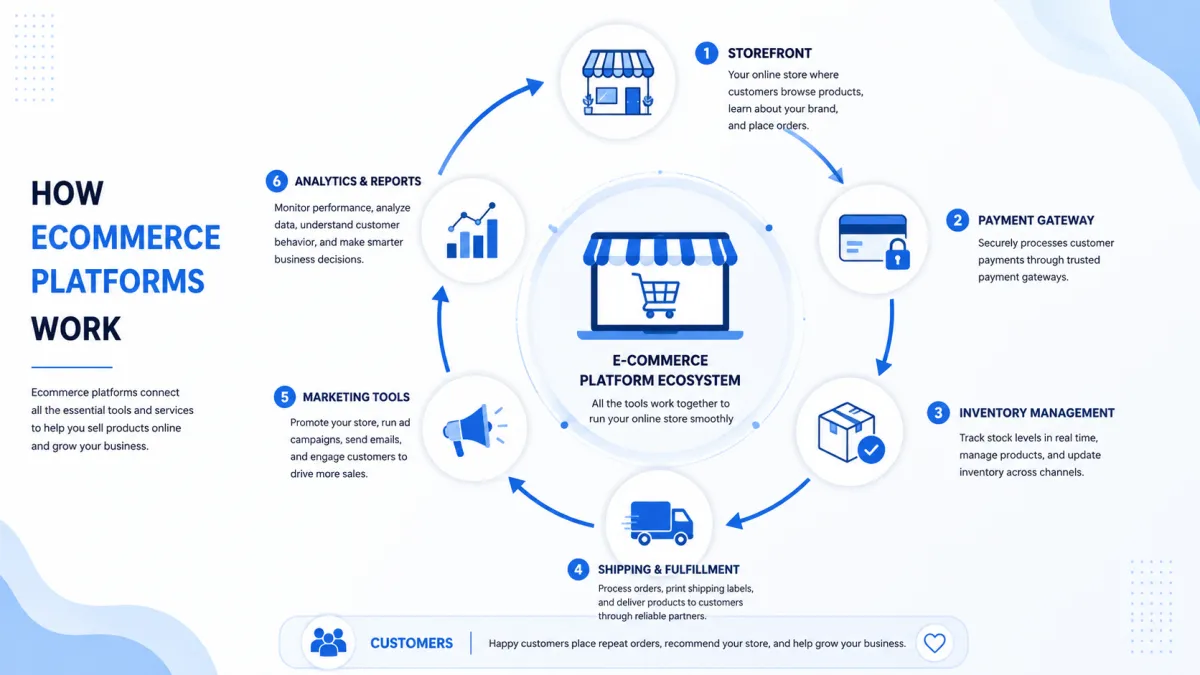
An e-commerce platform is software that allows businesses to build, manage, and operate an online store. It handles everything from product listings and payment processing to inventory management and order fulfillment, all in one place.
Think of it as the engine beneath your online store. When a customer lands on your site, browses a product, adds it to the cart, and completes a purchase, the platform is doing the heavy lifting behind every step. Depending on the platform, it may also manage your marketing emails, loyalty programs, tax calculations, and shipping logistics.
Anyone selling products or services online needs one. Whether you are a solo artisan selling handmade jewelry or a fast-growing brand shipping thousands of orders a day, the right platform determines how smoothly your business runs.
How We Evaluated These Ecommerce Platforms
We scored every platform across nine criteria to give you a fair and practical comparison. Speed and intuition matter for beginners. SEO capabilities matter for organic growth. AI tools matter for staying competitive in 2026. Pricing matters for every budget level.
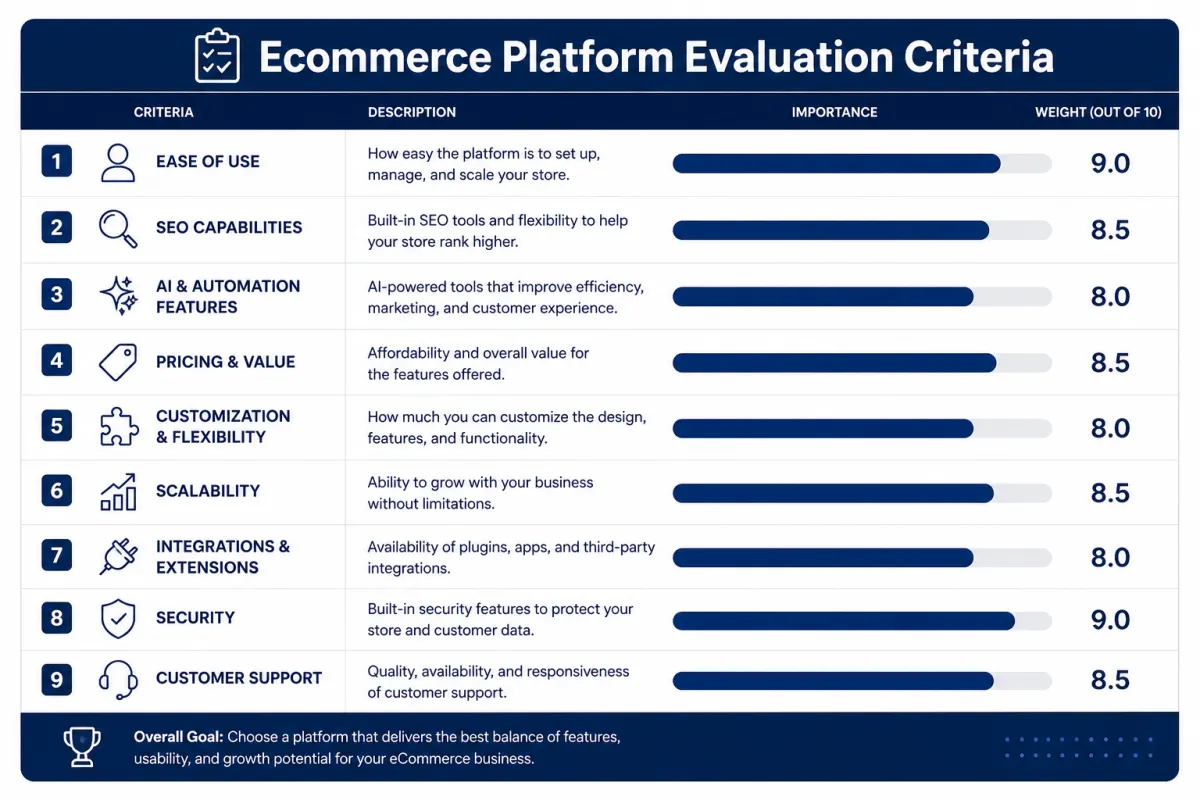
Here is how we scored each platform on a scale of 1 to 10:
| Criteria |
Why It Matters |
| Ease of Use |
How fast can a beginner go live? |
| SEO Capabilities |
Can it help you rank on Google? |
| AI Tools |
Does it include smart automation? |
| Pricing |
Is the value-to-cost ratio strong? |
| Customization |
Can you build exactly what you need? |
| Scalability |
Will it grow with your business? |
| Integrations |
Does it connect to your existing tools? |
| Security |
Is your store and customer data protected? |
| Support |
Can you get help when you need it? |
Top 10 Best Ecommerce Platforms in 2026
Quick Overview
Shopify remains the most popular hosted e-commerce solution in the world, with over 4.6 million live stores. In 2026, it has leaned heavily into AI with tools like Shopify Magic for product descriptions and Sidekick, its AI commerce assistant.
Key Features
Drag-and-drop store builder, 8,000+ app integrations, built-in payment gateway (Shopify Payments), multichannel selling across Instagram, TikTok, and Amazon, AI product description generator, one-page checkout, and 24/7 support.
Pros
Extremely easy to set up and use. Strong app ecosystem. Excellent multichannel and social commerce support. Reliable uptime with enterprise-grade infrastructure. Outstanding mobile optimization.
Cons
Transaction fees apply if you do not use Shopify Payments. The monthly cost adds up quickly at higher tiers. Advanced customization requires Liquid coding knowledge.
Pricing
Basic plan starts at $39 per month. Shopify plan at $105 per month. Advanced at $399 per month. Shopify Plus (enterprise) starts at $2,300 per month.
Best For
Beginner to mid-size stores, direct to consumer brands, social commerce sellers, and fast-growing startups.
Expert Verdict
Shopify is the gold standard for a reason. If you want speed, reliability, and a massive support ecosystem without needing a developer, this is your starting point.
Quick Overview
WooCommerce is a free, open-source plugin for WordPress that powers over 6 million online stores. It turns any WordPress website into a fully functional store with complete control over design and functionality.
Key Features
100% open source, thousands of free and premium plugins, deep SEO control via WordPress, customizable product types, support for physical and digital goods, and full code access.
Pros
Free core plugin. Maximum flexibility and customization. Outstanding SEO capabilities with tools like Rank Math and Yoast. No transaction fees. Ideal for content-led commerce strategies.
Cons
Requires a hosting plan, domain, and SSL certificate purchased separately. Not beginner-friendly. Security and performance optimization are your responsibility. Can get expensive when adding premium plugins.
Pricing
The core plugin is free. You will need hosting (starting around $5 to $30 per month), plus plugin costs that can range from $0 to $500 or more annually depending on your needs.
Best For
WordPress users, content marketers, bloggers who sell, and developers who want full control.
Expert Verdict
WooCommerce wins on flexibility and SEO. If you already run a WordPress site or you want to merge a content strategy with your store, this is the platform to build on.
Quick Overview
BigCommerce is a hosted SaaS platform built for growth. It is known for its enterprise-level features at mid-market pricing, including built-in SEO tools, multi-storefront support, and strong B2B capabilities.
Key Features
No transaction fees, built-in multi-currency support, advanced SEO controls, B2B features, native multi-storefront management, headless commerce support, and Google Shopping integration.
Pros
No additional transaction fees on any plan. Strong out-of-the-box SEO. Excellent for B2B and wholesale. Good developer flexibility with an open API. Multi-storefront management is genuinely powerful.
Cons
Annual sales limits per plan (you get bumped up when you exceed them). Fewer themes compared to Shopify. Steeper learning curve for non-technical users.
Pricing
Standard plan at $39 per month. Plus at $105 per month. Pro at $399 per month. Enterprise pricing is custom.
Best For
Mid to large online stores, B2B sellers, brands managing multiple storefronts, and businesses prioritizing SEO.
Expert Verdict
BigCommerce is the serious operator’s platform. No transaction fees, strong SEO, and genuine scalability make it a compelling alternative to Shopify for stores with higher volume ambitions.
Quick Overview
Adobe Commerce is the enterprise-grade choice for large, complex e-commerce operations. It offers unmatched customization but requires significant technical expertise and investment.
Key Features
Unlimited customization, advanced B2B functionality, AI-powered product recommendations via Adobe Sensei, multi-store and multi-language support, headless commerce architecture, and deep analytics.
Pros
Truly limitless customization. Best-in-class for complex catalogs and enterprise workflows. Strong B2B and wholesale support. AI and personalization features are industry-leading.
Cons
Very expensive. Requires in-house developers or an agency. Hosting, maintenance, and development costs add up fast. Not suitable for small businesses.
Pricing
Adobe Commerce starts at approximately $22,000 per year. Magento Open Source is free but requires self-hosting and technical management.
Best For
Enterprise brands, large retailers, B2B companies with complex catalogs.
Expert Verdict
If you are operating at scale and need complete control over every element of your store, Adobe Commerce delivers. Everyone else should look elsewhere.
Quick Overview
Wix has evolved from a simple website builder into a capable e-commerce solution for small businesses. Its drag-and-drop interface is the most beginner-friendly on this list.
Key Features
Intuitive visual editor, AI site generator, built-in marketing tools, abandoned cart recovery, product subscription support, and multichannel selling.
Pros
Easiest platform to use, period. Great for beginners with no technical background. All in one website and store builder. Affordable pricing. Good range of design templates.
Cons
Limited scalability for large catalogs. Fewer advanced ecommerce features compared to Shopify or BigCommerce. Once you pick a template, switching is difficult. SEO capabilities are improving but still lag behind WordPress-based platforms.
Pricing
Business Basic starts at $27 per month. Business Unlimited at $32 per month. Business VIP at $59 per month.
Best For
Very small businesses, local retailers, service businesses selling products, and beginners.
Expert Verdict
Wix is the fastest path from zero to a live store. If you are starting small and want something simple and affordable, it delivers.
Quick Overview
Squarespace is the platform of choice for creative businesses and design-conscious brands. It blends beautiful templates with solid e-commerce tools that work out of the box.
Key Features
Award-winning design templates, built-in analytics, email marketing tools, subscription and membership support, SEO tools, and social selling integrations.
Pros
Best-looking templates of any platform. All-in-one website and store. Clean, intuitive interface. Great for portfolio-led brands and visual product categories like fashion, art, and photography.
Cons
Transaction fees on lower plans. Limited app ecosystem compared to Shopify or WooCommerce. Not ideal for large catalogs or complex product options.
Pricing
Business plan at $23 per month (3% transaction fee). Commerce Basic at $28 per month (no fees). Commerce Advanced at $52 per month.
Best For
Designers, photographers, artists, lifestyle brands, and small stores prioritizing aesthetics.
Expert Verdict
If your brand identity depends on looking exceptional, Squarespace gives you a head start that no other platform matches.
Quick Overview
Ecwid is not a standalone website builder. It is a store widget you plug into any existing website, blog, or social media page. That makes it uniquely flexible for sellers who already have an online presence.
Key Features
Embeds into any website platform, multichannel selling, mobile-optimized storefront, automated tax calculations, and a free starter plan.
Pros
Works with any existing website. Free plan available. Easy to set up and manage. Good for multichannel sellers. No rebuild required.
Cons
Less control over design. Advanced features require higher plans. Not ideal for building a standalone store from scratch.
Pricing
Free plan available. Venture plan at $19 per month. Business plan at $39 per month. Unlimited at $99 per month.
Best For
Businesses that already have a website on WordPress, Wix, Joomla, or any CMS and want to add a store without rebuilding.
Expert Verdict
Ecwid is underrated. For anyone who does not want to rebuild their site just to add a shop, it is the most practical and low-friction solution available.
Quick Overview
PrestaShop is an open-source platform popular across Europe. It offers strong multilingual and multicurrency support with a robust developer community.
Key Features
Open-source codebase, 300+ built-in features, strong multilingual support, large add-on marketplace, and active global developer community.
Pros
Free to download. Strong multi-language and multi-currency support. Good for international businesses. Active community with thousands of modules.
Cons
Requires technical knowledge to set up and maintain. Hosting and paid modules can add significant cost. Less beginner-friendly than Shopify or Wix.
Pricing
Free open-source download. Hosting typically starts at $5 to $30 per month. Modules can cost $30 to $300 each.
Best For
International sellers, European businesses, and developers comfortable with open-source platforms.
Expert Verdict
PrestaShop is a strong choice for global expansion, especially in Europe. Just be ready to invest in technical setup or a developer.
Quick Overview
OpenCart is a lightweight, free, open-source e-commerce platform built for developers who want simplicity and control without the overhead of larger platforms.
Key Features
Free core platform, multi-store management, 13,000+ extensions, built-in affiliate system, and multilingual support.
Pros
Completely free. Lightweight and fast. Large extension marketplace. Supports multiple stores from one admin panel.
Cons
Requires technical setup. Limited built-in SEO features. Community support only unless you pay for commercial support. Design options feel dated compared to modern platforms.
Pricing
Free to download and use. Hosting costs apply. Extensions range from free to several hundred dollars.
Best For
Developers and technically confident store owners who want a free, flexible, self-hosted option.
Expert Verdict
OpenCart is functional and free. It is not the most exciting platform in 2026, but for budget-conscious developers who want control, it gets the job done.
10. Shift4Shop (formerly 3dcart)
Quick Overview
Shift4Shop is a US-based e-commerce platform that offers a fully free plan to US merchants who use its built-in payment gateway. That is a genuinely unique value proposition.
Key Features
Free plan for US merchants, unlimited products, built-in SEO tools, 100+ free themes, built-in blog, and no transaction fees.
Pros
Completely free for US businesses using Shift4 Payments. Unlimited products on all plans. Strong built-in SEO. No transaction fees.
Cons
The free plan locks you into Shift4 Payments as your processor. Less polished UI than Shopify or Wix. Smaller app ecosystem. Less well known, so community resources are thinner.
Pricing
Free (with Shift4 Payments). Paid plans start at $29 per month for non-US merchants or those using other payment processors.
Best For
US-based small businesses looking for a genuinely free e-commerce solution.
Expert Verdict
If you are a US merchant willing to use Shift4 Payments, this is the best free e-commerce deal available today. The feature set punches well above its price point.
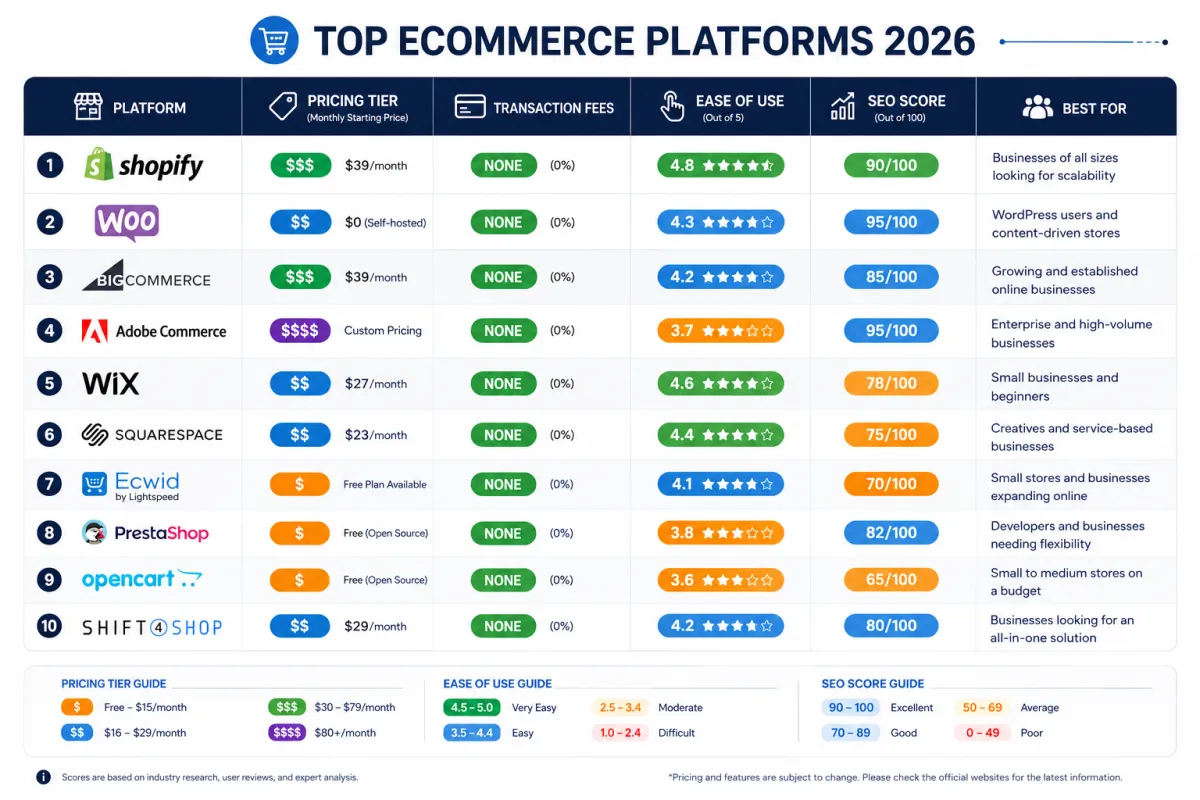
Platform Comparison Table
| Platform |
Starting Price |
Transaction Fees |
Best For |
Ease of Use |
SEO Score |
| Shopify |
$39/mo |
Yes (unless it’s Shopify Pay) |
All-round use |
9/10 |
8/10 |
| WooCommerce |
Free + hosting |
No |
WordPress users |
6/10 |
10/10 |
| BigCommerce |
$39/mo |
No |
Growing stores |
7/10 |
9/10 |
| Adobe Commerce |
$22,000+/yr |
No |
Enterprise |
4/10 |
9/10 |
| Wix e-commerce |
$27/mo |
No |
Beginners |
10/10 |
6/10 |
| Squarespace |
$23/mo |
Yes (lower plans) |
Creative brands |
9/10 |
7/10 |
| Ecwid |
Free |
No |
Add-on stores |
9/10 |
7/10 |
| PrestaShop |
Free + hosting |
No |
International |
5/10 |
7/10 |
| OpenCart |
Free + hosting |
No |
Developers |
5/10 |
6/10 |
| Shift4Shop |
Free (US) |
No |
Budget US stores |
7/10 |
8/10 |
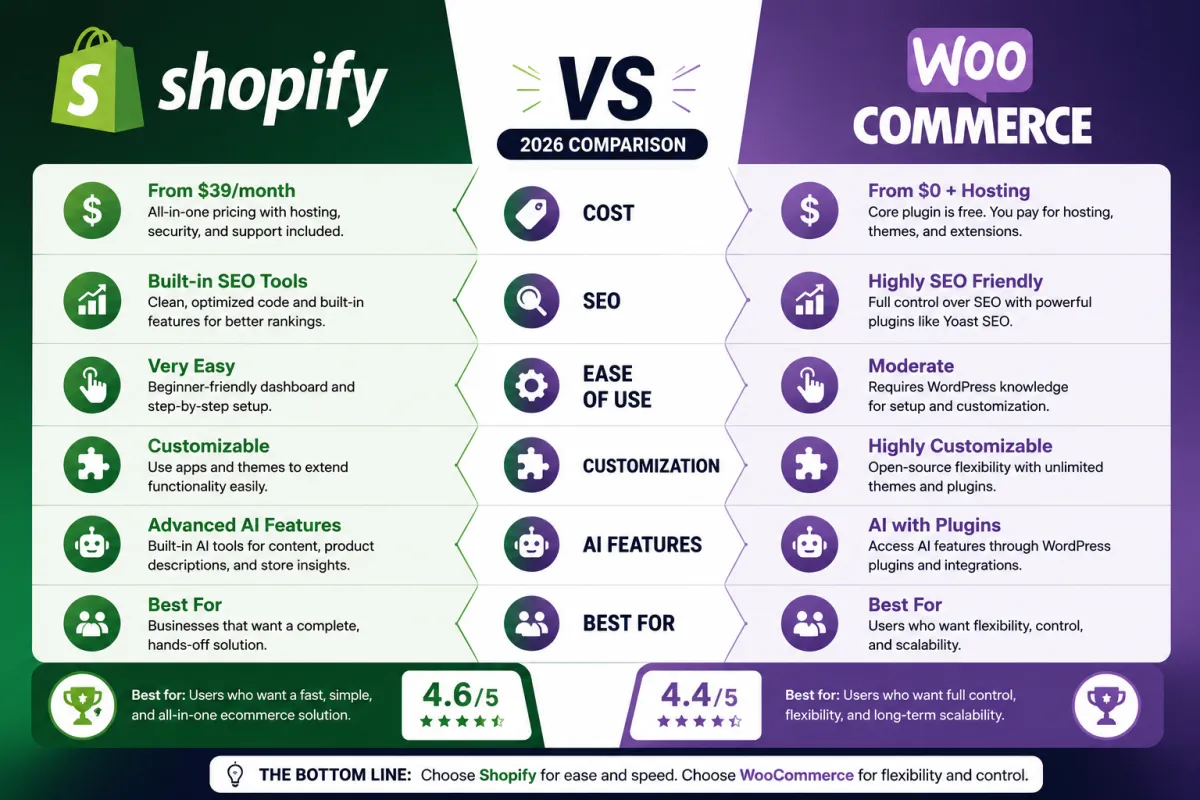
The two most used e-commerce solutions in the world sit on opposite ends of the hosting spectrum. Shopify is fully hosted, meaning the platform handles your servers, updates, and security. WooCommerce is self-hosted, meaning you control everything but are also responsible for everything.
Here is a detailed breakdown:
| Category |
Shopify |
WooCommerce |
| Cost (entry) |
$39/month |
Free plugin + $10 to $30/month hosting |
| Transaction Fees |
Yes (unless using Shopify Payments) |
No |
| Ease of Setup |
Very easy (hours) |
Moderate to hard (days) |
| SEO Capabilities |
Good |
Excellent |
| AI Features |
Shopify Magic, Sidekick AI |
Depends on plugins |
| Customization |
Good (limited without Liquid) |
Unlimited |
| Scalability |
Excellent (handles millions in revenue) |
Excellent (with right hosting) |
| Security |
Managed by Shopify |
Your responsibility |
| Best For |
Speed and simplicity |
Control and content |
Choose Shopify if you want a fast, reliable, managed store experience and you are not a developer. Choose WooCommerce if you are already on WordPress, you have some technical confidence, and SEO or content marketing is central to your growth strategy.
Best Ecommerce Platform by Business Type
Not every platform is right for every business. The best platform for online store operations depends on your stage, technical resources, and growth goals. Here is a clear decision matrix:
| Business Type |
Recommended Platform |
Runner Up |
Reason |
| Beginners |
Wix |
Shopify |
Easiest setup with no learning curve |
| Small Businesses |
Shopify |
Squarespace |
Reliability and growth room |
| Agencies Managing Client Stores |
WooCommerce |
Shopify |
Flexibility and margin on hosting |
| Enterprise Brands |
Adobe Commerce |
BigCommerce |
Complexity and custom workflows |
| Bloggers Who Sell |
WooCommerce |
Ecwid |
Content and commerce under one roof |
| B2B Companies |
BigCommerce |
Adobe Commerce |
B2B features without enterprise cost |
| Fast-Growing Startups |
Shopify |
BigCommerce |
Fast scaling and integrations |
If you are starting from zero with no technical background, go with Wix or Shopify. You will be live in a day, and you will not need a developer.
If you are growing fast and need multichannel support, Shopify or BigCommerce will serve you better than any other option.
If SEO and content are your primary customer acquisition channels, WooCommerce on WordPress is the only real answer. The combination of full editorial control and deep SEO plugin support gives you capabilities no other platform matches.
If you are operating at enterprise scale with complex product catalogs, custom checkout requirements, or advanced B2B workflows, only Adobe Commerce or BigCommerce Enterprise will deliver without compromise.

AI Trends Changing Ecommerce Platforms in 2026
Artificial intelligence is no longer a premium add-on in e-commerce. In 2026, AI is becoming a core part of how platforms operate, compete, and serve customers. Here is what is actually changing right now.
AI Product Descriptions at Scale
Platforms like Shopify with its Shopify Magic tool and BigCommerce with its AI writing assistant now allow merchants to generate SEO-optimized product descriptions from a bullet list of specifications. What used to take hours of copywriting now takes seconds. The quality has improved dramatically, and for stores with hundreds of products, this is genuinely transformative.
AI Customer Support
Conversational AI agents built into storefronts are handling a growing portion of customer service inquiries. These are not the clunky chatbots of 2019. In 2026, AI support tools can check order status, process returns, handle size queries, and escalate complex issues to human agents. Platforms like Gorgias and Tidio are now natively integrated with Shopify and WooCommerce for exactly this purpose.
Predictive Product Recommendations
AI recommendation engines analyze browsing behavior, purchase history, and real-time signals to surface products customers are most likely to buy next. Adobe Commerce’s AI powered by Adobe Sensei has offered this for years. In 2026, even smaller platforms like Wix and Ecwid have added basic recommendation logic to their storefronts.
AI-Powered Search
Semantic search is replacing keyword-based site search. Instead of exact keyword matching, AI search engines understand buyer intent. A customer typing “warm coat for rainy evenings” now gets relevant results even if no product description contains that exact phrase. BigCommerce and Shopify both have native AI search improvements in 2026.
Agentic Commerce
This is the frontier. Agentic commerce means AI agents that can complete purchases on behalf of users. A customer tells their AI assistant to buy a birthday gift under a certain budget, and it browses, selects, and checks out autonomously. Shopify has begun building infrastructure to support this, and it is likely to reshape how traffic and conversion work within the next two to three years.
Conversational Shopping
AI chat interfaces embedded in storefronts are allowing customers to describe what they want in natural language and receive curated product selections in response. This is already live in pilot programs across several enterprise brands and is rolling out to mid-market platforms throughout 2026.
Conclusion
After reviewing ten platforms across nine criteria, here is the clearest summary available.
Best overall platform: Shopify strikes the right balance between ease of use, scalability, AI features, and a reliable support ecosystem. Most businesses will be well served here, as it remains the top choice among the best e-commerce platforms available in 2026.
Best budget option: Shift4Shop for US merchants, or WooCommerce if you are comfortable with WordPress and want full control without monthly platform fees.
Best enterprise option: Adobe Commerce for businesses with complex catalogs and custom workflows. BigCommerce Enterprise is the more cost-efficient alternative for brands that do not need Magento-level customization.
Best WordPress option: WooCommerce, without question. If your business runs on WordPress or your growth strategy is anchored in content, WooCommerce gives you capabilities that no hosted platform can match.
The best e-commerce platforms all share one thing in common. They give you a foundation to build on. But the right platform is the one that fits where your business is today and where you plan to take it over the next two to three years. Do not choose based on what someone else is using. Choose based on your technical resources, your growth model, and your budget.
Pick your platform. Build your store. Your next customer is already out there looking for what you sell.
FAQs
Shopify is the best e-commerce platform in 2026 for most businesses. It offers the right mix of ease of use, AI tools, scalability, and a massive app ecosystem. For businesses focused on SEO and content marketing, WooCommerce is the strongest alternative. Your best choice depends on your budget, technical skill level, and long-term growth goals.
Shopify is the top recommendation for small businesses that want room to grow. Wix is the better choice if you are just starting out and need the simplest possible setup. Shift4Shop is worth considering for US-based small businesses on a tight budget since it offers a completely free plan when you use Shift4 Payments as your processor.
WooCommerce is better than Shopify specifically for SEO, content marketing, and full customization. It gives you complete control over your store with no transaction fees. Shopify is better for ease of use, managed hosting, and out-of-the-box e-commerce features. Neither is universally better. The right choice depends entirely on how your business operates and grows.
WooCommerce on WordPress is the best e-commerce platform for SEO. It gives you complete technical SEO control along with support for powerful plugins like Rank Math and Yoast SEO. BigCommerce is the strongest SEO option among fully hosted platforms. Both offer clean URL structures, fast page speeds, and strong metadata controls that help you rank on Google.
Shift4Shop offers a genuinely free plan for US merchants who use Shift4 Payments. WooCommerce and OpenCart are free to download as open-source software, though you will pay separately for hosting and plugins. Ecwid also has a free starter plan for sellers with a small product catalog. Among fully hosted platforms, Wix Ecommerce at $27 per month is one of the most affordable all-in-one options available.


 WooCommerce Solutions
 Solutions for WordPress