You built a beautiful store. Your product pages load fast, your copy converts, and your ads are running. Then someone hits checkout, and the payment fails. Or the process takes 12 seconds. Or the customer sees a gateway they do not recognize and closes the tab.
That single moment kills more revenue than bad copy ever will. Cart abandonment rates hover above 70% globally, and a significant chunk of that number traces back to checkout friction, payment errors, and trust issues at the point of payment. The best payment gateways for e-commerce do more than move money. They protect your brand at its most vulnerable moment, the second a customer decides whether to trust you with their card.
Quick Answer Box
What is the best payment gateway for e-commerce in 2026? Stripe is the best overall choice for most businesses due to its transparent pricing, global reach across 46 countries, and native support for subscriptions and marketplaces. For Indian e-commerce stores, Razorpay leads. For beginners on Shopify, PayPal works immediately out of the box.
What Is a Payment Gateway?
A payment gateway is the technology that securely captures and transfers payment data from a customer to a bank and back to a merchant. When a customer enters their card details, the gateway encrypts the information and sends it to the payment processor, which contacts the issuing bank for approval. The bank approves or declines, and the gateway tells your store the result in two to four seconds.
Many people confuse a payment gateway with a payment processor. The processor handles the actual movement of funds between banks. The gateway handles secure communication between your website and the processor. Stripe bundles both into one product. Authorize.net sits between your existing merchant account and the processor.
How to Choose the Right Payment Gateway
Transaction fees matter, but they are not the whole picture. Here is what actually separates good gateways from frustrating ones.
Fees: Most gateways charge between 1.5% and 3% per transaction plus a flat fee. Run your average order value through a real calculation before committing.
Security: Any gateway you use must be PCI DSS compliant. Tokenization, 3D Secure support, and SSL encryption should be standard features.
Supported countries and currencies: If you sell internationally, verify that your gateway supports the specific currencies your customers pay in. Some gateways support 135 currencies but only settle in 25.
Checkout experience: A redirect to an external page adds friction. Native or embedded checkout keeps customers on your site and reduces abandonment.
Refund handling: Some gateways return the full fee on refunds. Others keep the processing fee. Know this before a high-return period tests you.
WooCommerce and Shopify support: Not every gateway has a well-built, actively maintained plugin. A poorly coded plugin can slow your checkout or break during platform updates.
Fraud protection: Machine learning-based fraud detection, velocity checks, and chargeback management tools should be baked in, not sold as expensive add-ons.
Customer support: When payments break, you cannot wait 48 hours for an email reply. Prioritise gateways with 24/7 support.
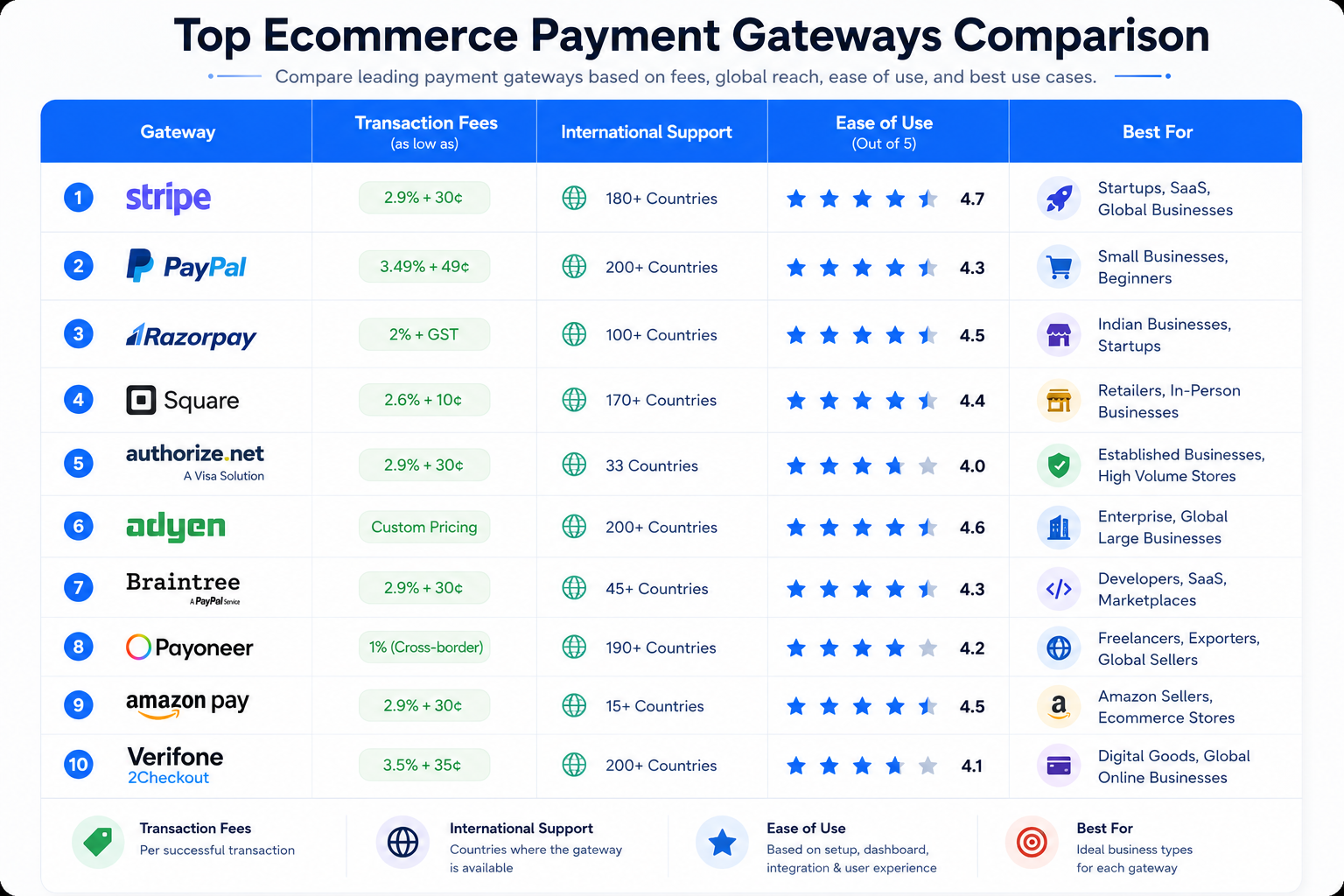
Stripe is the developer’s first choice and the default for serious e-commerce brands. It offers a complete payments infrastructure with clean APIs, extensive documentation, and products that scale from a side project to a large platform. Best for tech-forward teams, SaaS businesses, marketplaces, and subscription stores. Pricing is 2.9% plus $0.30 per transaction with no monthly fee. Expert verdict: The gold standard for online businesses in 2026. If you are building anything that needs to grow, start here.
PayPal remains the most recognized payment brand globally, which is both its biggest strength and its biggest limitation. Customers trust the logo. Best for small businesses and beginners who need instant credibility. Pricing sits at 3.49% plus $0.49 per transaction. Expert verdict: Indispensable as a secondary payment option. As your only gateway, the fee structure and account stability issues become harder to ignore at scale.
Razorpay is the dominant gateway for Indian e-commerce, handling UPI, net banking, wallets, and international cards in one dashboard. Best for Indian stores, D2C brands, and South Asian startups. Domestic pricing is 2% per transaction. Expert verdict: If your customers are in India, there is no meaningful competition. Razorpay is the answer.
Square started as a POS company for physical retailers and has built a capable e-commerce offering. It works well for businesses that operate both online and in a physical location. Pricing is 2.9% plus $0.30 for online transactions. Expert verdict: Right for brick-and-mortar retailers adding an online channel. Not the right choice for a digital-only store scaling globally.
One of the oldest gateways in the industry, now owned by Visa. It works with your existing merchant account rather than replacing it. Pricing is $25 per month plus 2.9% and $0.30 per transaction. Expert verdict: A reliable workhorse for businesses with an existing merchant account. Not built for modern checkout flows.
An enterprise-grade platform used by brands like Spotify and eBay. It handles acquiring, processing, and gateway functions in one unified stack across 250 plus payment methods. Pricing is interchange plus 0.3% per transaction with no monthly fee. Expert verdict: If you are moving serious transaction volume internationally, Adyen offers infrastructure depth that consumer-facing gateways cannot match.
A PayPal subsidiary offering a more developer-friendly experience than its parent product. Supports Venmo and PayPal acceptance alongside standard card payments. Pricing is 2.59% plus $0.49. Expert verdict: A legitimate Stripe alternative for businesses that need PayPal ecosystem access with more technical flexibility.
Best known as a cross-border payment platform, Payoneer extends into e-commerce payments for international sellers. Strong for receiving payments across 190 countries. Pricing is 3% for credit card transactions. Expert verdict: Choose Payoneer when your primary pain point is getting paid across borders, not when you need a polished consumer checkout experience.
Amazon Pay lets customers use the payment and address details stored in their Amazon account to check out on third-party stores. Best for US-focused stores targeting Amazon’s customer base. Pricing is 2.9% plus $0.30. Expert verdict: A strong secondary gateway for US stores. The brand trust it lends at checkout can lift conversion for the right audience.
Built specifically for digital goods and software businesses selling globally. Handles 45-plus payment methods, global tax management, and localized checkout in 87 languages. Pricing is 3.5% plus $0.35. Expert verdict: If you sell digital products internationally and need automated VAT compliance baked in, 2Checkout solves a problem others ignore.
Comparison Table
Gateway
Best For
Transaction Fee
International Support
Ease of Use
Stripe
All-round e-commerce
2.9% + $0.30
46 countries
High
PayPal
Beginners and trust
3.49% + $0.49
200+ countries
Very High
Razorpay
Indian stores
2% domestic
India’s primary
High
Square
Omnichannel retail
2.9% + $0.30
US, AU, UK, JP
Medium
Authorize.net
B2B and established
$25/mo + 2.9%
US primary
Medium
Adyen
Enterprise brands
Interchange + 0.3%
Global
Complex
Braintree
Mid-market
2.59% + $0.49
44 countries
High
Payoneer
Cross-border B2B
3% card
190 countries
Medium
Amazon Pay
US consumer stores
2.9% + $0.30
US, EU, JP
High
Verifone 2CO
Digital goods global
3.5% + $0.35
87 languages
Medium
Stripe vs PayPal: The Real Comparison
Cost: Stripe charges 2.9% plus $0.30. PayPal charges 3.49% plus $0.49. On a $100 order, Stripe costs $3.20 and PayPal costs $3.98. Multiply that across thousands of orders, and the gap becomes significant.
Ease of setup: PayPal wins for non-technical founders. You can add a PayPal button in under ten minutes. Stripe requires slightly more configuration but is still accessible using its no-code tools.
Subscriptions: Stripe Billing is one of the most powerful recurring billing tools in the market. PayPal Subscriptions works but lacks the granular control that subscription-first businesses need.
Developer tools: Stripe wins decisively. Its API documentation and SDK support are the best in the industry. PayPal’s developer experience is functional but dated.
Trust factor: PayPal has decades of brand recognition. A PayPal button still converts better with new audiences who are unfamiliar with your store.
Best use case: Use Stripe as your primary gateway and PayPal as an express checkout option. This gives you Stripe’s economics and PayPal’s brand trust simultaneously.
Best Gateway by Business Type
Best for beginners: PayPal. Zero technical setup, immediate credibility, and a familiar brand name that removes purchase hesitation on day one.
Best for small businesses: Stripe. Fair pricing, excellent plugin ecosystem, and you will not outgrow it when you start scaling.
Best for Indian e-commerce stores: Razorpay. UPI support, EMI options, and local payment method coverage that no international gateway can replicate.
Best for global sellers: Adyen for enterprise volume. Stripe for mid-market international expansion.
Best for subscriptions: Stripe Billing handles trials, proration, usage-based pricing, and failed payment retries natively without third-party tools.
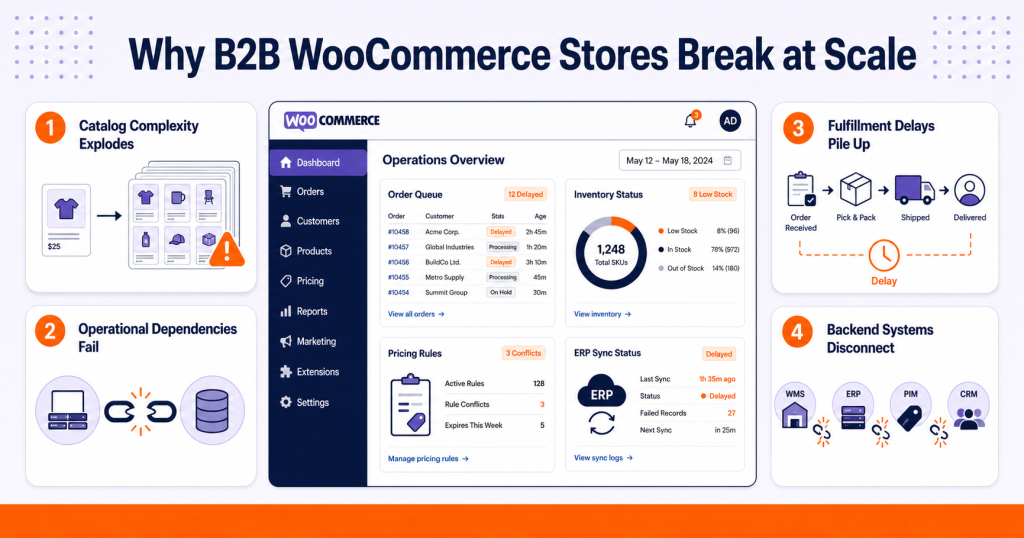
Best for marketplaces: Stripe Connect for multi-party payouts. If you are running a B2B marketplace, read how B2B WooCommerce stores break at scale before choosing your payment architecture.
Best for enterprise brands: Adyen. The unified acquiring and processing stack with dedicated account management justifies the complexity at volume.
Payment Trends in 2026
AI fraud detection is now standard on serious gateways. Stripe Radar, Adyen Revenue Accelerate, and Razorpay’s fraud suite all use machine learning to decline fraudulent transactions while keeping false positive rates low.
One-click checkout via Link, by Stripe and Shop Pay, is changing the conversion benchmark. A customer who checked out on one Stripe-powered store can complete checkout on any other in two taps.
Digital wallets including Apple Pay and Google Pay now account for a growing share of mobile transactions. Any gateway without wallet support is losing mobile conversions.
Buy Now Pay Later embedded at checkout increases average order value, particularly for products above $100. Stripe, PayPal Pay Later, and Razorpay EMI all offer native BNPL without external redirects.
Cross-border payments work best when customers see prices and are charged in their local currency. Gateways that force dollar conversion at checkout consistently underperform localized alternatives.
Mistakes to Avoid
Choosing only by the lowest fee is the most common error. A 0.5% lower processing rate that costs you 5% in abandoned carts is a bad trade. Calculate the real cost including checkout UX and support overhead.
Ignoring checkout flow is equally damaging. A gateway that redirects customers to an external page introduces friction that native checkout avoids entirely.
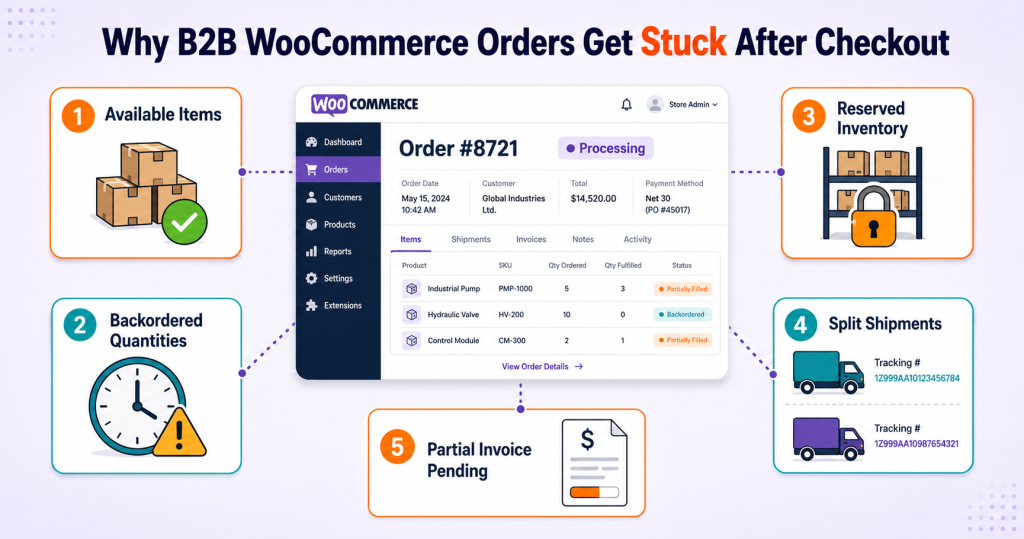
Not checking supported countries is expensive. Verify your gateway supports the specific countries and currencies your customers actually use before you launch. If your WooCommerce orders get stuck post-payment, understanding WooCommerce order fulfillment problems is worth your time.
Weak fraud prevention looks cheap until the chargebacks arrive. One percentage point saved on processing fees can disappear entirely with three chargebacks in a month.
Conclusion
Your checkout is not just a technical function. It is a trust moment that either converts a visitor into a customer or sends them somewhere else.
Best overall: Stripe. Transparent pricing, strong fraud protection, and the flexibility to grow without switching platforms.
Best for small business: Start with PayPal for trust, then add Stripe as your primary gateway as volume grows.
Best for global e-commerce: Adyen for enterprise volume, Stripe for mid-market international expansion.
Best for WooCommerce: Stripe with the official WooCommerce plugin. Stable, well-maintained, and covers every major payment method. Understanding how WooCommerce RMA workflows affect refunds will help you configure your gateway’s refund settings correctly from the start.
Best for Shopify: Shopify Payments built on Stripe to avoid the third-party transaction fee.
These are among the best payment gateways for e-commerce available right now, and the right one for your store depends on your market, your volume, and your platform. If you need expert help configuring your payment stack on WooCommerce or WordPress, Dazzlebirds has helped dozens of e-commerce businesses get this right. Get in touch with the team today and let us build a checkout flow that converts.
FAQs
Stripe is the best payment gateway for WooCommerce in 2026. It has an actively maintained official plugin, supports 46 countries, handles subscriptions natively, and integrates cleanly without slowing checkout. Razorpay is the better choice for Indian WooCommerce stores.
Yes, Stripe is available in India but with restrictions. Indian businesses can accept international payments through Stripe but cannot use it for domestic INR transactions. For domestic Indian e-commerce, Razorpay or PayU are the practical alternatives.
Stripe, Adyen, and Razorpay are among the safest payment gateways for online stores. All three are PCI DSS compliant, offer AI-powered fraud detection, support 3D Secure authentication, and provide chargeback management tools built into their standard plans.
Yes, Razorpay integrates with Shopify through its official plugin. It supports UPI, net banking, cards, and wallets at checkout. However, Shopify charges an additional transaction fee for third-party gateways unless you are using Shopify Payments.
Stripe, Razorpay, PayPal, and Braintree all charge zero monthly fees. You only pay per transaction. Authorize.net charges $25 per month. If you are an early-stage store watching fixed costs, start with a pay-per-transaction gateway first.


 WooCommerce Solutions
 WordPress Solutions