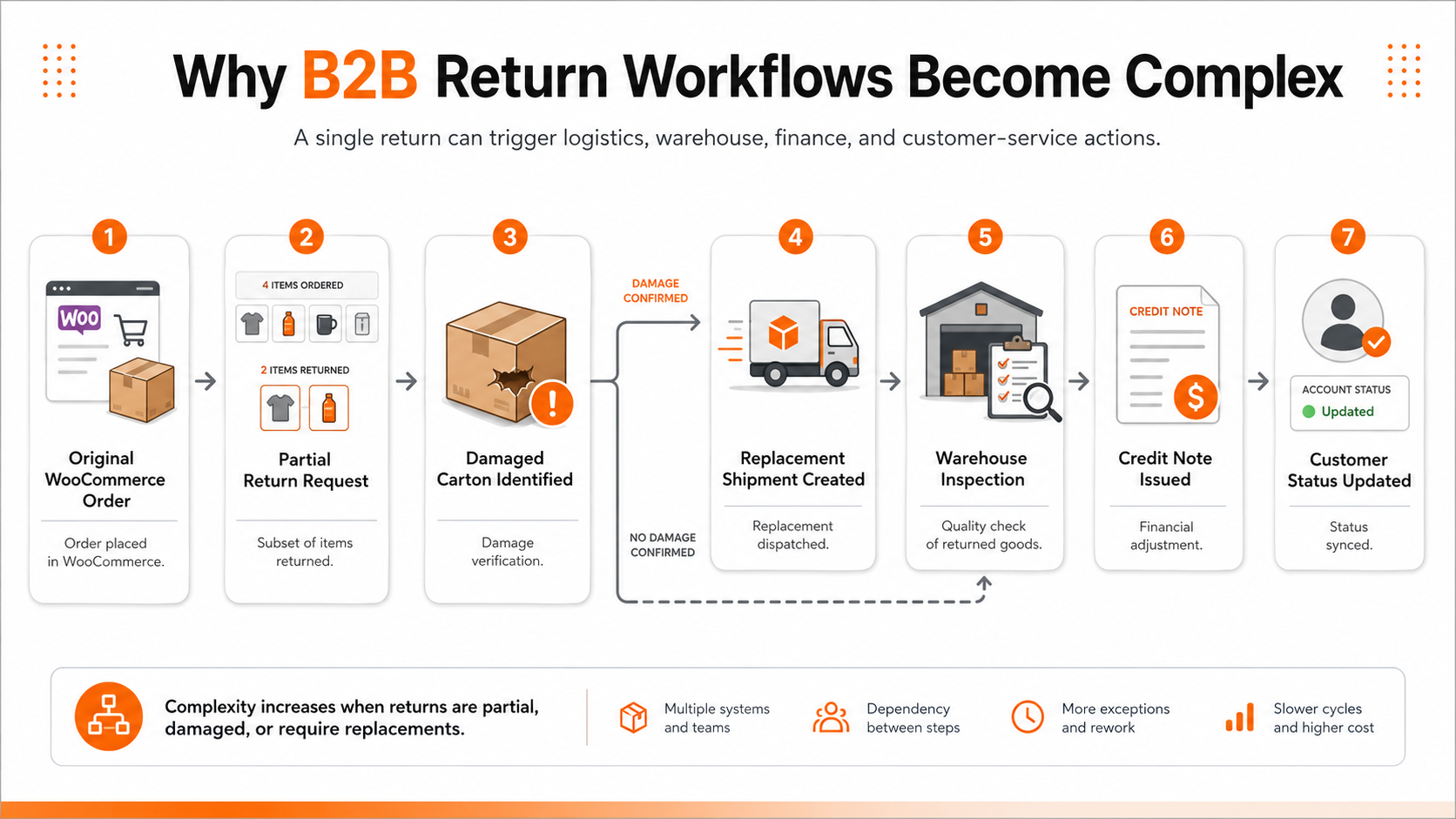
Picture this. A distributor places a WooCommerce order for 40 cartons of industrial components. The shipment arrives at their warehouse. Most of it is correct. But 6 cartons show visible freight damage, 2 cartons contain incorrect SKUs, and one critical item is needed immediately because the buyer has an active customer project dependent on it.
The distributor does not want a refund. They need a replacement shipment for the urgent item before anything is inspected, a credit note for the damaged cartons, and a status update they can relay to their own customer.
Meanwhile, your sales team wants to protect the account relationship. Your warehouse team needs to inspect the returned goods. Your finance team needs documentation before issuing credit. Your operations team is debating whether to ship the replacement before the original goods come back.
This is what B2B returns actually look like. And this is why standard WooCommerce refund workflows start breaking down at exactly the moment B2B operations need them most.
Why Do WooCommerce RMA Workflows Become Difficult for B2B Businesses?
WooCommerce RMA workflows become difficult in B2B because returns rarely involve a single product, a single reason, or a single team. B2B returns arrive as partial shipments from large orders, freight-damaged pallets requiring carrier investigation, warranty claims requiring invoice and serial number validation, or replacement requests that must be fulfilled before inspection. Each scenario pulls in sales, support, warehouse, finance, and operations simultaneously. Without workflows that handle partial quantities, customer-specific terms, credit notes, and replacement tracking, the process collapses under its own coordination weight.
Key Takeaways
- B2B returns often involve partial quantities from large orders, not full-order returns.
- Replacement shipments are frequently more operationally urgent than refunds for B2B buyers.
- Warranty claims require product history, serial numbers, invoice records, and account-level data before approval.
- Warehouse inspection determines whether returned goods are restockable, repairable, rejected, or written off, directly controlling credit and inventory decisions.
- Better return visibility improves customer trust, financial accuracy, and post-purchase operational control.
What Does RMA Mean in B2B WooCommerce?
A return merchandise authorization (RMA) is the process by which a seller reviews, approves, tracks, and resolves a product return before or after the goods are physically moved. In B2B WooCommerce, this is considerably broader than issuing a refund.
A B2B RMA process covers return requests against specific line items from large orders, replacement orders raised in parallel with returns, warranty claims validated against purchase history, return approvals following customer-specific contract terms, credit notes issued to customer accounts, warehouse inspection workflows, and inventory classification decisions after goods come back.
Consumer refund processes in WooCommerce handle a narrow version of this. A customer requests a return, a refund is issued, and stock is adjusted. B2B return merchandise authorization is a multi-step, multi-team, multi-outcome process that touches almost every operational function in the business.
Why WooCommerce RMA Workflows Become More Complex in B2B
The fundamental difference is that B2B buyers purchase in volume, operate under negotiated terms, and need operational continuity rather than transactional resolution.
A consumer returning a product wants money back. A B2B distributor returning part of a pallet shipment wants a replacement, a credit adjustment, and a resolution that does not disrupt their own supply chain commitments.
Bulk orders introduce partial return complexity immediately. A 200-unit order might generate a return request for 14 units across 3 SKUs, each with different reasons and resolution paths. Distributor return policies differ by account, product category, purchase volume, and contract terms. Warranty claims require data across multiple systems. Replacement orders need to be tracked against the original WooCommerce order for finance to reconcile correctly.
All of this requires solid WooCommerce order management at the foundation, because every return event must trace back to the original order, shipment, and invoice without manual searching.
Why Partial Returns From Bulk Orders Are Hard to Track
When a B2B buyer orders 40 cartons and returns 6, WooCommerce needs to understand this is not a full-order return. It is a partial return against specific line items involving multiple SKUs, multiple damage reasons, and multiple resolution paths. Some items qualify for replacement. Others qualify for credit. Others are rejected pending inspection.
Consider the scenario closely. A distributor returns 6 of 40 cartons. Three are damaged by freight. Two contain incorrect products. One contains a product no longer needed due to a project change. Each requires a different resolution path, a different warehouse instruction, and a different financial outcome. Tracking all three streams inside a single return request, connected to the original order, is where manual processes and basic refund tools fail first.
The return quantity approved, the replacement quantity dispatched, the inspection quantity pending, and the credit quantity processed all need to be visible simultaneously, connected to the original order reference, and updated in real time.
How Freight Damage Changes the Return Process
Freight and pallet shipments introduce complexity that has nothing to do with the product itself. When goods are damaged in transit, the question is not simply whether to accept the return. The question is who is responsible, what evidence exists, whether the carrier needs to be involved, and whether the return can be processed until liability is established.
A distributor receiving a damaged pallet may have discovered damage only after opening outer cartons. Carrier claims may need to be filed before credit can be issued. Photographic evidence may need to be submitted and reviewed. This is why WooCommerce shipping rules and freight handling policies need to be part of the return workflow conversation. Freight damage returns are investigative processes, not simple approve-or-reject decisions.
Businesses that approve freight damage credits without investigation risk inflated claims. Businesses that hold every freight damage return for full investigation risk damaging key account relationships. The right response depends on the customer account, shipment value, carrier involved, and evidence available. None of this logic exists in a standard WooCommerce refund tool.

Why Replacement Orders Are Often More Urgent Than Refunds
B2B buyers return products because something went wrong in a supply chain with downstream commitments attached. When a distributor’s customer is waiting on components that arrived damaged, a credit note does not resolve the issue. A replacement shipment does.
This creates a difficult trade-off. Shipping a replacement before the original goods are returned and inspected means carrying the cost and inventory risk of both shipments simultaneously. Waiting for a full inspection before shipping a replacement can cost the account relationship entirely.
Without a structured WooCommerce replacement order workflow, this decision gets made informally, tracked inconsistently, and communicated poorly. The replacement order exists outside the original order. The return is tracked separately. Finance is unsure what credit applies. The customer gets conflicting updates from sales and support.
A replacement order must be formally linked to the original WooCommerce order and the return request that triggered it so that every team has accurate information at the same time.
Why Warranty Claims Need More Than a Return Request
Warranty claims in B2B are not a subset of returns. They are a separate process with their own eligibility criteria, validation requirements, and resolution paths.
A B2B warranty claim might depend on the purchase date relative to the warranty period in the customer contract, the product type and warranty category, the manufacturer-specified usage conditions, whether the product was correctly installed, and whether the customer maintained their service registration.
Before any warranty claim can be approved, the business typically needs the original invoice to confirm the purchase date and SKU, the product serial number to verify the specific unit, the installation date if the warranty begins from commissioning rather than purchase, and, sometimes, photographic or diagnostic evidence of the fault.
None of these lives naturally inside a standard WooCommerce return request form. It must be collected, matched, and validated across the WooCommerce order history, the customer account, and, when applicable, an external ERP or service management system.
Why Customer Agreements Make Return Approval Harder
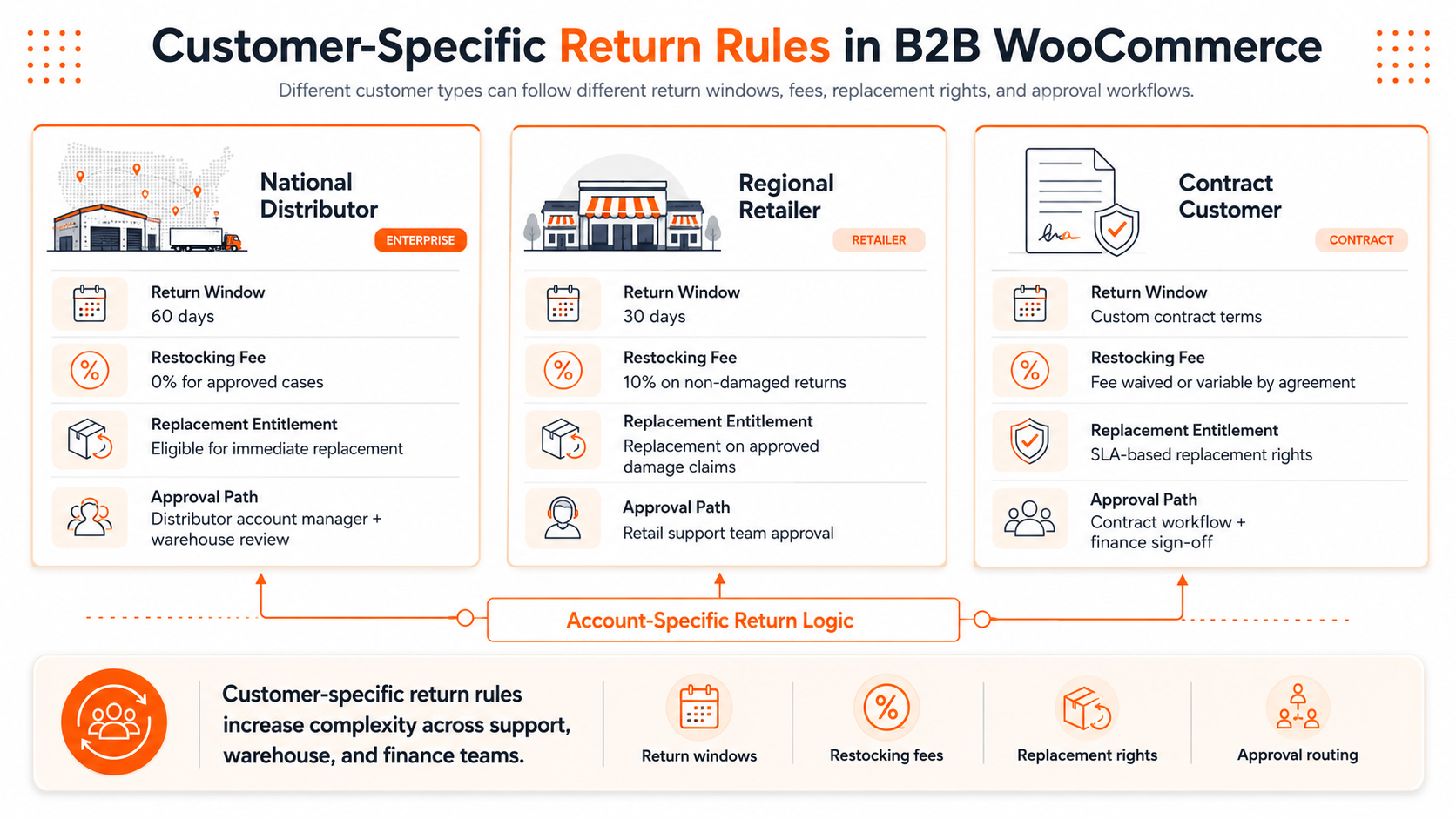
Not every B2B customer has the same return entitlements. A large national distributor might have a 90-day return window, no restocking fee, and a guaranteed replacement right. A smaller regional retailer on standard terms might have a 30-day window, a 15 percent restocking fee, and a credit-only resolution policy.
When approval rules vary by account and are stored in spreadsheets or known only to individual sales team members, approvals become inconsistent. One customer gets a replacement that another in a similar situation was denied. A support agent approves a return without knowing about the restocking fee clause. A distributor escalates because they were told their return window was 90 days, but the system only shows 30.
This is particularly complex in wholesale and distribution, where account-specific terms govern product category eligibility, return quantities, resale condition requirements, and purchase volume thresholds. A product purchased under a promotional agreement may carry different return conditions than the same product at list price.
Why Credit Notes Make B2B Returns More Financially Complex
In consumer eCommerce, refunds are returned to the payment method. In B2B operations, the financial resolution of a return is rarely that straightforward.
B2B buyers operate on credit accounts, net payment terms, and invoice-based trading relationships. When a return is approved, the resolution is typically a credit note applied to the customer account, reducing the outstanding balance on the next invoice cycle. This is not a WooCommerce refund. It is an account-level financial adjustment that needs to be reconciled against the original invoice and communicated to both the finance team and the customer’s accounts payable team.
This is where enterprise WooCommerce integrations become operationally important. When WooCommerce return data is disconnected from the ERP or accounting system, credit notes get issued manually, applied inconsistently, and reconciled late. The result is payment disputes, relationship friction, and audit problems that compound over time.
Why Warehouse Inspection Controls the Final Return Outcome
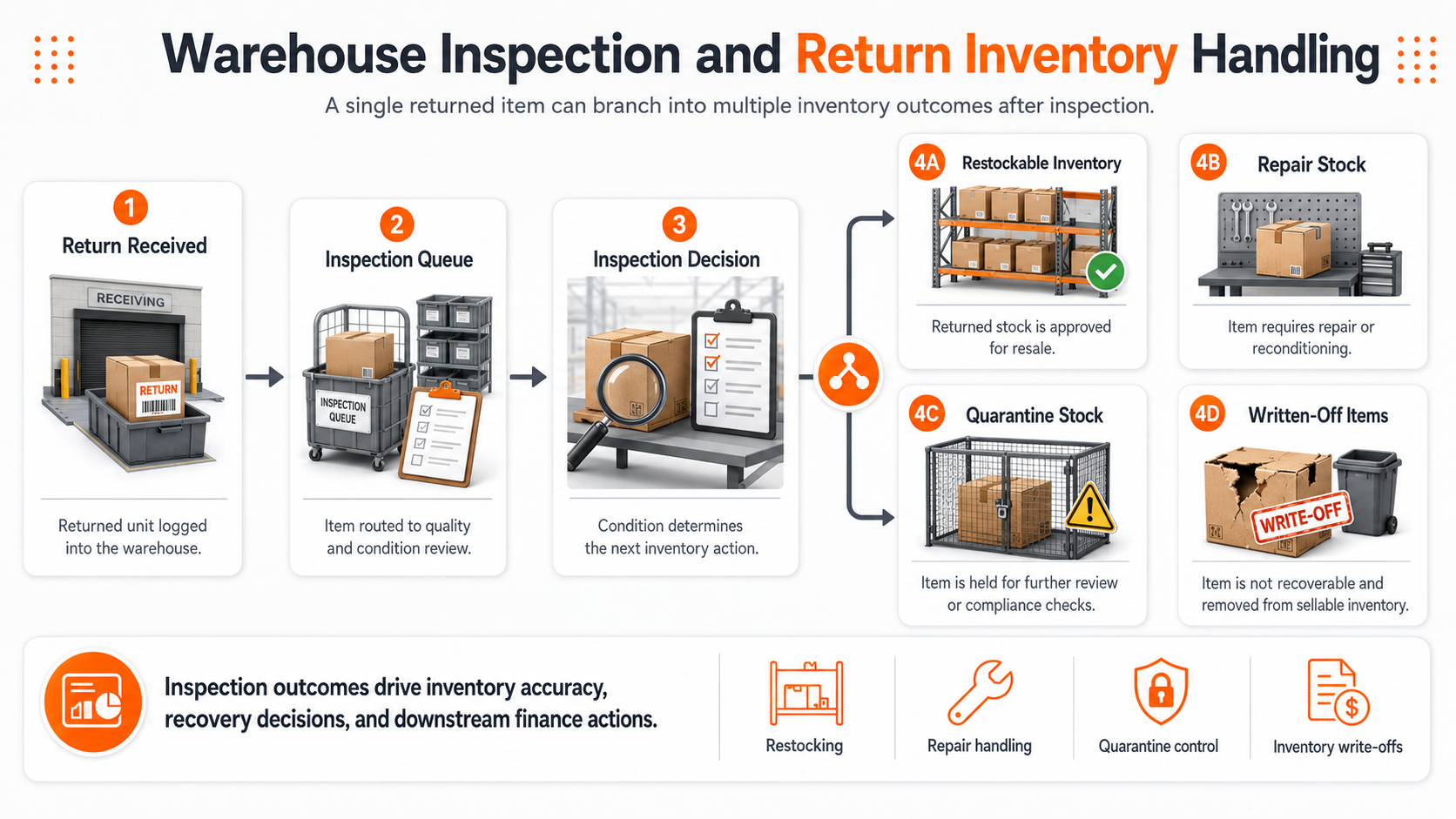
Nothing in the return process can be finalized until the warehouse team has physically inspected returned goods and recorded a disposition decision. Return disposition is the classification of returned inventory after inspection: restockable, repairable, damaged beyond repair, or written off.
A restockable item is returned to available inventory. A repairable item moves to repair stock. A damaged item is moved to quarantine stock pending write-off or a supplier claim. A written-off item is removed from inventory records entirely.
Each outcome produces a different financial result, inventory update, and stock adjustment. This is why WooCommerce should not update stock levels automatically when a return is received. Restoring stock before inspection risks adding unsellable goods back into available inventory, which then gets allocated to new orders and creates a new fulfillment problem.
Good WooCommerce inventory management means returned goods are placed in a defined holding status after receipt, inspection results are recorded against the return record, and stock updates occur only after the disposition decision is confirmed. Inspection results also determine whether the credit note value is correct. If a customer returns 6 cartons, claiming all are damaged, but inspection reveals only 4 are unsellable, the credit note value is adjusted accordingly.
Why Return Status Visibility Matters for B2B Customers
A B2B buyer who submitted a return request three days ago and has heard nothing is not quietly waiting. They are emailing their sales contact, calling support, and forming a judgment about whether this supplier is operationally reliable.
Return status visibility is one of the most underestimated problems in B2B WooCommerce operations. The return might be progressing correctly internally through receipt, inspection, finance review, and credit issuance. But if none of that is visible to the customer, the experience feels stalled regardless of internal activity.
B2B buyers need to see that the return has been received; the goods are under inspection; an outcome has been determined, the replacement has been dispatched, or the credit note has been issued; and the account has been updated. Each visible status point eliminates a support contact, reduces pressure on the sales relationship, and gives the buyer accurate information to relay to their own stakeholders. A B2B customer portal that surfaces return status in real time transforms this from frustrating opacity to operational transparency.
Why B2B Returns Require Multi-Team Coordination
A single return request in a B2B WooCommerce operation can involve every team in the business before it is resolved.
Support receives the initial return request and logs it against the original order. Sales reviews it because the account relationship is involved. The warehouse team receives the returned goods, inspects them, and records the disposition. Finance determines what credit note value to issue. Operations coordinates the replacement shipment, checking stock availability and dispatch timelines.
When these five teams work from email threads, spreadsheets, and separate system logins, the return process becomes a coordination problem as much as an operational one. Information goes missing between handoffs. Teams make decisions based on outdated status. The customer gets different answers depending on who they contact.
WooCommerce process automation can reduce manual coordination by routing return requests to the right team at each stage, triggering inspection tasks when goods are received, notifying finance when inspection is complete, and updating the customer record when credit is issued. But automation only works when the underlying return workflow is clearly defined with ownership assigned at each stage.
Why Return Data Must Stay Connected to Original Orders
Every B2B return event is a child of an original order. The return request links to an order number. The returned quantity links to a specific line item and SKU. The credit note links to the original invoice value. The replacement order links to the return authorization. The inspection result links to the specific units returned.
When these connections are broken because return records live in a separate system, a support ticket, or a spreadsheet, the business loses the ability to manage the account accurately. Finance cannot reconcile the credit against the right invoice. Operations cannot confirm whether the replacement was dispatched as part of an authorized return. The sales team cannot see the full post-purchase history when preparing for the next account conversation.
Connected return data also enables reporting: which product lines generate the most returns, which accounts have the highest return frequency, and which return reasons are most common across freight deliveries. Without data linked back to the original order, SKU, and customer account, none of these questions can be answered accurately.
What Better B2B Return Management Looks Like in WooCommerce
Better B2B WooCommerce return management is defined by whether the return process aligns with the operational realities of B2B trading relationships.
A well-structured B2B return workflow starts with a clear intake process that captures the original order reference, specific line items and quantities, the reason for the return, and the expected resolution. It automatically applies account-specific return rules, ensuring approval decisions are consistent with negotiated terms. It tracks replacement orders as formally linked records. It supports warranty claim validation by connecting the return to product history, serial numbers, and customer account data.
Warehouse inspection records a disposition status for each returned unit. That status drives both the inventory update and the credit note value. The customer sees meaningful status updates at each stage. Every team involved accesses the same return record connected to the original order, invoice, and customer account.
For B2B businesses building or scaling on WooCommerce, this level of return workflow sophistication typically requires custom development aligned to real operational requirements. That is where working with a specialist through WooCommerce development services makes a practical difference.
The Real Cost of Poor B2B Return Management
The problem is not that B2B customers return products. The real challenge is managing partial returns, freight damage, replacement urgency, warranty validation, credit notes, warehouse inspections, and customer communication while maintaining visibility.
When return workflows break down, the cost shows up as damaged account relationships, financial reconciliation errors, inventory inaccuracies, and growing backlogs of unresolved requests, putting pressure on every team at once.
For growing B2B businesses on WooCommerce, better return management is a post-purchase operational requirement that affects customer retention, financial accuracy, and scalability. DazzleBirds works with B2B WooCommerce businesses on these challenges, including return and replacement workflows, warehouse inspection processes, credit note visibility, and account-level post-purchase operations.


 WooCommerce Solutions
 Solutions for WordPress