If you are a B2B business owner, you have already experienced this: the first 50 orders were easy, and the first 500 were manageable. The first 5,000 exposed every manual process hiding inside the business.
Most developing B2B companies eventually reach this point. Not because of their bad decisions. Not that the team stopped caring. But because the growth has a way of coming faster than the systems designed to help it.
For one month, everything is under your control. And 3 months later, the same team is buried. Where it used to take an hour for approvals is now a day. The spreadsheet was managed by one person, and now it’s three people editing different versions. Customer emails get stuck in inboxes because no one is clear who owns the follow-up. A process that worked at 100 a week was never designed to handle 1,000 orders, and so your orders sit in a queue, waiting.
The business did not break. It grew. And growth exposed every shortcut, every handshake deal, and every manual workaround that had silently kept operations humming. As the business grew, what had felt under control before began to require more time, coordination, and effort to sustain.
It is not a technology issue. It is not a people problem. It is a process problem. And the exact way it comes up is almost identical in terms of ramping up B2B businesses. Work continues to flow in, expectations continue to rise, and the time available to deal with everything correctly only shrinks.
One of the most essential choices this fast-growing B2B company faces is figuring out when WooCommerce process automation starts to matter. Not that automation is the answer to everything; no, it’s not. It’s just that sometimes it can happen that the leading strategies used to build the company gradually begin to undermine and re-establish it, even if you now feel completely in control.

When Manual Processes Still Work
In the early days, manual processes are not the enemy. They are often the right choice.
Spreadsheets are something that makes sense when your team is small and order volume is low. Email approvals are fast enough. Product information updates are done in an afternoon, not a week. You know every customer personally. Your warehousing crew can pick and pack to order off a printed picklist (or good recall).
The ability to do things manually is actually a benefit when you are still experimenting with what your business needs. You can adapt quickly. You can make exceptions. You are doing it without having to change a system.
If we take a B2B distributor with 200 customers and 500 products in their catalog, it is possible to run pretty efficiently off spreadsheets, a couple of shared inboxes, and a decent team. Orders come in. Someone processes them. Stock gets checked. Things ship.
It is not about the manual process. This is a problem when the business grows but the process does not.
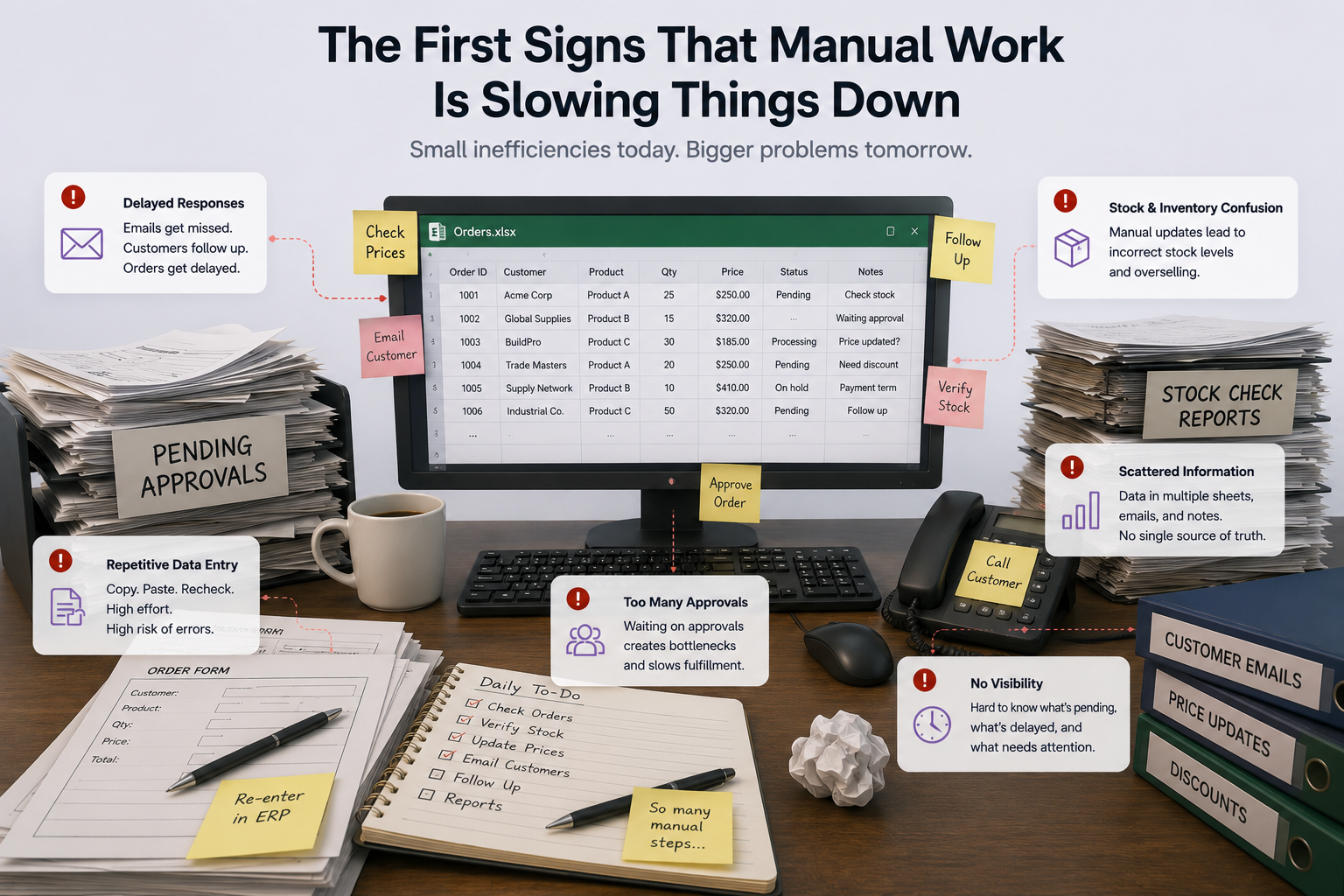
The First Signs That Manual Work Is Slowing Things Down
Growth rarely announces itself as a problem. It feels like success.
Almost never does self-growth feel like an issue that knocks at your door and asks to be let in. It feels like success.
More orders. More customers. More product lines. More sales channels. More team members. All good things, until one takes a peek under the hood.
Its initial symptoms are easy to overlook: an order takes slightly longer than before. Customer: Hey guys, when are you updating my pricing? You used to see one team member who dedicated half the day to copying data points from one system to another. A person sends the same update to three people because nobody knows who owns it.
These are not crises. They are friction points. Little inefficiencies that seem small, one at a time. But, as a whole, they amount to something that subtly throttles everything.
Some of the common early signs that manual work is causing real problems include data entry in multiple systems, approval requests sitting in inboxes for days, inconsistent product information across channels, and customer onboarding depending on one person remembering to do the next step.
Why Hiring More People Does Not Always Solve The Problem
The instinct when things slow down is to hire.
And it makes sense on paper. If you have too many people on the team, add more. If a few slow approvals are holding everything up, bring somebody on the team to manage. If the data entry is lagging, pull in some reinforcements.
But the reality is very different in many scaling B2B organizations, where more people means more coordination overhead.
Informal communication can be done in a five-member team. Processes are for a fifteen; it is almost the truth. Thirty people need to clearly own their work, have the workflows documented, and have standards consistent, or things begin slipping through the cracks in ways that are way harder to trace.
For a business, if the headcount doubles with no sign of improvement to processes, excitement quickly gives way to frustration; suddenly there are more emails, lengthier meetings, and drawn-out approval chains, which leave plenty of room for miscommunication. While the workload increases, so does the overhead to manage it.
This trend can be seen quite evidently in businesses dealing with pricing structures like WooCommerce B2B. Pricing for B2B customers can be a mess—multiple tiers, negotiated rates by customer, volume discounts, or contract pricing. The nature of manual pricing is that every individual who comes into contact with it, each new team member learns yet another point for errors to creep in. More people do not fix a broken process. It just distributes the problem.
One of the most difficult concepts for concerted growing businesses to digest is that capacity is not the problem. It is the process itself.
Hiring buys time. The problem is addressed by improving the process.
Why WooCommerce Process Automation Becomes Critical at Scale
Eventually, if you want to scale without scaling your operational overhead proportionately, the only way is by automating certain tasks in a structured, repeatable process where human judgment plays little role.

So, at this point, WooCommerce process automation goes from being an option to a requirement.
The thing is, WooCommerce order management automation isn’t about people replacement. It’s about eliminating all the tedious, low-impact work that eats up time without adding any real value, as a result giving your team members space to do what only they can.
For example, there are multiple steps needed once a WooCommerce order management is placed by a customer when it comes to B2B: validate the order; confirm price against that specific customer’s contract; get approval for orders above an XX amount; notify the warehouse; and get customer confirmation. If each and every one of those steps requires a human to move information from point A (wherever it is) to point B, then the same reason that would lead us towards automating non-fixed aspects will also be true: every single step like this represents another handoff in an endless chain reacting passively until someone moves their hands again on your behalf.
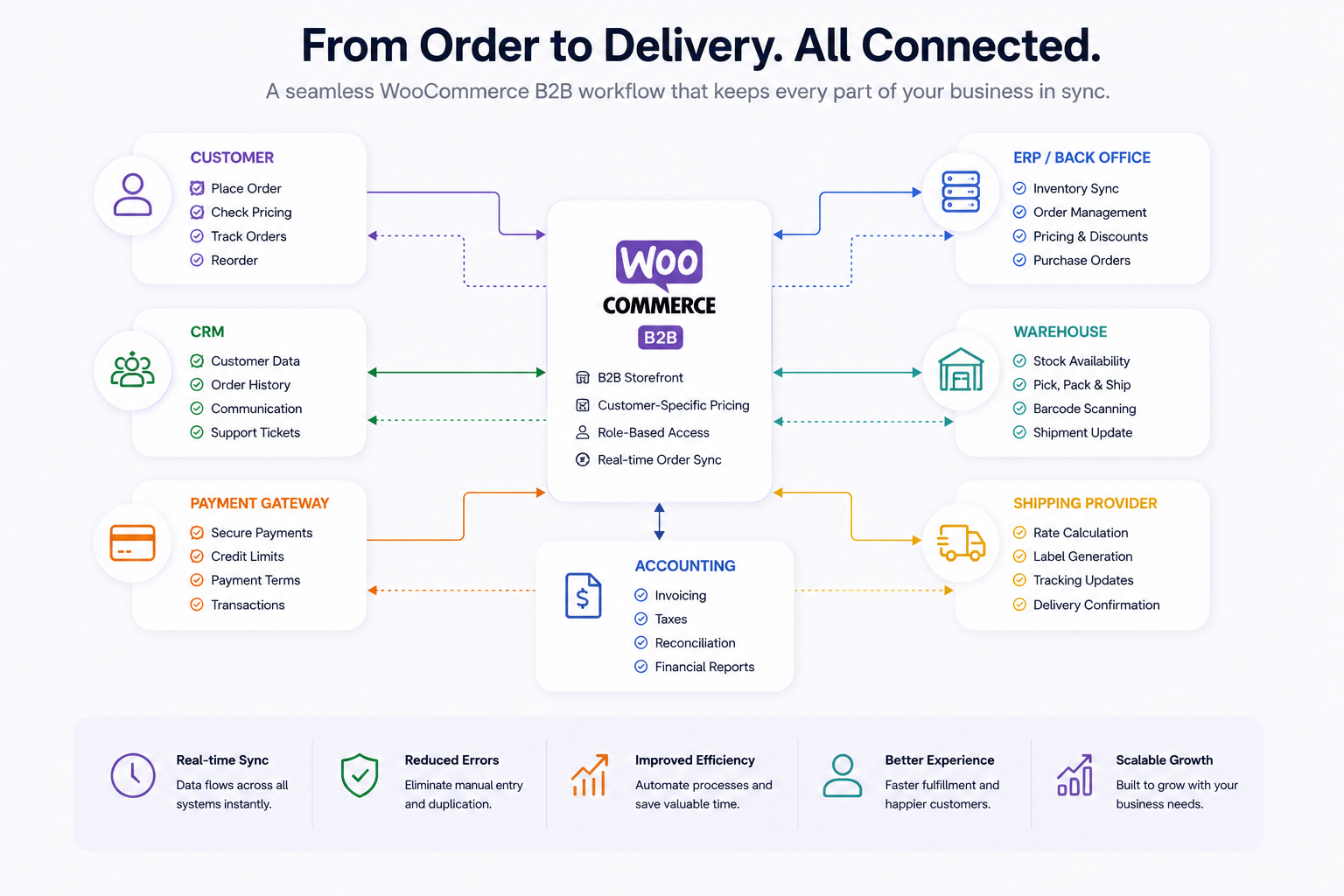
This is what Connected WooCommerce operational workflows alter. The order comes in. Gentio checks for the pricing agreement. Moves ahead automatically if in parameters. If it needs approval, then the right person is notified immediately, not someone some time later who may remember to check an inbox or see a task list. Nobody copies that pick to some other system; the warehouse gets this directly.
The work still gets done. But this gets done more quickly, with fewer errors and with less human intervention at each step.
Not surprisingly, this is especially important for companies with large-scale WooCommerce catalog management. If catalogs have thousands of SKUs, again, the manual updates take a huge chunk of time. Cost changes, stock availability, product descriptions, and category assignments all need to be handled consistently and at scale. By automating the process, you do not rely on one person to go through your whole catalog and apply updates; they simply happen consistently across everything.
The shift to WooCommerce workflow automation is not a technology decision. It is an operational decision. It is the point where a business decides that it wants to grow without adding proportional complexity.
The First Processes Growing B2B Businesses Usually Automate
Most businesses do not automate everything at once. They start with the processes that are creating the most pain and build from there.
| Process |
Business Benefit |
| Order approvals |
Faster processing; consistent standards, and no delays from manual sign-off |
| Customer-specific pricing updates |
Accurate pricing applied automatically at checkout eliminates manual intervention and pricing errors |
| Catalog updates |
Product information, availability, and pricing updated consistently across all channels |
| New customer onboarding |
Consistent experience, faster account activation, no dropped steps |
| Procurement requests |
Streamlined internal purchasing with clear approval paths |
| Fulfillment coordination |
Warehouse notified automatically; fewer errors; faster dispatch |
Typically, order approvals and pricing are the top two things on a list when it comes to B2B WooCommerce automation. They’re the processes closest to revenue and also the ones that are most visible (and damaging) if things go wrong—such as through manual errors or delays.
Another complex type of search that can benefit at an early stage from process work is for a WooCommerce product search complexity, especially where businesses have deep catalogs, and customers need to make the right choice quickly. The absence or incompleteness of catalog data creates friction everywhere: search, filter, comparison, and finally the purchase.
The Cost Of Waiting Too Long To Improve Processes
Every company that has gone through growth has a story like this.
Everyone was aware that the process did not work effectively. They had workarounds in place. The team was managing. And then a big order went south, or a customer defected, or someone that understood everything resigned and took the process knowledge with them; all of a sudden, the inefficiency became an emergency.
The price tag of procrastinating to optimize processes is typically normal. If your time is limited, there’s a painful evolution that got you here.
Workers are dealing longer and longer with tasks that should not occupy their time. Little mistakes snowball into bigger issues. Customer experience gets erratic, not because the team is not trying but simply because the process does not allow for consistency. The increased speed of operational costs has outpaced revenue.
Another, less obvious cost: all the work that does not happen. When your finest resource spends hours dealing with manual processes, they aren’t working on the things that actually move the business ahead—better customer relationships, new market opportunities, and better products.
Hard Work Doesn’t Build Scalable WooCommerce Operations: It is created by doing things more intelligently, starting with realizing when the way they do it no longer suits how business is being run.
This can be especially important for any enterprise WooCommerce integrations where you might have multiple systems communicating with one another. Manual coordination starts to become impossible when ERP data needs synching with warehouse management, customer accounts, and pricing. When scaled, its manual management becomes exponentially more complex.
What Efficient WooCommerce Operations Look Like
Efficient operations are not complicated to describe. They just take real effort to build.
Every process is clearly owned by someone in a well-run B2B WooCommerce business. Everyone is aware of their responsibilities and what follows. No more approval requests languishing in inboxes with no one really knowing who should be addressing them. No orders stalled because a team member is waiting for something to be confirmed by someone who is on holiday.
Processes are consistent. When getting a new customer on board is all the time? That the account is billed properly no matter which team member of yours manages it. It does not matter if the orders come into play on a Monday at 9am or Friday at 4pm either.
Workflows are connected. If something happens in one part of the business, everyone and everything are notified. Warehouse teams are no longer waiting to find out in an email what they need to pick. The finance department is not pursuing sales for confirmation of orders. No one sent over an update on the status of their order, so customers aren’t calling to check where it is.
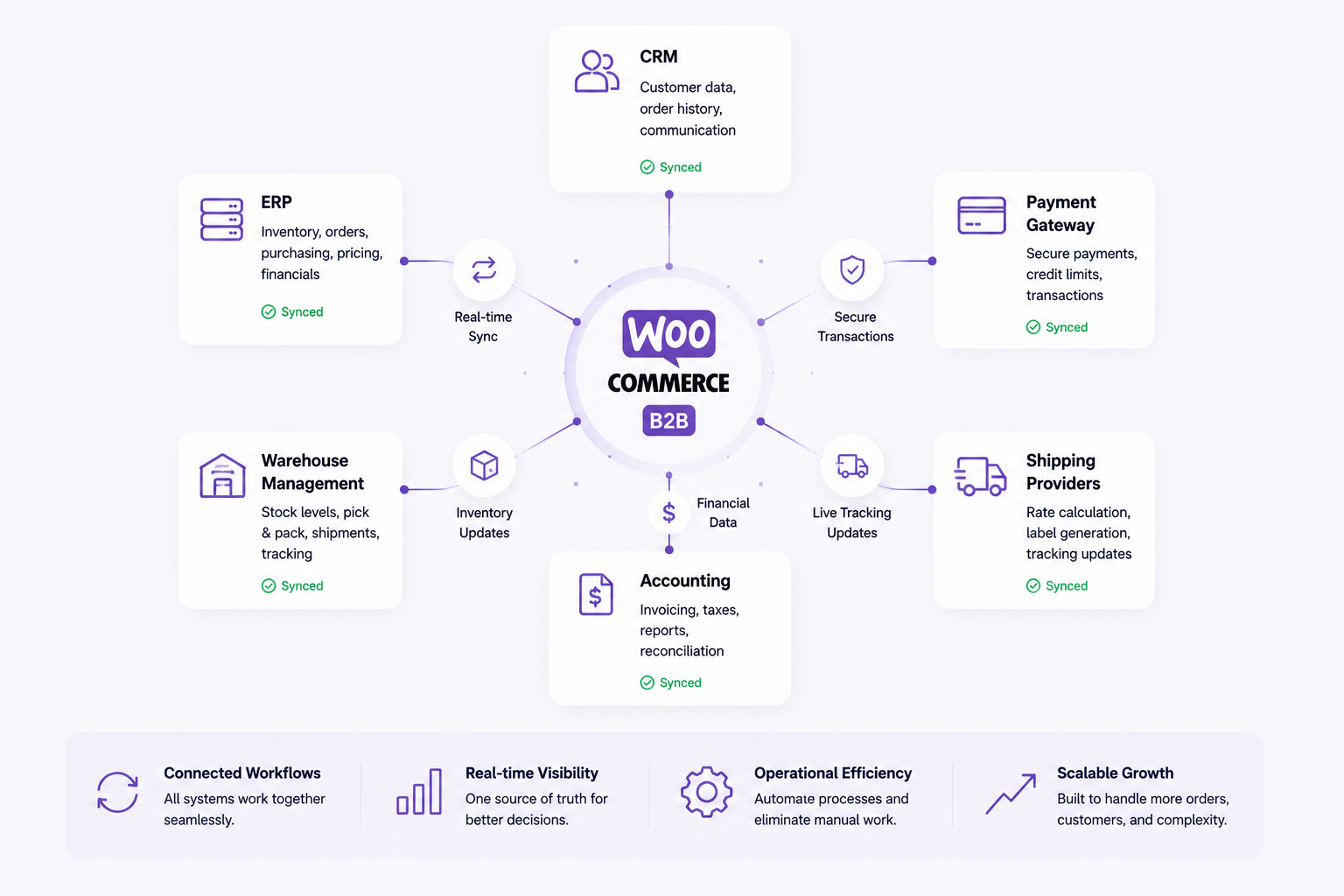
Decisions happen faster. If approval processes take too much time, it is not because you are having the wrong information at the right place but just a policy issue. Fast, organized, and settled without too much going back and forth.
This is what actually happens when WooCommerce business automation works. Not a technology transformation. A business improvement. This type of operational thinking should always be the beginning point of WooCommerce development services. This is understanding how business operates before we decide to do automation.
Building Toward More Efficient Operations
The move from manual processes to fast, scalable operations hardly happens overnight. It occurs in stages often triggered by the pressure of a single process that can no longer be sustained.
Businesses that go through this process successfully are those that treat every development as not the destination but a stage in an eternal journey. They also automate order approval and use the lessons learned to improve their pricing workflows. They optimize their pricing workflows and leverage that to redesign the customer onboarding. The first step is hard; each one gets easier.
The best place to do this starts with an understanding of where manual work is creating the biggest friction and works toward connected consistency and reliable operations incrementally. WooCommerce Process automation would be ideal if approached sequentially;
A not-perfect system is the goal. The point is a business that is able to scale without having to start from zero every time.
The Real Purpose of WooCommerce Process Automation
This version of the conversation gets way too technical: which platforms, what integrations, and which tools. That version misses the point.
WooCommerce process automation is not to replace people.
Reducing the maintenance overhead and freeing teams to do what actually drives growth.
The best operators we talk to get this instinctively. They’re not attempting to automate everything! They are trying to release their team from the dull, repetitive, mistake-prone, and time-consuming work that does not require human judgment so that humans on their team can focus exactly on what matters: building customer connections, solving difficult problems, and improving business.
Process automation, at best, is nearly transparent. Simple orders float through without anyone even considering them. Pricing is always right. Catalog information is always current. It provides new customers a uniform, professional experience from day one.
What is revealed are all the things that were previously obscured: how better work can happen now thanks to your team. How fast can the business get into action? Knowing your operations can accommodate growth without breaking is the confidence you need.
This is what it really looks like behind the scenes of scalable WooCommerce operations. Not a dashboard packed with automation rules. A staff that finally has time and the means to focus on what they are there for.
FAQs
WooCommerce process automation replaces repetitive manual tasks like order approvals, pricing updates, and catalog changes with connected, rule-based workflows. It helps B2B businesses reduce errors, speed up operations, and handle growing order volumes without adding unnecessary manual effort.
When manual tasks start causing delays, errors, or team coordination problems, it is time. Most B2B businesses benefit from WooCommerce process automation once order volumes grow, catalog complexity increases, or customer-specific pricing becomes difficult to manage consistently across the team.
It removes the repetitive work that slows teams down at scale. WooCommerce process automation ensures orders, pricing, and catalog updates follow consistent workflows automatically so the business can handle higher volumes without proportionally increasing headcount or operational complexity.
Start with the processes causing the most friction. Order approvals, customer-specific pricing, and catalog updates are common first priorities. WooCommerce process automation delivers the fastest business impact when applied to high-volume, repetitive tasks that currently depend on manual intervention at every step.
No. WooCommerce process automation removes low-value, repetitive tasks, not people. It frees your team from manual data entry and approval chasing so they can focus on higher-value work like customer relationships, problem-solving, and driving actual business growth.


 WooCommerce Solutions
 Solutions for WordPress