Have you seen this happen more than once?
A wholesale buyer goes to their supplier’s WooCommerce store, logs in, adds what they need to the cart, and clicks submit. The order is ready. The products are in stock. Account Status: Verified
But nothing moves.
The order is waiting in a pending queue; it requires manager confirmation before it can be completed. The buyer knows this. They expected it. They never expected to hear silence for two days.
So they send an email. Then a follow-up. They then ring their account contact. The account contact checks internally and finds out that the approver is on vacation. Find someone to fill in, approve the order for them, and then manually push it through. Once the confirmation sits in the buyer’s email address, trust in that supplier has received a very quiet but noticeable blow.
It is not a story of a system that broke down. Essentially, it is the story of a system not designed to handle the scale and complexity it now faces.
If a WooCommerce store serves only a handful of business accounts, approval workflows can become routine. Everyone roughly knows the rules. Disposals are processed through the telephone. It works, more or less.
But try forty, or a hundred, or two hundred accounts, and that informal structure falls apart. Different accounts have approval hierarchies that differ. Various purchasers have various spending limits. Various product categories to take step-by-step reviews. What was a simple validation turns into miles of rules that no one has ever documented or assigned full ownership of and to which no one is totally confident they are applying them consistently.
The WooCommerce order approval process does not completely stop functioning. It unravels thread by thread, order by order, until the delays and inconsistencies are visible to customers on the receiving end.
At that point, most businesses also regret not having addressed this earlier.
Why Does WooCommerce Order Approval Slow Down B2B Businesses?
WooCommerce order approval becomes difficult the moment a store moves beyond a handful of business accounts. Here is why it slows down:
Multiple buyers across different accounts all need different levels of purchase authority.
Spending limits vary by account, by buyer, and sometimes by product category.
Approvers are not always available, and there is no clear fallback when they are not.
Account permissions drift over time as teams change and rules are inconsistently updated.
Review steps pile up because nobody has mapped which orders need which level of sign-off.
Manual oversight fills the gaps, which means approvals depend on someone remembering to check.
B2B Orders Often Need Approval Before Checkout
B2B purchases usually involve multiple decision-makers.
A buyer may have access to select goods and create an order, but the purchase decision ultimately sits with a manager, a finance person, or a procurement lead. This is not a technical limitation. It more accurately reflects how businesses work in the real world.
Financial controls come with corporate purchasing. For example, a junior buyer at a retail chain might be allowed to order promo materials up to a set amount without review. Anything over that limit is routed to the category manager. Anything above the higher limit is sent directly to the finance director.
There are solid reasons for these rules. They protect budgets. They ensure accountability. They give procurement teams visibility into expenditures.
The issue with WooCommerce stores serving B2B customers is that the default checkout flow was never meant to be structured that way. By default, WooCommerce assumes the person adding items to the cart is the same person who will pay for them. That assumption falls apart pretty much immediately in the world of B2B WooCommerce, where multiple decision-makers are often involved.
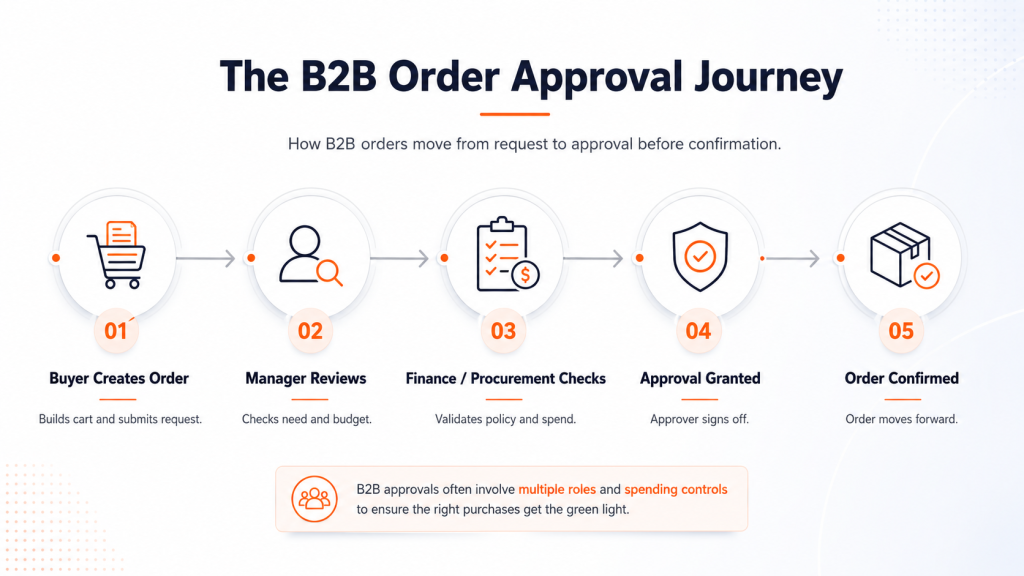
There ought to be a clear WooCommerce authorization process between the order request and the confirmed purchase. The buyer submits the order. The approver reviews it. The order is either approved or returned with feedback. Only then does the business proceed with fulfillment.
Such a B2B order approval workflow requires account-level controls, user role permissions, spending limit rules, and a transparent review process that operates without intervention at each step.
Why Approval Steps Become Harder as Customer Accounts Grow
If your enterprise WooCommerce integrations store has five or ten business customers, you can handle approval rules informally. With a little note in the account settings. A manual check before processing. Possibly a common spreadsheet that details accounts requiring review.
The moment scale comes into play, that strategy goes completely out the window.
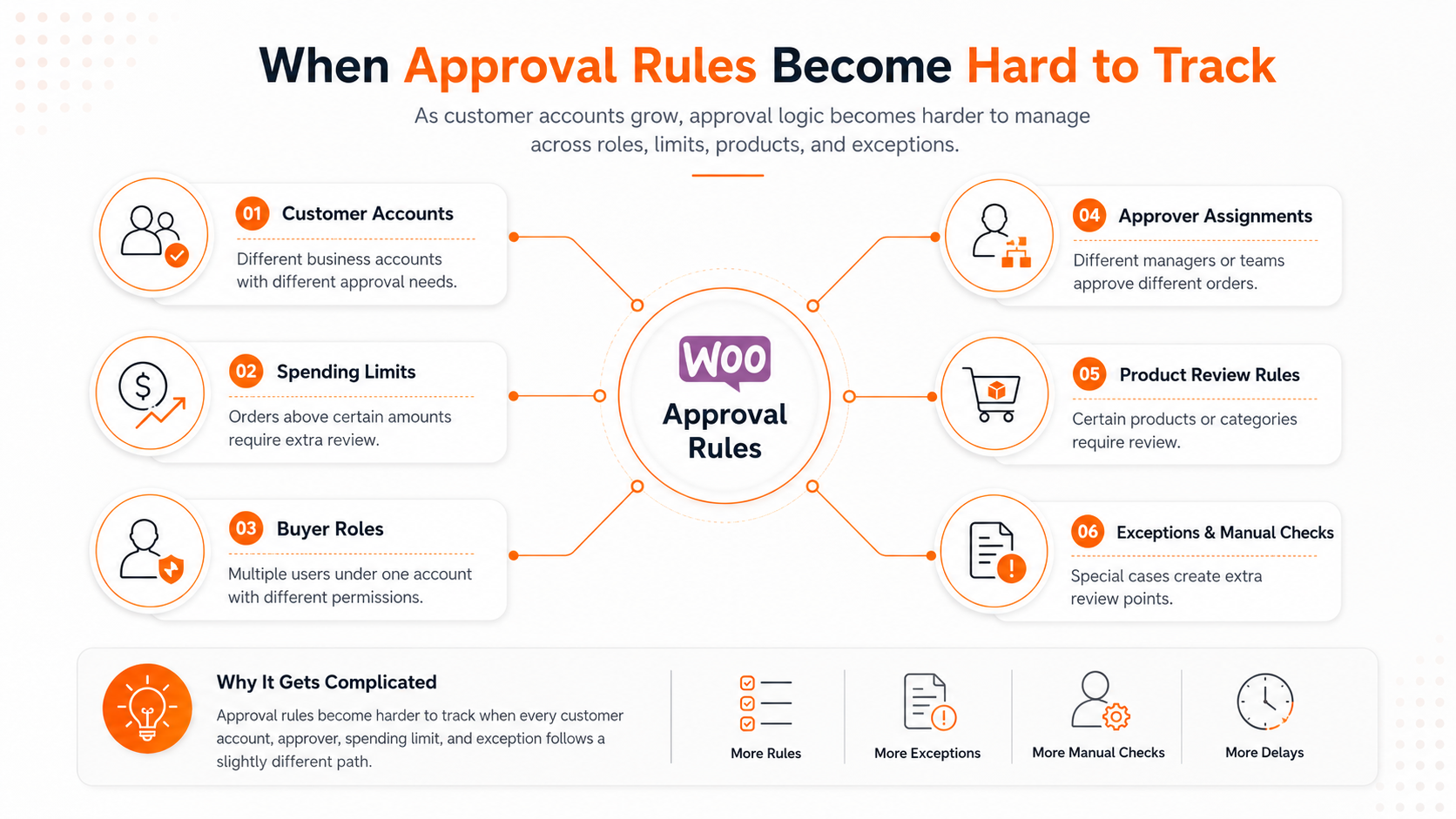
Think about what happens as tens of customer accounts become hundreds. There is a purchasing team specific to each account. Each team has different roles. A national retailer has had a central procurement department that approves all orders. A regional distributor grants approval authority, up to limited conditions, to each location manager. Franchisees need to obtain sign-off at the store level and have the head office approve orders above a certain threshold.
These structures are all different from each other. And this is the sort of totally unassessable, perfectly sentient meat-sorcerer who cannot be managed by some global rule for universal approval.
And it’s not just the account structure; it’s the users in each account. Two or three buyers have very similar buy access to the same account. One more account has a Sr. Buyer who can approve orders and two Jr. Buyers in the team who cannot. Another account made recently has also been elevated from within, and this change in permissions must reflect the same.
You will need a different config for each of these variations. Maintaining those configurations from their first account onwards is an ongoing challenge. When the store had 10 accounts, the WooCommerce approval process worked like a charm; now, with 200 accounts, it is giving inconsistent results, gaps in the process, and taking longer.
This is not a technological failure. It is a scale problem. The fact is, it is one of the most common problems faced by a typical B2B WooCommerce operation as it expands and develops.
The Hidden Work Behind Every Approval Rule
However, the logic behind each rule is much more complex than the description suggests.
Contents should be in order one day. Not every user on a business account should be able to buy stuff. Have partial access for users who can browse and create carts but not submit orders for approval?
Approver: Who should approve a given order? Depending on the account, the same person always approves the same thing. In others, it is based on order size, product category, or even the buyer department. For example, the marketing order would likely be assigned to someone in a marketing manager role. Any order over a certain amount may skip the department head altogether and go to finance directly.
What spending limits apply? This can be per order, per month, or per buyer. Which means they could be applied differently based on product type. For instance, a customer may have an annual limit on how much can be spent by him/her on each order (say, $1,000), but not a modifier for any one of his/her core product categories.
Which products require additional review? Certain B2B customers have their own in-house standards based on product types. If an order total is higher than USD 10,000, the orders may need to go through procurement review for items from a supplier not yet onboarded (new) and for products not on an approved list (heavily used or low-value procurement).
How are exceptions handled? Some orders are so urgent that they cannot afford a standard approval path. Someone has to own that, and there needs to be a process for that.
Account structure changes — how are the rules updated? Businesses promote staff. Approval authorities change. The new financial year has kick-started with revised spending limits. Reminder: any changes to the account structure will iterate the approval rules.
These are all maintenance operations. This is NOT something that occurs only once during installation. This process runs continuously on every customer account, as long as those accounts remain active. Manual maintenance creates gaps in this process. Those gaps create delays. Those delays can affect the buying experience of every customer who interacts with the WooCommerce store. Companies that implement effective WooCommerce order management significantly lower this overhead by establishing uniform, account-level processes from the outset.
Why Manual Approval Management Creates Delays
Many WooCommerce stores that manage B2B purchase approvals do so through a mix of email, internal messaging, and manual checks.
An order comes in. It is observed by a team member. An email is then sent on behalf of the account’s nominated approver. The approver is traveling. Their teammate receives the email but does not know whether they are allowed to approve it. They forward it to a manager. Days later, the manager replies, two days to be precise. In that time, the buyer has sent three follow-ups and is unsure if their order is being processed or stuck in a queue.
This is not an overstatement of the situation. This is how approval workflows typically work for most B2B WooCommerce operations that have quickly outgrown their internal processes.
The problems compound quickly. Approvals have no single owner; requests fall through the cracks when the go-to approver is unavailable. Notifications get lost because they end up in a shared inbox that is least consistently monitored by multiple people. Without a tracked view of all pending approvals, you cannot see at one glance what is waiting, what has been approved, and where the process has stalled.
Every approval in an inbox requires someone to take action, and this human intervention creates a lag in the order. Those delays add up. And they are completely transparent to the customer on the other end of that transaction.
Just as B2B buyers expect the order approval process to minimize friction, this is not a new source of that friction. As businesses have shifted away from inbox-based approvals to structured WooCommerce process automation, they have noted a major reduction in average approval time for even simple routing rules and the removal of human backups on steps that no longer require them.

How Approval Delays Affect The B2B Buying Experience
A buyer who submits an order and then waits without any update is not having a good purchasing experience. That might seem like an obvious statement, but it is worth sitting with.
B2C buyers have targets to meet. Procurement teams have timelines. A delayed order confirmation means slower delivery, but it also means more than that. It could equate to missed deadlines, plans gone wrong, and pressure within the company over who ordered it.
When approval delays become routine, the consequences multiply. Because of the anticipated wait, buyers begin ordering in advance to have a cushion. This leads to excess lead time in the supply chain. Even repeat orders, which ideally should be speedy because the items and volume are already known, take just as long because they go through exactly the same approval process.
We are creating a situation where procurement teams are starting to lose trust in the supplier process. The products might be excellent. The pricing might be competitive. But when ordering an item becomes a guaranteed three-day relay race, buyers weigh their options. Patience may be a virtue, but not in B2B commerce, where switching costs are high.
This situation is where sales teams fall short. If a buyer can’t get clear about the status of their order, they pick up and call their account manager. The account manager chases internally. A conversation that should never have happened takes up time.
These combined consequences are not dramatic on their own. But together, and over time, they have a genuine business cost. Google for Better B2B Purchase Approvals: Not Just an Operational Improvement. These issues undermine your efforts to retain customers. When businesses are testing a proper B2B customer portal approach, they often receive immediate customer feedback on visibility into request-for-approval processes. Buyers want to know where their order is without ever actually having to speak with anyone.
What Better WooCommerce Order Approval Looks Like
Many WooCommerce stores that manage B2B purchase approvals are doing it through a mix of email, internal messaging, and manual checks.
An order comes in. It is observed by a team member. An email is then sent on behalf of the account’s nominated approver. The approver is traveling. Their teammate receives the email but does not know whether they are allowed to approve it. They forward it to a manager. Days later, the manager replies, two days to be precise. In that time, the buyer has sent three follow-ups and is unsure if their order is being processed or stuck in a queue.
This is not an exaggeration of the situation. This is how approval workflows work for most B2B WooCommerce operations that have quickly outgrown their internal processes.
The problems compound quickly. Approvals have no single owner; requests fall through the cracks when the go-to approver is unavailable. Notifications get lost because they end up in a shared inbox that is least consistently monitored by multiple people. Without a tracked view of all pending approvals, you cannot see at a glance what is waiting, what has been approved, and where the process has stalled.
Every approval in an inbox requires someone to take action, and this human intervention creates a lag in the order. Those delays add up. And they are completely transparent to the customer on the other end of that transaction.
Just as B2B buyers expect the order approval process to minimize friction, this is not a new source of that friction. As businesses have shifted away from inbox-based approvals to structured WooCommerce process automation, they have noted a drastic reduction in average approval time for even simple routing rules, thanks to the removal of human delays on steps that no longer require them.

When Growing Businesses Should Improve Approval Workflows
There are usually clear signals that an approval process has outgrown its current structure.
- Customers are regularly asking where their approvals stand.
- Sales teams are spending time chasing order confirmations instead of selling.
- Finance teams are manually reviewing orders that should have been auto-approved.
- Repeat orders from established accounts are going through the same process as new ones.
- Approval rules are being applied differently across accounts by different team members.
- Order delays have become predictable enough that buyers are compensating for them in their planning.
Any one of these is worth taking seriously. When several appear together, the approval workflow is actively costing the business in customer satisfaction, internal time, and revenue that takes longer than it should to confirm.
Conclusion
The approval step is not the issue. B2B WooCommerce pricing structures require oversight. Budgets need controls. There are real reasons procurement processes operate this way.
The issue is that these approvals depend on emails, spreadsheets, memory, and manual follow-up. If approval depends on the right person checking their inbox or someone remembering to change a rule during an account transfer, it will eventually break for the customer.
Establishing an approval workflow in its place does not hamper purchasing. It removes the uncertainty and chasing that typify a poorly managed approval process, speeding up purchasing, reducing rework, and making it more reliable.
Buyers get clarity. Approvers get context. Finance teams get consistency. And the business maintains the necessary control without unnecessarily forcing customers to work around a broken process.
In most cases, the approval workflow is where visibility into operational gaps becomes very apparent for B2B WooCommerce stores going through growth. Fixing it is more than just a backend fix. It is an investment in the purchase experience.
If you are operating a complex B2B accounts store via WooCommerce, and the approval process is becoming difficult to manage, that can be addressed directly. This is precisely the type of internal operation challenge our WooCommerce development services are designed around, helping B2B brands build purchasing workflows that scale without generating any additional friction along the way.
FAQs
WooCommerce order approval is a review step where a B2B order must be checked by a manager, finance team, or procurement lead before it becomes a confirmed purchase. It helps businesses control spending, verify order details, and make sure the right person approves high-value or restricted purchases.
WooCommerce order approval workflows slow down B2B businesses when approvals depend on emails, spreadsheets, manual reminders, or unavailable approvers. As more buyers, spending limits, customer accounts, and review rules are added, orders can sit in pending status longer than expected, delaying confirmation and fulfillment.
A B2B business should improve its WooCommerce approval process when customers regularly ask for order status updates, sales teams chase approvals, finance teams manually review too many orders, or repeat purchases still need unnecessary review. These signs usually mean the approval workflow has become too manual to scale.
WooCommerce order approval improves the B2B buying experience when buyers can clearly see approval status, approvers receive the right context, and approved orders move forward quickly. A structured approval process reduces uncertainty, prevents unnecessary follow-ups, and helps customers complete purchases with more confidence.
The best way to manage B2B order approvals in WooCommerce is to use clear buyer roles, spending limits, account-level rules, automated routing, approval status tracking, and approval history. This creates a consistent process where the right orders go to the right approvers without relying on manual follow-up.


 WooCommerce Solutions
 Solutions for WordPress