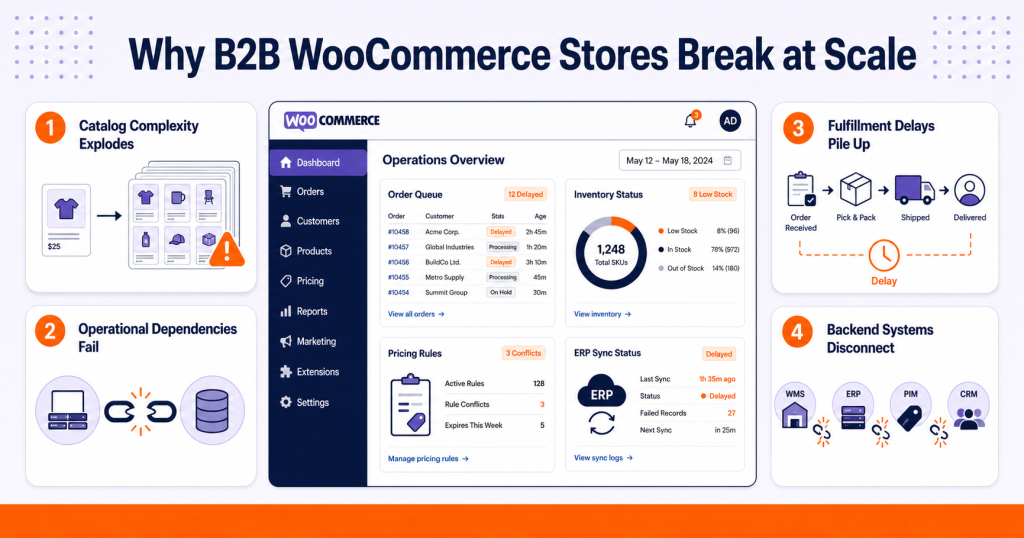
Here is something that surprises B2B businesses off guard: the storefront scales without much resistance. The product catalog grows, new customer accounts get activated, and order volumes climb. WooCommerce handles the front-end load without any complaints. The technology is not what breaks, though.
What breaks is everything behind it.
Order fulfillment coordination that was slick at 30 orders a week becomes a daily operational struggle as the number climbs to 300. The approval processes that lived informally in email threads fail to accommodate the complex procurement workflows of 40 wholesale accounts at once. A single owner of data might present an adequate level of inventory visibility, but when four unique teams are pulling from this same set at different velocities, it simply will not manifest into tangible insight. The operational infrastructure that has grown in parallel to the storefront, typically pieced together and run manually over many years, begins failing quietly but expensively.
The WooCommerce scaling challenge that gets way too little attention. Not platform limitations. Not plugin conflicts. Operational architecture that was never really built for the level of complexity achieved by the business The problem builds quietly, and by the time it manifests in missed SLAs, fulfillment errors, and reporting, no one wholly believes it’s been going for longer than most companies bother to notice.
In this article, we look at where that friction comes from—why WooCommerce order management is such a spiral of complication as B2B operations scale and what the companies who manage to grow without operational cataclysm do differently.
Why Does WooCommerce Order Management Become Difficult at Scale?
Most B2B operations come with layered workflows that the core WooCommerce platform does not manage well, especially as order volume increases. Order volumes continue to increase, but now consumers today require businesses to navigate customer-specific pricing, procurement approvals, coordination of fulfillment, and inventory visibility across broken systems. The complexity builds up faster than teams can digest it without frameworks for operationalizing the same.
B2B WooCommerce Order Workflows Are More Complex Than Most Businesses Expect
- Negotiated pricing specific to that account, separate from the standard catalogue
- Minimum order quantities that must be validated before checkout completion
- A preferred payment method, often tied to credit terms or purchase order issuance
- An established reorder pattern that expects streamlined replenishment, not a rebuilt cart each time
- Internal procurement requirements such as PO number fields, spend authorization thresholds, or manager approval before dispatch
Distributor accounts upload similar tracks. Split-cargo requirements indicate that the same system wants two successful addresses back on track, each of which is tracked and communicated separately. Approval systems indicate that the buyer, approver, and value chain can be 3 unique people on one account.
By early 2025, 70% of B2B sales orders will still be processed manually, which is consistent with Conexiom research. It determines how long the backlog of operational infrastructure tends to lag behind business ambition. When each account has its own terms and conditions and each must honor those terms appropriately, the guidance coordination burden compounds faster than most groups anticipate.
B2B WooCommerce data order workflow complexity is not a big task. That is the standard operating environment for any company that has moved beyond a handful of wholesale accounts into the actual business of the company. Understanding B2B WooCommerce pricing systems is usually the primary operational issue that companies face, but order workflow complexity runs just as deep.
Manual Order Processing Creates Operational Bottlenecks
There is a limit to what router order processing can handle, and B2B companies that are maximizing their scaling often reach that limit before recognizing it as a barrier.
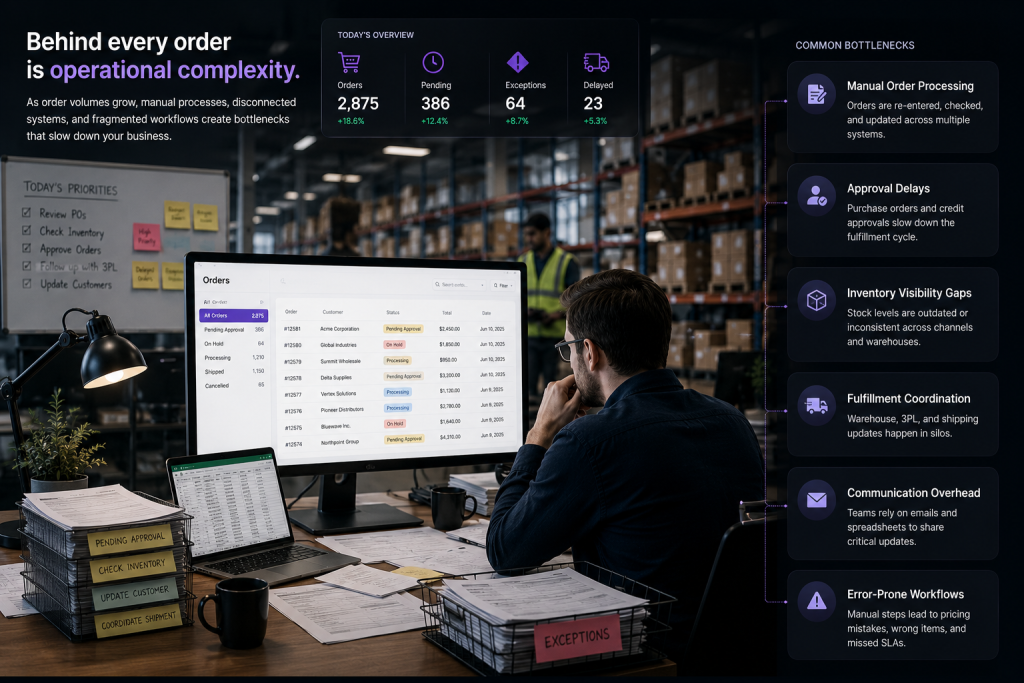
At the B2B level, manual WooCommerce order processing usually involves a complex set of repetitive tasks for each individual order:
- Verifying that the order aligns with the customer’s account-specific pricing agreement
- Checking current inventory availability before confirming
- Triggering internal approval routing where account conditions require it
- Communicating fulfillment instructions to warehouse teams
- Following up with third-party logistics providers on dispatch and tracking
- Updating the customer at each relevant stage of the order journey
- Handling exceptions such as partial stock availability or address discrepancies
Each of those steps requires human choice. Either option introduces delay. When a WooCommerce store grows beyond 50 orders per day, that chain of hand touchpoints stops being feasible and starts to become a structural bottleneck within technology management.
The problem deepens when it comes to customer-precise monitoring requirements. An account that requires an invoice to be approved before it can be sent enforces hard holds on each order cart for its customer. With split shipment requirements, the account approaches every success opportunity and will track, communicate, and confirm one at a time. When these requirements are managed manually simultaneously across dozens of loans, operational costs quickly increase disproportionately to inventory volume.
Research from 2025 found that 33% of errors in B2B online orders and 68% of consumers said they were discouraged from ordering online because of errors they experienced in the past, which were not errors or stage disasters. They are the initial end results of manual synchronization that were not at all intended to prove the extent and complexity of its implementation.
WooCommerce order processing at scale requires the structural functionality of how workflows work, no longer really the extra administrative effort implemented on a machine not built for this weight.
Why WooCommerce Order Management Gets More Difficult as Businesses Scale
Scale does not explicitly indicate multiple orders. There are greater layers of operations, additional customer-specific circumstances, and additional organizational dependencies, all of which interact with each other in ways that compound issues faster than I on my own would approve.
Consider what happens to fulfillment synchronization as the business grows. With low volumes, an unmarried inventory team can change the fortunes of any loan. As volume grows, the same retail company can coordinate fulfillment at multiple warehouse locations, deal with third-party logistics carriers, route orders based entirely on consumer-specific carriers, and handle go-back strategies for accounts with specific claims policies.
Processing bottlenecks drive 32% of transportation delays, making workflow optimization a primary lever for improving customer delight. These bottlenecks typically arise all through inventory confirmation, order batches, supplier delivery stages It can be
Remote workflows create a unique type of operational drag that is difficult to diagnose from the outside. When the WooCommerce storefront, inventory management engine, happiness platform, and customer service team all run with partially synced information, selections are made on old facts and orders are displayed against stock titles already made elsewhere. Fulfillment teams receive instructions that do not reflect overdue title customer changes. Support groups cannot provide accurate status updates because their visibility into system management is incomplete.
WooCommerce scalability requirements are not primarily technical in this case. They are demanding situations of operational control that are seen as technical friction. The platform often fails. The systems around it, built incrementally without a coherent operating framework, are where the problems reside. It’s the same dynamic that affects the WooCommerce product in complexity at scale: the front end of the store holds, while the operating structure behind it starts to evolve to break.
Bulk Ordering and Procurement Workflows Create Additional Complexity
Enterprise procurement and normal e-commerce purchasing do not work on the same logic. This is why an understanding of that difference and how it works becomes indispensable for any business working with big B2B WooCommerce order workflows.
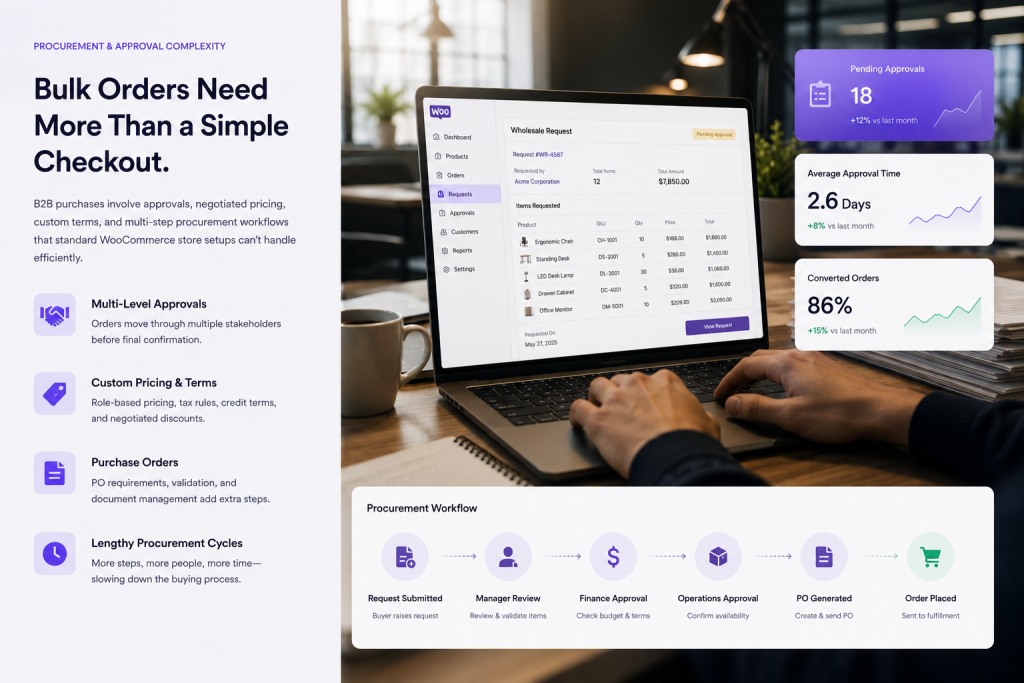
A procurement team is usually bound by a certain purchasing framework when they are putting in a bulk order. There are potentially an approved vendor list, a budget authorization structure, and internal approval steps that need to be executed before any order is validated. The person who buys is different from the one that approves. The approver may be different from the budget holder. Every link in that chain represents a dependency that the WooCommerce order workflow must handle robustly.
When it comes to WooCommerce bulk ordering at this level, you need more than just a big cart and some wholesale discounts. It requires the ability to:
- Capture and validate purchase order reference numbers at checkout
- Route orders through internal approval sequences before releasing to fulfillment
- Hold orders in a pending state until the relevant authorization is received
- Apply account-specific pricing consistently regardless of cart size or order frequency
- Release approved orders to fulfillment automatically without requiring a manual trigger
If capabilities like that aren’t layered in at the operational level, procurement teams abandon self-service completely to revert back to email or phone ordering and will still find ways around such a system, which only leads to problems with data integrity downstream.
The traditional procurement process that requires multiple approvals can take a long time. Automated purchase order approvals help businesses avoid bottlenecks, speed up procurement cycle times, and prevent approval delays to keep inventory and materials on track.
The challenge is compounded by repeat purchases. With standing orders, procurement teams expect replenishment workflows to be stable and predictable. But unless account-specific pricing is consistently reflected at the point of ordering in both e-commerce and direct order processes or unless delivery schedules can be reliably confirmed, then the perception of digital channel value drops off quickly. This is a commercial risk, not purely an operational inconvenience.
Account-based purchasing, negotiated pricing models, and procurement approval workflows are not edge cases in the world of B2B WooCommerce. Well, they are the standard operating environment. Operational maturity is built on creating the right infrastructure to handle WooCommerce orders reliably at scale, rather than just managing growth reactively.
Operational Visibility Becomes Difficult Across Teams
An underestimated consequence of the complexity of WooCommerce operations at scale is how difficult it will be for teams to maintain consistent visibility into what is actually happening within the order pipeline.
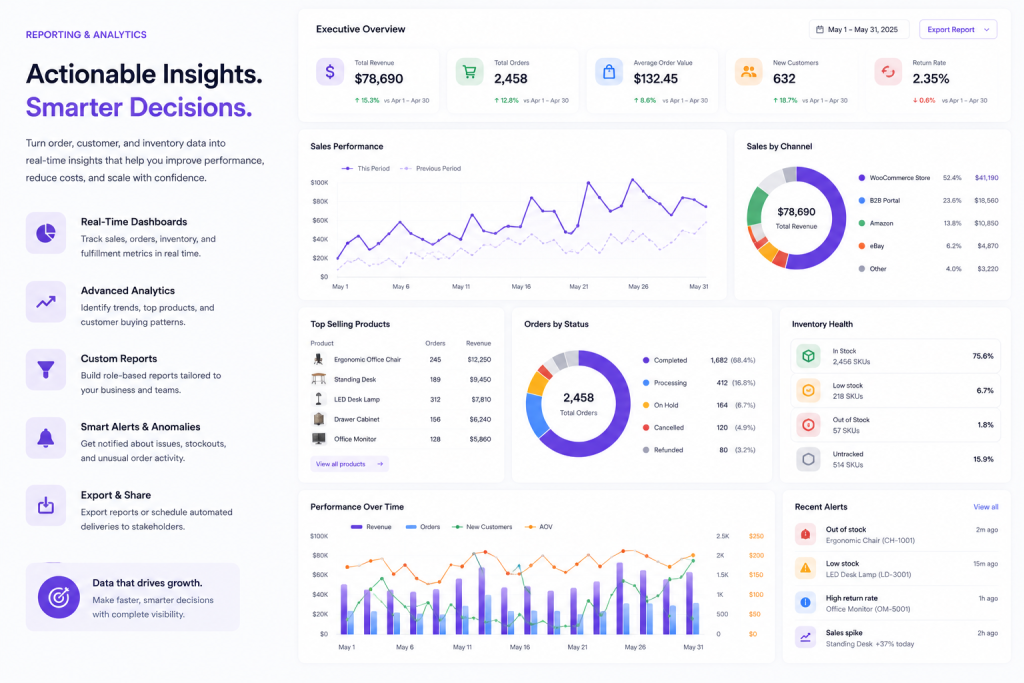
Every team internally in a scaling B2B operation has a specific visibility requirement that the order management infrastructure must serve accurately:
- Fulfillment teams need real-time inventory data that reflects current commitments, not delayed snapshots
- Support teams need complete, current order histories with stage-by-stage status they can communicate confidently
- Finance teams need order data that reconciles cleanly against invoicing records and payment terms
- Operations managers need performance reporting that reflects true workflow throughput, approval cycle times, and fulfillment accuracy
When each of those teams pulls from a specific level of inventory, with the same type of replacement frequency and different levels of reliability, the operational choices made throughout the commercial enterprise become less coordinated step by step.
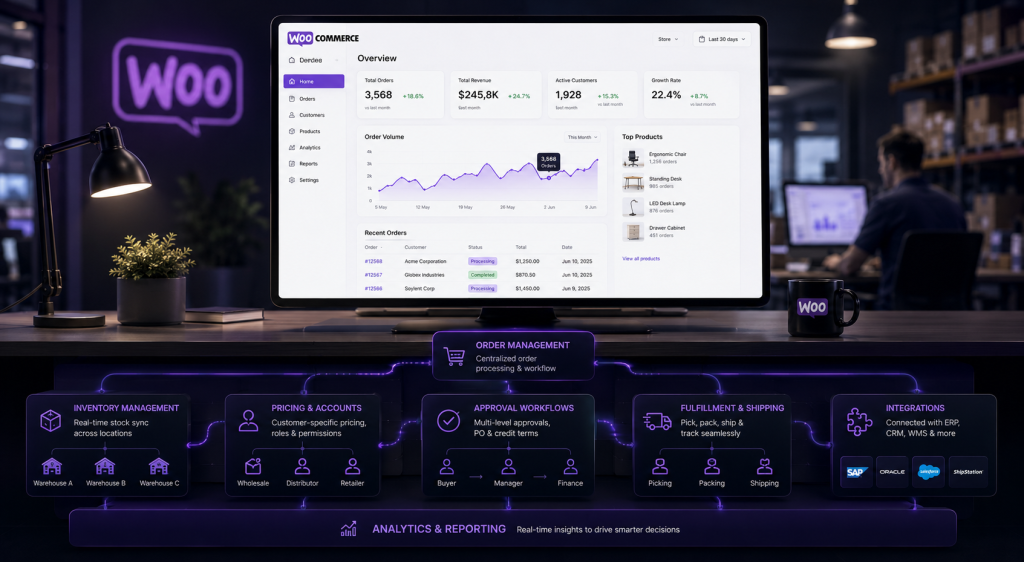
When ERP infrastructure, inventory control systems, eCommerce storefronts, and CRM tools aren’t fully contained, record discrepancies creep in. And with them, mistakes are inevitable. That integration gap is where visibility problems arise. Orders displayed on the storefront cannot be worried about in real-time within an ERP. Stock orders cannot be distributed across the technology systems quickly enough to prevent them from overselling. Customer research also provides access to a support team without having to edit the inventory.
The business impact of poor operational visibility is often not devastating in isolation. It manifests as a steady accumulation of small errors: orders held longer than necessary, technology errors that require high-value instructional fixes, customer queries that can’t be answered as they should, and operational reporting that doesn’t reflect truthfully enough to inform selection.
Enterprise WooCommerce integrations, via nicely designed fact pipelines that connect the storefront to ERP, stock management, and success structures, are a structural answer to this visibility problem, but I found that the integration by itself is not enough. How information flows between systems and the workflows that govern how teams act on that data must be designed from the outset with operational context in mind.

Why Workflow Automation Becomes Critical at Scale
It is not about making the human element in a WooCommerce context obsolete or replacing important cognitive functions. It is about reducing the manual coordination overhead of processes that should, in principle, be primarily auto-managing.
One good example of that is order approval workflows. For an approval that is capable of configuration only once, where it can automatically route to different internal stakeholders based on factors like order value, account type, or product category—there will be no need for hitting the trigger button manually in each & every case. Setting inventory allocation rules that run automatically at the time of order confirmation minimizes coordination costs between sales and fulfillment teams. Automate status updates at different points in the fulfillment pipeline; these reduce the need to ask for a support ticket while retaining customer communication quality.
If you deal with orders via paper or email, expect to spend approximately $7 per transaction; if internal teams are ineffective, this can be up three times as much. Those operating on digital workflows, however, pay around $2 to $6 per order. At the low end, automation recovers $5 to $15 per order. When operational efficiency becomes a significant differentiator at high order volumes.
WooCommerce order automation also solves a consistency issue that purely manual operations unavoidably generate. But consistency breaks down as complexity and volume rise when processes rely on individual team members choosing the right decisions at just the right time. Automating workflows that will abide by long-defined rules irrespective of their high volume. During peak periods, they do not slow down. Regardless of which team member is managing the queue, they yield similar results.
If done well, operational workflow automation also generates the type of audit trail demanded by governance-conscious enterprises. All approvals and all status changes and fulfillments can be logged systematically, providing you with the operational reporting infrastructure that no combination of disconnected manual processes could ever provide reliably.
The Businesses That Scale WooCommerce Successfully Usually Standardize Operations Early
Across successful businesses scaling WooCommerce, there is a consistent thrift: they standardize operations long before it feels necessary, and that investment compounds as volume grows.
B2B WooCommerce operational standardization in a given context goes like this: “Define and encode before scaling” requires the following:.
- How orders are received, validated, and routed based on account type and conditions
- What the approval workflow looks like for different order values, customer segments, and product categories
- How fulfillment instructions are communicated to warehouse teams and third-party logistics providers
- Where exception handling responsibility sits and how exceptions are escalated
- What operational performance metrics are tracked and how they are reported across teams
Most businesses approach this proactively. An operational infrastructure that prevents problems from occurring before they develop: a new level of approval to add after compliance issues; another integration with inventory triggers for fulfillment errors; yet another reporting layer built as quarterly reviews reveal gaps. This leads to a classic operational stack built by putting together fragments of incident responses, generally functional but rarely operating as an effective system.
Scalable WooCommerce operations look different. The coherent operational blueprint is designed to integrate the order workflow, approval structure, fulfillment coordination layer, and reporting infrastructure seamlessly. This means that when new accounts come onboard, they go into a system that’s already capable of dealing with everything you throw at it. The infrastructure scales because it was built to scale, not because the team has been able to push through increased manual load when order volumes increase.
This operational maturity difference is what separates companies that grow painlessly from those that do so painfully. Well executed WooCommerce migration workflows make exactly this case: the foundations of a new system are designed in advance, not changed once the volume arrives and problems rear their heads.
When WooCommerce Order Operations Start Becoming Difficult to Control
Another interesting thing is operational reporting starts getting confusing—different teams start referencing different numbers for the same metrics since they are pulling data from different sources and updating on different schedules.
Approval queues, which were fine at low volumes, become backlogs that add systematic delay to the fulfillment pipeline without introducing any change in decision processes.
Order volume tends to grow quicker than administrative overhead, as account onboarding and exception handling or customer status communication take up the resources that should be applied to growth.
So, customer communication about the order status becomes inconsistent across teams—not due to a lack of intent but rather because there is no single team that has access to an up-to-date and holistic view on where orders stand.
These are not signs that WooCommerce is the wrong fit for your site. They can be your alarm bells to a WooCommerce operational complexity problem, the type where it is too big for its pants. Resolving this does not call for more headcount wasted on processes that were already under strain; it calls for structural change.
Conclusion
WooCommerce order management demand requirements are, at their core, demanding scenarios of operational measurement. The platform itself usually does not fail under growth pressure. What is failing, gradually and predictably, is the operational infrastructure built around it: the workflows, approval structures, performance coordination layers, and visibility frameworks that high-broad B2B operations depend on for reliability.
Challenges do not arise. It increases incrementally with each new account, each new success dependency, and each new layer of procurement requirements that the current infrastructure is not designed to adapt to until the problem is truly visible in missed delivery windows, fragmented reporting, and growing administrative responsibilities.
Companies that manage to transition are not working harder in a system built for smaller scale but rather finding ways to automate their activities. They re-architect the operational infrastructure: normalizing processes, automating approval stages of fulfillment coordination systems with new visibility infrastructures that enable what is required for data-informed decision-making.
Challenges in the order management layer of WooCommerce scalability? Deal with it. However, they need systems thinking from an operations perspective that is much deeper than just a storefront configuration, and this is the work that actually scales B2B commerce.
At DazzleBirds, our work with the company’s WooCommerce business focuses on this exact step: building the operational infrastructure that allows complex B2B companies to scale order workflows, success coordination, and purchasing strategies without operational complexity becoming a growth blockage. If your WooCommerce business is approaching that threshold, it is really worth checking the underlying structure of the store before it becomes a story of difficulty.
FAQs
WooCommerce order management becomes difficult in B2B because each wholesale account carries unique pricing, approval requirements, and procurement workflows that the platform does not handle natively without structured operational infrastructure.
WooCommerce order processing typically becomes a scaling problem when manual coordination across fulfillment, approvals, and inventory can no longer keep pace with rising order volumes and account-specific operational demands.
Fulfillment workflows break down because WooCommerce order management relies on disconnected systems that do not synchronize inventory, approvals, and logistics data in real time across teams handling growing order volumes.
Workflow automation removes manual coordination from repetitive steps inside WooCommerce order management, reducing errors, accelerating approvals, and ensuring fulfillment instructions reach warehouse teams consistently regardless of order volume or team capacity.
Key warning signs include rising fulfillment delays, fragmented reporting across teams, approval backlogs, and growing administrative overhead that indicates WooCommerce order management has outgrown its current operational infrastructure.


 WooCommerce Solutions
 WordPress Solutions