Introduction
Discovering a product in B2B eCommerce is not pleasant. It is the operational backbone of the way buyers actually paint. A purchasing manager does not browse while looking for a specific commercial goal. They input an SKU, an element variation, or a technical specification and expect immediate, accurate results. When that search fails or an ineligible product is returned, the entire buying workflow stops.
This scenario is where massive WooCommerce catalogs start to reveal their structural limitations. The user-facing WooCommerce layout is basically designed around a specific browsing behavior. B2B users, especially in the wholesale, distribution, and manufacturing sectors, come in because it’s unique, often complex, and time-sensitive. Their catalogs have hundreds of SKUs, layered attribute schemes, account-specific visibility rules, and product relationships, which the famous WooCommerce tries to convert without architecting any way to address them at scale.
Problems are rarely an isolated step. This is a combination of catalog length, record architectural choices, and a lack of search infrastructure built for purchase-grade usability.
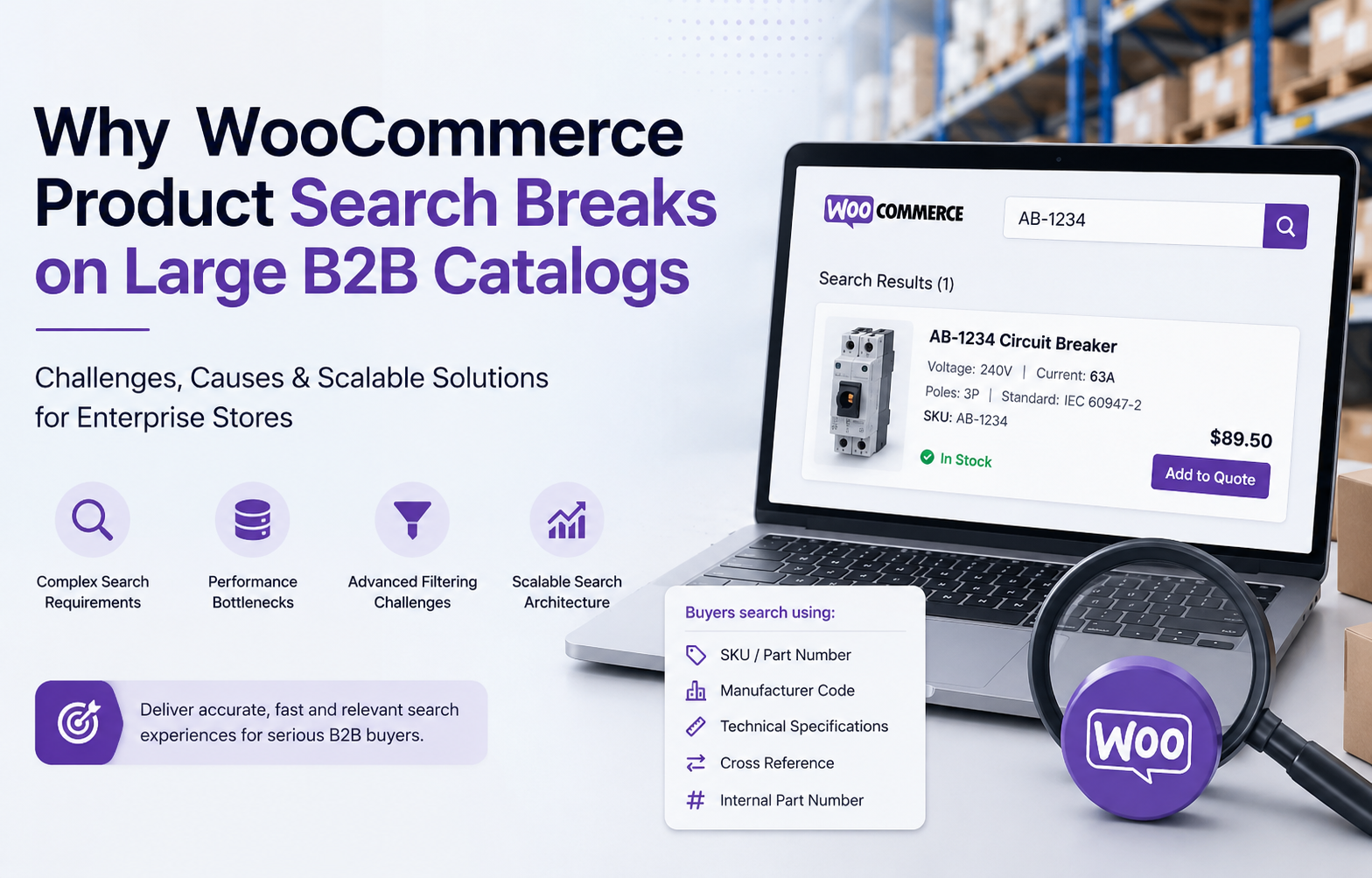
Why Does WooCommerce Product Search Break on Large B2B Catalogs?
WooCommerce product search relies on native WordPress database queries that degrade significantly as catalog size and feature complexity evolve. For large B2B warehouses, this messes up sequential response events, poor relevance, missing SKU impacts, and accidents that complicate procurement workflows and development support burdens across business units.
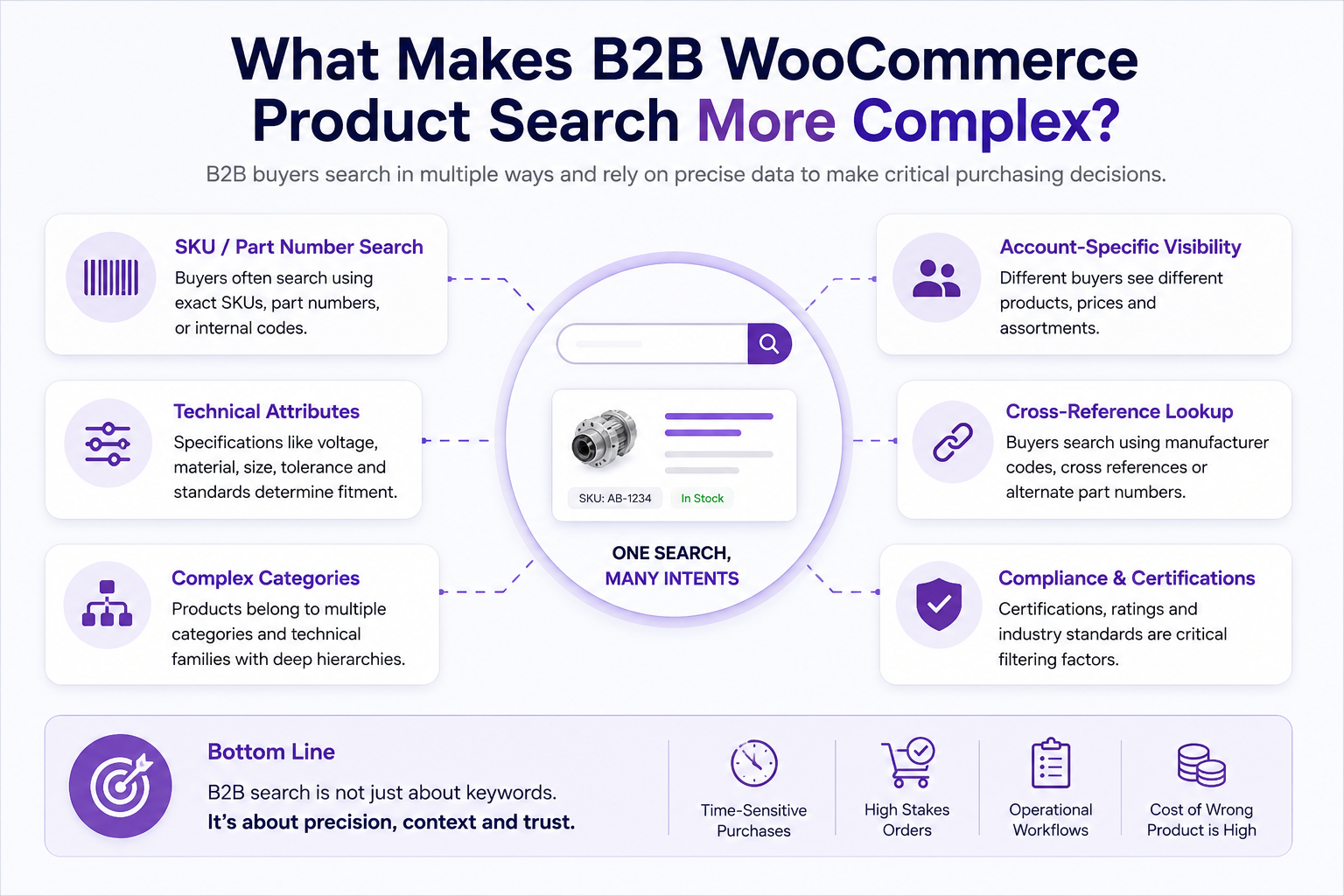
What Makes B2B WooCommerce Product Search More Complex?
B2B product search is categorically different from consumer in ways that go way beyond the catalog size. While B2C buyers usually search for product names or categories, the same is not true with B2B buyers, who interact through multiple distinct searching styles at once.
Say you are an electrical components distributor who needs to source electronic parts; you might search for a manufacturer part number, cross-reference code, technical specifications, or even something like an internal SKU. These are not all different ways of searching for the same thing. These are fundamentally different kinds of lookups, and each requires independent thought in the search framework.
Several factors compound this complexity:
Technical product catalogs not only have product description data but also attributes that determine whether they are procured. These are not marketing details; they are voltage ratings, load tolerances, material grades, and dimensional tolerances as well as compliance certifications. These are the metrics, which buyers use to qualify a product as suitable for their application in the first place.
Account-specific visibility means the same search query from two different buyers should, in many catalog configurations, come up with very different results. Search layers extending well beyond your typical WooCommerce install, such as contract pricing or restricted product lines and account-tier assortments.
SKU-based procurement enterprise buyers typically have internal part catalogs and enter specific SKU references. Partial SKU matching, cross-reference lookups, and manufacturer code resolution are functional requirements rather than a nice-to-have.
The complexity of categories in distributor and wholesale catalogs regularly spans across 100s of categories with overlapping classification logic. A product can belong to more than one technical family, leading to hierarchical structures affecting the filtering performance and search relevance.
These are the operational realities that separate the best WooCommerce product search needs from the search options that ship with standard WooCommerce setups.
Why WooCommerce Search Performance Slows Down on Large Catalogs
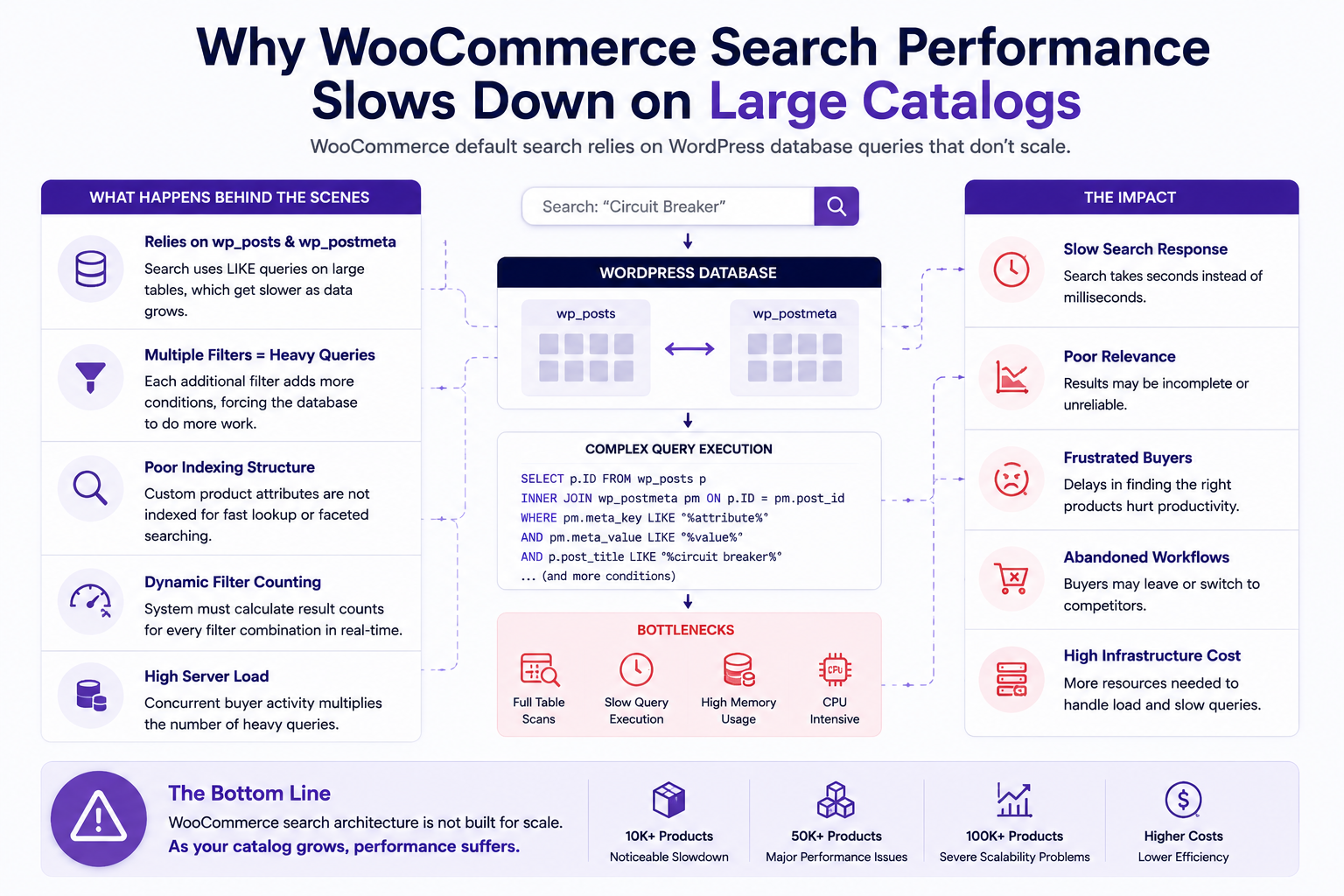
Enterprise WooCommerce stores do not suffer performance degradation at random. It is a property of the architecture and makes it worse as catalog size grows.
Standard WooCommerce search runs on the wp_posts and wp_postmeta tables with LIKE queries. This query pattern is not scalable; query execution times increase significantly for product counts greater than several thousand SKUs, especially if the query contains attribute filtering.
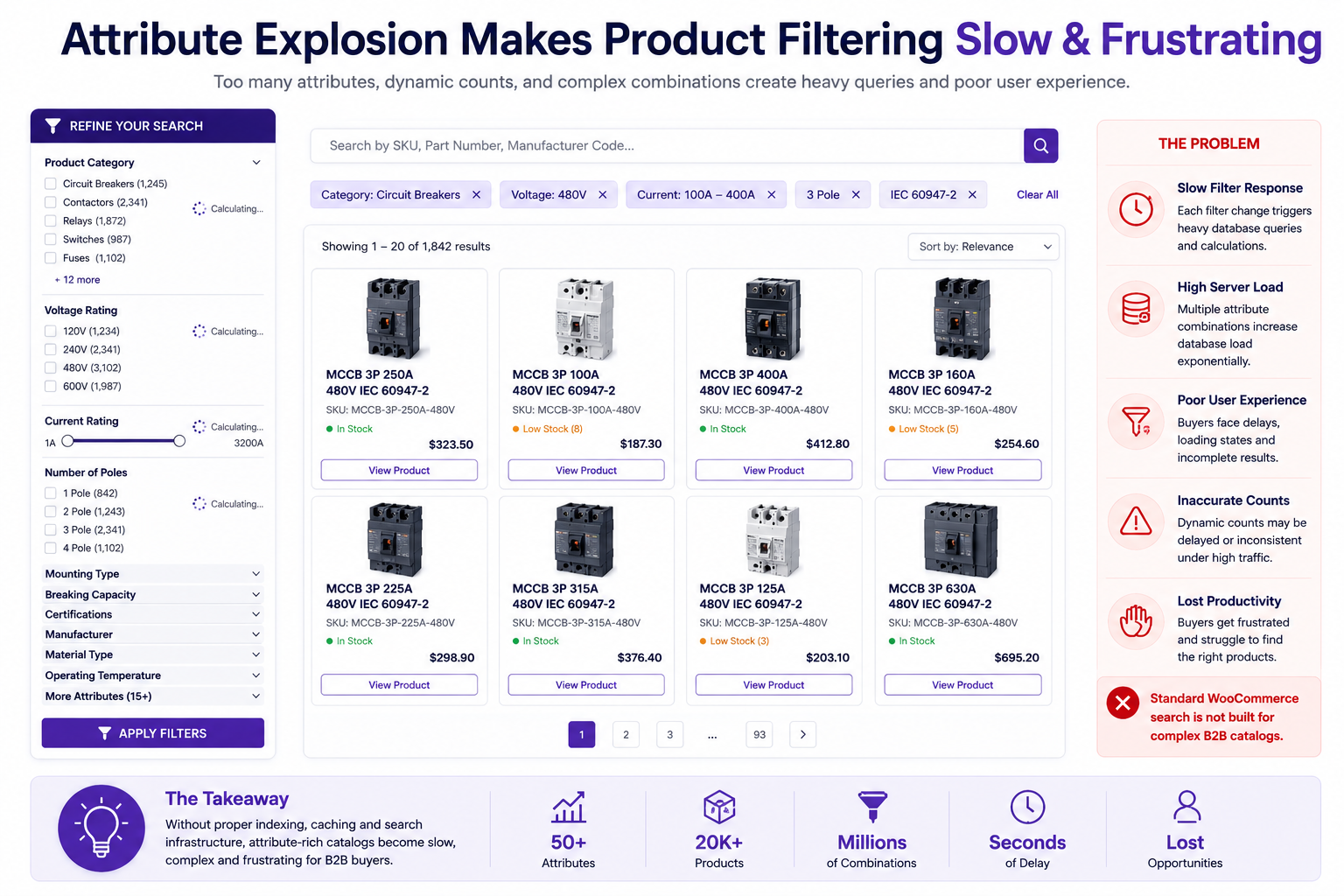
Faceted search amplifies this problem. If we consider a buyer who filters by multiple attributes (say, product category + material type + certification standard and stock status), the database needs to treat each filter as an independent condition and perform an intersection of results. This is manageable in light traffic. These queries create a measurable load on databases and visible latency as concurrent loads are typical for B2B environments with purchasing teams purchasing through procurement systems hitting the catalog at the same time.
Indexing is the core limitation. WordPress’s default search indexing is not optimized for finding products with multiple attributes. Indexing custom product attributes for fast faceted filtering functionality is not built-in. You perform all filters interactively instead of querying a cached/indexed policy.
Dynamic filtering creates further overhead. You have to throw your product counts next to filter options as you desire. Your points need the system. It has got this bad boy down so that it can check how many results exist for any visible combination of filters instantly when requested, which Adores makes a huge ask. This is a challenging server-scale task that increases exponentially for each filter dimension on a catalog of fifty attributes and twenty thousand products.
The result is a WooCommerce search performance profile that only looks good against the demo catalog of hundreds or thousands of products but falls down at an operational level on truly enterprise catalogs, where buyers expect sub-second responses and tight filtering capabilities.
What Product Filtering Challenges Do Large B2B Stores Face?
Beyond overall performance, WooCommerce organization-level product filtering introduces hard and fast structural demand situations, which are basically around information management and inventory structure.
The most common problem is attribute explosion. When the range of products increases, so do the sets of attributes. Every new product line or supplier onboarding usually comes with a set of new attributes being introduced instead of mapping to existing ones. Over time catalogs end up with dozens of attribute taxonomies, inconsistent naming conventions, and duplicate fields between different classes (e.g., if a buyer uses the product filter of “material,” they may see five separate interpretations across disparate products).
This is further weakened by inconsistent classification. When catalog data originates from a pair of vendors, ERPs, or guided access processes, the goodwill of the category is often not uniform. Products that together belong to operating statements are separated by means of inconsistent category assignments. Products that are unique are grouped under common features because the classification is not done with filtering in mind at all.
We can look at category sprawl the same way. A common example of this is wholesale and distributor catalogs, which tend to grow their category trees as needed only when new product lines come along, without pruning or hand-crafting the broader hierarchy. The result is a category structure based on the internal logic of suppliers, rather than buyer search behavior.
Handling filter maintenance grows increasingly complex, resulting in operational overhead. Each change to the filtering system is an exhaustive exercise in auditing data across tens of thousands of products when attributes are structured inconsistently. Just a seemingly easy change in the way dimensions are identified can highlight mismatches against everything from hundreds of SKU records.
Downstream, this translates to poor search relevance. If a buyer searches for the term “316 stainless tube 50 mm,” that should set up an exact ranked result set. If the attribute data is inconsistent or if the category structure is fragmented, then too many results are returned, wrong results are returned, and even no result is returned. From here, B2B product filtering is no longer a feature; it becomes an operational liability.
Why Standard WooCommerce Search Often Fails for Procurement Workflows
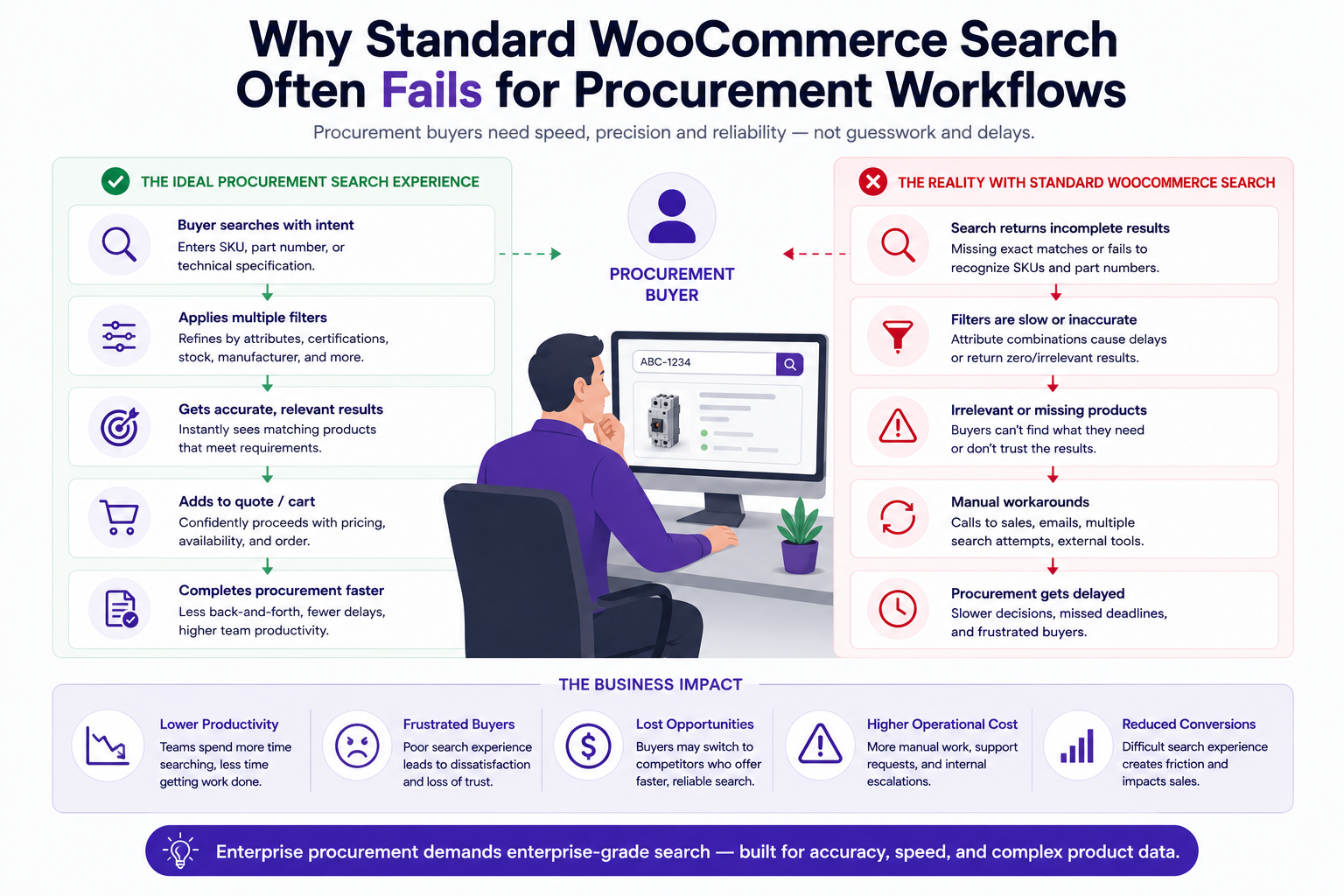
The buying behavior of procurement is essentially one that focuses on speed, accuracy, and repeatability. None of these three requirements are handled by the standard WooCommerce search.
The clearest example is exact SKU matching. If a buyer types in the right part number, they want an exact answer. By default, WooCommerce’s native search does a wide text match against product titles and descriptions. It also doesn’t give preference to SKU field matches, so an exact match on an SKU can return non-relevant products ranked above the correct product or, at worst, no results at all, as the SKU lives in a custom field and was not grabbed by default search.
This makes matters worse, as there is partial SKU matching. When it comes to technical product catalogs, variant SKUs typically have a prefix or stem in common. For example, when a buyer enters the first six characters of a part number, he will expect to receive an advert that spans the full range of variants available. It needs a more structured search logic requiring an understanding of product relations, not random text entry.
Standard search also breaks down in other subject areas such as bulk product discovery. I mean a procurement manager constructing an order does not go looking for one product per search. They have a list of requirements to work through and need to get from one lookup, on the value proposition, to another quickly. If each search necessitates many refinements, resets of filters, or manual scrolling to find the right result, then an aspect of friction is being added to a directory RSS work stream that should be as smooth and streamlined as possible.
Repeat ordering is similarly affected. B2B buyers come back to the same products. WooCommerce’s standard search does not maintain the context of searches, is unable to quickly look up reorders, and fails to address account-level purchasing patterns where such procurement again would be faster. These are not luxury features. They are table stakes for wholesale and distribution environments.
The cumulative effect is a catalog that educated consumers learn to work around rather than through, which means they spend time looking for friction to engage with instead of completing the purchase responsibility.
How Poor Product Search Impacts B2B Operations
The effects of insufficient WooCommerce catalog search are much broader, however, than just the customer experience. This introduces quantifiable redundancies and inefficiencies throughout an organization.
Most of all, support burden. Buyers call or email when they do not get the products via search. A staff member must find the product, check for specifications, and then communicate these each time one of those interactions happens. For a business processing hundreds of orders a week, that is a significant time cost, which increases with catalog complexity.
Sales friction is an intangible but just as damaging. A procurement manager does not necessarily call for help when unable to find a product quickly. Talking to a rival supplier may be checked by them. Search performance issues on an enterprise catalog are not just a UX problem. It is a conversion risk.
The number of abandoned searches is an indicator for how healthy a catalog will be. Whenever buyers fail to complete product lookups, order frequency declines and average order value reduces. When it is catalog usability that caused these metrics, they are often attributed to other factors like pricing or competition.
Distributor frustration has channel implications. If they do a lot of wholesale or reseller business, then making it difficult for their channel partners to competently navigate the catalog ruins that relationship and sends those customers off looking elsewhere since those partners really cannot be your advocates.
If the procurement workflow is slower, it makes this ordering platform also less attractive than others. Over the long run, buyers who can find one stage to finish an order in three minutes and another where it would take them twelve will converge toward that quicker choice.
How Large B2B Stores Improve WooCommerce Product Discovery
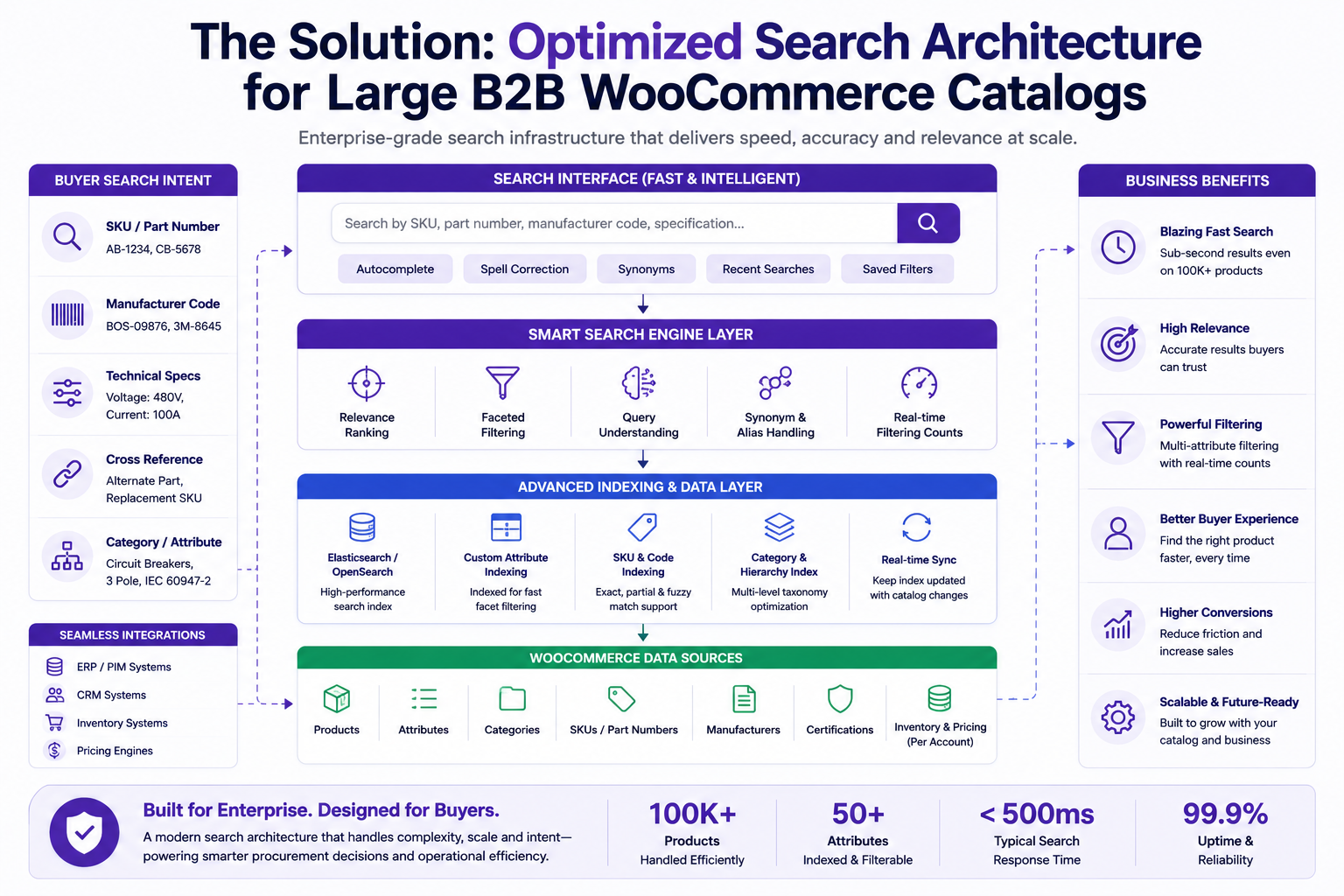
Addressing WooCommerce search’s overall performance on huge B2B listings requires a structural approach instead of a tactical one. The goals are architectural, and the answers will fit that scope.
A structured classification configuration is the basis. Before any search optimization can be meaningful, the underlying category and feature structure must reflect exactly how buyers search. This method audits existing catalog structures, rationalizes redundant attributes, standardizes naming conventions, and creates category hierarchies that map to buying common sense instead of internal supplier organization.
The search indexing infrastructure is the next layer. Business WooCommerce listings benefit greatly from decoupling the search from the native WordPress database query stage. Purpose-built for searching an index, Answers maintains a unique, customized index of product facts that supports fast full-text content search, feature matching, and relevance assessment by clicking on the main database on each query.
A layered search architecture will be designed with performance in mind from the start. Precomputed page computations, stored filter states, and feature indexing techniques can reduce the database load of complex filtering interactions from real-time computations to near-direct index lookups.
Inventory management is a commonly missing operational step. Without ongoing management processes, even well-established warehouses sink close to inconsistencies when new products, suppliers, and categories are added. Establishing clean statistical standards for product attributes, SKU formatting, and category assignments prevents structural problems that overwhelm the form niche.
These capabilities require a level of query structures that goes past plugin configuration. They represent architectural choices about how product data is accessed, stored, and queried at scale. Businesses navigating this space benefit from the same strategic angle that applies to the WooCommerce pricing structure and ERP integration complexity, where bottom-grade configuration is simple yet has operational implications for every decision compounded over the years.
When Standard WooCommerce Search Stops Being Enough
These are familiar signs that a WooCommerce catalog has started to outstrip the built-in search system. Identifying these signals early is valuable, as the heavy operational cost of hand-wavy search builds up quietly until it reaches a critical level.
The most quantifiable performance indicator is search response time. Buyers are increasingly noticing delays when filtering interactions that take longer than one or two seconds to return results. As concurrent usage pushes that response time higher, session data and support volume reveal the problem.
Early signals include filter inconsistency. If buyers complain that filtering on a certain attribute yields incomplete results or if well-known products do not show up in the expected category, the data architecture is already causing operational issues.
There is a cycle on how procurement complaints trend. Search failures have consequences on a buyer’s operational timelines when you literally can’t find products by SKU, return empty search results for known part numbers, or require the uninitiated to scroll through multiple pages of totally irrelevant “results.”
Search measurable rates, and heavy support requests about where to find the product are lagging indicators. These metrics only become meaningful after the catalog has already been causing friction for a while.
The growth of the catalog itself is also a trigger. For example, a WooCommerce installation that is managing five hundred products has different requirements than one that’s running twenty thousand. It is not a linear transition between those scales, and corpus growth rarely waits for teams to accommodate the performance or relevance impacts.
This maturity is a function of early recognition of these signals. The companies that do catalog at scale are those who view search architecture as a core infrastructure decision rather than an afterthought tackled only once pain becomes acute.
WooCommerce Product Search at Scale Is an Operational Infrastructure Problem
The core takeaway across all of these challenges is that large B2B catalog WooCommerce product search problems are not in the search box itself. These all relate to data architecture, query infrastructure, and catalog governance but also the bridge between how products are structured versus how buyers actually search for them.
You can invest in search performance, but if your taxonomy is inconsistent, you only get so far. If we improve the filter UX and not address attribute data quality, it is cosmetic. If you build a technically sound search index on top of an unstructured catalog, that gets you partial improvements at best.
The companies that attack this problem at scale take a systems perspective. They view operational decisions—including catalog architecture, search infrastructure, and data governance—as related to each other instead of as separate technical tasks. They know that procurement efficiency, how usable the catalog is for a given distributor, and order frequency are downstream effects of how well your catalog supports the lookup behaviors their particular buyer set requires.
For a B2B WooCommerce operation where inventory complexity causes measurable operational friction, it’s often not a matter of whether or not to face a catch structure. The question is the chain method of working with broad platform infrastructure choices to determine how the business scales. DazzleBirds works with enterprise WooCommerce businesses to navigate exactly this kind of art complexity, where tasks don’t care about disruption but build the right architecture to clean up permanently.
FAQs
WooCommerce product search is the built-in functionality that allows buyers to find products within a WooCommerce store by entering keywords, product names, or SKUs. It operates through native WordPress database queries against product titles and descriptions. On small catalogs it functions adequately, but it lacks the indexing, relevance logic, and attribute-matching capability required for large B2B or enterprise catalogs.
WooCommerce search slows down on large catalogs because it runs LIKE queries against the wp_posts and wp_postmeta tables without a dedicated search index. As the SKU count grows, these queries take longer to execute. Faceted filtering compounds the problem by generating multiple simultaneous database conditions resolved in real time, creating significant load under concurrent usage typical in B2B procurement environments.
Businesses should upgrade their WooCommerce search architecture when filter response times exceed one to two seconds, exact SKU searches return missing or irrelevant results, support requests about product location are increasing, or procurement teams report consistent difficulty locating products. Catalog growth past several thousand SKUs is itself a reliable trigger, as performance and relevance issues typically surface before operations teams have planned for them.
Filters become difficult to manage in large WooCommerce stores because attribute structures accumulate inconsistently over time. Each new supplier onboarding or product line addition often introduces new attributes rather than mapping to existing ones. The result is redundant fields, conflicting definitions, and overlapping category logic that requires auditing thousands of product records whenever the filtering system needs to be adjusted.
WooCommerce can support enterprise product catalogs, but not with its default search and filtering configuration. Stores managing tens of thousands of SKUs require a dedicated search index, structured attribute taxonomy, faceted search architecture, and ongoing catalog governance. Without these layers, search performance degrades, filter reliability drops, and procurement workflows slow down as catalog complexity increases.


 WooCommerce Solutions
 Solutions for WordPress