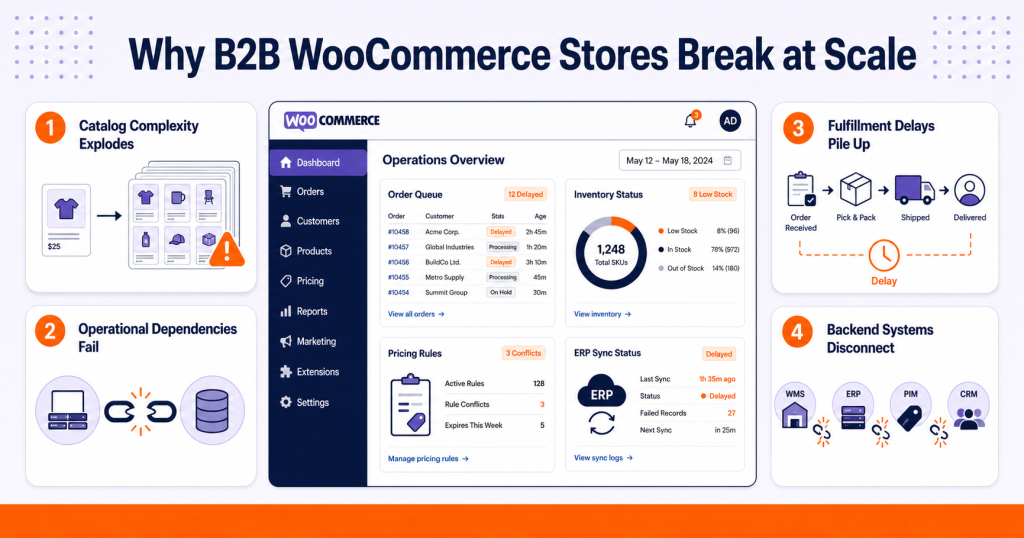
Here is something I’ve witnessed happen more times than I can count. An e-commerce site starts a WooCommerce store with maybe 300 products. Clean categories. Consistent naming. Everything makes sense. Fast forward two years, and that same store has 4,000 SKUs, six product lines representing three regional variations per product, and a category structure nobody can remember. Not even the people who created it!
That’s not a failure. That’s just growth. In fact, I don’t know if it’s possible to avoid in B2B commerce.
We didn’t make the catalogue bigger. It is that the systems and habits optimized for 300 products are never going to be designed for when you have 4,000. What began as a simple product library slowly turns into one of the most operationally dirty areas in the whole company. Data by itself is not trustworthy for pricing teams. Sales teams find duplicate listings. Navigation gets customers to a dead end. and the catalog team spends more time fixing than managing it.
It sounds like a bold technical problem, I mean, WooCommerce catalog management. From my experience, it is primarily an operational one.
Why Does WooCommerce Catalog Management Become Difficult at Scale?
WooCommerce catalog management is difficult because the dataset, category structure, and attribute framework were never intended for the high SKU volumes that are common in large catalogs. Here is the problem: As B2B catalogs grow, poor product data quality leads to uncontrolled category expansion and ungoverned attributes, giving rise to operational problems where undoing the damage requires deliberate catalog governance.
Catalog Growth Creates Complexity Faster Than Most Businesses Expect
B2B businesses do not expect catalog complexity! They plan for catalog growth. And those are two very different things.
Adding SKUs feels like progress. With new product lines come additional revenue opportunities. Regional variations serve more customers. Distributor-specific catalogs make partnerships easier. That all makes sense at the individual decision point level. However, every one of those decisions takes the underlying catalog schema and makes it more complex, and that complexity builds rapidly.
Here’s where the complexity typically comes from in growing B2B catalogs:
Addition of new product lines without evaluating the existing category form
Regional product variants were created as separate SKUs instead of through product attributes, increasing the catalog size without evoking actual org structure.
Distributor-specific catalogs with no well-defined governance layer separating them from the main catalog build on top.
Specific pricing and visibility rules for the customer domain applied to these products that were never architected to leverage such segmentation.
Expansion of the product lifecycle, where some new versions live alongside old ones because no one owns archiving.
I’ve talked to operations teams managing WooCommerce product catalogs with tens of thousands of SKUs where no one can solve even the most basic questions. Which merchants are still alive? Who had previously been torn for six months but not fired at all? Why are there 3 listings for what appears to be the same product? These are not edge cases. They are the herbal product of warehouse growth with external control.
The B2B context makes it even worse. Unlike retail listings, where products are incredibly robust, B2B WooCommerce listings often provide customer-specific pricing, visibility guides, and product bundles that vary by account. An unmarried physical product exists in perhaps five different listing layouts depending on who buys it. Which is quite complex to manage, and that complexity just doesn’t live meaningfully on product pages.
Why Product Data Consistency Becomes Difficult to Maintain
Here’s the thing about product data. It degrades. Slowly at first, then faster than you’d expect.
With a small enough catalog, one person can easily keep data standards. They know every product. They remember the naming conventions. They catch the duplicates before they live. However, at this size the catalog scales, and as more people contribute product data, inconsistencies begin to creep in. Not because people are careless. Because there’s no shared standard.
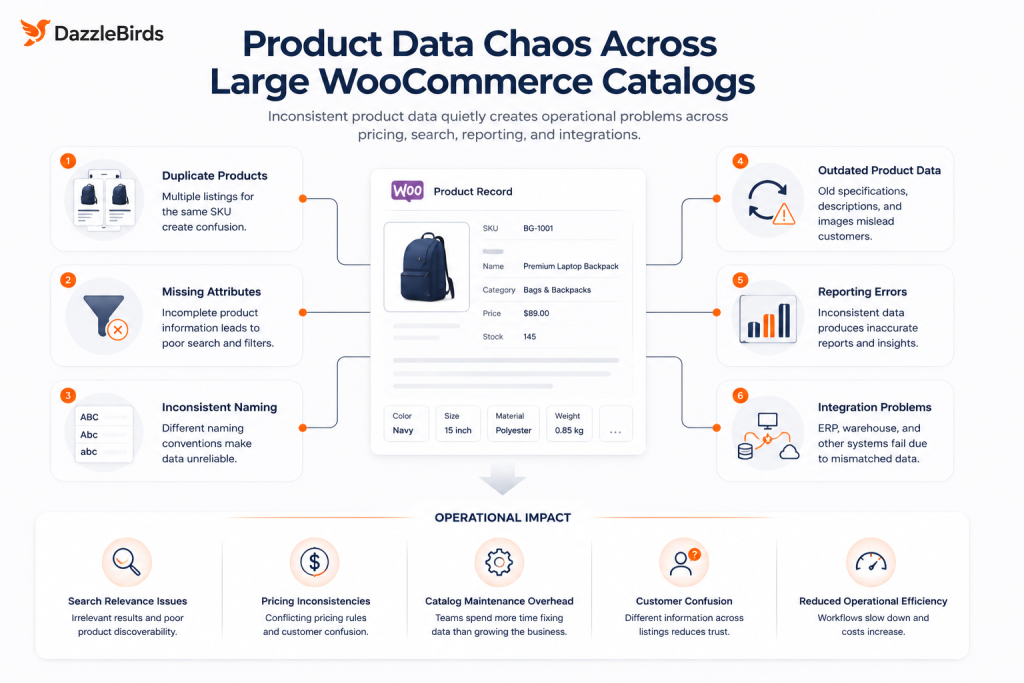
WooCommerce product data management problems usually show up in predictable ways:
Product names formatted differently depending on who uploaded them, making search and filtering unreliable
Descriptions that are detailed for some products and completely missing for others
Attributes created ad hoc because nobody checked whether a similar one already existed
Weight, dimension, and specification fields filled in inconsistently across similar product types
Outdated product descriptions that were never updated when the product changed
None of these feel catastrophic in isolation. Together they create a catalog that customers and internal teams genuinely can’t trust.
One of the more painful symptoms of not managing your WooCommerce product data well is duplicate records for products. They occur when there is no clear process for teams to check existing catalog records before adding new ones. Over time you find yourself with 2 or maybe even 3 listings for functionally identical products, sometimes at different prices and with sometimes differing stock levels. This is a mess operationally and desperately confusing for customers.
The downstream impact is real. Reporting is not trustworthy because both the product data fields are inconsistent. The void where data is empty or poorly formatted results in integrations with ERP systems/inventory platforms breaking/throwing errors. Our product entries in the database do not follow predictable title / description patterns; thus, the search returns irrelevant entities for customer-facing applications.
Category Sprawl Creates Hidden Catalog Problems
Category structures are one of those “easy to manage until they’re not” things.
Most catalogs begin with a reasonable category hierarchy. The main categories are the actual product lines. Subcategories make sense. Navigation is logical. However, in the absence of governance (and probably some foresight), categories can proliferate far beyond what was anticipated. A category is added for a limited-time promotion and never removed. Two teams independently invent categories for similar types of products, and both survive. This is especially true on product sets that honestly should have been managed with attributes and instead sculpt subcategories three levels deep.
Managing WooCommerce categories at scale is the same kind of discipline as managing any other aspect of the catalog. However, despite this being the trickiest part of analytics that is least discussed, category problems emerge slowly over time. They don’t break anything immediately. They just silently make the catalogue harder to use and even more difficult to maintain.
Category sprawl impacts the customer experience in ways that aren’t necessarily visible until they start to become major problems. Navigation becomes inconsistent. What this means in terms of the user experience is that when customers shop across product lines, they are faced with vastly different category depth and differing organizational logic, which degrades confidence in the store. If products are not in the categories their customers actually search, they will get buried. Since customer-facing search and filtering are often powered by large WooCommerce catalogs, fragmented categories have a direct impact on their relevance.
Internally you have duplicate (or inconsistent) category structures, which just make bulk operations more difficult. For example, if you need to update all the products in a specific category, let’s say due to price changes or promotional tasks, your operation will be manual and error-prone because of the fragmented structure. Data quality problems proliferate rapidly with manual catalog operations at scale.
Product Attributes Become Difficult to Govern at Scale
Things get really particular when we start talking about WooCommerce product attributes.
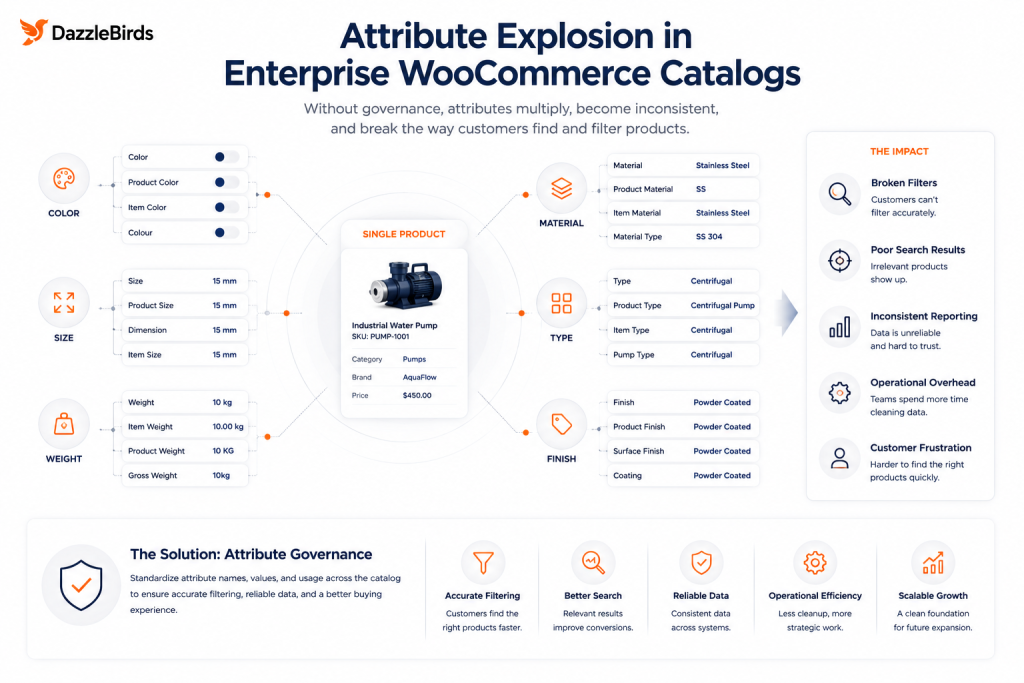
Attributes power filtering. They support product variations. They are the difference between a search experience that works and one that clashes with customers. For a micro catalog, attribute management is simplicity itself. When you have a large B2B WooCommerce catalog, attribute governance becomes its own operational discipline.
Attribute explosion is the most common issue. As time goes on, attributes get created to address the immediate need without verifying if an existing attribute could have served instead. Which means you might end up with color, product color, and item color sitting as four separate attributes within the same catalog. Each seemed logical at the time it was crafted. Fuse them together and you have a filter layer that breaks all too often, along with an ass-backwards data structure.
Adding to this are inconsistent attribute assignments. Certain products were assigned five attributes. Others have one or none. With filters used to narrow search results, products without complete attribute data simply don’t show up. That means that the catalog is not only difficult to manage internally. It’s failing customers right now on levels at which you could never trace back to the source of that failure without actually auditing your entire catalog.
When you manage a large catalog, the complexity of WooCommerce product search is tied directly to attribute governance — an area worth diving into here. One of the most common reasons why technically working WooCommerce search does not deliver useful results in practice is due to its poor attribute structures.
Why Catalog Inconsistency Impacts More Than Search
I feel catalog problems are usually a search and navigation problem. And yes, those creatures absolutely affect those things. But the operational ripple effects extend much further.
Inaccurate pricing is the next one, which comes from having clean product data. You may find it difficult to apply price rules and B2B WooCommerce pricing structures in a reliable way if your products are duplicated or poorly structured. For example, an automatic discount that is supposed to apply to a category of items might be missing some products because they are incorrectly categorized. Pricing exceptions that you would expect to qualify for a certain SKU may be qualifying against the wrong SKU or not applying at all.
Reporting is another casualty. Review by product line per month, margin category-wise, and stock movement of molded attributes. Each of those reports requires high-quality, standardized product data. Reporting is not trustworthy when its catalog data is contaminated. Unreliable reporting therefore results in critical business decisions based on erroneous/incorrect information, and this is a more serious issue than slow updating of catalogs.
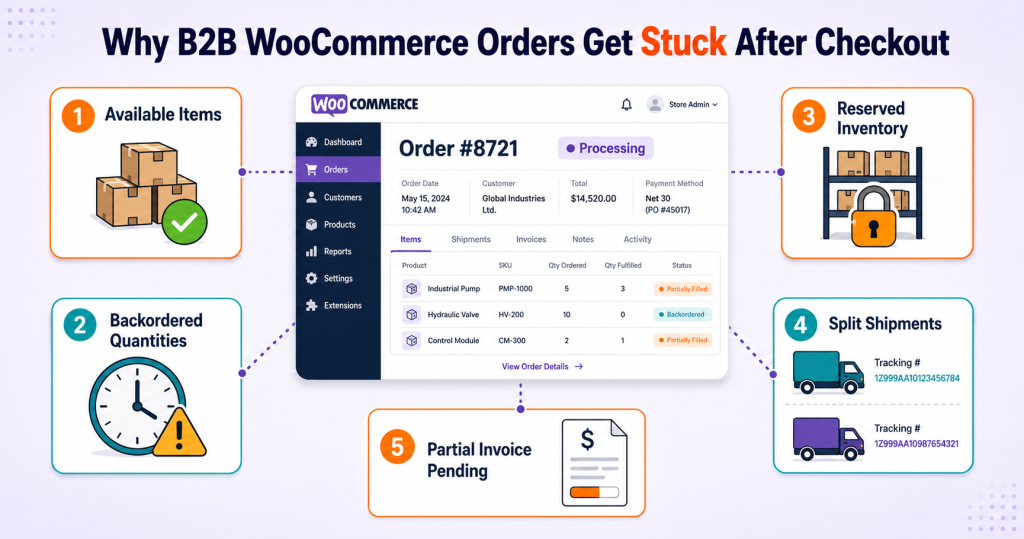
When product data is inconsistent, WooCommerce order management also becomes really complicated. For example, orders with discontinued SKUs are not being processed. Orders for products either have missing data that leads to processing errors or fulfillment teams have a problem matching order line items to physical stock when product naming is inconsistent. These are large-scale realities of neglecting the catalog.
Poor catalog governance leads to a high level of integration complexity. Any system that has to sync directly with the WooCommerce product catalog—integrations are more complex and error-prone, for example—can expect the data presented in relatively predictable ways. ERP, a warehouse management system, or a supplier data feed when it isn’t. This translates into the type of acute operational burden that saps team productivity through a slow meandering drain in capacity.
The Businesses That Scale Successfully Usually Establish Catalog Governance Early
And honestly, that’s the trend I am continuing to see. Well, technically sophisticated small WooCommerce catalogs aren’t necessarily the kind that make it big and clean. They were the ones who defined ownership and the shape of standards in an era before governance felt impossible for a complex catalog.
Good catalog governance isn’t complicated. At its core it is about consistently answering a few simple questions:
Who is responsible for approving new product entries before they go live?
What naming conventions apply to product titles, descriptions, and SKUs?
Which attributes are required for every product type, and what format should values follow?
How are discontinued products handled, and who makes that call?
What’s the process for adding new categories, and who reviews that decision?
How often is the catalog audited for duplicates, stale data, and structural inconsistencies?
Those questions sound simple. However, for the most part, in growing B2B operations, I have seen these answers don’t exist or at least aren’t consistent across teams. Marketing answers them one way. Operations answer each other. The outcome is a catalogue showing various competing standards instead of one unified framework.
Product data standards form the backbone of scalable WooCommerce catalog structures. We do this by defining what an ideal product record looks like for each type and then enforcing that definition across the entire catalog, which solves most of the major data quality issues forcing large catalogs to be so incredibly challenging. It’s far easier to prove a standard than to apply it retroactively to a catalog of thousands—some documented in similar ways, others not at all.
Oversight quickly pays off in product lifecycle management, too. Clear stages for products—active, seasonal, discontinued, and archived—and what happens to a product in each stage of its lifecycle help prevent the catalog from becoming filled with stale records that slowly waste time.
This is the part that I think gets underestimated most often.
WooCommerce catalog management at scale is not always primarily a technical enterprise. It is a challenge to organization and responsibility. The platform can help with large, complex inventories. The question is whether the employer who manages the warehouse is subject to its continued maintenance.
Operational adulthood appears to be unique in certain dimensions. An operation with 500 merchandise items requires shorter inspections than one with 50,000 items. The order is the same. Someone owns a catalogue. Standards exist; processes are included. Exceptions are planned instead of unintentional.
The inventory renewal obligation is one of these that tends to fall through the gaps in development companies. Not glamorous pictures. Its visibility cannot be the release of a new product or the online redesign of a primary website. But its absence creates late operating debt that is too expensive to pay off later.
And here’s what most teams don’t realize until there’s already a problem. Without clean owners, high-quality inventory options are purchased through the person who will have the goods with them that week. A person follows a naming convention. He doesn’t know another one exists. One 1/3 is aware that it exists and still does not have time to look into it. So the catalog slowly accumulates discrepancies that no one intended and no one feels charged at all to solve.
WooCommerce scalability challenges are usually rooted in list complexity, which was not handled nicely at all, and addressing it requires a recurring-scale effort. Far less extra effort in maintaining the need would be taken in the first place.
It turns out it is the businesses that treat catalog maintenance as an operational responsibility instead of a quarterly cleanup effort and deliver high-quality catalogs at scale. That’s not a technical insight. It’s an organizational one.
Warning Signs That Catalog Complexity Is Becoming a Problem
Some of these will be obvious. Some less so.
Repetitive entries of the same product with minor name variations or separated records for identical products
Similar products have inconsistent attributes; therefore, filtering and faceted search return incomplete results.
Search relevance problems not addressed through the search engine configuration alone, generally because of inconsistent naming or fragmented categories
The catalog didn’t raise any reporting errors when analyzed by category or product line, but the structure isn’t clean enough to support a reliable aggregate of data.
Any slowdowns in catalog updates where adding or changing a product takes orders of magnitude longer than it ever used to—usually due to the team working through differences instead of following a clear process
Increasing amount of administrative work that scales more quickly than the catalog itself, a sure sign that your catalog lacks strong structure and clear ownership
These are not in themselves signs of catastrophic warning. But taken together, they suggest a catalog that is harder to change over time, not easier. And the longer that pattern continues, the extra effort it takes to clean well. Some companies reach a factor where inventory is so inconsistent that even a basic product audit takes weeks. That’s no longer the forum’s problem. It is what happens when an individual’s ownership is not sufficient to fulfill the claims in the long run.
Scaling a B2B WooCommerce Catalog Is an Operational Challenge First
Generational conversation on WooCommerce list management topics. The right data form, the right feature framework, the right class architecture. This is all real and important.
However, in most cases where huge WooCommerce catalogs grow to be difficult to manipulate, basic motivation is not the platform. There is a lack of clear ownership and a lack of regulated standards and processes that only follow as the commercial enterprise grows. Product statistical matching, batch size, attribute standardization, inventory assets. These organizational choices are as terrible as they are technological.
Complexity in a B2B catalog is not a sign that WooCommerce cannot scale. It is often a sign that the inventory exceeded the strategies designed to control it. And indeed, it happens in many businesses. Not because they already made a terrible decision, but because it’s easy to deprioritize the storage area when everything else is growing much faster.
Addressing it requires more than technical fixes. It requires agreement on who owns the catalogue, what the requirements are, and how those standards should be maintained as the product range grows.
DazzleBirds works with B2B companies in exactly those types of list architecture and operational demand scenarios, helping groups to build SEO-safe WooCommerce migration listings that look flexible as the business grows rather than becoming a source of constant operational friction.
FAQs
WooCommerce catalog management is the process of organizing, maintaining, and standardizing product data across a WooCommerce store. It covers product naming, category structure, attributes, SKUs, and pricing. At scale, it becomes an operational discipline that requires clear ownership and consistent standards.
As SKU volumes grow, product data inconsistencies, duplicate records, uncontrolled category expansion, and ungoverned attributes accumulate. Without clear ownership and defined standards, catalog quality degrades over time, making search, reporting, pricing, and integrations increasingly unreliable across the entire operation.
The most common problems are duplicate product records, inconsistent attribute usage, category sprawl, missing product data, and outdated descriptions. These issues compound as the catalog grows and directly impact search accuracy, reporting reliability, and the overall customer buying experience.
Poor product data affects search relevance, pricing accuracy, order processing, and ERP integrations. It creates reporting inaccuracies and increases administrative workload. Over time it erodes customer trust and makes routine catalog updates significantly slower and more error-prone than they should be.
As early as possible. Businesses that define product naming conventions, required attributes, category rules, and clear catalog ownership before scaling avoid the compounding inconsistencies that make large catalogs so difficult to clean up and maintain later.


 WooCommerce Solutions
 WordPress Solutions