WooCommerce scalability becomes harder when you manage multiple stores with separate catalogs, inventory, pricing, orders, and reports. This guide explains what breaks first and how to build a scalable WooCommerce multi-store operation.
The first store was working, so opening a second one just made sense. That made sense to separately bubble out a B2B portal because of an enterprise client’s need for custom pricing. Of course, a regional storefront that demanded different product/localization and tax logic made sense for this new market. All of those decisions are grounded in business needs. None of those were mistakes in and of themselves.
In fact, most businesses do not even realize they have a WooCommerce scalability problem until it is too late, and by that time they are buried under the weight of one. These were all warning signs, but back then they seemed like progress.
The first store was working, so opening a second one just made sense. That made sense to separately bubble out a B2B portal because of an enterprise client’s need for custom pricing. Of course, a regional storefront that demanded different product/localization and tax logic made sense for this new market. All of those decisions are grounded in business needs. None of those were mistakes in and of themselves.
Why Does WooCommerce Scalability Become Difficult Across Multiple Stores?
WooCommerce scalability is difficult for a couple of stores due to the boom adding layers of operations faster than the operating systems can take on. Each additional protection introduces its own inventory, pricing policies, workflows, and administrative costs. Without central control, these stores act as separate structures that share nothing, developing duplication, inconsistency, and fragmented visibility that compounds over the years.
Multi-Store WooCommerce Growth Usually Starts Small
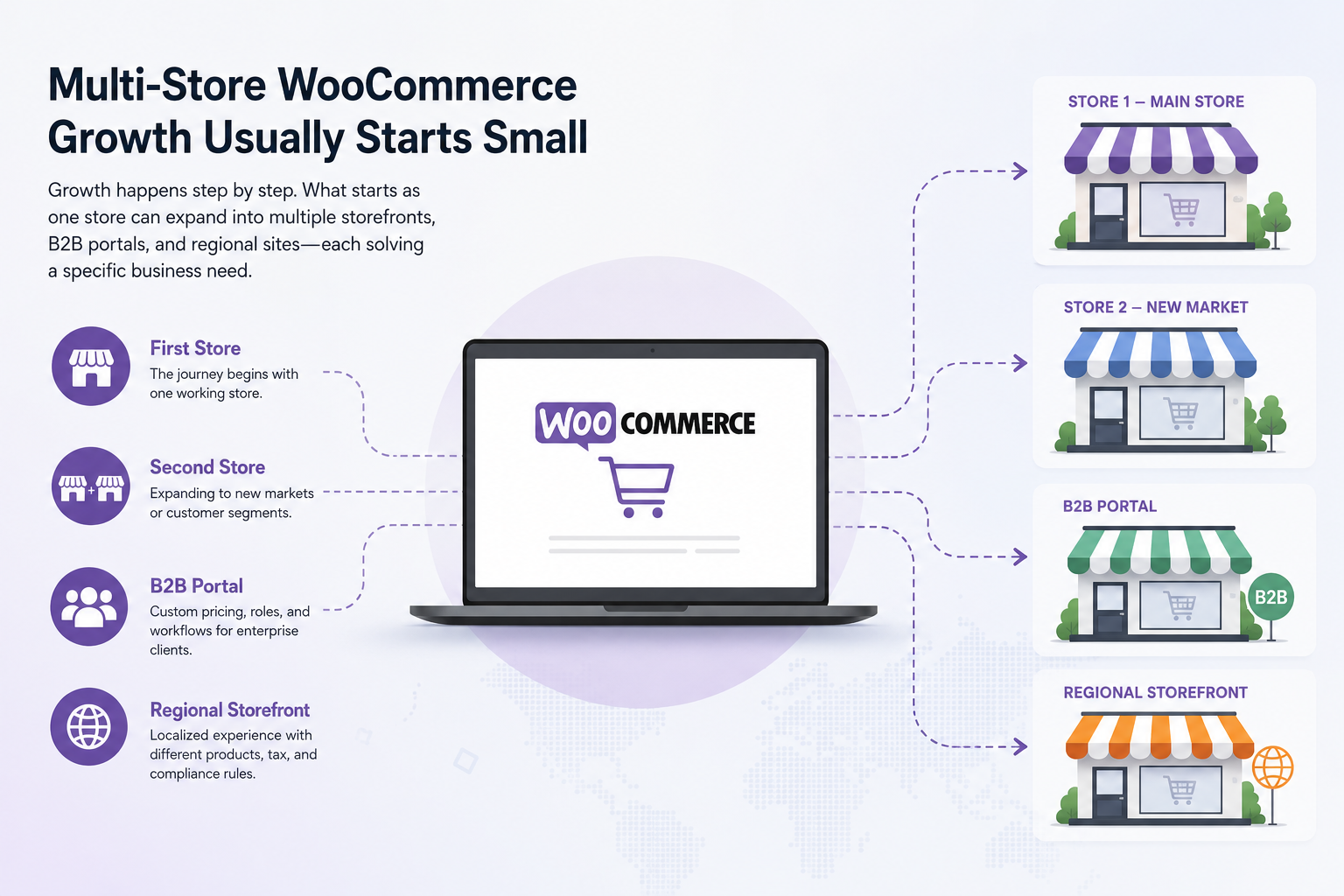
Most organizations no longer get down to creating complex multi-care settings. The expansion is gradual, and each increase feels justified.
Regional expansion is often the primary driver. A nationally promoting company decides to create a separate storefront for a particular geography, be it a type of U.S. state, the national phase market, or the nearest distribution area. The goal is localization; however, the real end result is another fair shop, which now needs its own maintenance, updating of its very own inventory, and personal operational interest.
B2B portals are another frequent trigger. Introducing price schedules, order workflows, or product visibility rules that simply can’t live on such a public-facing store is something you’ll want for enterprise customers. The easiest way is to create an isolated portal; this then becomes another running environment with its catalog and management overhead.
Just like this, stores are distributed by distributors. The national distributor wants an ordering environment of their own. A regional wholesaler needs a store set up for their pricing tier. Each one of these adds another independent WooCommerce installation to your operating stack.
All of this is not bad by nature. Utilizing multiple WooCommerce stores is a reasonable architectural decision for businesses that have truly different operations between markets or customer segments. The issue is that the operational infrastructure to operate these outlets at scale seldom gets built as quickly as building out the stores does. The storefronts multiply. The governance does not.
The Real Problem Is Operational Duplication
When a business is trying to run three or more WooCommerce stores, the most pressing issue centers around operational duplication. It is cropping up all over, but it hits catalog management the worst.
Imagine a business that operates five regional stores. Pricing on forty products is updated by a supplier. For a centralized operation, that propagation of the update is done once. In a fragmented multi-store environment, somebody has to update it five times in five different WooCommerce installs, hoping for the product structures to be remotely sufficient to adequately apply those changes. They often are not. A number of stores have renamed products, but many others are yet to follow. Category hierarchies have drifted. The catalog contains custom attributes that were added at one store scope and never copied.
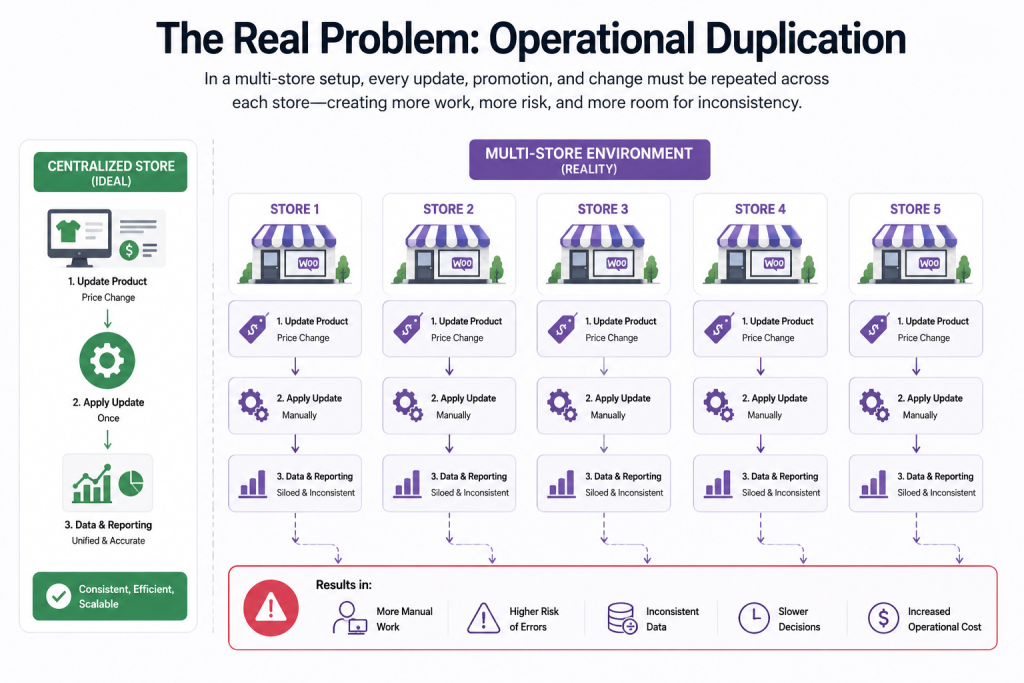
Promotional campaigns are subject to a similar duplication issue. To run a discount on every single product for everyone across your site, you need to set up the same promotion per store. Seasonal pricing management consists of updating the rules in each environment separately. It finds that anything you would hope to be a business-as-usual operation becomes a process in collaboration because there is no common operational layer across the stores.
Reporting is equally fragmented. Since each store creates its own data, aggregating revenue or order volume and product information requires connecting manually to multiple sources of the same type. Leadership is ultimately forced into making decisions based on partial pictures simply because it takes too long to assemble the whole picture regularly.
This is deep into the core of what we call the WooCommerce scalability problem for multi-store operators. This is not to say that WooCommerce cannot run multiple stores from a technical perspective. It is that the operational overhead around governing them without central governance grows faster than the business can digest.
Why WooCommerce Scalability Gets More Complicated Across Multiple Stores
One of the least used words regarding WooCommerce is “governance,” but it has to be said the most. It is commercial governance that keeps a multi-store operation cohesive, versus the slow decoherence of a set of storefronts with little beyond sharing some intangible aspects of a brand name.
On fellow WooCommerce multi-store owners — that is, whether or not their new retail store can fill the governance role with respect to these). To get started, who approves changes on priced products, and how are those passed to shops? Who’s in charge of making sure a product that doesn’t ship to one store no longer appears in all other stores, and how fast? Store process—how do you launch a new product across the full store network?
In the case of single-store operations, these questions have informal answers that are “good enough.” Over time, as enterprise WooCommerce operations span multiple stores, the unstructured answers become ineffective. In the absence of explicit governance, a single product is handled with differing sets of logs at various stores. Regional teams sometimes make localized decisions that result in inconsistencies. This causes administrative work to get done redundantly, as no one has visibility into what other certified teams have already performed.
Coordination problems are particularly acute for companies where there is an operational aspect that varies by region. A business running stores in different countries may have truly distinct market-by-market pricing, tax logic, or product availability. With a governance layer in place to manage those differences, every operational change has the challenge of creating a path through each store’s unique configuration and local rules—not surprisingly requiring careful application lest unintended consequences arise. The cognitive overhead itself makes operations very slow.
Adding more complication to the matter is customer management. With more customers operating in different areas, businesses need insight on how their shoppers are buying across store footprints. A person who places orders on three different regional portals, without cross-store visibility, appears as three unique accounts. Commercial connections are obscure, and the business no longer has control of those accounts at a strategic level.
Catalog Consistency Becomes Difficult to Maintain
Catalog consistency is the operational challenge in WooCommerce multi-store management that quietly unravels and has most downstream impact.
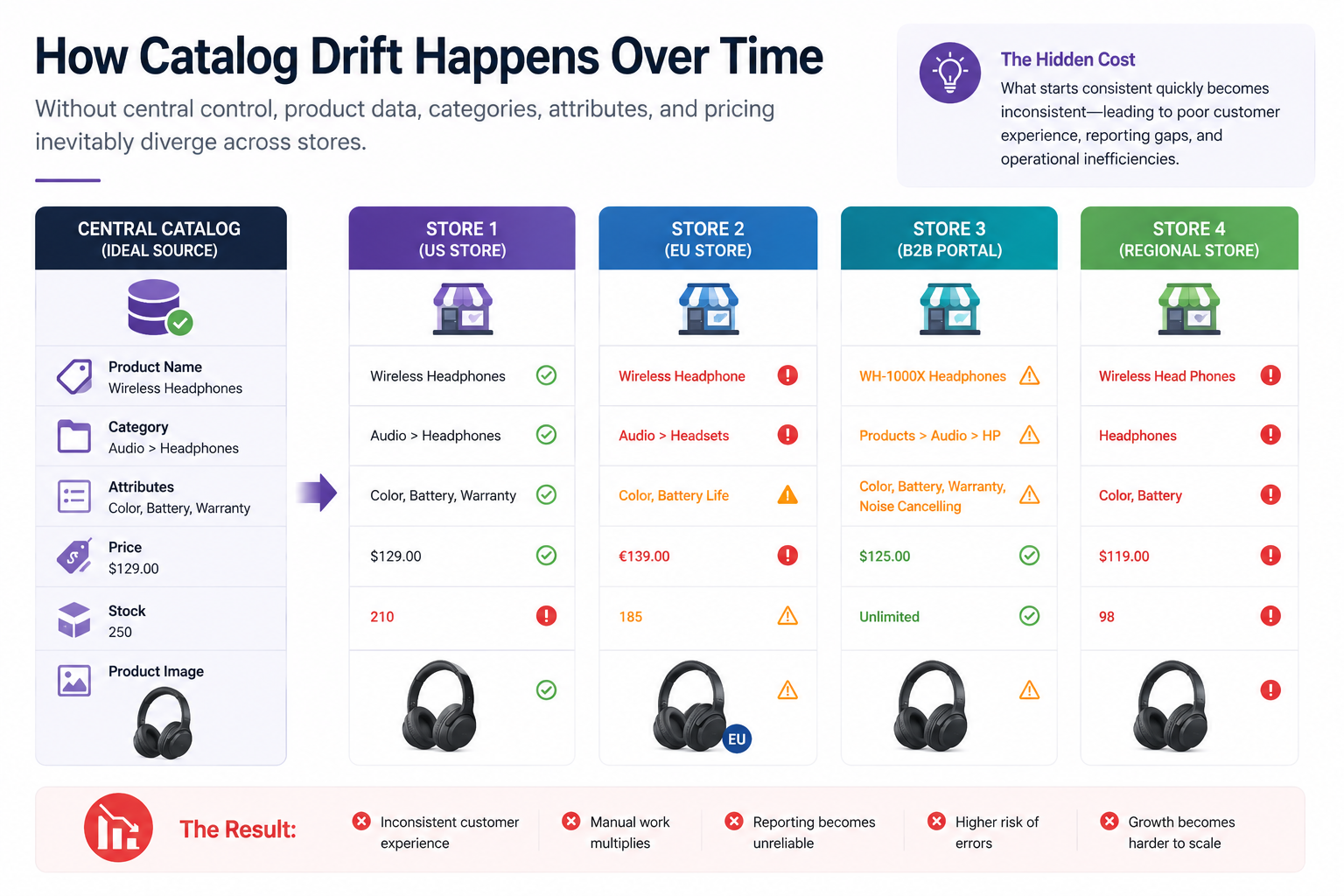
You will end up experiencing catalog drift in the regular course of events. One store has an updated product that is not reflected elsewhere. Then, a new attribute is added addressing some regional need and quickly gets neglected when the same products are later updated. Category structures are store specific, which means that the same product sits under a different category based on what store you happen to be in; SEO changes to product descriptions taken in one environment don’t reflect elsewhere.
Initially, these inconsistencies are relatively low and easy to address. Over time, they compound. A woo-commerce business whose catalog construction isn’t always uniform begins to get sidetracked through multiple prongs. Internal teams have no way of trusting their product data because they also know it, but not the same across stores. Product identifiers and structures just don’t have a clean alignment, meaning that integration work with ERP systems or logistics platforms is complicated. This is also where the correlation between WooCommerce product search complexity and catalog consistency becomes clear; an inconsistent taxonomy or attribute structure complicates getting products to customers in a meaningful context.
The maintenance overhead grows proportionally. When your catalog data is dispersed across stores, it has its own operational function: maintaining the accuracy and consistency of that data. This is particularly the case for businesses that did not anticipate it and are spending huge amounts of administrative capacity on catalog reconciliation work without any return—generating zero revenue but entirely because operational scale was simply never designed into architecture in the first place.
Why Centralized Management Matters More at Scale
The most successful businesses treating WooCommerce multi-store operations more as a game of chess than pinball tend to have one thing in common: they build centralized operational infrastructure before the complexity gets too painful. The ones that fail typically create store after store without anything in the way of a management layer, then face the far harder task of attempting to retrofit governance into an already diffuse ecosystem.
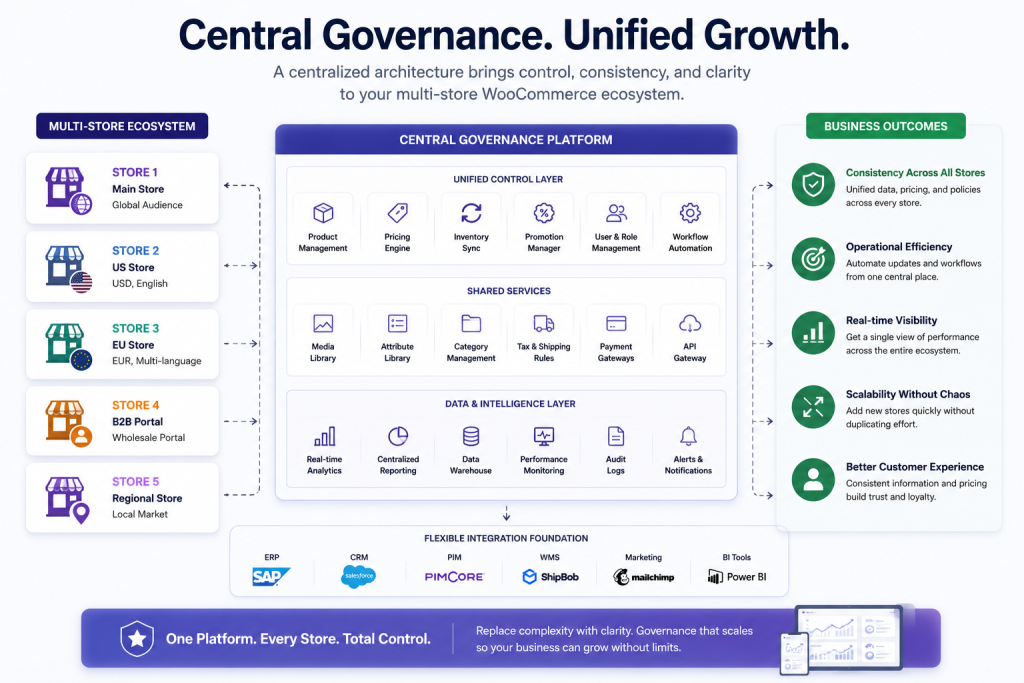
In this case, centralized management does not even prefer one single WooCommerce installation. Separate stores may be the right technical architecture for businesses with truly unique needs. Per-market centralized management does mean a common set of systems used to operate those stores: a single source of truth for product catalog data, uniform pricing governance frameworks (compound markup logic approved through organizational workflow structure), aggregated reporting across stores, and standardized workflows for shared operations, such as launching new products into the market or running promotional campaigns.
These types of operational efficiencies from that kind of centralization are huge. A pricing change that once required manual labor across five different stores is now just a single operation. A new product launch would have previously entailed coordinating five separate catalog updates—now it is a structured workflow that automatically flows through all appropriate stores. Duplicated five times, administrative work gets done once.
Centralized catalog governance is also directly related to B2B WooCommerce pricing. Businesses that manage pricing centrally, creating effective rules for how regional variations interact with customer tier discounts and volume pricing, usually have far fewer operational errors and therefore far superior commercial outcomes than businesses where they have had to manage price completely independently in each store.
Furthermore, centralized catalog governance has a direct relationship with B2B WooCommerce pricing structures. In our experience, businesses that manage pricing centrally with well-defined rules on the interplay between regional variations and customer tier discounts or volume prices will have many fewer operational errors and a much better commercial outcome than those managing prices independently in each store.
Multi-Store Complexity Impacts Customer Experience Faster Than Most Businesses Expect
The operational problems described above are internal. They are externally driven, affect consumer enjoyment, and generally tend to track more closely than the company expects.
Changes in product availability between products/services are always noticed by customers first. If you have an area store displaying the item as available, it’s scary for the other customer—they may be off the list. A promo price points to a market that is invisible to any other retailer serving the same customers. Since this inventory update is completed manually most efficiently, they can be in the background when applying updates to different storefronts.
Another level of inconsistency comes from sequential workflows. Specific touchpoints using more than one regional portal of a user’s business stories. Because of the way each funnel is designed and run one at a time, confirmation techniques, order tracking, and customer support workflows swing from one funnel to another, and the disconnected customer will enjoy operational versatility that seems manageable.
This variance is no trivial issue, especially for B2B customers. Enterprise customers count on operational reliability. When the experience is not the same in every store, or inventory information cannot be relied upon to be complete and accurate, it causes friction in buying and selection, and then the operating propellers become aggressively defective.
The Businesses That Scale WooCommerce Successfully Usually Standardize Operations Early
The pattern that emerges in companies that successfully scale WooCommerce is consistent: standardization comes before extension. Before adding a third rescue, they created an operational structure to handle the three stores consecutively. Before entering a new regional market, they have identified a management framework that can accommodate the new market without the need to restructure the entire operating equipment.
Standardization in this context means a few specific things:
- A canonical product catalog that is the single source of truth for all stores and has an incremental process associated with it where updates propagate to individual storefronts as opposed to being manually applied in each environment.
- And pricing governance that has defined ownership on how prices are set, how regional variations are managed, and who can change what across the store network.
- Reporting infrastructure that aggregates data across stores out of the box, instead forcing teams to report by reconciling numbers every time leadership wants a full picture.
Workflow automation makes a niche right here. Many businesses running WooCommerce stores that have not been computerized, with unusual operational responsibilities, find themselves investing in images and inappropriate administrative time that needs to be organized. WooCommerce migration workflows, inventory management technology, and drive-shop reporting are all areas where investments in automation can quickly yield returns that compound with growing retail networks.
When WooCommerce Multi-Store Operations Start Becoming Difficult to Control
Multi-savings There are recognized factors in a WooCommerce business where management outage warnings start to appear. They’re not all dramatic. Many are quiet enough to be dismissed as momentary operational noise unless they are sincere. These are the warning signs you really need to pay attention to:
Operational bottlenecks—an updated catalog takes a day; it has taken up to a week because of cross-store environment coordination without clear ownership. A pricing change is in limbo pending approval because the process for governing multi-store changes to prices was never clearly defined.
Redundant processes—Teams in individual regions are doing the same catalog work independently, as there is no shared system. Actually build a reporting infrastructure that can aggregate automatically, so they have started manually compiling reports from different data sources.
Fragmented reporting — Leaders are making operational decisions on single-store data because consolidating across stores is too difficult. Performance data is fragmented, thus missing out on growth opportunities or misreading them.
Inconsistencies across stores—product data inconsistencies out in customer disclosures. Sequential processes are different in very muddled ways. However, the operational fragmentation that was an issue internally now becomes external.
Increasing operational burden—When the cost of maintaining a multi-store environment comes to represent a large and increasing proportion of operations, it becomes difficult not to justify investing in management infrastructure. By then, building that infrastructure will be a lot harder than it would have been at the beginning.
Scaling WooCommerce Is an Operational Decision, Not a Technical One

Stores are not a hard element. It is the act that connects them.
Most WooCommerce scalability issues that bottom out at the four- or five-store mark are set in motion much earlier when the second or third store changes without any associated funding added to centralized governance, shared inventory management, or pass-key reporting infrastructure. When friction becomes visible, operating debt is already expensive.
Groups that are well-sized do not expect communication to be pushed. They tackle operational design especially from the beginning, just as they tackle storefront design, pricing processes, or customer experiences.
WooCommerce can help with complex, multi-tenant business operations. that it relies far less on a single channel on the platform than on the operational infrastructure built around it. It is the choice that is worth getting right.
FAQs
WooCommerce scalability becomes difficult because each additional store introduces its own catalog, pricing rules, and workflows. Without centralized management, multi-store eCommerce management creates operational duplication and fragmented visibility that compounds as the business grows.
The biggest challenges in managing multiple WooCommerce stores are catalog inconsistency, duplicated workflows, and disconnected reporting. As WooCommerce operational complexity grows, maintaining consistent product data and pricing across separate store environments becomes increasingly difficult without centralized governance.
WooCommerce catalog management breaks down when product structures, categories, and attributes evolve independently across WooCommerce regional stores. Without a centralized catalog ownership model, updates get applied inconsistently, product data drifts, and the maintenance overhead grows with every store added to the network.
A business should invest in scalable WooCommerce architecture before adding a third store. By that point, enterprise WooCommerce operations require centralized catalog governance, unified reporting, and standardized workflows to prevent operational duplication from becoming the dominant cost of running the business.
Centralized WooCommerce management means having one source of truth for catalog data, consistent pricing governance across all stores, and unified reporting that aggregates performance without manual reconciliation. For enterprise WooCommerce operations at scale, it is the foundation that makes multi-store growth operationally sustainable.


 WooCommerce Solutions
 Solutions for WordPress