Introduction
Most businesses don’t think about their CMS until something breaks. A plugin conflict causes checkout to go down during a sale. A developer leaves, and nobody else understands the custom theme. A simple landing page request turns into a three-week ticket because marketing can’t touch the site without IT.
Choosing among the best CMS platforms in 2026 is not a one-time technical decision. It is a structural choice that shapes how quickly your marketing team can publish, how well your content is surfaced in both traditional search and AI-generated answers, how much of your IT budget is consumed by maintenance, and how painful your next redesign will be.
Quick answer: For most small to mid-sized businesses, WordPress offers the strongest balance of cost, flexibility, and SEO performance in 2026. Large enterprises with complex personalization needs tend to land on Sitecore, AEM, or Drupal. Ecommerce businesses default to Shopify. The right platform depends on your specific business size, technical resources, and growth plans, not a universal ranking.
This guide breaks down the platforms businesses are actually evaluating right now: WordPress, Sitecore, Adobe Experience Manager, Drupal, HubSpot CMS, Joomla, Contentful, Webflow, and Shopify. We cover what each one does well, where it falls short, what it actually costs, and which type of organization each platform suits.
What Is a CMS?
A content management system (CMS) is software that lets non-technical staff create, edit, organize, and publish content without writing code for every change.
A CMS does three things for an organization:
-
Separates content from design, so a marketing team can update copy or add a blog post without touching code
-
Provides structure and governance, so multiple people can work on a site without conflicts or downtime
-
Determines scalability, meaning how easily the site can grow to support new product lines, languages, or integrations
The CMS you choose early on tends to outlive its original use case. A platform selected for a five-page brochure site is often still running the company’s blog, careers page, and lead generation forms five years later, long after it has stopped being the right fit.
How We Evaluated the Best CMS Platforms
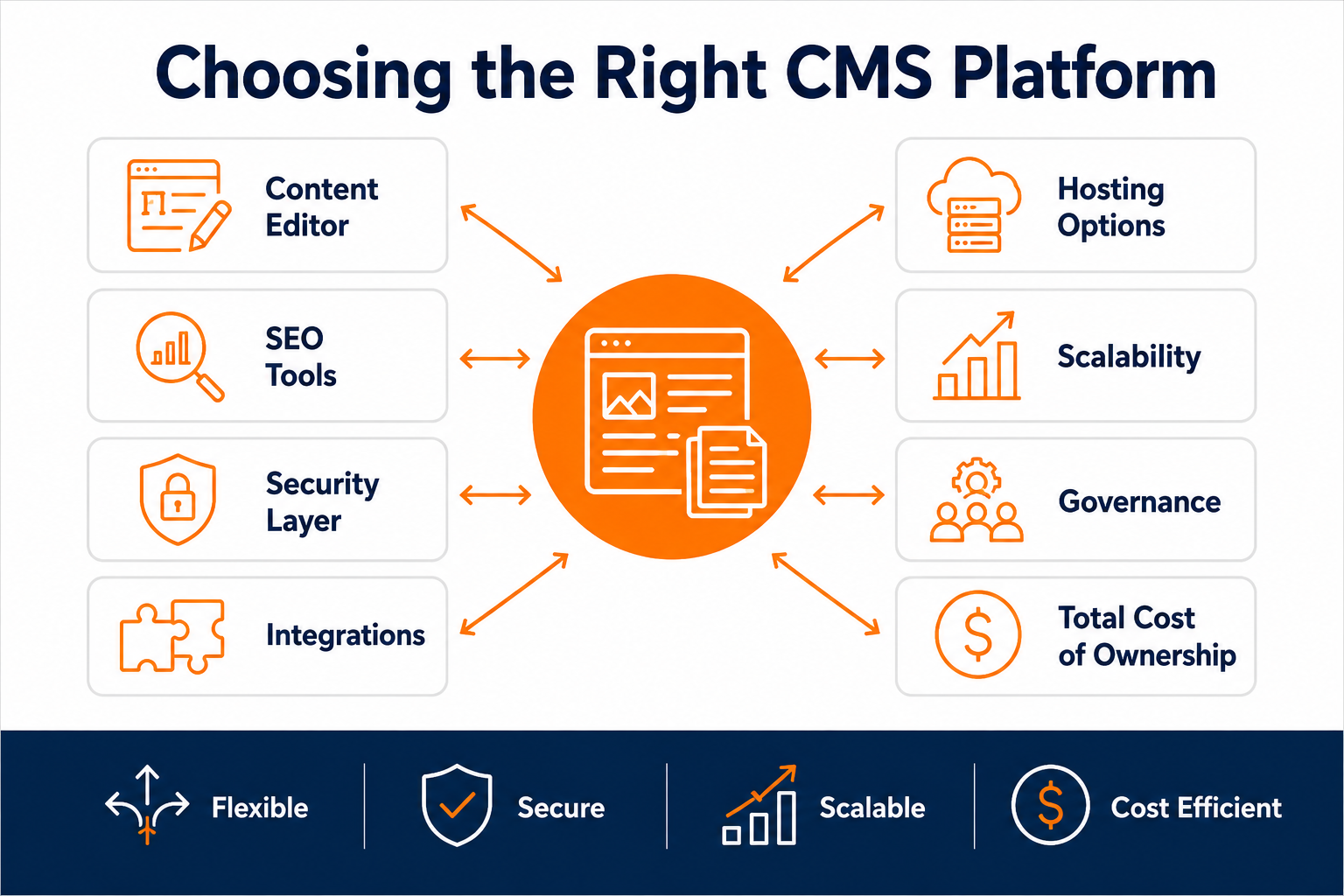
This comparison reflects how these platforms behave in real implementations, scored against ten criteria:
-
Ease of use – Can marketing teams operate independently, or does every change need a developer?
-
Scalability – Does the platform handle traffic spikes and content growth without a full rebuild?
-
SEO and AEO readiness – Native support for clean URLs, structured data, schema markup, and content formats that AI answer engines can extract and cite
-
Security – Patch cadence and ongoing maintenance burden
-
Integrations – Native connections to CRM, marketing automation, and analytics tools
-
Customization – How far the platform can be pushed before hitting a wall
-
Governance – Role-based permissions and approval workflows
-
Maintenance requirements – Ongoing developer hours needed to keep the platform secure
-
Total cost of ownership – Licensing, hosting, development, and specialized talent costs
-
Long-term flexibility – Adaptability to headless architecture and API-first delivery

Best CMS Platforms Compared for 2026
WordPress
Overview: WordPress powers a larger share of the web than every other CMS combined, having evolved from a blogging tool into a flexible platform capable of running everything from small business sites to enterprise marketing sites.
Best suited for: Small to mid-sized businesses, content-heavy sites, and increasingly, enterprises seeking flexibility without proprietary licensing overhead.
Key strengths:
-
Massive plugin and theme ecosystem, so most functionality already exists rather than requiring custom development
-
Mature block editor that non-technical staff can use confidently
-
Granular SEO control through plugins, without developer involvement for routine changes
-
Hosting options ranging from budget shared hosting to enterprise managed WordPress with strong performance guarantees
-
Largest developer talent pool of any CMS, keeping development costs competitive
-
Fast content publishing speed, which matters for AEO since answer engines favor frequently updated pages
Limitations:
-
Quality depends heavily on how the site is built; a poorly built site can be slow and insecure
-
Requires more discipline around plugin management and updates than closed platforms
-
No built-in enterprise governance layer; this must be configured
Cost considerations: Core software is free. Costs come from hosting, premium plugins, and development time, generally resulting in a lower total cost of ownership than proprietary enterprise platforms.
SEO and AEO capabilities: Strong. Clean permalink structures, mature SEO plugins, schema markup support, and fast indexing make WordPress one of the most search- and AI-answer-friendly platforms available.
Scalability considerations: Scales well with the right hosting and architecture, though it requires more deliberate technical planning than a platform with scalability built in by design.
Sitecore
Overview: Sitecore is a .NET-based enterprise platform built around personalization, multi-site management, and marketing automation.
Best suited for: Large enterprises with complex personalization needs, multiple brands or regions, and strong internal technical resources.
Key strengths:
-
Sophisticated personalization and customer journey tooling
-
Strong multi-site and multi-language management for global organizations
-
Deep integration with enterprise marketing stacks
Limitations:
-
Significant implementation complexity, with projects often running longer than initially scoped
-
Smaller, more expensive pool of experienced Sitecore developers
-
Steep learning curve for content authors
Cost considerations: High. Licensing alone can run into six figures annually before development, hosting, and staffing.
SEO and AEO capabilities: Capable, but achieving strong AEO readiness typically requires custom development, since structured, AI extractable content formatting is not the platform’s default focus.
Scalability considerations: Built for enterprise scale and handles large multi-site environments well, assuming sufficient budget and technical staffing.
Adobe Experience Manager (AEM)
Overview: AEM is Adobe’s enterprise content and digital asset management platform, typically deployed alongside other Adobe Experience Cloud products.
Best suited for: Large enterprises with substantial digital asset management needs and existing Adobe ecosystem investments.
Key strengths:
-
Strong digital asset management for large content libraries
-
Tight integration with Adobe’s broader marketing suite
-
Robust workflow and approval tooling for large content teams
Limitations:
Cost considerations: Very high. Generally justified only when an organization is already deep in the Adobe ecosystem.
SEO and AEO capabilities: Solid foundational controls, though strong AI answer engine visibility usually requires custom structured data work rather than out-of-the-box configuration.
Scalability considerations: Built for large-scale enterprise deployment with complex governance structures.
Drupal
Overview: Drupal is an open-source CMS known for its flexibility, security, and strength in complex content modeling, which is common in government, higher education, and large publishing.
Best suited for: Organizations with complex content structures, strict security or compliance requirements, and access to skilled Drupal developers.
Key strengths:
-
Exceptional content modeling flexibility for complex taxonomies
-
Strong security track record and update history
-
Genuine enterprise scalability without proprietary licensing costs
-
Granular structured data control, useful for AEO and schema-heavy implementations
Limitations:
-
A steeper learning curve for content editors than WordPress
-
Smaller, more specialized, and higher-cost developer talent pool
Cost considerations: No licensing fees, but development costs tend to be higher than with WordPress due to the build’s complexity.
SEO and AEO capabilities: Strong, with good control over URL structure, metadata, and performance, particularly valuable for large, complex content taxonomies that AI engines need to parse cleanly.
Scalability considerations: Excellent for high traffic, complex permissions, and large content volumes.
HubSpot CMS
Overview: HubSpot CMS combines content management with HubSpot’s CRM, automation, and analytics tools in a single platform.
Best suited for: Marketing teams already using HubSpot for CRM and automation who want tight integration between site content and lead data.
Key strengths:
-
Native integration with HubSpot’s marketing and sales tools
-
Easy-to-use editor for independent marketing teams
-
Built-in SEO and content strategy recommendations
Limitations:
-
Less flexible than open-source platforms for highly custom functionality
-
Migrating away later is more involved, since content and tooling are tied closely to the ecosystem
Cost considerations: Subscription-based, scaling with the HubSpot tier required, which can become expensive as needs grow.
SEO and AEO capabilities: Strong built-in SEO guidance embedded directly in the editing experience, useful for teams without dedicated SEO staff.
Scalability considerations: Good for mid-sized marketing-driven organizations; less commonly the right fit for large, complex enterprise sites.
Joomla
Overview: Joomla is an open source CMS positioned between WordPress’s simplicity and Drupal’s complexity.
Best suited for: Small to mid-sized organizations wanting more built-in structure than WordPress without Drupal’s complexity.
Key strengths:
-
Solid built-in multi-language support
-
Flexible user access controls without additional plugins
-
Free core software with moderate development costs
Limitations:
Cost considerations: Free core software, moderate development costs depending on customization.
SEO and AEO capabilities: Decent native SEO settings, though the dedicated SEO and structured data tooling ecosystem is far smaller than WordPress.
Scalability considerations: Handles mid-sized sites reasonably well, less commonly chosen for large-scale enterprise deployments today.
Contentful
Overview: Contentful is a headless CMS that manages content through an API rather than dictating front-end presentation.
Best suited for: Organizations with strong development resources delivering content across multiple channels, including web, mobile apps, and IoT devices.
Key strengths:
-
Genuine flexibility for omnichannel content delivery
-
Clean, modern editing experience for content teams
-
API-first architecture suited to multi-platform AEO strategies, since the same content can be formatted differently per channel
Limitations:
Cost considerations: Subscription-based and can become expensive at scale, with custom front-end development adding high cost.
SEO and AEO capabilities: Entirely dependent on how well the custom front end is built, since headless architecture provides no native SEO tooling.
Scalability considerations: Excellent for organizations building complex, multi-channel digital experiences with strong engineering capacity.
Webflow
Overview: Webflow combines visual design tools with a built-in CMS, popular among design-conscious teams for marketing sites and landing pages.
Best suited for: Small to mid-sized businesses and design teams wanting strong visual control without custom code.
Key strengths:
Limitations:
Cost considerations: Subscription-based, generally moderate, increasing with traffic and team size.
SEO and AEO capabilities: Strong technical foundation with fast load times and clean markup, both of which support AI crawler readability.
Scalability considerations: Suitable for small to mid-sized sites; less commonly the right fit for large, complex enterprise environments.
Shopify
Overview: Shopify is an e-commerce-focused platform combining content management with a full commerce engine.
Best suited for: Ecommerce businesses of nearly any size, from single-product stores to large multi-brand retailers.
Key strengths:
-
Best-in-class commerce functionality, including payments and inventory management
-
Large app ecosystem for extending functionality
-
Strong product-structured data support, which helps product pages surface in AI shopping answers
Limitations:
-
Less flexible for complex non-commerce content, such as large resource libraries or extensive editorial content
-
Some technical SEO controls are more limited than open platforms
Cost considerations: Subscription-based plus transaction fees on certain plans, increasing as merchants add apps.
SEO and AEO capabilities: Solid native e-commerce SEO, including clean product URLs and structured data for products.
Scalability considerations: Built specifically to scale commerce operations, particularly on Shopify Plus for larger merchants.

CMS Comparison Table
| Platform |
Ease of Use |
SEO & AEO Readiness |
Flexibility |
Scalability |
Cost |
Security |
Enterprise Readiness |
| WordPress |
High |
Strong |
High |
High |
Low to Moderate |
Moderate |
Growing |
| Sitecore |
Moderate |
Moderate |
High |
High |
Very High |
High |
Strong |
| AEM |
Moderate |
Moderate |
High |
High |
Very High |
High |
Strong |
| Drupal |
Moderate |
Strong |
Very High |
Very High |
Moderate to High |
High |
Strong |
| HubSpot CMS |
Very High |
Strong |
Moderate |
Moderate |
Moderate to High |
High |
Moderate |
| Joomla |
Moderate |
Moderate |
Moderate |
Moderate |
Low |
Moderate |
Limited |
| Contentful |
Low (for editors) |
Build dependent |
Very High |
Very High |
High |
High |
Strong |
| Webflow |
High |
Strong |
Moderate |
Moderate |
Moderate |
Moderate |
Limited |
| Shopify |
High |
Strong (commerce) |
Moderate |
High (commerce) |
Moderate |
High |
Strong (commerce) |
Which CMS Is Right for Your Business?
Small Businesses: WordPress or Webflow offers the best balance of cost, ease of use, and design flexibility for daily operations without a development team.
Growing Businesses: WordPress with solid hosting and architecture, or HubSpot CMS if marketing and CRM integration is the priority.
Enterprises: Drupal, Sitecore, or AEM for complex governance and multi-brand needs. Well-architected enterprise WordPress increasingly belongs in this conversation too, particularly for organizations prioritizing flexibility and cost control.
E-commerce Organizations: Shopify as the default strong choice, with WordPress plus WooCommerce as a flexible alternative.
Content-heavy organizations: Drupal or WordPress, depending on team size and technical resources.
Trends Influencing CMS Decisions in 2026
-
Open-source adoption continues to grow as organizations reduce licensing costs and avoid vendor lock-in
-
Headless CMS growth continues for true omnichannel delivery, though many businesses are realizing it adds development overhead that isn’t always justified
-
Cost optimization has become a board-level conversation, with finance teams scrutinizing software spend more closely
-
AEO and GEO are now core requirements, not optional extras. Platforms and content structures that AI answer engines can extract and cite are gaining priority over platforms optimized purely for traditional rankings. Over 60% of Google searches now end without a click to a third-party website, and AI-generated answers are accelerating this shift
-
AI-assisted content operations are changing how content teams work inside their CMS, from drafting assistance to automated metadata generation
-
Freshness signals matter more than ever for citation. Research has found that for commercial and evaluation stage queries, 83% of AI citations came from pages updated within the past 12 months, with more than 60% refreshed within the last six months
-
Platform consolidation is a quieter trend, as organizations running multiple CMS instances evaluate standardizing on one platform
Why More Organizations Are Reassessing Their CMS Investments
-
Vendor lock-in makes it expensive and difficult to extract content and rebuild elsewhere, so organizations stay on platforms longer than they would choose to
-
Rising licensing costs have outpaced the value many organizations feel they’re getting, especially when advanced personalization or asset management features go underused
-
Complex maintenance requirements consume specialized developer time that could go toward business initiatives instead
-
Scalability concerns show up when organizations choose enterprise platforms, anticipating growth that didn’t materialize at the projected scale
-
Technical debt accumulates on every platform, becoming a forcing function for migration when patching an aging implementation costs more than rebuilding
One pattern we often see: a mid-sized company moved to a proprietary enterprise CMS during a growth phase, anticipating multi-brand expansion that never materialized at the planned scale. Three years later, they were paying for enterprise licensing for a single-brand website that WordPress or Drupal could have handled at a fraction of the cost.
DazzleBirds’ Approach to CMS Evaluation and Migration
CMS selection conversations tend to start in the wrong place. Most organizations begin by comparing feature lists when the more useful starting question is what the business actually needs the platform to do over the next three to five years.
-
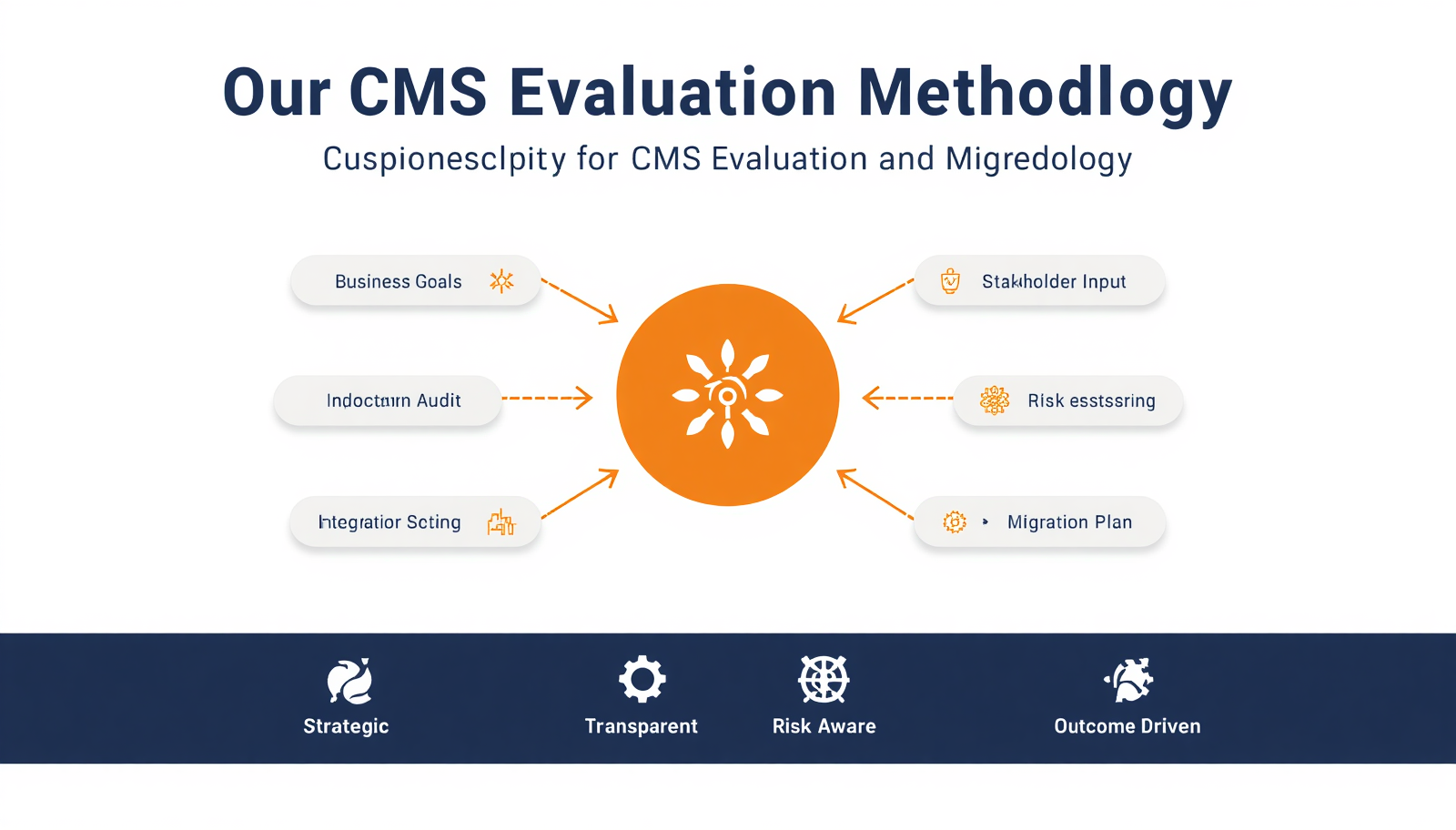
Business goals first. We start by understanding growth plans, content volume trajectory, and how marketing, IT, and other departments actually want to operate day to day before we touch on platform comparisons.
-
Stakeholder alignment. Marketing wants editorial independence. IT wants security and maintainability. Finance wants predictable costs. Surfacing these priorities early prevents a platform decision from getting unwound mid-implementation.
-
SEO and AEO preservation planning. Before any migration begins, we map the existing URL structure, identify which pages carry the most organic and AI citation value, and build a redirect and structured data strategy to protect visibility during the transition.
-
Content inventory and structure analysis. Understanding what content exists, how it’s organized, and what content types the business will need going forward shapes which platform’s content modeling actually fits.
-
Migration risk assessment. We name risks honestly upfront, including data loss, downtime, broken integrations, and SEO or AEO impact, so the migration plan deliberately mitigates them.
-
Platform scalability evaluation. We look at how the platform performs under the specific growth scenarios relevant to that business, not vendor claims.
-
Integration requirements. We map the platform against the organization’s existing CRM, marketing automation, and analytics tools.
-
Governance considerations. Who can publish what, what approval workflows are needed, and how the platform supports the actual team structure.
-
Long-term operational efficiency. A platform that costs more upfront but reduces the ongoing maintenance burden can be the better financial decision over a five-year horizon.
This is the process that shapes our CMS recommendations and migration plans, and it’s why platform choice always follows business analysis rather than the other way around.
Final Verdict: Which CMS Performs Best in 2026?
There is no single best CMS platform that fits every organization.
-
For most small to mid-sized businesses, WordPress remains the strongest overall choice in 2026, balancing cost, flexibility, SEO and AEO performance, and ease of use, provided the implementation is built properly.
-
For large enterprises with complex personalization or multi-brand needs and the budget to support them, Sitecore and AEM remain credible options, though organizations should assess whether they’re using enough advanced functionality to justify the cost.
-
For organizations with complex content structures and stringent compliance requirements, Drupal is a strong open-source alternative to proprietary enterprise platforms.
-
For marketing teams deeply invested in HubSpot’s ecosystem, HubSpot CMS offers integration value that’s hard to replicate elsewhere.
-
For e-commerce businesses, Shopify remains the default strong choice.
-
For organizations building genuinely complex multi-channel experiences with strong engineering teams, Contentful’s headless approach offers unmatched flexibility.
The practical advice for decision makers: map your actual business requirements first, weigh the total cost of ownership over a multi-year horizon, and involve the teams who will use the platform daily before finalizing a decision.
FAQs
There is no universal answer. WordPress is generally the strongest overall choice for small to mid-sized businesses, while Drupal, Sitecore, and AEM suit larger enterprises with more complex requirements.
WordPress and Drupal both offer strong native SEO capabilities, structured data support, and content formats that AI answer engines can extract and cite reliably. Webflow and Shopify perform well for their respective use cases.
Yes, when properly architected with appropriate hosting, security practices, and development standards. Enterprise WordPress implementations increasingly compete with proprietary platforms while offering lower total cost of ownership.
Most mid-sized migrations take between two and six months when properly planned, including content migration, SEO preservation, testing, and launch.
High licensing and implementation costs, longer implementation timelines, dependency on specialized and expensive developer talent, and the risk of paying for functionality the organization doesn't fully use.


 WooCommerce Solutions
 Solutions for WordPress