Introduction
Eventually, every business owner finds themselves at the same crossroads.
Their WordPress website works. Products are listed. Pages load. The contact form sends emails. However, as the state of affairs advances from “it works” to “it does exactly what our business requires,” there’s a disconnect that widens each time.
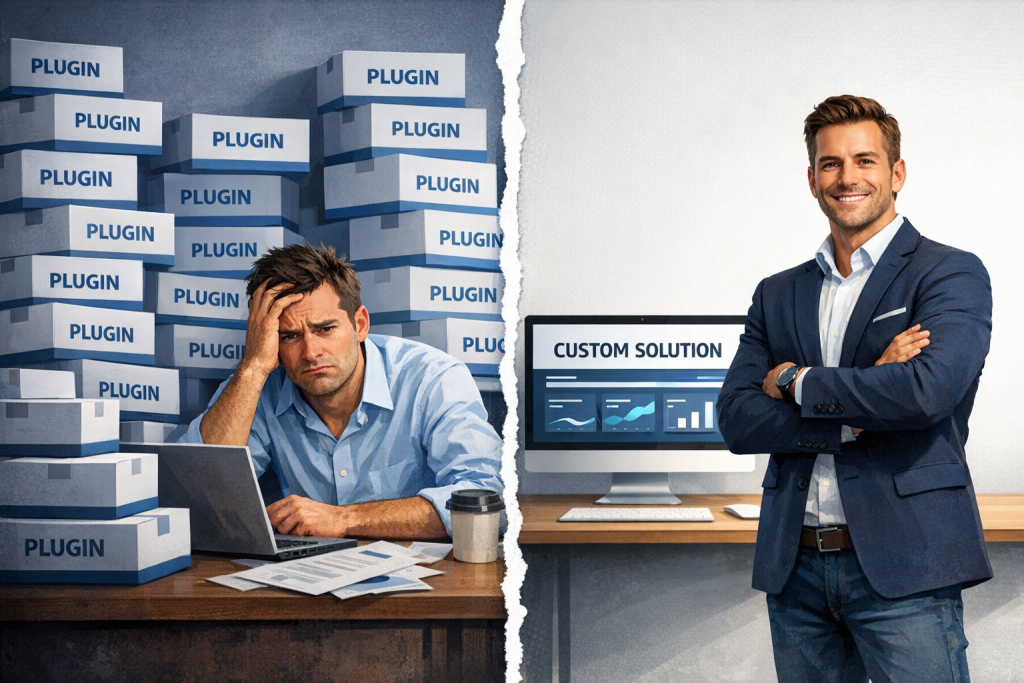
They use a plugin to correct it. Then yet another plugin to repair the damage done by the first. A third plugin to link the two together. Soon enough, the site is running on a fragile stack of tools, each designed for somebody else’s needs and patched together with hacks that no one really understands anymore.
This problem affects all businesses because it represents one of the main obstacles that WordPress-based companies experience. The problem exists because there is a straightforward solution that needs no maintenance work after implementation.
Custom WordPress plugins.
Not that custom is always good. But because when your business has a specific requirement with specific workflows and for a purpose, you always need a tool specifically built to meet that that will succeed as compared to a generic solution targeting the largest target market possible.
WordPress powers 43.2 percent of all sites on the web today. There are now more than 70,000 choices in the plugin directory. Having more choice seems beneficial. Practically, more plugins = more bloat + conflicts + security vulnerabilities and hours wasted managing tools instead of running your business.
The guide explains the proper times to use custom WordPress plugins for better results and demonstrates their actual value through real-world examples. The guide provides a comparison between custom WordPress plugins and prebuilt solutions while showing businesses when to stop using standard software tools.
What Are Custom WordPress Plugins
So before jumping into the when and the why, let us be clear about what custom WordPress plugins are because this term is often used a lot but in a loose context.
A custom WordPress plugin is a software module specially designed to extend and improve the functionality of your site from the WordPress core. These tools are not just optional extras for large enterprises anymore in the current digital landscape. They are, in effect, strategic assets specially designed to accommodate business logic unique to the organization and proprietary workflows and linkages that off-the-shelf solutions cannot manage.
Translation: a premade plugin is something that a dev built for the masses. A custom WordPress plugin is that which is developed exclusively for how your business functions. No more, no less, and with zero waste.
That distinction sounds straightforward. Getting it right has a major business impact.
Why Use Custom WordPress Plugins
The best part is that most of the guides on this topic start with abstract benefits. Well, here is something more realistic instead.
You are having a service business where online appointments are booked. You set up a hot new booking plugin. It does basic scheduling but doesn’t integrate with your internal CRM. Thus, you install an integration plugin. Client secret not supported for your CRM version You discover a workaround employing another automation tool. But you have three plugins doing what one custom solution could do cleanly (and now they all need to be monitored, updated, and occasionally fight each other when conflict comes).
This is exactly what makes using a custom WordPress plugin a real business question. Not because custom is always better. However, generic tools add complexity, not reduce it, when your business has particular needs.
Designed for this, a custom plugin creates a true bi-directional flow of information within seconds and compliments your internal operations. Instead of using connectors by third parties that are often broken or not mapping the data you require, everything works as it is meant to work in your business.
The Real Benefits of Custom WordPress Plugins
Built Around Your Business Logic
Each business has processes and rules that are specific to how it runs. Of course, a law firm would handle the initial intake of their new clients differently as compared to a logistics company. The requirement of access control between the membership platform and wholesale distributor differs.
This is where the significance of custom WordPress plugins comes into play. When a plugin is designed around your needs, each aspect has its purpose. No bloat from the features you’ll never use, and no compromise where the tool barely does what you need. That was the brief, really—it does exactly what you need.
Performance That Generic Plugins Cannot Match
Modern web architecture emphasizes the need for clean and lean code that does one specific thing just for business functionality without technical spam. A common all-in-one plugin will load CSS, JavaScript, and database queries for fifteen features you never use, just to power the two that you do.
Loading what is required using a custom solution That directly contributes to page speed, Core Web Vitals scores, and ultimately the conversion rates of every page on your site.
Security Without the Shared Vulnerability Problem
Not every target is for attack, but we have only one. Attackers scan for sites that run outdated, vulnerable versions of popular plugins at scale since one vulnerability can easily lead to millions of affected sites.
Not a public-list custom, not cataloged in vulnerability databases, and does not fall into automated exploit scanners; follows a plug-in-type unit. This eliminates a class of risk that is exclusive to running popular software with known exposure levels publicly.
Scalability on Your Own Terms
Prebuilt plugins are designed for the largest audience possible. The roadmap for development is based on what most users want, not what it is that your business can be meeting next quarter.
Built for your business, the roadmap is all yours with WordPress plugin customization. New feature needed? Build it. New platform integration required? Update it. You never are waiting on another developer to set the priority of your work or hostage to price fluctuations on a tool your operations rely on.
Custom vs Prebuilt WordPress Plugins: An Honest Comparison
The main question business owners want to answer through their research leads directly to the present topic. The explanation will follow direct and honest testing, which describes all details.
Prebuilt plugins are the right choice when:
The functionality you need is actually pretty standard. Basic SEO tools, contact forms, and image galleries. The prebuilt market already has an abundance of reasonably priced, production-grade solutions for a variety of common use cases too, and rebuilding those from scratch would be wasteful.
You are in the process of validating an idea. Within the context of a new feature that you are unsure if it is worth building, a prebuilt plugin allows you to validate your idea quickly before spending development budgets.
A simple requirement is always constrained by budget and timeline. In real, simple use cases the initial cost of a custom development project does not always produce immediate commercial viability.
Custom WordPress plugins are the right choice when:
You have enough specific requirements that you cannot drop in any prebuilt integration and use it cleanly without extensive workarounds.
You have lost precious developer time managing plugin conflicts, debugging edge cases, or maintaining brittle integrations between too many tools.
Your company deals with sensitive data or operates in a highly regulated industry where data handling control is not up for discussion.
You are embedding competitive differentiation within your website. The attributes that make your business unique online should not be available to every competitor within one plugin listing.

Clear Signs Your Business Needs Custom WordPress Plugin Development
These are the definite situations where investing in WordPress plugin development translates into clear and measurable return.
You Are Running Multiple Plugins to do one job.
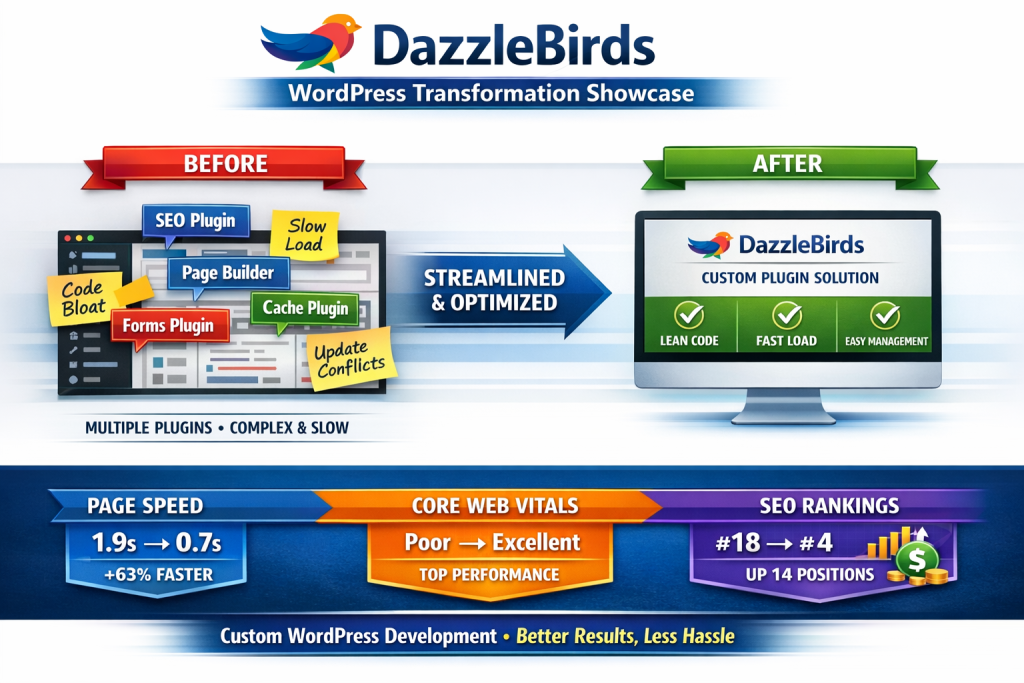
If it takes walking through a series of three or more interconnected plugins to explain how any given feature works on your site, that is technical debt inherently built into your architecture. Every link in that chain represents an area of maintenance responsibility and a point of potential failure. A custom plugin that replaces the whole chain is almost always more stable, faster to load, and tons easier to maintain down the line.
Your Team Handles Repetitive Manual Tasks That Should Be Automated
Custom development can take some recurring tasks, which somebody on your team performs with a regular schedule inside your website. Export data, reports, notifications to customers, restocking of items, and booking confirmations. The return from custom WordPress plugin development is simple to calculate when you consider staff hours that are being used for tasks that can be taken care of automatically with a plugin.
Your Website Needs to Communicate With External Systems
The process of connecting WordPress to CRM systems, ERP systems, inventory systems, and external APIs through prebuilt connectors. The first option exists as an unimplemented solution, while the second option handles partial system requirements, and the third option fails when system updates occur. Your website needs custom development work because your business uses it to reach customers and bring in leads and handle order processing.
You Are Experiencing Performance Issues From Plugin Overhead
Your site performance issues need resolution through performance audits, which show excessive plugin usage as one of the main performance issues. The use of one custom-built plugin produces better results than five different pre-existing tools that offer the same functions.
Your Business Has Grown Beyond What Your Current Setup Handles
The methods that proved successful for your business at one hundred customers will fail when your business reaches one thousand customers who use advanced systems for their high-volume operations. The fastest way to discover the boundaries of standard software applications occurs when businesses expand their operations. Your business reaches its development limit when your WordPress website begins to obstruct your operations and custom development becomes the solution for your situation.

What WordPress Plugin Customization Actually Involves
Many business owners assume that developing custom WordPress plugins requires substantial resources that only large companies can afford. In practice, the scope varies enormously depending on what needs to be built.
A skilled developer needs several days to create a basic custom plugin that connects form submissions with a particular CRM endpoint. A complex multi-role workflow system with external API integrations, custom admin interfaces, and automated notifications is a larger project. Most business requirements fall somewhere between those two ends of the spectrum.
You need to create proper WordPress plugin customizations, which begin with a precise project description that defines the problem to be solved and the functions to be performed and the functions to be restricted and the criteria for successful operation in its active state.
Your custom solution will be constructed according to current standards, which enable your development team to create scalable products that remain operational throughout platform development. Your system requires proper design, which functions correctly at the beginning yet causes problems after one year of operation.
How Custom WordPress Plugins Directly Support SEO and Growth
This connection deserves more attention than it usually gets.
Confirmed Google ranking factor: site speed. WordPress plugin bloat is one of the frequent causes of poor Core Web Vitals scores. In other words, the new leaner plugin architecture directly contributes to higher performance scores, which, of course, translates into more powerful organic rankings.
Of course, the benefits of custom WordPress plugins go further than speed; they also facilitate unique user experiences and can reduce bounce rates while increasing time on site or improving conversion paths throughout the buying journey. These behavioral signals contribute to how Google assesses the quality and relevance of your site in the long term.
They also allow for more specialized implementations of structured data, custom internal linking logic, and content workflows to be used that would likely not be possible or effective with prebuilt tools.
WordPress customization services with custom plugin development are not simply capabilities for websites; they represent an investment in competitive search visibility. For serious businesses, representing organic growth and lead generation on their site—so you should absolutely consider adding these developers to your team or retaining them as a consultant if first-party resources may be limited.

Why the Right Development Partner Makes All the Difference
Deciding when you need custom WordPress plugins is one thing. The decision to select well-suited people that will build them is what makes the difference in whether their investing delivers real value today and tomorrow.
At launch, the line between a well-built custom plugin and one that has been poorly put together can be less than clear-cut. On day one, both might seem to work just fine. The one that is poorly built raises issues six months later when the WordPress core update breaks it, starts causing database performance problems at scale, or you need to extend its functionality and realize building on top of code is impossible cleanly.
Investment in professional WordPress plugin development (as long as it’s built to current coding standards, properly documented, and scaled/maintainable architecture) is a valuable asset over time. Without those standards, quick-buck devops code is simply a ticking time bomb that’s going to get increasingly harder for you to take care of as the years go by.
So when you assess the WordPress customization services, if the team asks preparation questions before suggesting anything and then gives documentation as a part of delivery along with having a proven experience building out integrations to other systems that your business relies on and treats how your specific kind operates or what it needs in terms of software measures first (not just reverse-engineering this so they can fit into some template already prepared), believe us—these are signs pointing at being able to trust someone.
If done correctly, custom WordPress development is an investment for the long term in your site’s capacity and your team’s proficiency. The right development partner will know this from that very first conversation.
Why Dazzlebirds for Custom WordPress Development
Dazzlebirds makes WordPress development through custom solutions, which they consider their main service. The team has dedicated its work to this service since its establishment.
Before any WordPress plugin development work at Dazzlebirds, we first need to see how your business functions. What processes need automating? What systems need integrating? Which of your competitive advantages require some wicked custom code embedded into your site in a manner no prebuilt plugin available in a public directory can do for you uniquely?
The team then builds custom solutions using current development standards on that foundation, complete with a clean architecture so the app scales out as your business grows and documentation to make it simple for whomever is responsible for future updates.
It does not matter if you need a simple single plugin for one specific operational issue or a complicated multifeature custom solution ripping an entire stack of Best premade tools—Dazzlebirds will treat every project with the same mindset and respect for precision and longevity, be it WordPress customization services covering your whole site architecture end-to-end.
Are the businesses that are standing out online using different plugins than their competitors? They’re the ones that actually invested in building something their competitors could never make by just going to a plugin directory. And this is where Dazzlebirds shines in custom WordPress development.
Conclusion and Call to Action
Plugins written generically for everyone will always be a compromise to someone. Every business has its own specific workflows, integration requirements, performance standards, and user experience goals that a prebuilt solution capable of serving the broadest possible audience will never completely meet.
That is where custom WordPress plugins came about, to bridge that gap. They deliver exactly what your business needs, on the terms you lay out, at a maintenance schedule that works for you and is 100% owned by you.
Patching multiple plugins together to mimic functionality you require, your team is spending hours on manual processes that should be automated by the website software, or site performance is being dragged down due to plugin overhead and inability to compete online, delivering an experience at which your business rivals thrive. These are all big indicators custom WordPress plugin development will deliver a return.
The question is not if your business needs some custom solution, as it covers more miles. It is this: Do you wait for that frustration to become costly enough before making the decision, or do you make proactive moves when competitive opportunity is still very much in front of your nose?
If you are looking for custom WordPress plugin development, get in touch with Dazzlebirds today to schedule your free consultation. Rather than telling them what your business needs, ask the team to tell you how exactly they will build that properly, cleanly, and made to last.
Schedule Your Free Custom WordPress Development Consultation With The Dazzlebirds
Because your website should behave like the way your business behaves. Not the other way around.
FAQs
Custom WordPress plugins are purpose-built tools designed specifically for your business workflows, unlike generic prebuilt options. They eliminate unnecessary bloat, improve performance, and do exactly what your business requires.
When you are running multiple plugins to do one job, dealing with constant conflicts, or handling repetitive manual tasks, your business has clearly outgrown prebuilt solutions.
The upfront cost is higher, but custom plugins eliminate ongoing workaround costs, reduce maintenance time, and deliver long-term ROI that generic plugins simply cannot match.
Custom plugins load only necessary code, improving page speed and Core Web Vitals scores directly. Faster sites rank better on Google and convert significantly more visitors into customers.
Timelines vary by complexity. A focused single-function plugin can be delivered within days. Larger integrations with external systems typically require a few weeks of professional development work.


 WooCommerce Solutions
 Solutions for WordPress