Shipping rarely feels like a strategic priority until it becomes the reason a business can’t grow any further. For manufacturers, wholesalers, and distributors running B2B e-commerce operations, this moment tends to arrive quietly. Order volume climbs, a second warehouse comes online, a major account negotiates custom pricing tiers, and suddenly the shipping logic that worked fine at a smaller scale starts generating errors, delays, and support tickets.
A proper B2B e-commerce shipping setup is not the same project as configuring shipping for a direct-to-consumer store. It involves order management, warehouse coordination, ERP data, carrier contracts, and business rules that shift depending on customer type, order size, and destination. When these pieces aren’t connected correctly, the cracks show up in fulfillment delays, inaccurate freight quotes, and warehouse teams manually re-keying order data.
This guide walks through what a scalable B2B e-commerce shipping setup actually requires, why manual and semi-automated workflows break down under growth, and what operations, logistics, and digital transformation leaders should prioritize when building shipping infrastructure meant to last beyond the next funding round or peak season.
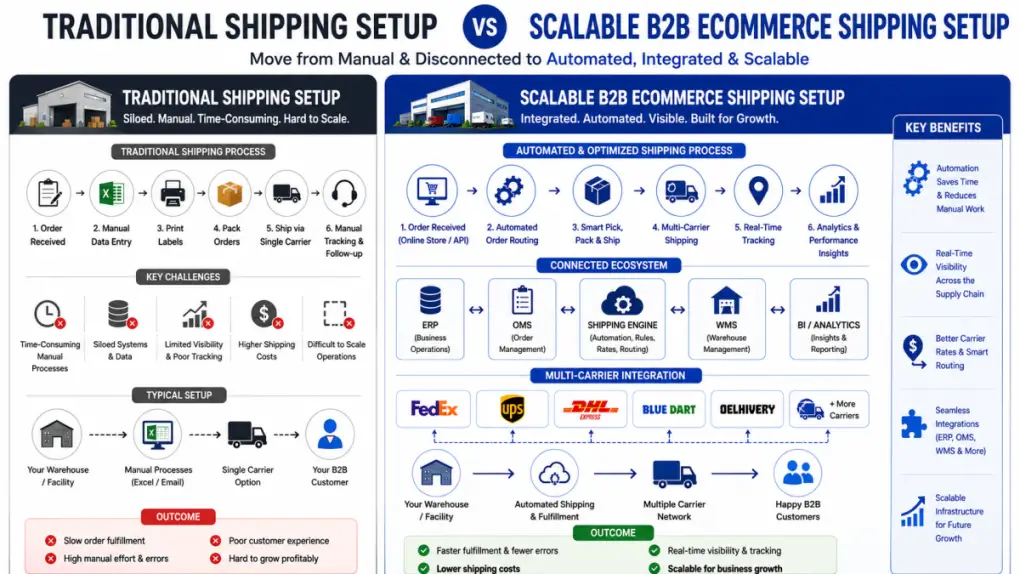
What Is a B2B Ecommerce Shipping Setup?
A B2B e-commerce shipping setup is the combination of systems, rules, and integrations that determine how orders move from purchase to delivery for wholesale, distribution, and enterprise buyers. It covers everything from how shipping costs are calculated at checkout to how warehouse teams receive pick lists and how tracking data reaches procurement departments.
The objective isn’t just “getting packages out the door.” A well-built setup needs to
- Apply different shipping rules based on account type, contract terms, or order volume
- Support freight, LTL, and parcel shipping within the same platform
- Route orders to the correct warehouse automatically
- Keep inventory and shipping data synchronized with ERP and WMS systems
- Scale without manual intervention as order volume or SKU count grows
How B2B Shipping Differs From B2C Shipping
| Factor |
B2C Shipping |
B2B Shipping |
| Order size |
Typically single units |
Bulk, pallet, or freight-level |
| Pricing |
Fixed or flat-rate |
Negotiated, tiered, contract-based |
| Fulfillment |
Single warehouse common |
Multi-warehouse, regional routing |
| Shipping methods |
Parcel carriers |
Parcel, LTL, FTL, freight brokers |
| Buyer expectations |
Fast, low-cost delivery |
Reliable, documented, accountable delivery |
Scalability matters here because B2B shipping complexity compounds. A single new distribution region, a new carrier contract, or a new product line with special handling requirements can multiply the number of shipping rules a system needs to evaluate correctly. A setup that isn’t built to absorb that complexity ends up requiring workarounds, spreadsheets, and manual overrides — all of which slow fulfillment down.
Why Traditional Shipping Setups Stop Working
Most B2B e-commerce businesses start with a shipping configuration that’s manageable: one warehouse, a couple of carriers, and relatively simple rate rules. That setup works well right up until the business starts scaling, at which point several pressure points tend to appear at once.
Increasing order volume exposes every manual step in the fulfillment process. What took a warehouse team a few minutes per order becomes hours of backlog during peak periods.
Multiple warehouses introduce routing decisions that spreadsheets and basic plugins were never designed to handle: which location has stock, which is closest to the customer, and which split shipment makes the most operational sense.
Wholesale pricing structures mean shipping costs can’t be calculated with a single flat formula. Rates need to reflect contract terms, order thresholds, and account-specific agreements.
Complex shipping rules—restricted destinations, hazardous materials handling, minimum order quantities—often live in someone’s head or an outdated document rather than in the platform itself.
Multiple carrier management becomes unmanageable without integration. Manually checking rates and generating labels across several carriers is not sustainable past a certain order volume.
Inventory synchronization issues cause overselling or shipping delays when stock counts across warehouses and the storefront fall out of sync.
Manual order processing slows everything downstream — from label printing to customer communication — and increases the likelihood of costly fulfillment errors.
Customer expectations in B2B buying have shifted. Procurement and operations teams expect tracking visibility, predictable delivery windows, and accurate shipping documentation, much like they’d expect from any modern digital purchasing experience.
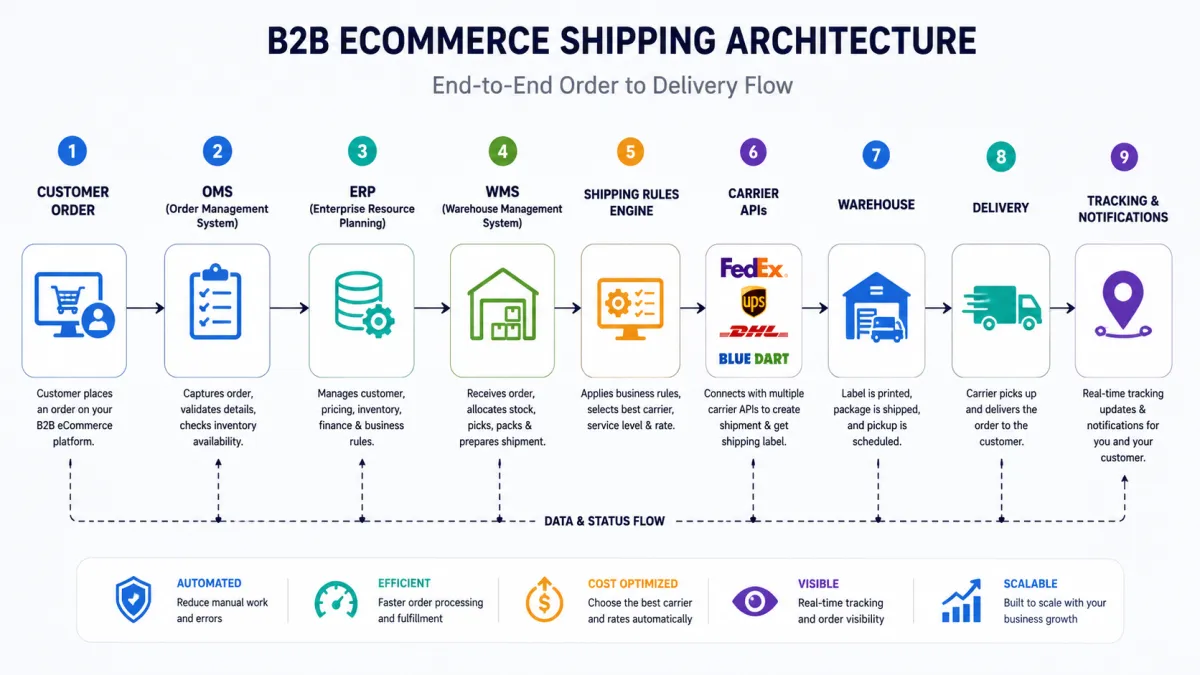
Core Components of a Scalable B2B E-commerce Shipping Setup
Order Management System (OMS)
The OMS acts as the coordination layer for every order, tracking its status from placement through fulfillment and delivery. In a scalable setup, the OMS needs to communicate cleanly with the storefront, ERP, and warehouse systems rather than existing as an isolated tool.
Warehouse Management System (WMS)
A WMS manages inventory location, picking, packing, and shipping readiness inside the warehouse itself. For multi-warehouse operations, WMS data needs to feed back into the OMS in near real time so orders route correctly.
Shipping Rules Engine
This is where account-specific pricing, order thresholds, destination restrictions, and carrier preferences are applied automatically. A rules engine removes the need for staff to manually determine which shipping method or rate applies to a given order.
Carrier Integrations
Direct API connections to parcel carriers, LTL providers, and freight brokers allow real-time rate shopping, label generation, and tracking updates without manual carrier portal logins.
ERP Integration
ERP systems typically hold the source of truth for inventory, pricing, and customer account data. Without a clean ERP integration, shipping decisions are made on outdated or incomplete information.
Inventory Synchronization
Real-time inventory visibility across all warehouse locations prevents overselling and ensures orders are routed to a location that can actually fulfill them.
Tracking & Notifications
Automated tracking updates reduce “where is my order” support requests and give procurement teams the visibility they expect from a modern B2B buying experience.
Returns Management
B2B returns often involve different rules than consumer returns—restocking fees, partial returns, and freight return logistics—and need to be built into the shipping setup rather than handled as an afterthought.
Shipping Automation for High-Volume B2B Operations

Once order volume reaches a certain threshold, manual shipping management stops being a staffing issue and becomes a structural limitation. Automation addresses this directly through several connected processes:
- Automatic order routing sends each order to the correct warehouse based on stock availability and proximity to the customer
- Shipping label generation happens automatically once an order is ready to ship, removing manual data entry
- Address validation catches errors before shipment, reducing costly delivery failures and reshipments
- Shipping rate calculation pulls real-time rates from multiple carriers rather than relying on static tables
- Batch processing allows warehouse teams to process large volumes of orders together during peak periods
- Carrier selection logic automatically chooses the most cost-effective or fastest option based on business rules
- Delivery notifications keep buyers and internal teams informed without manual follow-up
- Workflow automation connects each of these steps so an order moves from placement to dispatch with minimal manual touchpoints
The business benefit isn’t just speed. Automation reduces fulfillment errors, lowers labor costs per order, and creates the operational headroom needed to handle growth without proportionally growing headcount.
Multi-Carrier Shipping Strategy
Relying on a single carrier creates risk. Rate increases, service disruptions, or capacity limits during peak seasons can directly affect delivery reliability if there’s no alternative in place.
A multi-carrier strategy typically includes the following:
- Domestic vs. international carriers, since few single providers offer optimal rates and service levels across both
- Freight vs. parcel shipping, with freight typically better suited to palletized or bulk orders and parcel suited to smaller shipments
- Rate optimization, comparing live rates across carriers rather than defaulting to one provider
- Carrier redundancy, so operations aren’t dependent on a single provider’s network or pricing
- Performance monitoring, tracking on-time delivery rates and service issues by carrier to inform future contract negotiations
For B2B businesses shipping to a mix of retail, wholesale, and distribution partners, carrier flexibility often has a direct impact on both cost control and customer satisfaction.
Multi-Warehouse Fulfillment Strategy
As B2B businesses expand into new regions, fulfilling every order from a single location becomes both slower and more expensive. A multi-warehouse fulfillment strategy addresses this through the following:
- Warehouse allocation logic that assigns orders to the location best positioned to fulfill them
- Regional fulfillment, reducing transit time and freight cost by shipping from the closest available stock
- Inventory balancing across locations to prevent one warehouse from being overstocked while another runs short
- Split shipments, when a single order needs to be fulfilled from more than one location
- Faster delivery, a direct result of shorter shipping distances
- Lower shipping costs, since freight and parcel rates typically scale with distance and zone
Getting this right requires accurate, real-time inventory data across every location — without it, the routing logic is only as good as outdated stock counts.
Optimizing Shipping Costs Without Sacrificing Service
Cost control in B2B shipping isn’t about choosing the cheapest carrier every time—it’s about building a system that consistently makes the right cost-versus-service tradeoff. Key levers include:
- Packaging optimization, reducing box size and material waste to lower dimensional weight charges
- Dimensional weight awareness, since many carriers now price based on package volume rather than actual weight alone
- Shipping zones, understanding how distance-based pricing affects total fulfillment cost by region
- Freight optimization, consolidating shipments where possible to reduce per-unit freight cost
- Automated rate comparison, so the system selects the most cost-effective carrier for each shipment automatically
- Carrier negotiations, using shipping volume and performance data as leverage for better contract terms
- Shipping analytics, tracking cost-per-shipment and delivery performance trends over time to inform ongoing decisions
Common Shipping Mistakes Growing B2B Businesses Make
Several patterns show up repeatedly in businesses that outgrow their shipping setup:
- Treating shipping rate configuration as a one-time setup rather than something that needs regular review as contracts and volume change
- Relying on manual processes for tasks—like carrier rate comparisons or label generation—that should be automated well before volume makes this unsustainable
- Failing to integrate ERP and WMS data, resulting in shipping decisions based on outdated inventory or pricing
- Underestimating the complexity of multi-warehouse routing until a shipment error affects a major account
- Not tracking shipping performance data, which makes it difficult to identify recurring delivery issues or negotiate better carrier terms
- Building shipping logic directly into a storefront platform without a scalable rules engine, creating a system that becomes difficult to maintain as rules multiply
Best Practices for Future-Proof Enterprise Shipping
Building a shipping setup that holds up over time requires treating it as infrastructure rather than a one-off configuration task. A few practices consistently separate scalable setups from ones that need frequent rework:
- Prioritize automation for any process that’s repeated at volume, from label generation to rate calculation
- Invest in API integrations rather than manual data transfers between systems
- Ensure ERP connectivity is treated as a core requirement, not an optional add-on
- Continuously review warehouse optimization, especially as new locations or regions are added
- Put performance monitoring in place across carriers, warehouses, and fulfillment timelines
- Define clear shipping KPIs—on-time delivery rate, cost per shipment, error rate—and review them regularly
- Build scalability planning into every system decision, evaluating whether a tool or workflow will still work at two or three times current order volume

How DazzleBirds Helps Businesses Build Scalable Shipping Systems
Building a shipping setup that can support B2B growth requires a structured process, not a single configuration change. This is the approach DazzleBirds follows when working with manufacturers, wholesalers, distributors, and enterprise WooCommerce businesses:
Understanding the Shipping Requirements
The first thing we would do is understand how the business currently handles shipping and what challenges are expected as order volume grows.
We would identify:
- Products being shipped
- Shipping destinations
- Carriers in use
- Order volume
- Warehouse locations
- Business-specific shipping rules
This discovery phase helps define a shipping strategy that supports both current operations and future growth.
Analyzing the Existing Shipping Setup
Once the requirements are understood, we would evaluate how the current eCommerce platform manages shipping.
We would review:
- Shipping zones
- Shipping methods
- Rate calculation rules
- Packaging and box logic
- Order fulfillment workflow
- Third-party shipping integrations
The goal here is to identify limitations that could create operational challenges as the business scales.
Designing the Shipping Strategy
Based on the findings, we would create a scalable shipping architecture that supports the business requirements.
This may include:
- Rule-based shipping methods
- Real-time carrier rates
- Multi-warehouse fulfillment
- Split shipments
- Local pickup options
- International shipping
- Shipping restrictions and custom rules
A well-designed shipping strategy reduces manual work while improving accuracy and customer experience.
Automation & Integrations
As order volumes increase, automation becomes essential.
We would review:
- Carrier integrations
- Shipping label generation
- Tracking updates
- ERP and WMS synchronization
- Inventory availability
- Customer notifications
Automating these processes helps reduce fulfillment errors and improve operational efficiency.
Scalability & Performance
A growing online store needs a shipping system that can support increasing demand.
We would ensure the solution can efficiently handle:
- Higher daily order volumes
- Multiple fulfillment locations
- Complex shipping rules
- International expansion
- Additional carriers
- Future business requirements
This creates a flexible shipping infrastructure that can grow without requiring a complete redesign.
Testing & Validation
Before launching the shipping workflow, we would validate:
- Shipping rate calculations.
- Checkout functionality.
- Carrier integrations.
- Order fulfillment workflows.
- Customer notifications and tracking.
This ensures the shipping system operates accurately across real-world ordering scenarios.
Expected Outcome
The end result would be a scalable eCommerce shipping solution that automates fulfillment, supports complex shipping requirements, improves operational efficiency, and delivers a reliable checkout and delivery experience as the business continues to grow.
This process draws on hands-on experience with custom WooCommerce development, enterprise e-commerce development, ERP integration, API integration, warehouse integrations, shipping customization, and performance optimization—the same building blocks covered throughout this guide.
Conclusion
A scalable B2B e-commerce shipping setup isn’t something businesses need until, suddenly, they need it urgently. Order volume grows faster than manual processes can absorb, a second or third warehouse comes online, and shipping rules that once fit in a single plugin configuration start requiring workarounds that slow the whole operation down.
The businesses that scale smoothly are the ones that treat shipping infrastructure — OMS, WMS, ERP integration, carrier connections, and automation — as a core part of their growth strategy rather than a problem to solve after it becomes urgent. A well-built B2B e-commerce shipping setup reduces fulfillment errors, controls shipping costs, and gives operations teams the visibility they need to make informed decisions as the business expands.
Investing in scalable shipping infrastructure before complexity becomes a bottleneck is what separates B2B e-commerce businesses that scale predictably from those that spend their growth phase firefighting fulfillment problems instead of building on top of them.
FAQs
A B2B e-commerce shipping setup is a connected system that manages order processing, warehouse operations, carrier selection, shipping automation, tracking, and ERP integration. It helps businesses streamline fulfillment, reduce manual work, improve delivery accuracy, and scale operations efficiently.
Shipping automation reduces manual tasks by automatically selecting carriers, generating shipping labels, validating addresses, calculating shipping rates, and sending tracking updates. This improves operational efficiency, minimizes errors, speeds up fulfillment, and supports business growth as order volumes increase.
Businesses can create a scalable B2B e-commerce shipping setup by integrating an ERP, order management system (OMS), warehouse management system (WMS), carrier APIs, shipping automation, inventory synchronization, and analytics to efficiently manage increasing order volumes and complex fulfillment workflows.
Using multiple shipping carriers enables businesses to compare rates, improve delivery coverage, reduce shipping costs, avoid service disruptions, and offer flexible shipping options. A multi-carrier strategy also supports regional, national, and international fulfillment requirements more effectively.
Enterprise B2B ecommerce shipping typically requires ERP integration, Order Management Systems (OMS), Warehouse Management Systems (WMS), carrier API integrations, inventory synchronization, shipping automation, tracking solutions, and analytics dashboards to improve fulfillment efficiency, operational visibility, and scalability.


 WooCommerce Solutions
 Solutions for WordPress