Introduction
If your website is not showing on Google – or even on AI tools like chat – this can be due to some common seo mistakes. Small issues such as duplicate content, slow loading page, or wrong keywords can silently prevent your website from performing your best. Good news? These problems are not permanent – they can be fixed with the right steps. With the right fix, you can bend things around and help to rank your site high, load rapidly, and attract more visitors.
In this guide, we show you the biggest seo problem businesses make, why they matter, and how to fix them. In this way, your site can load faster, rank high, and perform better on all devices.
1. Duplicate Content Problems
The Mistake:
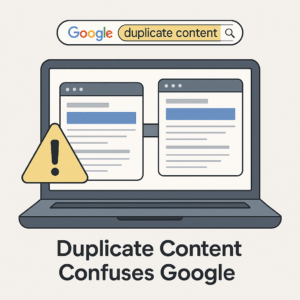
Duplicate material occurs when the same or very similar text appears on more than the first pages of your website – or even on various websites. It confuses the search engines like Google because they do not know which version of the page to rank. Instead of giving full ranking power to a page, Google divides it between duplicates. This often leads to a lower ranking than your site.
Duplicate content can appear in many ways, such as:
- “WWW” vs “non-www” or “http” vs “https”are not properly managed
- Using the same product details on many e-commerce pages
- Creating an additional version of the same page through a printer-friendly page, categories or tags
- Posting the same blog article in different classes of your site
- Why It Matters:
If Google cannot determine which page to prefer for your site’s visibility. This means that fewer visitors, weak SEO, and less confidence from both search engines and users.
How to Fix It:
• Use canonical tags: Which page is the main version of Google so that the page gets ranking credit.
• Set 301 redirect: If two pages serve the same objective, mix them in the red and strong page.
• Audit your site: Use devices such as copyscape, Siteliner, or Ahrefs to find duplicate content.
• Integrated material: Instead of having several small pages on the same subject, merge them into a wide, useful page.
• Fix the URL variations: Make sure your site continuously uses the same format (eg “www” vs. www, “or” http “versus” https “), so search engines do not consider them as different pages.
The Bottom Line:
Cleaning the duplicate material makes it easy for the search engine to crawl your site and site get a better experience. These two help your website rank more.
2. Keyword Stuffing & Poor Keyword Targeting
The Mistake:
Keyword stuffing occurs when you use the same keywords several times in your content. This makes writing strange and unnatural. Google also sees it as spam, which can damage your ranking. Another mistake is targeting the wrong keyword – which people are really searching. In that case, even if you get traffic, it will not be the right audience.
How to Fix It:
Focus on what people want: Write a material that actually answers your audience questions, not just the material packed with keywords.
Use variations: Add long-tail keywords (eg “how to fix SEO mistakes”) to create your writing flow naturally.
Review your targeting: To check if you are focusing on the correct keywords and adjust if necessary.
The Bottom Line:
The use of smart keywords is about balance. Do not overdo it – make your content clear, natural, and helpful so that both reader and search engines rely on it.
3. Thin Content Issues
The Mistake:
Thin content means pages with very few useful information. These pages do not rank well because search engines prefer detailed, useful and valuable materials that really answer what people are looking at.
How to Fix It:
• Add more values: Extend the small pages by incorporating FAQ, example or case study.
• Mix weak pages: If you have many small posts on the same subject, merge them into a strong, detailed article.
• Write a blog deeply: Target for about 1200-2000 words with real, useful information instead of filling space only.
The Bottom Line:
The more useful and your content will be completed, the better that your ranking will be, and the chances are likely to keep you busy.
4. Mobile Optimization Mistakes
Why Mobile Optimization Matters
These days, more than half of all websites come from visiting phones. People no longer use desktops – they read and find everything right from their mobile devices.
Google also knows this.
Therefore, if your site is not suitable for mobile, then you are in trouble. Small text, hard-to-click buttons, and slow loading time leaves visitors rapidly. This increases your boom rate and damages your boost seo ranking. In short: poor mobile design = Lost Visitor + Lower Ranking.
How to Fix It
1. Make your site responsible
Your site must automatically adjust to fit any screen – desktop, tablet or phone. In this way, users get a smooth experience, whether they use any device.
2. Check with Google tool
Use Google’s free mobile optimization issues test. Just type in the URL of your site, and it will show if your site works well on mobile and highlights whether fixing is required.
3. Fix general issues
• Small buttons/links: Make them quite large so that people can easily tap with their fingers.
• Hard-to-read text: Font should be clear and easy, without zooming.
• Slow Loading: Compress images, use caching, and consider a CDN so that the page loads rapidly.
4. Improve core web vitals
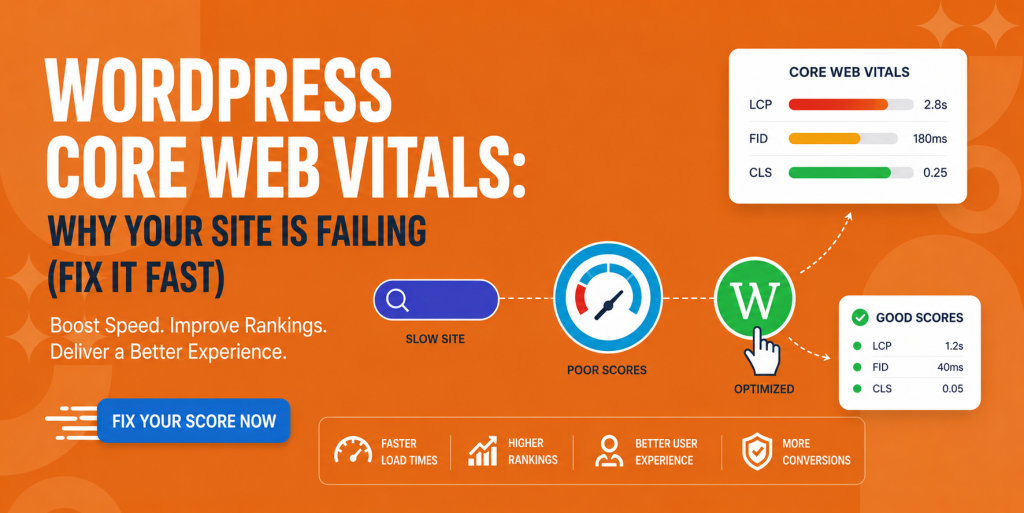
Google also sees how fast your page loads, how quickly users can interact, and how stable your layout is when loading. The improvement of these makes your site better for both users and search rankings.
5. The Mistake: Having a Slow Website
Let’s be honest – no one likes to wait for a slow website to load. Imagine that you click on a link, & it simply keeps moving. What do you do? You leave you. What else? Most people do the same.
Research suggests that if it takes more than 3 seconds to load a site, people lose patience & move forward. This means low sales, low visuals, and less confidence in your brand.
But it is not only for visitors who care about speed – Google also does. A slow site speed ranks less in search results, which makes people even additional difficult to find you.
In short: slow website = unhappy visitors + bad Google ranking.
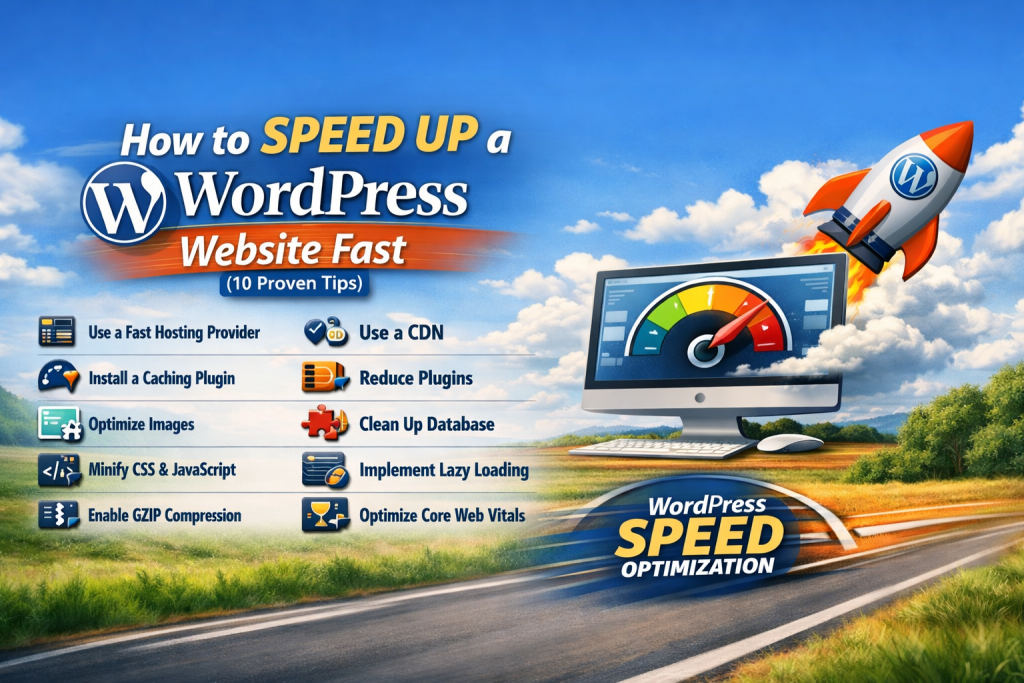
How to Fix It: Simple Steps to Make Your Website Faster
1. Shrink your images
- Large images do not use
- Use free tools
- Save your images in modern formats like WebP so that they load quickly.
Just doing this can cause your load to be cut in a few seconds from time to time.
2. Use cashing
Every time someone opens your site, their browser loads everything – from code, images, and text – from scratch. It takes time.
The cashing is like giving a shortcut to the browser. This saves a ready version of your site so that it is immediately loaded next time.
3. Upgrade your hosting
Think of your hosting provider as the foundation of your home. If the foundation is weak, the entire house suffers.
Cheap hosting means that your site is crowded on a server with hundreds of other sites, which slows down everything.
Switching on a fast hosting plan – or even better, can promote a large speed to your site – better, managed WordPress hosting and cloud hosting.
4. Check with Google Page Speed Insight
Not sure what your site slows down? Google has a free tool called Page Speed Insights.
Just enter your website link, and it will be:
• Show your speed score for both desktop and mobile
• Tell you that your site is slowing
• Suggest that you can make
It likes to get a free check-up for the health of your website.
6. The Mistake: Unoptimized URL Slugs
Have you ever seen a link full of random numbers or symbols that do not mean anything? It looks bad, is difficult to read, and does not tell you what the page is. Those are called uncontrolled URL slugs. On the other hand, when your URLs are small, clean and descriptive, they immediately tell visitors what the page is. The search engines can also understand them better, which helps to improve your ranking.
Messy links do not look only unprofessional – they remember, it is difficult to share, and it is difficult to confuse search engines. This makes it difficult for both people and Google to understand your page, which can hurt your SEO and your credibility.
Why Clean URLs Are Important
• Makes the trust – people feel more comfortable in clicking clean and clear links.
• Easy to share – copying short and simple links is very easy to copy, paste and share with others.
• Looks professional – Clean URLs give your website a polished and organized experience.
• Better SEO – Use URL to find out what a page is about in search engine. A clean URL makes it so easy.
How to Fix It: Create SEO-Friendly URLs
Here’s how you can make your link strong and more effective:
• Keep them simple and small – Do not add additional words that are not required.
• Stick to Lowercase – Always use lowercase letters to keep things consistent & clean.
• Include keywords – Use words that clearly describe the page content.
• Avoid random characters – special symbols, leave ID, or wire of meaningless text.
• Use hyphen, not underscore – Hyphen is easy to read for both people & search engines.
7. Ignoring the Balance Between SEO and PPC
Many businesses make the mistake of choosing only SEOs or only PPCs. First, it may look smart – the CO feels like free traffic after a once rank, and PPC gives you quick results. But if you rely on just one, then you are missing a very big opportunity.
How to Fix It
SEO (Search Engine Optimization): This is your long game. The result takes longer to see, but once your site ranks, it brings in a stable traffic without paying every click. In addition, it creates confidence with the right to your audience and your brand.
PPC (Pay-Per-Click Ads): This is your fast lane. When you want quick visibility, this is correct – such as when you are launching a new product or doing tests that people really click. It also helps you to sell which keywords sell before investing the construction of SEOs around you.
When you use both together, where is the real development? So instead of SEO vs. PPC, start thinking of SEO or PPC. That combo helps you to win now and win in the long time – visible, reliable and growing your business.
8. Ignoring Technical SEO Basics
The Mistake:
Many people think that SEO means adding keywords or writing long blog posts. But there is another side for this- technical SEO- and it is equally important. Another common mistake is not using HTTPS (a little paddling in the browser). Google prefers safe websites, so if you are not safe, it can hurt your ranking and make you trust the visitors less.
How to Fix It:
Make sure your website has a strong technical setup. Create a sitemap (a simple file that lists all your important pages) and submit it to the Google Search Console so that Google knows where to look. Use devices such as frogs or ahrefs to find and fix broken links – think of these as “Dead Ends” that disappoint both visitors and search engines. Link your pages to each other with each other so that people can easily detect your site, and Google can understand how your content adds. Finally, if you are not already, move your site to https. This is not only good for ranking, but it also shows visitors that your website is safe and reliable.
9. Not Optimizing Images for SEO
The Mistake:
Images are a big part of making your website attractive and attractive, but they can also be a silent SEO killer if not customized. Uploading huge, heavy images slows your site load, and in today’s world, people are not waiting for more than a few seconds before leaving. On top of that, if you are not adding a descriptive file name or ALT text, you are missing a big chance to get traffic from improved access and Google images.
10. Forgetting About User Experience (UX)
The Mistake:
You can have quality content and a beautiful design, but if it is difficult to use your site, people do not stick around. High bounce rates (when people leave quickly) send negative signs to low-engagement search engines.
How to Fix It:
Pay attention to making your site simple, clean and easy to navigate. Keep your website menu clear and easy so that visitors quickly know what they need. One of the best ways to improve the UX is that you test it yourself – brooage your website like you were a customer. Better yet, ask friends or real users to try it and tell you where they get stuck. Small twices for user experience can create a big difference between keeping people busy and promoting your SEO.
11. Skipping Local SEO (If You are a Local Business)
The Mistake: Forgetting About Local SEO
A lot of businesses, especially small and medium-sized businesses, focus only on general SEO and forget about local adaptation. This means that they are remembering those who discover services within my city. For example, if a person types “Best WordPress developer” in Ahmedabad and your site is not adapted to local discovery, they will probably find your rivals instead of you. Local SEO is important for businesses that depend on leg traffic, city-specific services or local leaders. It is one of the most common areas that people ignore.
How to Fix It:
- Set and customize your Google Business profile (East Google My Business). This is the box that shows Google Maps and local search results. Add your right business name, address, phone number, website, business hours and even photos so that people get a complete picture.
- Use local keywords in your content and metadata. Instead of writing “WordPress developer” only, there are phrases such as “WordPress Developer in Ahmedabad” or “SEO Services in Gujarat”. These small transformation search engines help to connect your business with local intentions.
- Encourage customer reviews. Positive Google Reviews not only create confidence with potential customers, but they also improve the possibilities of ha a high ranking in local search.
- Create location-specific landing pages if you serve many areas. For example, if you provide services in Ahmedabad, Surat and Baroda, having a separate page for each city will help you to show up in search of each place.
By focusing on local SEOs, you make it very easy for nearby people to search your business, go to your store or rent your services.
Conclusion
The SEO may feel complex, but most of the problems come due to some common mistakes, such as duplicate content SEO fix, slow websites, poor mobile design, or technical basics being lost. The good news is that each of these issues is a fix. By taking small steps-cleaning your content, sharpening your site, using the right keywords, and balancing with PPC-you set your website for stable, long-term development.
Remember, SEO is not about quick tricks; It is about the construction of a site that is easy to use for people and search engines. Fix the basics, improve your content, and remain constant. Over time, your site will rank higher, attract more visitors, and earn more confidence.
In Dazzlebirds, we help businesses to avoid these technical seo issues and create websites that are rapid, customized and designed to grow.
-term action plan to create a start ranking improvement and a strong foundation. For example:
• Month 1: Audit your website, set tracking, research keywords, fix technical issues, and create a content calendar.
• Month 2: Publish customized material, improve on-page SEO (title, URL, internal link), & start small link-making efforts.
• Month 3 • In the third month, focus on updating your old content, publishing the new post, and starting the construction of off-page SEO through things such as guest posting and outreach. At the same time, Google Search Console is used to track its performance to see what is working.
Remember, the SEO usually takes 6–12 months to show big results. But following a solid 3-maiden plan helps you see initial progress and creates a strong base for long-term development.
FAQs
Ans: Start by search an SEO audit with tools like Ahrefs, Semrush, or Google Search Console. These devices get problems like broken links, duplicate materials, missing meta tags and slow pages.
Fix those issues one by one:
• Add a unique title and meta details on every page.
• Speed up your site and compress images.
• Mobile-friendly.
• Reduce or remove the broken link.
• Improve internal linking so that Google can understand your site better.
The key is to fix the technical errors first, then focus on the backlink and material.
Ans: Focus on long-tail keywords, structured materials and FAQs. AI engine loves well-organised content.
Ans: The 3 C’s of SEO are:
1. Content -high-quality, centric content and valuable.
2. Reliability - Construction of Trust through Backlinks, Brand Authority and Review.
3. Code: a technically sound website (rapid speed, clean code, mobile-friendly).
When you balance all three, you create a strong SEO Foundation.
Ans: The 4 pillars of SEO are:
1. Technical SEO - to ensure that your site can be indexed and crawled (security, mobile, speed).
2. On-page SEO- Title, Title, Optimising content, Adaptation of Internal Links and Picture.
3. Building Authority with Off-Pose SEO-Backlinks, PR and social signals.
4. Material - Creating useful, relevant & attractive materials that answer the user's intentions.
Ans: Yes, both Google and AI engines give priority to fast-loading & mobile-friendly sites.
Ans: The 3-month SEO strategy is a short-term action plan to create a start ranking improvement and a strong foundation. For example:
• Month 1: Audit your website, set tracking, research keywords, fix technical issues, and create a content calendar.
• Month 2: Publish customized material, improve on-page SEO (title, URL, internal link), & start small link-making efforts.
• Month 3 • In the third month, focus on updating your old content, publishing the new post, and starting the construction of off-page SEO through things such as guest posting and outreach. At the same time, Google Search Console is used to track its performance to see what is working.
Remember, the SEO usually takes 6–12 months to show big results. But following a solid 3-maiden plan helps you see initial progress and creates a strong base for long-term development.


 WooCommerce Solutions
 Solutions for WordPress