Choosing an e-commerce platform is one of the few technology decisions that a B2B company rarely gets to make twice without pain. Migrations are expensive. They pull developers off product work, disrupt sales operations, and often take six to twelve months longer than anyone planned. Meanwhile, customers who expect a smooth self-service buying experience simply go elsewhere.
The real cost of a wrong platform choice is not the license fee. It is the compounding operational drag: manual pricing overrides, broken ERP syncs, sales reps re-keying orders, and a website that cannot support a new business unit without a six-figure change order.
This is why platform selection should be treated as a long-term business decision, not a software purchase. The right platform becomes the operating system for how a company sells, fulfills, and grows. The wrong one becomes a constraint that shapes every roadmap conversation for the next five years.
This guide lays out a practical how-to choose the right B2B ecommerce platform, a vendor-neutral framework for evaluating B2B e-commerce platforms so enterprise teams can make a decision based on business fit rather than marketing claims. If you want more context on the shift driving this decision in the first place, see Why B2B Buyer Expectations Are Changing Today.
Why Platform Selection Matters More Than Ever
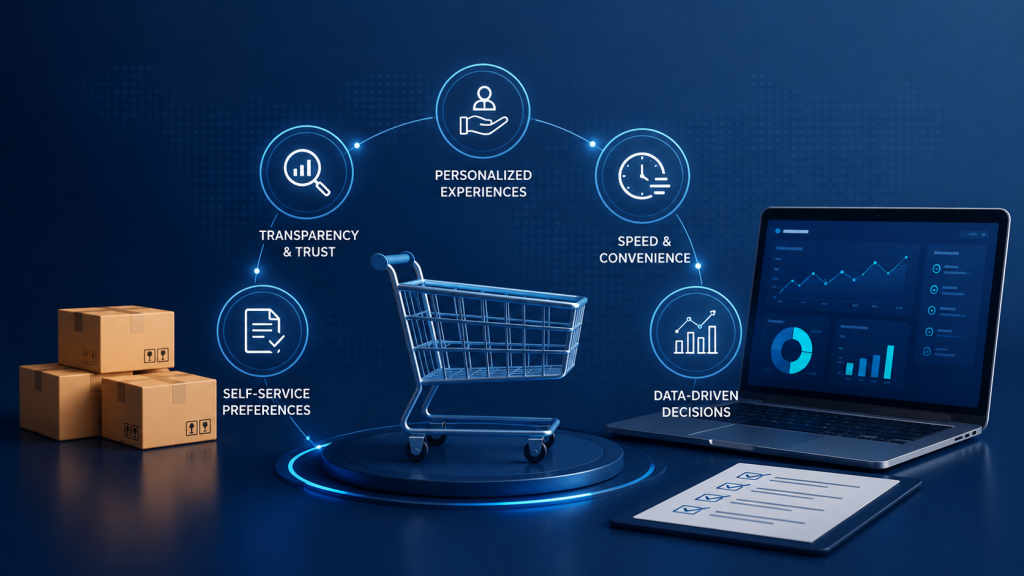
Digital commerce expectations have shifted faster than most internal systems have kept up with. Buyers who order supplies for a business now expect the same convenience they get as consumers, but layered on top of far more complex requirements.
A few forces are driving this shift:
Growing digital commerce expectations. Procurement teams expect real-time inventory visibility, saved carts, and instant reordering, not a PDF price list and a phone call.
Complex B2B buying journeys. A single purchase often involves multiple stakeholders, budget approvals, and negotiated pricing, which means the platform has to support workflows, not just checkout.
ERP integration. Pricing, inventory, and order data typically live in an ERP system. A platform that cannot sync cleanly with that system creates duplicate work and data drift almost immediately.
Self-service portals. Buyers increasingly want to manage their own account, view order history, track shipments, and reorder without contacting a sales rep.
Customer-specific pricing. Contract pricing, volume tiers, and account-level discounts are standard in B2B, and the platform needs to handle this natively rather than through workarounds.
Multi-channel commerce. Many B2B sellers now operate across a website, a sales rep portal, a marketplace presence, and sometimes EDI, all of which need to stay in sync.
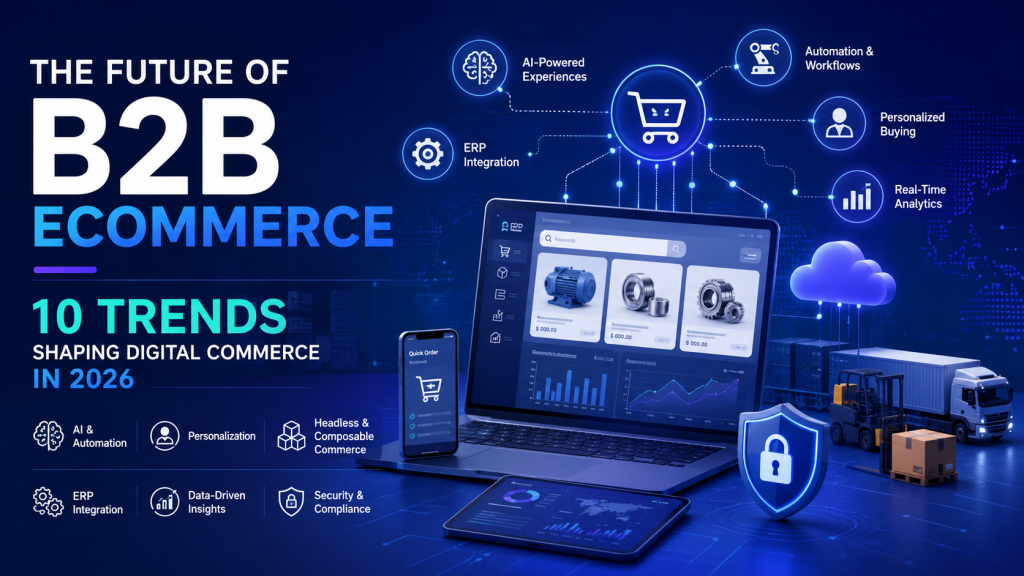
Future scalability. A platform that works for one warehouse and one currency today may not hold up when the company adds a second business unit or expands internationally. For a broader look at where the market is headed, see The Future of B2B Ecommerce: 10 Trends Shaping Digital Commerce in 2026.
Each of these forces adds weight to the decision. This is why the evaluation needs a structured framework rather than a feature checklist alone.
Start with Your Business Requirements
Before comparing platforms, it is worth pausing on the business itself. Most failed implementations trace back to requirements that were assumed rather than documented.
Start by clarifying:
- Business goals. Is the priority growth, cost reduction, customer experience, or operational efficiency?
- Current pain points. What is actually broken today, and who feels that pain, sales, operations, or customers?
- Future growth plans. Are there acquisitions, new product lines, or new markets on the horizon?
- International expansion. Will the platform need to support multiple currencies, languages, and tax jurisdictions?
- Multiple warehouses. How complex is fulfillment, and does inventory need to be split by location?
- Sales team involvement. Do reps need to place orders on behalf of customers or manage assigned accounts?
- Customer portals. Do buyers need self-service access to order history, invoices, and reordering?
- Approval workflows. Are there multi-level purchase approvals within customer organizations?
- Subscriptions. Does the business sell on a recurring basis, such as consumables or replenishment orders?
- RFQ capability. Do customers need to request quotes before committing to a purchase?
- Repeat ordering. How often do customers reorder the same products, and how fast does that process need to be?
- Budget. What is realistic for licensing, implementation, and ongoing maintenance?
- Timeline. Is there a hard deadline, such as an ERP cutover or contract expiration?
- Technical resources. Is there an in-house development team, or will an agency or partner manage the build?
Requirements Checklist
- Business goals documented and prioritized
- Current pain points identified by department
- Growth plans for the next 3 to 5 years outlined
- International requirements defined
- Warehouse and fulfillment complexity mapped
- Sales team workflow requirements captured
- Customer self-service expectations defined
- Approval workflow requirements documented
- Subscription or recurring order needs identified
- RFQ process requirements outlined
- Repeat ordering volume and frequency estimated
- Budget range confirmed with finance
- Implementation timeline agreed with stakeholders
- Internal technical capacity assessed
Expert tip: Involve sales, operations, and finance in this stage, not just IT. Platforms fail more often from unaddressed operational needs than from technical shortcomings.
Essential Features Every Modern B2B Ecommerce Platform Should Offer
Once requirements are clear, the next step is understanding which features are foundational to B2B commerce. Not every business needs every feature, but each should be evaluated deliberately rather than assumed.
Customer-specific pricing. The platform should support negotiated pricing at the account or contract level, not just generic discount codes.
Multiple catalogs. Different customer segments often need different product visibility and pricing structures.
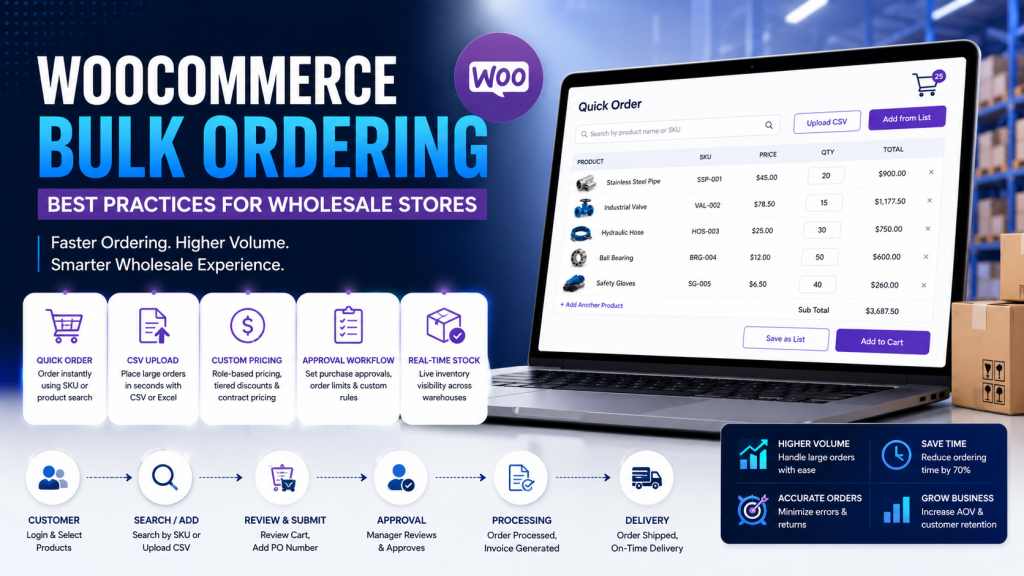
Quick order. Buyers who know their SKUs need a fast way to add products by item number rather than browsing categories.
Bulk ordering. Support for uploading order lists via CSV or entering quantities across multiple products at once.
RFQ functionality. A structured way for customers to request pricing on non-standard quantities or custom items.
Role-based permissions. Different users within a customer account may need different levels of access, such as viewer, buyer, or approver.
Approval workflows. Purchases above a certain threshold often need sign-off from a manager before the order is finalized.
Purchase orders. Support for PO-based payment terms, common in B2B relationships with net terms.
Account hierarchy. Parent and child account structures for organizations with multiple locations or departments.
ERP integration. Real-time or near-real-time sync for pricing, inventory, and order data. Businesses running on WordPress can see what this looks like in practice in WooCommerce ERP Integration.
CRM integration. Alignment between sales activity and e-commerce behavior for a unified customer view.
Inventory synchronization. Accurate, timely stock visibility across all sales channels. See WooCommerce Inventory Management for an example of how this works at the platform level.
Shipping automation. Rate calculation, carrier integration, and fulfillment rules that scale with order volume, as outlined in WooCommerce Shipping Rules.
Tax management. Automated tax calculation across jurisdictions, especially important for multi-state or multi-country sellers.
Reporting. Visibility into sales performance, customer behavior, and operational metrics.
Mobile experience. A responsive, functional experience for buyers ordering from a phone or tablet.
Security. Data protection, PCI compliance, and safeguards appropriate for enterprise-level transaction volume.
Performance. Fast page loads and reliable uptime, particularly during peak ordering periods.
API support. Open, well-documented APIs for custom integrations and future flexibility.
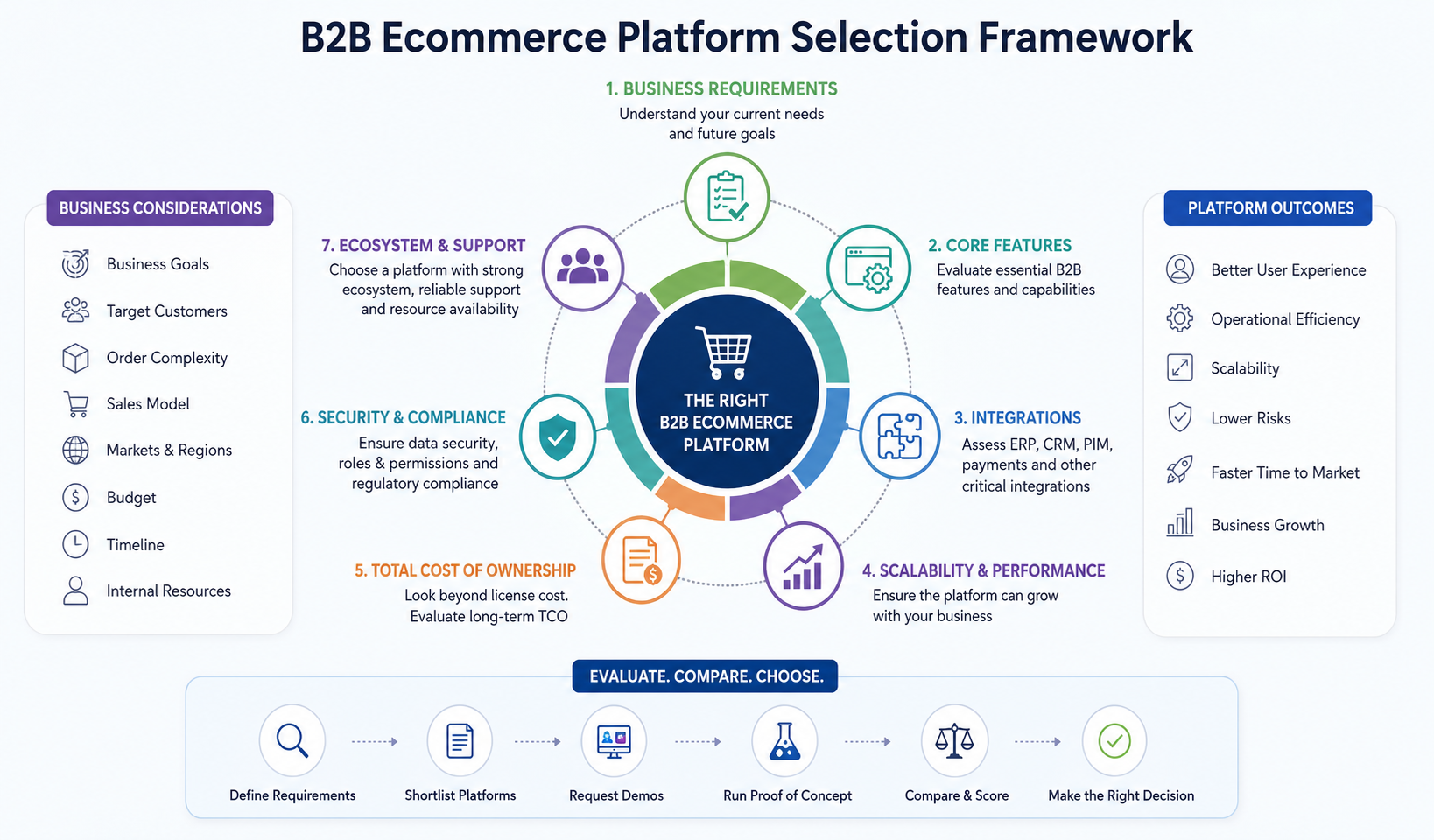
The Decision Framework
With requirements and features defined, the next step is a structured evaluation. Rating each criterion by importance helps teams avoid getting swayed by features that look impressive in a demo but do not matter for the actual business.
Critical. These factors should be considered deal-breakers.
- Business fit, determining whether the platform matches how the company actually sells
- Scalability, preventing another migration in two to three years
- Integrations, since ERP and CRM connectivity is the backbone of B2B operations
- Security, protecting customer data and transaction integrity
Important. These meaningfully affect long-term cost and usability.
- Ownership cost, including licensing, hosting, development, and maintenance
- Customization, or how closely the platform can match unique workflows
- Performance, which impacts conversion and customer experience
- Support, affecting how quickly issues get resolved post-launch
- Ease of management, or how much ongoing technical dependency exists
- Upgrade flexibility, which impacts long-term maintenance burden
Nice to Have. Valuable, but rarely decisive on their own.
- Vendor ecosystem, meaning access to partners, agencies, and extensions
- SEO capabilities, which matter more for businesses reliant on organic discovery
- Content management, relevant for companies investing in content marketing
- Internationalization is only critical if global expansion is on the roadmap
- Developer availability, affecting long-term staffing and support costs
This weighting will shift depending on the business. A company with no international plans can treat internationalization as a lower priority, while a company mid-acquisition should treat scalability as non-negotiable.
Questions to Ask Before Making the Final Decision
- How does the platform handle customer-specific pricing at scale?
- What does native ERP integration look like, and what requires custom development?
- How does the platform perform under peak order volume?
- What is the true total cost of ownership over three years, not just year one?
- How much developer dependency does ongoing maintenance require?
- What does the migration path look like from the current system?
- How does the platform support approval workflows and account hierarchies?
- What security certifications and compliance standards does the platform meet?
- How flexible is the platform for future customization needs?
- What does the support model look like, and what are the response time guarantees?
- How does the platform handle multi-warehouse or multi-location inventory?
- What is the learning curve for internal teams managing the platform day to day?
- How well does the platform support SEO and content marketing efforts?
- What does the partner and agency ecosystem look like for ongoing development?
- How has the platform evolved over the past two to three years, and what does the roadmap look like?
Common Mistakes Companies Make
These patterns show up often enough that they are worth naming directly, and they overlap with the pitfalls covered in B2B Ecommerce: 5 Critical Mistakes That Hurt Online Sales.
Choosing based on popularity. A platform being widely used does not mean it fits a specific business model.
Ignoring integrations. Underestimating the complexity of ERP or CRM integration is one of the most frequent causes of budget overruns.
Underestimating customization. B2B workflows are often more complex than they appear during the sales demo phase.
Ignoring future growth. Selecting a platform that only fits current needs, without headroom for growth, often leads to another migration within a few years.
Poor migration planning. Underestimating the time and effort needed to migrate historical data, SEO equity, and customer accounts.
Ignoring SEO. Some platforms make it harder to preserve URL structure and organic rankings during a migration, which can quietly cost significant traffic.
No stakeholder involvement. Leaving the decision entirely to IT or entirely to sales, rather than involving both, tends to produce blind spots.
Selecting the cheapest option. Lower upfront cost often means higher long-term cost through workarounds, plugins, or custom development to fill functionality gaps.
Real-World Evaluation Process
Companies that go through a successful platform evaluation tend to follow a similar structured process rather than jumping straight to vendor demos.
Discovery. Internal stakeholders align on goals, pain points, and constraints before looking at any vendor.
Requirements gathering. Detailed documentation of workflows, integrations, and must-have features, ideally validated across departments.
Vendor demos. Structured demos based on the company’s actual use cases, not generic vendor scripts.
Proof of concept. A limited, hands-on test of the platform against real business scenarios, such as a sample RFQ workflow or ERP sync test.
Technical validation. Development teams assess integration feasibility, hosting requirements, and customization limits.
Security review. IT and compliance teams evaluate data protection, certifications, and access controls.
Migration assessment. A realistic estimate of what it takes to move existing data, content, and SEO value to the new platform, including how order fulfillment processes need to adapt, as discussed in WooCommerce Order Fulfillment.
Implementation roadmap. A phased plan with clear milestones, rather than a single large launch date.
Conclusion
There is no shortcut around a structured evaluation when the decision will shape how a business sells for years to come. Businesses that treat platform selection as a strategic decision, grounded in documented requirements and a weighted framework, consistently make choices that hold up as they grow.
Prioritizing long-term scalability, integration depth, and business fit over short-term cost savings tends to separate companies that scale smoothly from those facing another costly migration in two or three years. The goal is not to find the platform with the most features. It is to find the platform that fits how the business actually operates today and has room to grow into what it becomes tomorrow.
FAQs
Learning how to choose the right B2B ecommerce platform starts with evaluating your business requirements, scalability, integrations, customization options, security, total cost of ownership, and long-term growth goals.
Understanding how to choose the right B2B ecommerce platform helps businesses avoid costly migrations, select features that match operational needs, and invest in a scalable solution that supports long-term digital commerce growth.
A modern B2B ecommerce platform should support customer-specific pricing, bulk ordering, RFQs, ERP integration, inventory synchronization, role-based permissions, self-service portals, and robust reporting to streamline business operations.
The best B2B ecommerce platform depends on your business size, budget, technical requirements, and growth plans. Compare scalability, flexibility, integrations, and support before selecting a platform that fits your objectives.
Avoid choosing a platform based only on popularity or price. Consider future growth, integration capabilities, customization, security, migration complexity, and total ownership costs to make a sustainable long-term investment.


 WooCommerce Solutions
 Solutions for WordPress