Edge Computing for Web Development: The Honest 2026 Guide
Introduction
Google tightened its speed bar again this year. As of the May 2026 Chrome UX Report, only 55.9% of tracked websites pass all three Core Web Vitals, and Google lowered the “Good” threshold for Largest Contentful Paint from 2.5 seconds to 2.0 seconds. Interaction to Next Paint (INP) is no longer a secondary metric either — as of March 18, 2026, Google confirmed it now carries equal weight alongside LCP and CLS. Mobile sites are struggling more than desktop: only 48% of mobile origins pass all three metrics, against 56% for desktop.
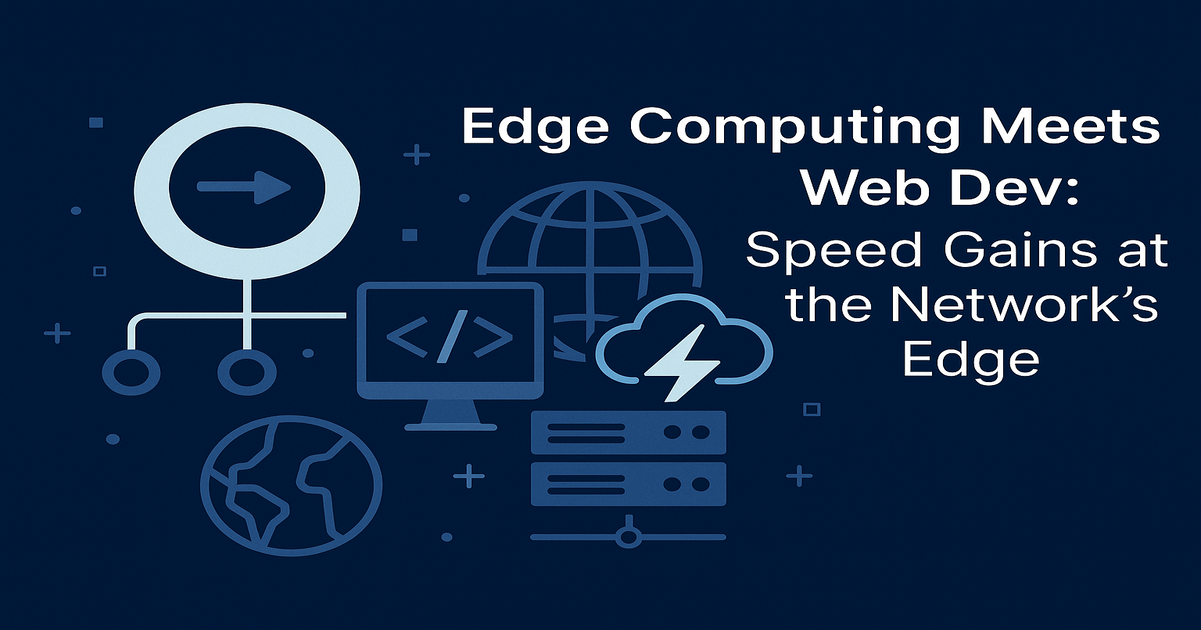
The business cost of ignoring this is well documented. Amazon’s own internal testing found that every 100ms of added latency costs roughly 1% in sales. This is why more web development teams are turning to edge computing for web development — running code physically closer to the visitor instead of routing every request back to one central server.
What Edge Computing Actually Changes
Edge computing moves compute and caching to servers distributed across hundreds of locations worldwide, rather than a single origin server. In practice, this cuts round-trip latency from the old normal of 150-300ms down to under 50ms for most global visitors — a reduction of roughly 40-70% depending on where your audience sits relative to your original hosting. That has a direct line to Time to First Byte, which feeds straight into LCP.
For a WordPress or custom web app, that typically means moving specific tasks — not your whole database — to the edge: authentication checks, A/B test routing, geo-based redirects, image resizing, and personalization logic that doesn’t need a full database round-trip.
Cloudflare Workers vs. Vercel Edge Functions vs. AWS Lambda@Edge
The three platforms most development teams evaluate in 2026 behave quite differently:
Cloudflare Workers is framework-agnostic and currently has the fastest cold starts in the category — under 5ms, across more than 330 cities — plus built-in primitives for state (Durable Objects, D1) and edge AI inference. Pricing is a flat $5/month per account plus metered usage.
Vercel Edge Functions, running on Vercel’s Fluid Compute model, are the natural fit if you’re already building in Next.js or React: expect 1.2x to 5x faster server-side rendering, though cold starts run 50-250ms and pricing is seat-based at $20/seat plus multiple metered dimensions.
AWS Lambda@Edge / CloudFront Functions makes sense if your infrastructure is already AWS-heavy and you want edge logic without leaving that ecosystem, though it typically requires more manual configuration than the other two.
When Edge Computing Is Worth It (and When It Isn’t)
Edge computing earns its cost when you have a global audience, real-time personalization, or Core Web Vitals problems traced back to Time to First Byte. It’s a poor fit if your traffic is regional, your app leans on heavy relational database writes that can’t be distributed, or your current bottleneck is actually render-blocking JavaScript rather than network latency — in which case front-end optimization will move the needle faster than any edge migration.
How Dazzlebirds Approaches Edge Migrations
We start by profiling where latency is actually being lost — DNS, TLS handshake, TTFB, or render — before recommending a platform. Most WordPress sites don’t need a full edge rebuild; targeted edge caching and a handful of edge functions for personalization or redirects usually close most of the Core Web Vitals gap without touching the core application.
Conclusion
With Google’s 2026 thresholds tighter and INP now weighted equally with LCP and CLS, the sites that keep failing Core Web Vitals are increasingly the ones still routing every request through one distant origin server. Edge computing isn’t a requirement for every site, but for global or performance-sensitive ones, it’s often the fastest lever left to pull.
FAQs
Edge computing typically cuts round-trip latency from 150-300ms down to under 50ms for global visitors, a reduction of roughly 40-70% depending on how far your audience sits from your original server.
Cloudflare Workers wins on raw speed, with sub-5ms cold starts across 330+ cities and flat $5/month pricing. Vercel Edge Functions make more sense if you're already building in Next.js or React, offering 1.2x to 5x faster server-side rendering, though cold starts run 50-250ms and pricing is seat-based.
Indirectly but meaningfully: edge computing improves Time to First Byte, which feeds directly into Largest Contentful Paint. As of May 2026, only 55.9% of sites pass all three Core Web Vitals, and Google lowered the "Good" LCP threshold from 2.5s to 2.0s, so shaving TTFB via edge caching or edge functions can be the difference between passing and failing.
No. It's worth the cost for global audiences, real-time personalization, or Core Web Vitals problems traced to Time to First Byte. If your traffic is regional or your bottleneck is render-blocking JavaScript rather than network latency, front-end optimization will move the needle faster than an edge migration.


 WooCommerce Solutions
 Solutions for WordPress