A distributor lists the same valve assembly on WooCommerce, in a printed catalog, on a marketplace, and inside a distributor portal used by regional resellers. The dimensions on WooCommerce say 14 inches. The ERP record says 355 millimeters, which happens to be correct. The marketplace listing, uploaded eight months ago by a marketing coordinator who has since left the company, still shows an older part number. A buyer notices the mismatch, calls support, and the order slips two days while someone manually confirms the specifications.
None of this happened because anyone was careless. It happened because the business never built a system for owning, validating, and distributing product data. Each channel became its own source of truth, and none of them agreed with each other.
This is the problem product information management exists to solve. It is not a plugin or a spreadsheet replacement. It is a business discipline that determines whether your product data can be trusted by customers, sales teams, ERP systems, and increasingly, by the AI systems that now summarize product information before a buyer ever reaches your website. For enterprise manufacturers, distributors, and B2B sellers running WooCommerce alongside ERP and multiple sales channels, getting product data right is a revenue function, not a back-office task.
Quick Answer
Product Information Management, or PIM, is the business process and software discipline used to centrally collect, enrich, govern, and distribute accurate product data across every sales channel, including WooCommerce, marketplaces, ERP systems, distributor portals, and printed materials. A PIM system acts as the single source of product truth, so every channel displays the same specifications, pricing attributes, and digital assets, reducing errors, accelerating launches, and improving product discoverability for both customers and AI search engines.
Why Enterprise Businesses Need Product Information Management
The short answer is consistency at scale. Once a catalog grows past a few hundred SKUs and touches more than one system, manual product data management stops being sustainable, and the cost shows up in places leadership rarely connects back to product data.
Data consistency. When product specifications, images, and attributes originate from one governed source instead of being re-entered separately in WooCommerce, the ERP, and a marketplace feed, discrepancies stop compounding with every update.
Customer experience. Buyers compare specifications across suppliers before they ever speak to sales. Inconsistent or incomplete data reads as unreliable, and B2B buyers rarely give a second chance after a bad first impression on technical accuracy.
Operational efficiency. Product teams spend less time chasing corrections across systems and more time enriching new products because there is one place to update a record instead of five.
Faster product launches. New SKUs move from creation to live publication in days instead of weeks once WooCommerce PIM workflows replace manual enrichment, validation, and approval steps handled over email threads.
Reduced errors. Centralized validation catches missing attributes, incorrect units, and incomplete compliance documentation before a product ever reaches a customer-facing channel.
Improved product discovery. Structured attributes and consistent taxonomy make filtering, search, and comparison actually work, both for shoppers on WooCommerce and for AI systems parsing your product feed.
Higher conversion rates. Complete, accurate product pages with the right specifications and assets close more B2B deals, because technical buyers make purchasing decisions based on data, not marketing copy.
Enterprise Product Information Lifecycle
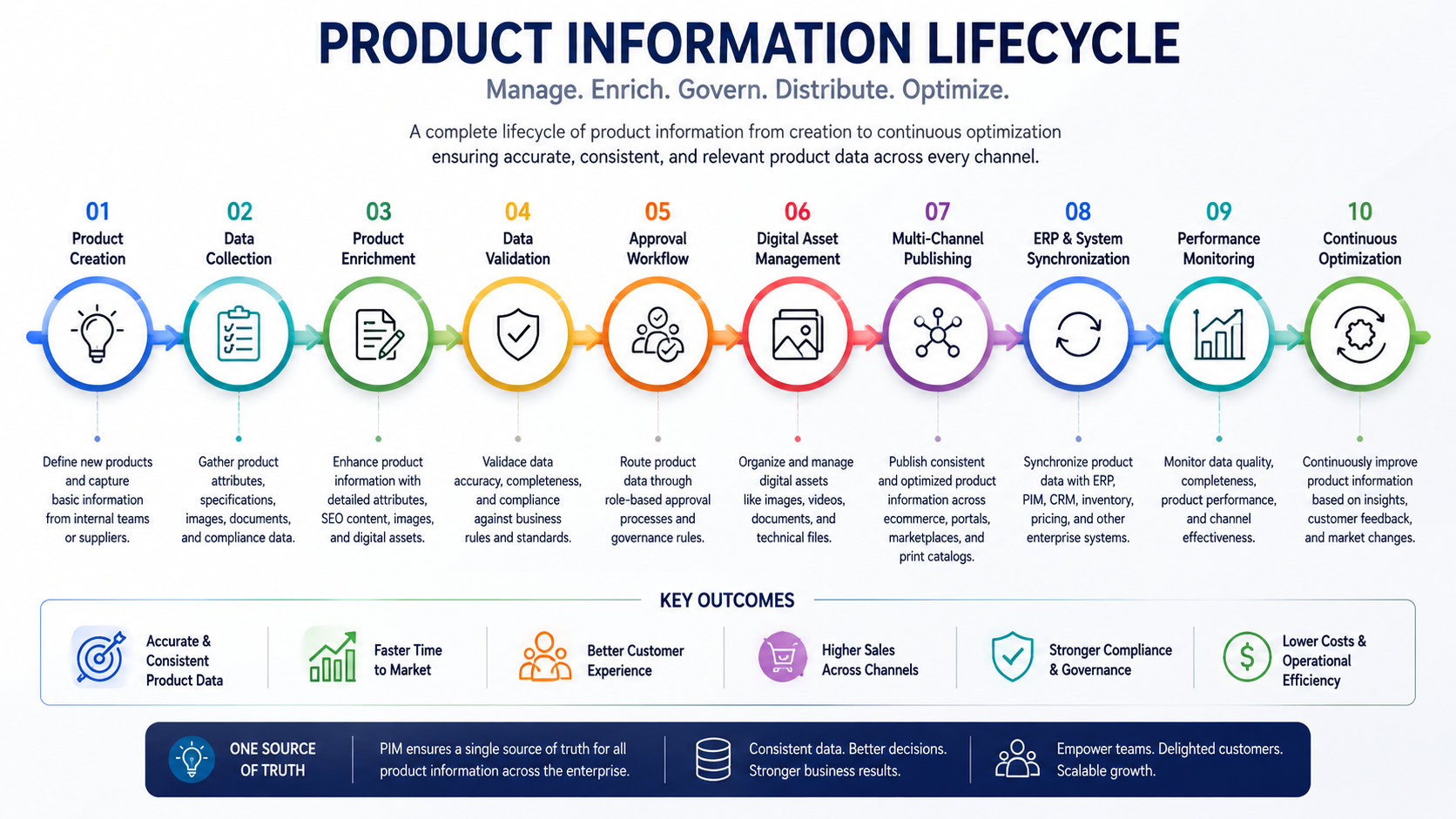
Product data does not simply exist. It moves through a lifecycle, and most of the data quality problems enterprises experience trace back to a broken or skipped stage in this flow.
- Product Creation
- Data Collection
- Product Enrichment
- Data Validation
- Approval Workflow
- Digital Asset Management
- Multi-Channel Publishing
- ERP and WooCommerce Synchronization
- Performance Monitoring
- Continuous Optimization
Each stage needs an owner, a standard, and an exit condition. Skipping validation to hit a launch date is how incomplete or inaccurate records end up live on a public storefront. Enterprises that treat this as a governed pipeline, not a series of disconnected tasks, consistently launch faster with fewer downstream corrections.
Core Components of a Modern PIM System
A PIM system is built around a handful of structural components. Understanding them helps you evaluate whether a given tool or process actually functions as a PIM or is simply a product database with a nicer interface.
Master product records act as the canonical entry for each item, holding every attribute, relationship, and asset reference in one place.
Attributes define the specific data points that describe a product, from technical specifications to compliance ratings, and are typically organized by product type so a bolt and a software license do not share irrelevant fields.
Product taxonomy and categories create the structure buyers and search engines use to navigate and filter your product catalog management system, and poor taxonomy is one of the most common reasons enterprise search feels broken even when the underlying data is accurate.
Variants manage the relationship between a parent product and its size, color, or configuration options without duplicating shared attributes across every variant.
Digital assets including images, spec sheets, CAD files, and certifications are linked to the correct product version and reused across channels instead of being re-uploaded separately.
Localization and translation allow one master record to produce accurate, market-specific content for international sales channels.
Pricing attributes stay distinct from transactional pricing logic in the ERP, but PIM still needs to hold pricing-relevant specifications such as unit of measure and packaging configuration.
Specifications and compliance documentation are stored with version control, which matters enormously in regulated industries where an outdated safety data sheet is a liability, not an inconvenience.
Product Data Governance Framework
Strong product data governance is the part of PIM that most enterprises underinvest in, and it is the part that determines whether data quality holds up as the catalog grows. Governance answers a simple question: Who is allowed to change what, and under what conditions?
A working governance framework assigns five roles. A data owner defines what “correct” looks like for a product category, typically a product or category manager. A data steward enforces standards and reviews submissions, usually sitting inside PIM or e-commerce operations. An approver, often a department lead or compliance officer, signs off before anything publishes. A contributor, whether a vendor, supplier, or internal team member, enters the raw product data and assets. An auditor reviews historical accuracy and change logs to support compliance and dispute resolution.
Beyond assigning these roles, the framework needs documented data standards so contributors know what “complete” means, version control so changes are traceable, ongoing quality monitoring rather than one-time cleanup, and business rules that enforce mandatory fields before a product can go live.
Product Data Quality KPIs
You cannot manage what you do not measure, and product data quality is one of the most under-measured areas of enterprise e-commerce operations.
| KPI |
What It Measures |
Why It Matters |
| Completeness |
Percentage of required attributes populated |
Incomplete records hurt search and buyer confidence |
| Accuracy |
Rate of validated vs. flagged records |
Directly tied to return rates and support tickets |
| Consistency |
Attribute alignment across channels |
Prevents conflicting specs between WooCommerce and marketplaces |
| Duplicate Records |
Number of redundant SKUs or listings |
Duplicates fragment sales data and confuse buyers |
| Time to Publish |
Days from creation to live across channels |
Reflects workflow efficiency, not just data quality |
| Attribute Coverage |
Depth of technical detail per category |
Deeper attributes improve filtering and AI comprehension |
| Data Freshness |
Time since last verified update |
Stale specs are a common source of compliance risk |
| Catalog Quality Score |
Composite of the metrics above |
Gives leadership one number to track over time |
PIM vs ERP vs Spreadsheet Management
| Capability |
Spreadsheet |
ERP Alone |
Dedicated PIM |
| Central product record |
No |
Partial |
Yes |
| Multi-channel publishing |
Manual |
Rare |
Built for this |
| Digital asset management |
No |
Limited |
Yes |
| Approval workflows |
Manual, email-based |
Rigid, finance-focused |
Flexible, product-focused |
| Attribute-level governance |
No |
Limited |
Yes |
| Version history |
Manual, error-prone |
Yes, transactional focus |
Yes, product focus |
| Scales past a few hundred SKUs |
Breaks down quickly |
Depends on configuration |
Designed for scale |
ERP systems remain essential for inventory, pricing logic, and financial transactions. They were not built to manage rich product content, digital assets, or multi-channel publishing workflows, which is exactly where PIM fills the gap rather than competing with the ERP.
WooCommerce + ERP + PIM Architecture
WooCommerce is one publishing destination among several, not the center of the product data ecosystem. In a mature enterprise architecture, the PIM holds the governed master record. The ERP owns inventory levels, cost, and financial pricing logic. WooCommerce, marketplaces, distributor portals, and print catalogs each receive a filtered, formatted feed of the same underlying data.
This separation matters because it prevents a common failure pattern: businesses that try to manage rich product content directly inside WooCommerce or directly inside the ERP eventually hit a ceiling. WooCommerce was not designed to be a governance layer, and ERP systems were not designed to hold marketing copy, high-resolution imagery, or channel-specific formatting rules.
A functioning architecture typically routes data as follows. Product creation and enrichment happen in the PIM. Inventory, cost, and order data stay in the ERP, connected through proper ERP product integration rather than manual exports. WooCommerce receives product data synchronization feeds for both content and stock levels, then displays a unified product page built from both sources. When a specification changes, it changes once in the PIM and propagates outward, instead of requiring updates in three separate systems.
Common Product Data Management Mistakes
Most product data problems are avoidable, and most of them repeat across industries. The following mistakes show up consistently in enterprise catalogs we have audited.
- Duplicate products created because teams could not find an existing record, so they built a new one instead
- Missing attributes that leave technical buyers unable to compare products confidently
- Poor taxonomy that forces buyers to guess which category a product lives in
- Inconsistent naming conventions across departments, vendors, and channels
- Manual updates performed separately in each system instead of from one governed source
- Disconnected systems where WooCommerce, ERP, and marketplace feeds never actually talk to each other
- No governance so anyone can publish incomplete or inaccurate data without review
- Weak approval workflows that exist on paper but are not enforced in practice
Why Product Data Quality Matters More Than Product Quantity
Enterprises often measure catalog health by SKU count, when quality is the metric that actually predicts revenue performance. A catalog of five thousand well-governed, fully attributed products will consistently outperform one of fifteen thousand inconsistent listings, because search, filtering, and AI systems reward completeness over sheer volume.
The Hidden Cost of Poor Product Information
The visible cost of bad product data is a support ticket or a returned order. The hidden cost is larger: sales teams lose credibility quoting from outdated spec sheets, marketing spends budget driving traffic to pages that fail to convert, and compliance absorbs risk when outdated documentation stays attached to a live product. These costs rarely appear on one line item, which is why they persist far longer than they should.
Building a Single Source of Product Truth
A single source of truth means every system pulls product data from the same governed origin, rather than maintaining its own independent copy. Every downstream channel, whether WooCommerce, a distributor portal, or a printed catalog generator, receives data from the PIM instead of a locally maintained spreadsheet. Correct a specification once, and it corrects everywhere automatically.
Why Product Governance Fails
Governance frameworks rarely fail because they were poorly designed. They fail because enforcement lapses once the initial rollout excitement fades, and contributors start bypassing approval steps to hit deadlines. Without automated field validation and periodic audits, governance quietly erodes back into the same chaos it was meant to replace.
Product Data Maturity Model
Product data maturity moves through five recognizable stages. Stage one is fragmented, where data lives in spreadsheets and individual systems with no central ownership. Stage two is centralized, where a single system holds product data but governance is still inconsistent. Stage three is governed, where clear ownership, approval workflows, and quality standards are actually enforced. Stage four is optimized, where data quality is actively monitored with KPIs and continuous improvement. Stage five is intelligent, where AI-assisted enrichment and validation support human governance at scale.
Most enterprise WooCommerce businesses we assess sit at stage one or stage two. Moving to stage three delivers the largest single improvement in data reliability, because governance is what makes every later stage sustainable.
Scaling Product Catalogs Across Multiple Channels
True multi-channel product management looks simple until you try it with governed, consistent data. Each channel has different formatting requirements, character limits, and attribute expectations. A PIM handles this through channel-specific publishing rules layered on top of one master record, so a single B2B product catalog appears correctly on WooCommerce, a marketplace, and a distributor feed without maintaining separate versions of the truth.
Product Information as a Competitive Advantage
In categories where products are functionally similar across suppliers, data completeness becomes a differentiator on its own. A buyer comparing two nearly identical industrial components will often choose the listing with complete specifications and accurate imagery over one that requires a phone call to clarify basic details.
Enterprise Product Approval Framework
A practical approval framework includes three checkpoints: a completeness check confirming mandatory attributes and assets are present, a technical accuracy review by someone with domain expertise, and a final compliance or brand check before publication. Skipping any checkpoint is how inaccurate data reaches live channels.
AI in Product Information Management
- AI is changing how product data gets created and maintained, though it changes the workload rather than the need for oversight.
- AI product descriptions can draft consistent copy from structured attributes, reducing the manual writing burden across large catalogs.
- Automated tagging applies category and attribute values based on patterns learned from existing governed data.
- Image recognition can flag missing, mismatched, or low-quality product images before they publish.
- Attribute extraction pulls structured data from supplier spec sheets and PDFs, cutting down manual data entry significantly.
- Translation accelerates localization for international channels without a full manual translation cycle for every update.
- Data enrichment suggests missing attributes based on similar products already in the catalog.
- Duplicate detection flags likely duplicate records that would otherwise sit undetected for months.
- Catalog optimization surfaces underperforming or incomplete listings that need attention.
AI Will Improve Product Data, Not Replace Governance
None of these capabilities remove the need for human governance. AI accelerates enrichment and flags anomalies, but a governed approval process still has to confirm accuracy, since AI-generated attributes can be confidently wrong without domain review. The enterprises getting the most value from AI use it to speed up governed workflows, not to skip them.
Preventing Product Data Chaos During Business Growth
Growth tests, product data, and discipline are harder than anything else. New product lines, acquisitions, and expanding vendor networks introduce data faster than manual processes can absorb. Businesses that stay in control during rapid growth are the ones that invested in governance before the pressure arrived, not after the catalog had already fragmented.
How Dazzlebirds Designs Enterprise PIM Solutions
Our approach starts with business discovery, not software selection. We map how product data currently moves through your organization, including every spreadsheet and every point where someone re-types the same information into a different system.
From there, we run a catalog assessment, evaluating attribute completeness, taxonomy structure, and duplicate rates against the KPIs outlined earlier in this guide, then map how master records will connect to WooCommerce, your ERP, and any additional sales channels.
Governance planning establishes ownership, approval workflows, and data standards specific to your product categories rather than a generic template. WooCommerce and ERP synchronization are then built to route content and transactional data through their appropriate systems, following the architecture described above.
Migration accounts for the reality that most enterprises are not starting from a blank catalog. Existing data is cleaned, standardized, and validated before it enters the governed system, not after. Testing confirms synchronization holds up under real update scenarios, and optimization continues post-launch using the same KPIs.
Enterprise PIM Readiness Checklist
- Product ownership is assigned by category, not left ambiguous
- Current data lives in a documented, known set of systems
- Duplicate and incomplete records have been identified
- Taxonomy has been reviewed for gaps and inconsistencies
- Digital assets are stored centrally rather than scattered across drives
- ERP and WooCommerce integration points are mapped
- Governance roles have executive sponsorship, not just team-level agreement
Product Data Audit Checklist
- Calculate completeness rate across mandatory attributes
- Identify duplicate SKUs and merge candidates
- Review taxonomy against actual buyer search behavior
- Check digital assets for resolution, format, and version accuracy
- Confirm compliance documentation is current, not expired
- Cross-check attribute consistency between WooCommerce and ERP
WooCommerce PIM Integration Checklist
- Confirm which system owns which attributes before mapping begins
- Define sync frequency for product content versus inventory data
- Test how variant and configuration data maps between systems
- Validate image and asset handling across the integration
- Build error handling for failed or partial synchronization events
- Establish a rollback process for incorrect bulk updates
Key Takeaways
- Product Information Management is a governed business process, not simply a product database
- Poor product data creates hidden costs across sales, marketing, and compliance that rarely appear as a single line item
- A single source of product truth means every channel pulls from one governed origin, not independent copies
- Governance frameworks fail most often from lack of enforcement, not poor initial design
- Data quality should be measured with concrete KPIs, including completeness, accuracy, and time to publish
- WooCommerce, ERP, and PIM each serve distinct roles and function best working together, not as substitutes for one another
- Multi-channel publishing requires channel-specific formatting layered on top of one master record
- AI accelerates enrichment and validation but does not remove the need for human governance
- Growing SKU count without growing data discipline scales the underlying quality problem, not the business
- Product data maturity moves through defined stages, and most enterprises have the most to gain by reaching the governed stage
Conclusion
Product Information Management is not a project you finish once and move on from. It is an operating discipline that either compounds in your favor, producing cleaner data, faster launches, and stronger buyer trust, or compounds against you, producing exactly the kind of mismatched specifications and lost orders described at the start of this guide.
Enterprises that treat product data as a governed, measurable business asset consistently outperform those that treat it as a background task owned by whoever has time that week. Whether you are just beginning to centralize product data or looking to connect an existing PIM more tightly with WooCommerce and your ERP, the businesses that get this right start with governance, not software.
If you are evaluating how product information management fits into your broader e-commerce architecture, our team at Dazzlebirds works with enterprise manufacturers, distributors, and B2B sellers to design product data systems built around your actual catalog, not a generic template.
FAQs
Product Information Management (PIM) is a centralized system that stores, enriches, governs, and distributes product data across WooCommerce, ERP platforms, marketplaces, and sales channels, ensuring consistent, accurate, and high-quality product information throughout the customer journey.
Product Information Management helps enterprise B2B e-commerce businesses eliminate inconsistent product data, accelerate catalog updates, improve customer experience, simplify multi-channel publishing, and maintain accurate product information across WooCommerce, ERP systems, distributors, and digital marketplaces.
Product Information Management integrates with WooCommerce and ERP systems by synchronizing product attributes, pricing, inventory references, digital assets, and catalog updates, creating a single source of truth that improves operational efficiency and product data accuracy.
A product information management system improves product data quality, reduces manual errors, accelerates product launches, strengthens governance, supports multi-channel commerce, and enables enterprise businesses to deliver consistent product experiences across every customer touchpoint.
Product Information Management is ideal for manufacturers, wholesalers, distributors, healthcare suppliers, industrial businesses, and enterprise B2B e-commerce organizations that manage large product catalogs, multiple sales channels, complex product attributes, and WooCommerce-integrated commerce ecosystems.


 WooCommerce Solutions
 Solutions for WordPress