A regional healthcare distributor runs its business across five systems. The CRM has one version of a customer’s billing address. WooCommerce has a shipping address entered by a different team eighteen months ago. The ERP has a third address tied to the original credit application. When finance closes the quarter, revenue by account does not reconcile, because the same customer exists as three separate records under three slightly different names.
Nobody entered any of this data incorrectly. Each system simply captured what it needed at the time, from whoever happened to be entering it. Over years, this is how a business ends up with no reliable answer to a question as basic as how many active customers it actually has.
This is the problem Master Data Management exists to solve. It is not a database project or an IT initiative that lives in a server room. It is the governance layer that decides which version of a customer, product, supplier, or location record is the correct one and makes sure every system in the business agrees with it.
For enterprise manufacturers, distributors, and B2B sellers running WooCommerce alongside ERP, CRM, and other operational systems, master data is the foundation everything else sits on. Digital transformation initiatives, AI adoption, and business intelligence all inherit whatever data quality already exists underneath them.
Quick Answer
Master Data Management, or MDM, is the discipline of creating and governing a single, trusted version of an organization’s core business entities, including customers, products, suppliers, locations, and financial records, so every connected system references the same accurate data instead of maintaining separate, conflicting copies. MDM resolves duplicate records into golden records, enforces data governance rules, and synchronizes that trusted data across ERP, CRM, WooCommerce, and other enterprise platforms.
Why Enterprise Businesses Need Master Data Management
The direct answer is trust. Without a governed master data layer, no report, forecast, or customer interaction can be fully trusted, because nobody can confirm which system holds the accurate version of the underlying record.
Business consistency. When every department references the same customer, product, and supplier data, sales, finance, and operations stop working from different pictures of the same business.
Enterprise scalability. Manual reconciliation between systems works for a few hundred records. It collapses once a business operates across multiple entities, acquisitions, or sales channels, which is exactly when MDM becomes necessary rather than optional.
Operational efficiency. Teams stop spending hours reconciling spreadsheets before a board meeting or an audit because the trusted record already exists, and WooCommerce inventory management stops depending on a manual cross-check against the ERP every time stock counts look off.
Data governance. MDM gives governance a concrete object to govern. Without a defined master record, governance policies have nothing specific to enforce.
Regulatory compliance. Industries handling financial, healthcare, or safety data need an auditable, single version of the truth to satisfy reporting and compliance obligations, not three conflicting versions across three systems.
Customer experience. A buyer should not need to re-explain their account history because the support team, the sales team, and the billing team are each looking at a different record. This is especially visible in where a quote built on an outdated account record quotes the wrong terms before the buyer even sees a price.
Business intelligence. Reporting is only as reliable as the data feeding it. Fragmented master data quietly produces confidently wrong dashboards, and it is just as damaging too, since a forecast built on duplicate SKUs overstates demand for a product that only exists once.
Digital transformation. Every automation, AI initiative, or system migration inherits the state of the underlying master data. Clean data accelerates transformation. Fragmented data undermines it before it starts.
Enterprise Master Data Lifecycle
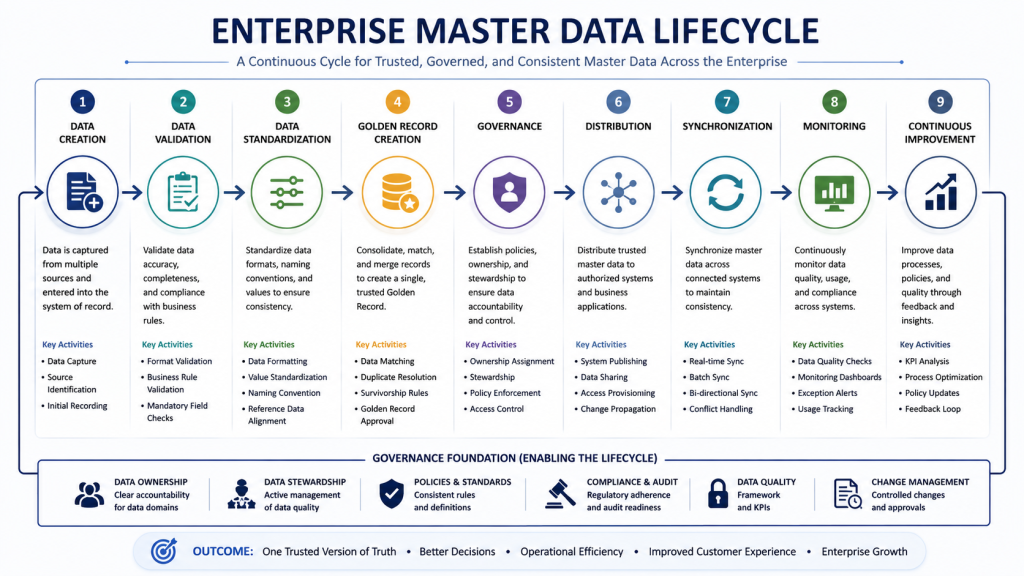
Master data moves through a defined lifecycle, and most data quality failures trace back to a stage that was skipped or never formally established.
- Data Creation
- Data Validation
- Data Standardization
- Golden Record Creation
- Governance
- Distribution
- Synchronization
- Monitoring
- Continuous Improvement
Treating this as a governed pipeline, rather than a one-time cleanup project, is what separates businesses that maintain data quality over time from those that clean their data every few years and watch it degrade again in between.
Types of Master Data
Enterprise organizations manage several distinct categories of master data, each with different owners and different quality requirements.
Customer master data covers accounts, contacts, billing and shipping information, and contract terms and is often the most fragmented category because customers interact with sales, support, and billing through separate systems. Fragmented customer records are also what break rules, since a pricing engine can only apply the correct contract terms if it knows which account record is authoritative.
Product master data covers specifications, attributes, and catalog information. This overlaps with, but is distinct from, product information management, since MDM decides which product record is authoritative while enrichment and publishing happen downstream of that decision.
Supplier master data covers vendor records, contact details, terms, and compliance documentation and directly affects how reliably a business can run supplier performance management. Inaccurate vendor records are also where purchase order management breaks down, since a purchase order sent to an outdated supplier contact never reaches the right person.
Location master data covers warehouses, branches, and facilities, which matters enormously for businesses coordinating multi-warehouse inventory across multiple sites.
Financial master data covers chart of accounts, cost centers, and billing entities, and errors here have direct consequences for financial reporting accuracy.
Employee master data covers organizational records used across HR, payroll, and access management systems.
Asset master data covers equipment, machinery, and fixed assets tracked for maintenance, depreciation, and compliance purposes.
Golden Record Strategy
A golden record is the single, trusted version of a master data entity, built by resolving duplicate and conflicting records into one authoritative source that every downstream system references.
Building a golden record requires four things working together. Data matching identifies which records across systems actually refer to the same customer, product, or supplier, often using a combination of exact and fuzzy matching logic. Duplicate resolution merges those matched records rather than leaving duplicates to coexist indefinitely. Survivorship rules determine which value wins when two systems disagree, for example, preferring the ERP’s billing address over a CRM entry that has not been updated in years. Record hierarchy defines relationships, such as a parent account with multiple subsidiary accounts, so the golden record reflects real organizational structure rather than a flat list.
Enterprise trust in reporting, forecasting, and customer interactions depends entirely on whether the golden record strategy behind it is sound. A dashboard built on unresolved duplicate customer records will always undercount or overcount, no matter how sophisticated the analytics layer on top of it is.
Master Data Governance Framework
Governance determines whether golden records stay accurate after the initial cleanup, and it is the difference between an MDM initiative that holds and one that quietly decays.
A working governance model assigns clear roles. Data ownership sits with a business stakeholder accountable for a specific domain, such as a VP of Sales owning customer master data. Data stewardship sits with the operational team member who enforces standards day to day and reviews submissions before they merge into the golden record. Business rules define what qualifies as a duplicate, which fields are mandatory, and which source system wins in a conflict. Approval workflows require sign-off before major changes propagate to downstream systems. Audit history captures who changed what and when, which matters both for internal accountability and for regulatory compliance. A governance committee, typically representing sales, finance, operations, and IT, meets on a regular cadence to resolve escalated conflicts and approve changes to the governance rules themselves.
Master Data Quality KPIs
You cannot govern what you do not measure, and master data quality benefits from the same discipline applied to any other operational metric.
| KPI |
What It Measures |
Why It Matters |
| Completeness |
Percentage of required fields populated per record |
Incomplete records break downstream automation |
| Accuracy |
Rate of validated versus flagged records |
Directly affects reporting and compliance confidence |
| Consistency |
Field alignment across connected systems |
Prevents conflicting values between ERP, CRM, and WooCommerce |
| Uniqueness |
Duplicate record rate |
Duplicates inflate counts and fragment history |
| Validity |
Records conforming to defined formats and rules |
Invalid data breaks integrations silently |
| Timeliness |
Time since last verified update |
Stale master data drives poor decisions |
| Duplicate Rate |
Number of unresolved duplicate records |
A leading indicator of governance erosion |
| Golden Record Coverage |
Percentage of entities with a confirmed golden record |
Measures how much of the business actually has trusted data |
MDM Compared to PIM and ERP
Enterprises frequently confuse these three systems, and the confusion itself causes architecture mistakes.
| Capability |
MDM |
PIM |
ERP |
| Primary focus |
Trusted identity across all entity types |
Rich product content and publishing |
Transactions, inventory, and financials |
| Entities managed |
Customers, products, suppliers, locations, finance |
Products only |
Orders, inventory, accounting |
| Resolves duplicates |
Yes, core function |
Limited |
Rare |
| Publishes to channels |
No, feeds other systems instead |
Yes, built for this |
Limited |
| Owns transactional data |
No |
No |
Yes |
MDM does not replace either system. It sits underneath both, supplying the trusted identity layer that PIM and ERP then use for enrichment and transactions, respectively.
WooCommerce, ERP, and MDM Architecture

WooCommerce should never be treated as the system of record for master data. In a properly designed architecture, MDM holds the golden record for customers, products, suppliers, and locations. ERP consumes that trusted data for transactions, inventory, and financial processing. WooCommerce consumes it for storefront display, checkout, and account management.
When a customer’s billing terms change, the update happens once in the governed master record and propagates outward through WooCommerce ERP integration to every connected system, rather than requiring separate manual updates in WooCommerce, the ERP, and the CRM. This is the architectural pattern that prevents the exact scenario described at the start of this guide, where three systems each hold a different version of the same customer.
Common Master Data Management Mistakes
Most master data failures are structural, not technical, and they repeat across industries in predictable ways.
- Duplicate records left unresolved because no matching or survivorship logic was ever defined
- Poor governance that exists as a documented policy but is not enforced in daily operations
- No ownership where nobody is accountable for a specific master data domain
- Spreadsheet dependency for what should be governed: system-level master data
- Disconnected systems where ERP, CRM, and WooCommerce each maintain independent, unsynchronized records
- Weak validation that allows incomplete or malformed records into the golden record
- No stewardship so data quality depends entirely on whoever happens to be entering records that day
- Ignoring data quality metrics until a reporting error or compliance issue forces the conversation
Why Master Data Fails Before Technology
Most failed MDM initiatives fail on the business side, not the technical side. Organizations purchase an MDM platform, load in existing data, and expect the software to resolve years of inconsistent naming conventions and undefined ownership on its own. Technology can automate matching and enforce rules, but it cannot decide who owns customer data or what counts as a duplicate. Those are business decisions that have to happen before implementation, not during it.
Data Ownership Versus Data Stewardship
These two roles are often conflated, and the confusion undermines governance. Data ownership is accountability, typically held by a business leader responsible for a domain’s overall quality and business rules. Data stewardship is execution, held by the person who reviews submissions, applies standards, and flags issues day to day. A business can have clearly assigned owners and still fail if no steward exists to enforce standards in practice, and it can have diligent stewards who cannot succeed without an owner empowered to resolve disputes and fund the work.
Why Golden Records Matter More Than Databases
A common misconception equates MDM success with having a central database. The database is infrastructure. The golden record, built through disciplined matching, survivorship, and governance, is what actually makes that infrastructure trustworthy. A perfectly architected database populated with unresolved duplicates and conflicting values delivers no more trust than the fragmented systems it replaced.
Hidden Cost of Poor Master Data
The visible cost of bad master data is a reconciliation project before quarterly close. The hidden cost is larger: sales teams working from outdated account information lose deals they should have won, procurement pays inconsistent supplier terms because the same vendor exists under two records, and wholesale buyers placing repeat orders run into a catalog that no longer matches what they ordered last time. These costs compound silently because they rarely trace back to a single root cause report.
AI in Master Data Management
AI changes how master data gets matched, cleansed, and monitored, though the underlying governance requirements do not disappear.
Duplicate detection uses pattern matching beyond simple exact-match logic to catch near-duplicate customer and supplier records that manual review would miss.
Data cleansing standardizes formatting, corrects common entry errors, and flags anomalies at a scale manual review cannot match.
Entity matching identifies when records across disconnected systems likely refer to the same real-world customer or supplier, even when names and formatting differ.
Predictive governance flags records likely to become inaccurate or duplicated based on patterns seen in historical data.
Metadata classification automatically tags and categorizes records to support governance rules and reporting structure.
AI-assisted stewardship surfaces the records most in need of human review, so stewards spend time on genuine judgment calls instead of routine checks.
AI Will Improve Master Data, Not Replace Governance
None of these capabilities remove the need for a human governance layer. AI can propose a match or flag an anomaly with high confidence, but a steward still has to confirm business-critical merges, because an incorrect automated merge of two customer accounts can be more damaging than the duplicate it was meant to fix. Businesses getting real value from AI in MDM use it to accelerate governed review, not to bypass it entirely.
Measuring MDM Success Beyond Data Quality
Data quality metrics tell you whether the golden record is accurate. They do not tell you whether the business is actually using it. A more complete measure of MDM success tracks how many downstream systems actively consume the golden record instead of maintaining their own shadow copy, how often teams still fall back to spreadsheets for reporting, and whether time to close a financial period or resolve a customer dispute has actually improved.
Executive Governance for Enterprise Master Data
Governance frameworks that report only to IT tend to stall, because master data decisions are business decisions with business consequences. A governance committee with real executive sponsorship, including finance, sales, and operations leadership, is what gives stewards the authority to enforce standards and resolve conflicts that cross departmental lines. Without that sponsorship, governance policies exist on paper while daily practice quietly drifts.
Master Data as the Foundation of AI Readiness
Enterprises investing in AI for forecasting, personalization, or automation are, whether they realize it or not, also investing in the master data underneath those initiatives. An AI model trained on fragmented customer records with unresolved duplicates will confidently produce fragmented, unreliable outputs. Businesses that get real value from AI initiatives almost always have governed master data in place first, not as an afterthought once the AI project stalls.
Enterprise Master Data Maturity Model
Master data maturity moves through five recognizable stages. Stage one is fragmented, where each system maintains its own independent, unreconciled records. Stage two is consolidated, where data has been pulled into one place but governance and matching logic remain weak. Stage three is governed, where clear ownership, stewardship, and survivorship rules are enforced in practice. Stage four is synchronized, where golden records actively propagate to every connected system rather than sitting in a central repository unused. Stage five is intelligent, where AI-assisted matching and monitoring support governance at a scale manual review could never sustain.
Most enterprise B2B businesses we assess sit at stage one or two. The jump to stage three consistently delivers the largest improvement in reporting accuracy and operational trust.
How Dazzlebirds Designs Enterprise MDM Solutions
Our approach starts with business discovery, not platform selection. We map how customer, product, and supplier data currently move across your CRM, ERP, WooCommerce store, and any other operational systems, including every point where the same entity is manually re-entered.
From there, we run a current-state assessment, measuring duplicate rates, completeness, and consistency against the KPIs outlined earlier in this guide, then map how golden records will connect to each downstream system.
Governance planning establishes ownership, stewardship, survivorship rules, and an approval workflow specific to your business, not a generic template. WooCommerce and ERP synchronization are then built so golden records propagate outward instead of requiring manual updates in multiple places.
Migration planning accounts for the reality that most enterprises are consolidating years of existing, fragmented records rather than starting clean. Testing confirms synchronization holds up under real update scenarios before go-live, and continuous governance keeps data quality from drifting once the initiative launches. Businesses building B2B e-commerce automation on top of governed data see the workflows perform only as well as the master data feeding them.
Enterprise MDM Readiness Checklist
- Ownership is assigned for each master data domain, not left ambiguous
- Current systems holding customer, product, and supplier data are fully documented
- Duplicate rates have been measured, not assumed
- Executive sponsorship exists beyond the IT department
- Survivorship rules are defined for known system conflicts
- Downstream systems that will consume golden records are identified
Golden Record Checklist
- Matching logic is defined for each entity type before deduplication begins
- Survivorship rules specify which source wins for every conflicting field
- Merge decisions are logged and reversible in case of error
- Record hierarchy reflects real organizational and account relationships
- A steward reviews high-risk automated merges before they finalize
Key Takeaways
- Master Data Management governs which version of a customer, product, or supplier record is trusted across every system
- Most MDM failures are governance failures, not technology failures
- Golden records require matching, duplicate resolution, survivorship rules, and record hierarchy working together
- Data ownership and data stewardship are distinct roles, and both are required for governance to hold
- MDM sits underneath PIM and ERP, supplying the trusted identity layer both systems depend on
- WooCommerce should consume golden records, not serve as the system of record for master data
- AI accelerates matching and monitoring but still requires human review for high-risk mergers
- Poor master data creates hidden costs across sales, procurement, and executive reporting
- Master data quality is a prerequisite for reliable AI and automation initiatives, not a parallel workstream
- Governance with real executive sponsorship holds up over time, while IT-only governance tends to stall
Conclusion
Master data management is not a cleanup project that ends once duplicates are merged. It is an ongoing governance discipline that determines whether every other system, report, and initiative built on top of your customer, product, and supplier data can actually be trusted.
Enterprises that treat master data as a governed business asset, with clear ownership and executive sponsorship, consistently avoid the fragmented reporting and reconciliation cycles described at the start of this guide. Those that treat it as a one-time IT project tend to watch the same problems resurface within a year.
If you are evaluating how master data management fits into your broader e-commerce and ERP architecture, our team at Dazzlebirds works with enterprise manufacturers, distributors, and B2B sellers to design governed data systems built around your actual business, not a generic template.
FAQs
Master Data Management is the discipline of creating one trusted version of core business records, such as customers, products, and suppliers, so every connected system references the same accurate data instead of maintaining separate, conflicting copies.
A golden record is the single, authoritative version of a data entity, created by matching and merging duplicate records from multiple systems using defined survivorship rules to resolve conflicting values.
No. Master Data Management governs trusted identity across customers, products, suppliers, and locations, while product information management focuses specifically on enriching and publishing product content across sales channels.
Businesses running WooCommerce alongside ERP, CRM, or multiple sales channels typically need master data management once duplicate customer or product records start causing reporting or fulfillment errors across systems.
Master Data Management provides the clean, governed identity data that AI models and automation workflows depend on, since fragmented master data produces unreliable outputs regardless of how sophisticated the model or workflow is.


 WooCommerce Solutions
 Solutions for WordPress