A distributor carrying seventy-five thousand SKUs across four warehouses notices demand shifting hard toward a handful of product lines heading into a seasonal period. Some categories need more stock committed now. Others need less, and getting that split wrong in either direction costs real money, either in missed sales or in capital tied up on a shelf.
This decision has nothing to do with warehouse operations or supplier negotiation. It happens earlier, in the planning step that determines what should be purchased in the first place. WooCommerce inventory forecasting is that planning discipline: turning demand signals into a number the business can commit budget and warehouse space against before a single purchase order goes out.
WooCommerce demand forecasting and enterprise inventory planning describe the same underlying discipline from slightly different angles. One starts from predicting what customers will want; the other, from deciding what stock position the business should hold, and a mature program treats both as a single connected process rather than two separate exercises.
Forecasting gets treated as a reporting function in too many businesses, a dashboard someone checks after the fact. Enterprise forecasting works the other direction. It feeds procurement, budget planning, and supplier commitments, which is why the businesses that treat it as a strategic discipline consistently outperform the ones still reacting to whatever the last few weeks of sales happened to look like.
What Is WooCommerce Inventory Forecasting?
WooCommerce inventory forecasting is the practice of predicting future product demand using historical sales, seasonality, and market signals, then translating that prediction into target stock levels and purchasing quantities. It answers what to buy, how much, and by when, before procurement or purchase order workflows begin. Done well, it balances the cost of holding too much inventory against the cost of running out at the wrong moment.
Why Enterprise Businesses Need Inventory Forecasting
Demand uncertainty is the core problem forecasting solves, since no enterprise business sells at a perfectly predictable rate month to month. Revenue planning depends on knowing roughly what will sell, and cash flow planning depends on knowing how much capital will sit in inventory rather than in the bank.
Inventory investment decisions carry real financial weight. Every dollar committed to stock that does not sell on schedule is a dollar not available for something else the business needs. Supplier lead times add pressure from the other direction, since a forecast that arrives too late to act on is barely better than no forecast at all.
Business continuity depends on this planning holding up under pressure. A supply disruption or a demand spike tests whether the forecasting process was built for real volatility or only for a calm, predictable quarter.
Enterprise Inventory Forecasting Lifecycle
Forecasting is a repeating cycle, not a one-time calculation, and each stage feeds the next.

- Historical sales: past order data forms the baseline every forecast starts from.
- Demand analysis: patterns, trends, and anomalies get separated from normal variation.
- Seasonality detection: recurring cycles are identified so they do not get mistaken for genuine growth or decline.
- Forecast generation: a model produces a projected demand figure for a defined period ahead.
- Safety stock planning: a buffer is calculated to absorb forecast error and lead time variability.
- Procurement planning: the forecast becomes a purchasing plan with quantities and timing.
- Purchase orders: procurement executes against that plan through the business’s supplier workflow.
- Inventory replenishment: stock arrives and gets allocated according to the original plan.
- Performance monitoring: actual demand is compared against the forecast to measure accuracy.
- Forecast improvement: the gap between prediction and reality feeds back into the next cycle.
Most forecasting programs break down at performance monitoring, the stage most likely to get skipped once the pressure of the next cycle begins.
Types of Inventory Forecasting
No single forecasting method fits every product line, and enterprise teams typically run several in parallel depending on the SKU.
Historical forecasting projects future demand from past sales alone. It works well for stable, mature products but fails badly on new items with no sales history. Seasonal forecasting adjusts historical data for known cyclical patterns, which matters enormously for businesses with holiday or weather-driven demand.
Predictive forecasting incorporates external variables such as market trends or economic indicators, catching shifts that pure historical data misses. AI forecasting extends this further, identifying patterns across large, complex datasets that manual analysis would take too long to find, though it depends entirely on clean, sufficient historical data to train against.
Demand-based forecasting starts from actual customer signals, such as quote requests or committed orders, rather than past sales alone. Collaborative forecasting brings sales, procurement, and even key customers into the process directly, which improves accuracy but requires real coordination discipline to sustain.
Safety Stock Planning
Safety stock is the buffer inventory held above forecasted demand to absorb the gap between prediction and reality. It exists because every forecast carries error, and lead time itself is rarely perfectly consistent from one order to the next.
Demand variability drives the size of that buffer more than any other factor. A product with wildly swinging weekly sales needs more safety stock than one that sells at a near-constant rate, even if both average the same monthly volume. Lead time variability compounds this, since a supplier with an unpredictable delivery window forces a larger buffer regardless of how stable demand itself looks.
The tradeoff is direct and unavoidable. Higher safety stock protects service levels and reduces stockout risk, but it also ties up capital and increases carrying cost. The right answer differs by product tier, and treating every SKU with the same safety stock formula is one of the most common ways enterprise inventory planning quietly wastes money.
Inventory optimization is the ongoing process of narrowing that gap, product by product, as better data becomes available. It is never a one-time calculation finished at launch. It is a standing discipline revisited every planning cycle.
Forecast Accuracy Metrics
Measuring forecast accuracy is what separates a genuine planning discipline from a guess dressed up as a number.
| Metric |
What It Measures |
| MAPE (Mean Absolute Percentage Error) |
Average forecast error as a percentage of actual demand |
| Forecast bias |
Whether forecasts consistently run high or low, not just how far off |
| Fill rate |
Percentage of demand met from available stock without delay |
| Inventory turnover |
How efficiently stock converts to sales over a given period |
| Days inventory outstanding |
Average number of days stock sits before selling |
| Stockout rate |
Frequency of demand exceeding available inventory |
MAPE alone can mislead if a forecast is consistently biased in one direction, which is why bias needs to be tracked separately rather than assumed away by an average error number that looks acceptable.
ERP, WooCommerce, and BI Forecasting Architecture
Forecast quality depends entirely on the data feeding it, and that data usually lives across several disconnected systems unless the architecture is designed to connect them.
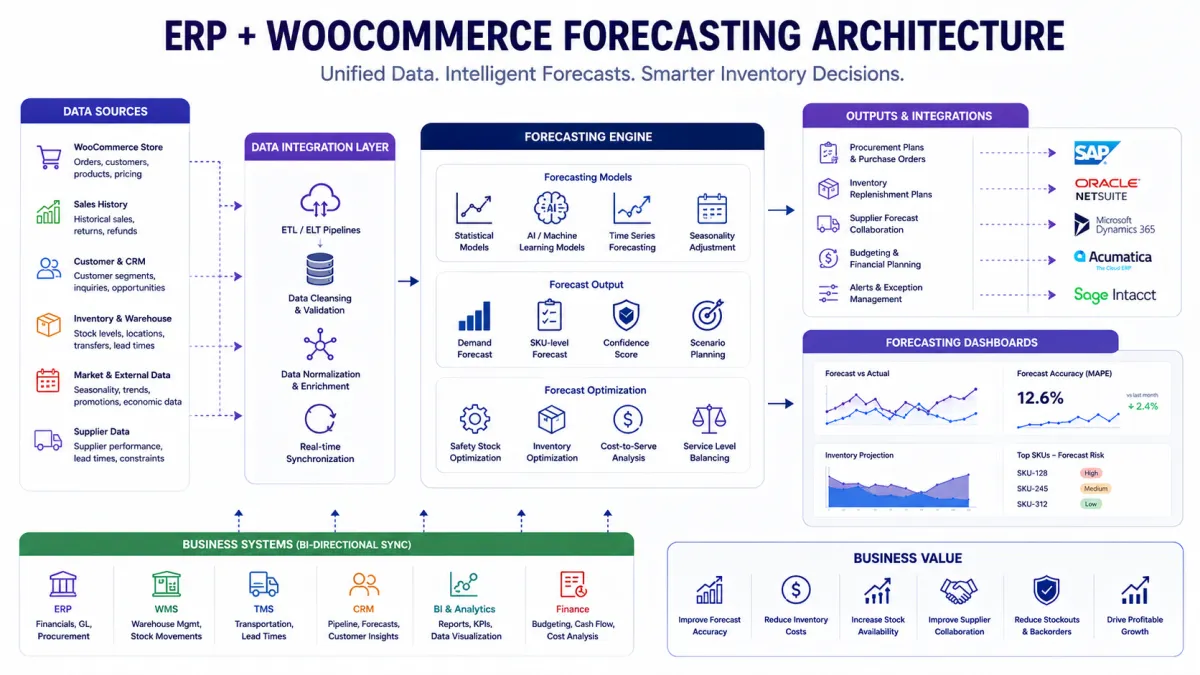
The ERP typically holds historical sales, inventory, and supplier lead time data, all of which a forecast model needs as raw input. Business intelligence tools sit on top of this data, running the actual forecasting models and surfacing results in a dashboard planners can act on. WooCommerce contributes real-time sales and order data that keeps the forecast current rather than working from a monthly export.
CRM data adds visibility into upcoming deals and contract renewals that would not yet show up in historical sales but materially affect near-term demand. Warehouse data confirms what is physically available to compare against forecasted need. Inventory analytics dashboards tie all of this together, giving planners one place to see forecast, actual demand, and current stock position instead of three separate reports.
ERP inventory forecasting works best when the ERP is treated as the system of record for the raw inputs, while the forecasting logic itself can live in a dedicated BI layer built for that purpose. Getting this system ownership right follows the same logic covered in our guide to ERP vs CRM vs OMS, which applies directly to forecasting architecture decisions.
Why Forecasting Fails Before Technology
Most forecasting failures are not caused by a weak model. They come from treating forecasting as a reporting task instead of a financial planning discipline with real budget consequences.
The hidden cost of over-forecasting rarely shows up as a single obvious loss. It accumulates quietly in carrying costs, warehouse space, and capital that sits unsold, and it often goes unnoticed until a slow-moving inventory report finally forces a write-down. Under-forecasting causes a more visible but equally damaging problem: missed sales, emergency reorders at rush pricing, and customers who quietly start buying from a competitor who had the stock in place.
Both failure modes trace back to the same root cause. Forecasting was treated as a number to generate once, not a discipline to govern, measure, and continuously correct.
Why Sales Teams and Procurement Teams Disagree
Sales teams tend to forecast optimistically, since a missed opportunity from understocking feels more visible and painful to them than the cost of excess inventory sitting in a warehouse. Procurement teams lean the opposite direction since they own the budget and carrying cost consequences directly.
Neither bias is wrong on its own, but left unreconciled, the two produce a forecast nobody actually trusts. The fix is a shared forecast governance process where both teams review the same data and agree on assumptions before numbers get finalized, rather than each side quietly adjusting the other’s number after the fact.
Common Forecasting Mistakes
Several patterns repeat across enterprise forecasting reviews regardless of industry.
- Relying on historical sales alone, ignoring market or seasonal shifts
- Ignoring seasonality entirely, or applying last year’s pattern without adjustment
- Ignoring known supplier delays that should already be factored into lead time
- Poor data quality feeding the forecast, from incomplete or inconsistent sales records
- Manual spreadsheets that cannot scale past a few hundred SKUs reliably
- No KPI tracking, so forecast accuracy is never actually measured
- Forecasting every SKU with the same method regardless of volume or volatility
Forecasting at Scale: 100,000+ SKUs and Multiple Warehouses
Forecasting logic that works cleanly for a few thousand SKUs in one location rarely scales cleanly past six figures of products and several warehouses. Demand at that scale is not uniform. It has to be forecasted at the location level, not just the SKU level, since the same product can trend differently in two regions at once.
A catalog that was never structured with clean categories and attributes makes this dramatically harder, since accurate grouping is what lets a forecast model treat similar products consistently. This is why a clean WooCommerce catalog management foundation often has to come before forecasting sophistication improves. Query and reporting performance become real constraints at this scale as well, the same issue covered in our guide to WooCommerce database optimization for large stores.
AI Forecasting and Market Volatility
AI does not replace human planning, even where forecasting models are genuinely strong. It replaces the manual pattern-spotting work, leaving humans to apply judgment the model cannot, such as a known supplier issue, a planned promotion, or a competitor’s price change that has not yet shown up in historical data.
Market volatility is where this distinction matters most. A model trained entirely on stable historical patterns struggles the moment real conditions shift sharply, whether from a supply shock or a sudden demand spike. The businesses that handle volatility well treat AI inventory forecasting output as a strong starting point for a planner to review, not a number to accept automatically.
Inventory replenishment planning benefits the most from this human and model partnership, since the reorder point itself is a forecasting output, not a fixed number set once and left alone. A replenishment trigger built on a stale forecast quietly drifts out of sync with actual demand until someone notices stock running short or piling up.
How Dazzlebirds Designs Enterprise Forecasting Systems
Every forecasting engagement starts with business discovery focused on how planning decisions actually get made today, not on which forecasting software has the most features. That means understanding current data sources, existing spreadsheet workarounds, and where sales and procurement currently disagree.
Historical data assessment and forecast model selection follow, since the right method depends heavily on data quality and product volatility, not a one-size answer applied to every SKU. An ERP assessment confirms what data can be trusted in real time versus what needs cleansing first, since WooCommerce inventory forecasting is only as reliable as the data behind it.
Data cleansing is frequently the most time-consuming step and the most skipped, even though a forecast built on inconsistent historical records will mislead regardless of the model chosen. Dashboard design turns model output into something planners can actually use daily, and AI readiness assessment confirms whether the business has enough clean historical data to support a predictive model at all.
Testing and optimization validate the forecast against real outcomes before it drives procurement decisions at scale. Continuous improvement keeps the system aligned as product mix, seasonality, and market conditions evolve. Our enterprise WooCommerce technical audit process is often the starting point for exactly this kind of forecasting discovery work.
Future of Inventory Forecasting
Machine learning models are moving from simple trend projection toward genuinely predictive analytics that weigh dozens of variables simultaneously, catching demand shifts a human planner would miss until it was too late to act. Digital twins are beginning to let planners simulate a demand scenario before committing real budget to it.
Autonomous planning, where routine reorder decisions execute without manual review, is becoming realistic for stable, well-understood product lines, freeing planner time for the genuinely uncertain categories that need human judgment. Real-time forecasting and self-learning models that recalibrate automatically as new sales data arrives are replacing the monthly or quarterly refresh cycle that most forecasting programs still run on today.
Enterprise Forecast Readiness Checklist
Before investing in a formal forecasting system, confirm the business can answer these questions with confidence.
- Is historical sales data clean, complete, and accessible in one place
- Does the current process account for seasonality explicitly, not just gut feel
- Can forecast accuracy currently be measured using MAPE or a similar metric
- Do sales and procurement review the same forecast data before it is finalized
- Is safety stock calculated by product volatility, not a single flat rule
- Can forecasting be applied at the warehouse level, not just company-wide
- Is there a defined cycle for comparing forecast to actual and correcting course
Key Takeaways
- Inventory forecasting should guide procurement decisions, not react to stock shortages after they happen.
- Historical sales data alone is rarely sufficient for enterprise-level forecasting accuracy.
- Safety stock should balance service levels against carrying cost, not follow one flat formula.
- Forecast accuracy requires continuous measurement using metrics like MAPE and forecast bias.
- AI forecasting improves decisions only when supported by clean, sufficient historical data.
- ERP, CRM, and WooCommerce synchronization directly increases forecast reliability.
- Multi-location businesses need location-specific demand planning, not one company-wide number.
- Strong governance prevents sales and procurement from working from conflicting forecasts.
- Over-forecasting and under-forecasting both carry real, measurable financial costs.
- Forecasting maturity grows through a repeating cycle of measurement and correction, not a single model rollout.
Conclusion: Implementation Roadmap and Next Steps
WooCommerce inventory forecasting works when it is treated as an ongoing financial planning discipline rather than a report generated once and forgotten. The businesses that get real value from it clean their historical data first, measure forecast accuracy continuously, and give sales and procurement one shared number to plan against instead of two competing ones.
The practical starting point is an honest audit of current data quality and how far forecast accuracy currently sits from actual demand. From there, the roadmap is direct: fix data quality first, establish accuracy measurement second, and only then layer in more sophisticated forecasting methods or AI models. Discipline and clean data determine forecasting accuracy far more than any single tool or algorithm choice does.
FAQs
WooCommerce inventory forecasting is the process of predicting future product demand using historical sales, seasonal trends, supplier lead times, and business data to help B2B companies optimize inventory levels, reduce stockouts, and improve purchasing decisions.
WooCommerce inventory forecasting helps enterprise B2B businesses maintain optimal inventory, improve forecast accuracy, reduce carrying costs, support procurement planning, and ensure products remain available during changing customer demand and seasonal fluctuations.
WooCommerce inventory forecasting integrates with ERP systems to combine sales history, inventory levels, supplier lead times, procurement data, and financial information, enabling accurate demand forecasts and better inventory planning across enterprise operations.
Accurate WooCommerce inventory forecasting relies on historical sales, customer demand patterns, seasonal trends, supplier performance, inventory turnover, lead times, promotional campaigns, and ERP data to generate reliable forecasts and smarter replenishment decisions.
Yes. AI enhances WooCommerce inventory forecasting by analyzing large datasets, identifying demand patterns, predicting seasonal changes, improving forecast accuracy, and helping enterprise businesses make faster, data-driven inventory and procurement decisions.



 WooCommerce Solutions
 Solutions for WordPress