An operations director at a mid-market distributor spends her Monday morning triaging the same problems she triaged last Monday. A supplier missed a delivery window, and nobody flagged it until the customer complained. A quote sat in an inbox for 36 hours because pricing approvals required three emails. Inventory allocated to one warehouse should have shipped from another warehouse, but the routing logic could not account for both stock availability and freight costs simultaneously.
These are not technology failures. They are coordination failures. They persist because ERP, WooCommerce, PIM, and WMS cannot reason across each other in real time. Traditional automation handles tasks you define in advance. AI agents handle decisions you cannot.
This guide explains what AI Agents for Enterprise Ecommerce are, where they create measurable value in enterprise ecommerce, how to architect them, and what most organizations get wrong during implementation.
Key Takeaways
- AI agents differ from traditional automation by perceiving context, reasoning across systems, and acting autonomously within defined boundaries.
- Enterprise ecommerce needs AI agents for multi-step, cross-system decisions that rule-based workflows cannot handle at scale.
- Start with a single high-impact agent (procurement or inventory) before expanding into adjacent operations.
- Every AI agent deployment requires a governance framework with human override, audit trails, and defined authority limits.
- Data quality determines agent performance. Clean, connected data across ERP and WooCommerce is the prerequisite.
- AI agents do not replace ERP or WooCommerce. They sit between systems as an orchestration layer that coordinates decisions.
- Security architecture must enforce least-privilege access, meaning agents should only reach the data and actions their role requires.
- Measure agent value through operational KPIs such as order cycle time, stockout rate, and quote turnaround, not technology metrics.
- Most failed AI agent projects invested in models before fixing data pipelines and process documentation.
- The competitive window is narrow. By 2028, agent-ready architecture will be table stakes for enterprise B2B commerce.
What Are AI Agents for Ecommerce?
AI agents for ecommerce are autonomous software systems that perceive operational conditions, reason about the best course of action, and execute decisions across enterprise commerce platforms. Unlike chatbots or rule-based workflows, AI agents operate across multiple systems simultaneously, handling tasks like procurement optimization, inventory rebalancing, dynamic pricing adjustments, and supplier risk assessment without requiring step-by-step human instruction.
What Are AI Agents?
An AI agent is a software system designed to pursue a goal autonomously. It perceives its environment through data inputs, reasons about what action to take, and acts by calling APIs, updating records, or triggering workflows.
The distinction from conventional automation is significant. A rule says “if stock drops below 50, create a purchase order.” An AI agent evaluates current stock, incoming order velocity, supplier lead time history, warehouse capacity, and freight cost before deciding whether to reorder, from which supplier, in what quantity, and to which location.
Three characteristics define enterprise-grade AI agents. First, they maintain context across interactions, remembering previous transactions and adjusting behavior accordingly. Second, they coordinate across system boundaries, pulling data from ERP, acting in WooCommerce, and reporting to analytics. Third, they operate within governance constraints with defined authority limits and escalation paths.
AI agents are not general artificial intelligence. They are narrow, purpose-built systems optimized for specific operational domains.
Why Enterprise Ecommerce Needs AI Agents
Enterprise B2B commerce involves decisions that are too complex for static rules and too frequent for manual handling. Consider the daily volume: thousands of SKUs, hundreds of customer accounts with unique pricing, dozens of suppliers with variable lead times, multiple warehouses with shifting capacity. Every order triggers a cascade of allocation, routing, invoicing, and fulfillment decisions.
Rule-based automation served this environment when variables were limited. It breaks down when the decision space expands. Inventory forecasting that factors in supplier reliability, demand seasonality, promotional calendars, and warehouse capacity requires adaptive intelligence, not static thresholds.
Three conditions signal that an organization needs AI agents. First, when operational decisions involve more than four variables that change in real time. Second, when the same decision type repeats thousands of times weekly but requires nuanced judgment each time. Third, when the cost of slow or wrong decisions is material to quarterly performance.
AI agents for ecommerce do not replace human operators. They absorb high-volume, data-intensive decisions so teams can focus on strategy and exceptions.
Types of AI Agents in Enterprise Ecommerce
Enterprise AI agents fall into four functional categories based on how they operate and what they control.
Reactive agents respond to specific triggers. A reactive agent monitors incoming orders and flags anomalies such as unusual quantities, mismatched addresses, or pricing errors. It operates event-by-event without maintaining memory.
Deliberative agents plan before acting. A deliberative procurement agent evaluates demand forecasts, current inventory, supplier scores, and budget constraints before generating a recommended purchase order.
Collaborative agents coordinate with other agents or human operators. A warehouse agent negotiating fulfillment routing with an inventory agent and a shipping agent operates collaboratively, each contributing domain-specific intelligence.
Adaptive agents learn from outcomes. An adaptive pricing agent adjusts recommendations based on win/loss data from quote request workflows, improving margin optimization as it accumulates transactional history.
Most enterprise deployments use deliberative agents first, as they deliver the clearest ROI with the most controllable risk profile.
AI Agent Architecture

Enterprise AI agent architecture consists of five layers that must work together without creating new integration debt.
Perception layer. Agents consume data from WooCommerce (orders, carts, and customer activity), ERP (financials, inventory, and procurement), PIM (product attributes and taxonomy), and external sources (supplier feeds and market signals). Data arrives through APIs, webhooks, or event streams.
Memory layer. Unlike stateless automation, agents maintain operational context. A procurement agent remembers that Supplier A delivered late on the last three orders and adjusts its sourcing recommendations accordingly. Memory is stored in vector databases or structured knowledge graphs.
Reasoning layer. The core decision engine. This is where a language model, optimization algorithm, or hybrid system evaluates options against constraints and objectives. The reasoning layer must be explainable. If a pricing agent recommends a 4% discount for a specific account, the reasoning should be traceable to specific inputs (order history, margin target, competitive pressure).
Action layer. Agents execute decisions by calling system APIs. A purchase order management agent creates a PO in the ERP. An inventory agent updates allocation in WooCommerce. A support agent generates a response and routes a ticket.
Governance layer. Every action passes through policy checks. Authority limits define what an agent can do autonomously versus what requires human approval. Audit logs capture every decision for compliance and performance review.
AI Agents + WooCommerce + ERP + CRM + PIM + MDM + WMS

AI agents do not operate inside a single platform. They sit as an orchestration layer across the enterprise technology stack. The integration architecture must account for each system’s role.
A stable WooCommerce ERP integration is the foundation. Without bidirectional, real-time data flow between commerce and back-office systems, agents cannot perceive or act accurately. Every agent decision depends on trusted data from the system of record.
Product information management provides the product data agents need for classification, recommendation, and catalog operations. Master data management ensures that customer, supplier, product, and location records remain consistent across every system an agent touches. When master data is fragmented, agents learn from conflicting signals and produce unreliable outputs.
WMS integration enables warehouse agents to make allocation and routing decisions based on real-time bin-level inventory, pick capacity, and carrier availability. CRM integration gives customer-facing agents access to account history, open cases, and relationship context that shapes how they prioritize and respond.
The principle is straightforward. AI agents are only as reliable as the data they consume and the systems they act upon. Integration architecture is not a separate project. It is the prerequisite.
AI Agent Use Cases
Customer Service Agent. Classifies incoming support tickets by intent and urgency, retrieves relevant order and product information, generates draft responses for agent review, and identifies patterns that indicate systemic fulfillment or quality issues.
Sales Agent. Monitors account activity for buying signals, such as increased catalog browsing, repeat visits to high-margin products, or lapses in reorder cadence. Generates outreach recommendations with account-specific talking points based on purchase history and contract terms.
Quote an agent. Accelerates customer-specific pricing by pre-populating quotes with margin-aware line items, applying volume and contract discounts automatically, and routing complex quotes to the correct approver based on deal size and risk profile.
Inventory Agent. Manages WooCommerce inventory management across locations by monitoring stock velocity, predicting depletion dates, and recommending transfers between warehouses. For multi-warehouse inventory operations, the agent optimizes which location fulfills each order based on proximity, cost, and available capacity.
Purchase Order Agent. Converts demand forecasts and reorder signals into purchase orders, selecting the optimal supplier based on supplier performance management scores, lead time reliability, and pricing history. Consolidates orders across SKUs to meet minimum quantities and maximize volume discounts.
Supplier Performance Agent. Continuously scores suppliers on delivery accuracy, quality rejection rates, responsiveness, and pricing consistency. Flags deteriorating performance trends before they affect fulfillment. Recommends supplier diversification when concentration risk exceeds defined thresholds.
Pricing Agent. Analyzes margin contribution by customer, product, and channel. Recommends price adjustments that balance competitiveness with profitability targets. Operates within guard rails that prevent pricing below defined floors or above maximum markup rates.
Product Information Agent. Automates attribute extraction from supplier datasheets, detects incomplete or inconsistent product records, and flags catalog entries that need enrichment. Supports product lifecycle management by identifying products approaching end-of-life based on sales velocity decline and replacement availability.
Master Data Agent. Performs entity resolution across systems, identifying duplicate customer, supplier, or product records. Monitors data quality metrics and escalates when consistency drops below defined thresholds. Maintains a unified view across ERP, WooCommerce, PIM, and WMS.
Warehouse Agent. Optimizes pick paths based on order clustering, suggests labor allocation by predicted shift volume, and identifies receiving discrepancies during inbound processing. Coordinates with the inventory agent for cross-warehouse transfers.
Analytics Agent. Synthesizes operational data from multiple systems into executive-level insights. Identifies root causes behind KPI changes, such as why order cycle time increased 14% this month, and recommends corrective actions.
AI Agents vs. Traditional Automation
The question is not whether AI agents are better. The question is which decisions belong to agents and which remain in rule-based workflows.
| Dimension |
Traditional Automation |
AI Agents |
| Decision type |
Binary, predefined |
Multi-variable, contextual |
| Adaptability |
Static rules, manual updates |
Learns from outcomes, adjusts autonomously |
| System scope |
Single system |
Cross-system orchestration |
| Handling exceptions |
Fails or escalates |
Reasons through alternatives |
| Setup effort |
Lower upfront, higher maintenance |
Higher upfront, lower maintenance |
| Auditability |
Fully deterministic |
Requires explainability framework |
| Best for |
Compliance workflows, notifications |
Procurement, inventory, pricing, routing |
The practical approach is coexistence. Use rule-based B2B ecommerce automation for deterministic processes (order status notifications, invoice generation, and compliance checks) and AI agents for decisions that involve trade-offs, variable inputs, and continuous optimization. Refer to the broader AI for enterprise ecommerce framework for guidance on where each fits.
Enterprise AI Governance
Governance is not a feature you add after deployment. It is the architecture that makes deployment responsible.
Enterprise AI Governance Checklist:
- Authority limits defined per agent (what it can decide vs. what requires human approval)
- Escalation paths configured for low-confidence decisions
- Decision audit trail captured for every agent action
- Bias monitoring in place across customer segments and supplier evaluations
- Model retraining schedule documented with performance thresholds
- Data access permissions follow least-privilege principles
- Incident response plan exists for agent errors or unexpected behavior
- Stakeholder review cadence established (monthly performance, quarterly strategy)
Without governance, AI agents become operational liabilities. An unsupervised pricing agent can erode margins. An unchecked procurement agent can over-commit to a single supplier.
AI Agent Security
Security for AI agents differs from application security because agents access multiple systems, make autonomous decisions, and process sensitive commercial data.
Three principles apply. First, least-privilege access. Each agent should access only the data and APIs required for its function. Second, action boundaries. Agents must operate within hard limits for financial commitments, data modifications, and customer communications. Third, audit completeness. Every action must produce an immutable log entry.
Additional considerations include prompt injection protection, data isolation between tenants in multi-customer environments, and model supply chain security to validate third-party models have not been tampered with.
AI Implementation Roadmap
Phase 1: Assessment (Weeks 1 to 6). Audit existing data quality across ERP and WooCommerce. Document current decision processes. Identify the highest-impact agent use case. Establish baseline KPIs for the target process.
Phase 2: Foundation (Weeks 7 to 14). Strengthen data pipelines and integration points. Implement the governance framework. Build the first agent in a sandboxed environment with human-in-the-loop review on every decision.
Phase 3: Pilot (Weeks 15 to 24). Deploy the first agent against live operational data with human approval gates. Measure performance against baseline KPIs. Iterate on reasoning logic and authority thresholds based on outcomes.
Phase 4: Expansion (Months 7 to 12). Add adjacent agents. Enable agent-to-agent collaboration (e.g., inventory agent feeding signals to the procurement agent). Reduce human approval gates for high-confidence decisions.
Phase 5: Optimization (Month 13 onward). Continuous model improvement. Expand agent authority as trust builds. Introduce adaptive agents that learn from outcomes. Report ROI quarterly.
Enterprise AI Readiness Checklist:
- ERP-WooCommerce integration is stable with real-time data sync
- Product data is structured with consistent taxonomy and complete attributes
- Historical transactional data covers at least 18 months
- Decision processes for target use case are documented
- Data ownership and stewardship roles are assigned
- Security and compliance requirements are defined
- An executive sponsor is identified with clear success criteria
- The budget includes ongoing model maintenance and agent monitoring
Common Implementation Mistakes
- Building agents before fixing data. The most common failure. An agent trained on inconsistent product data, duplicate customer records, or stale inventory counts will produce unreliable decisions at scale. Invest in data quality first.
- Deploying too many agents simultaneously. Multi-agent deployments compound complexity. Start with one, prove value, then expand. Organizations that launch five agents at once spend more time debugging inter-agent conflicts than capturing value.
- Treating agents as projects instead of products. Agents require continuous monitoring, retraining, and governance. Budget for ongoing operations, not just deployment. A procurement agent that performed well six months ago may underperform if supplier dynamics have changed.
- Ignoring change management. Operations teams adopt agents faster when they understand the reasoning behind decisions. Transparency builds trust. Organizations that skip training and explanation see low adoption rates regardless of agent accuracy.
- Over-automating compliance-sensitive processes. Regulatory approvals, financial commitments above defined thresholds, and safety-critical decisions should retain human approval. Agents can prepare the recommendation. Humans should authorize the action.
Why AI Agent Projects Fail
Beyond implementation mistakes, structural issues cause failures. Misaligned expectations top the list. Executives expect results in weeks, but reliable enterprise agents need months of data preparation, integration work, and iterative refinement.
Organizational resistance is second. Middle management often views agents as threats rather than tools that redirect effort from repetitive decisions to strategic work. Third, vendor dependency. Organizations building entirely on a single vendor’s platform inherit that vendor’s limitations and pricing changes. Modular architecture with interchangeable components reduces this risk.
Human + AI Collaboration
The most effective deployments position agents as decision-support systems, not decision-replacement systems. The human role shifts from executing routine decisions to supervising agent behavior, handling exceptions, and providing contextual judgment.
In practice, a procurement manager reviews agent-generated purchase orders before submission, gradually approving more autonomously as confidence builds. A sales director reviews pricing recommendations for strategic accounts while allowing automated pricing for standard transactions.
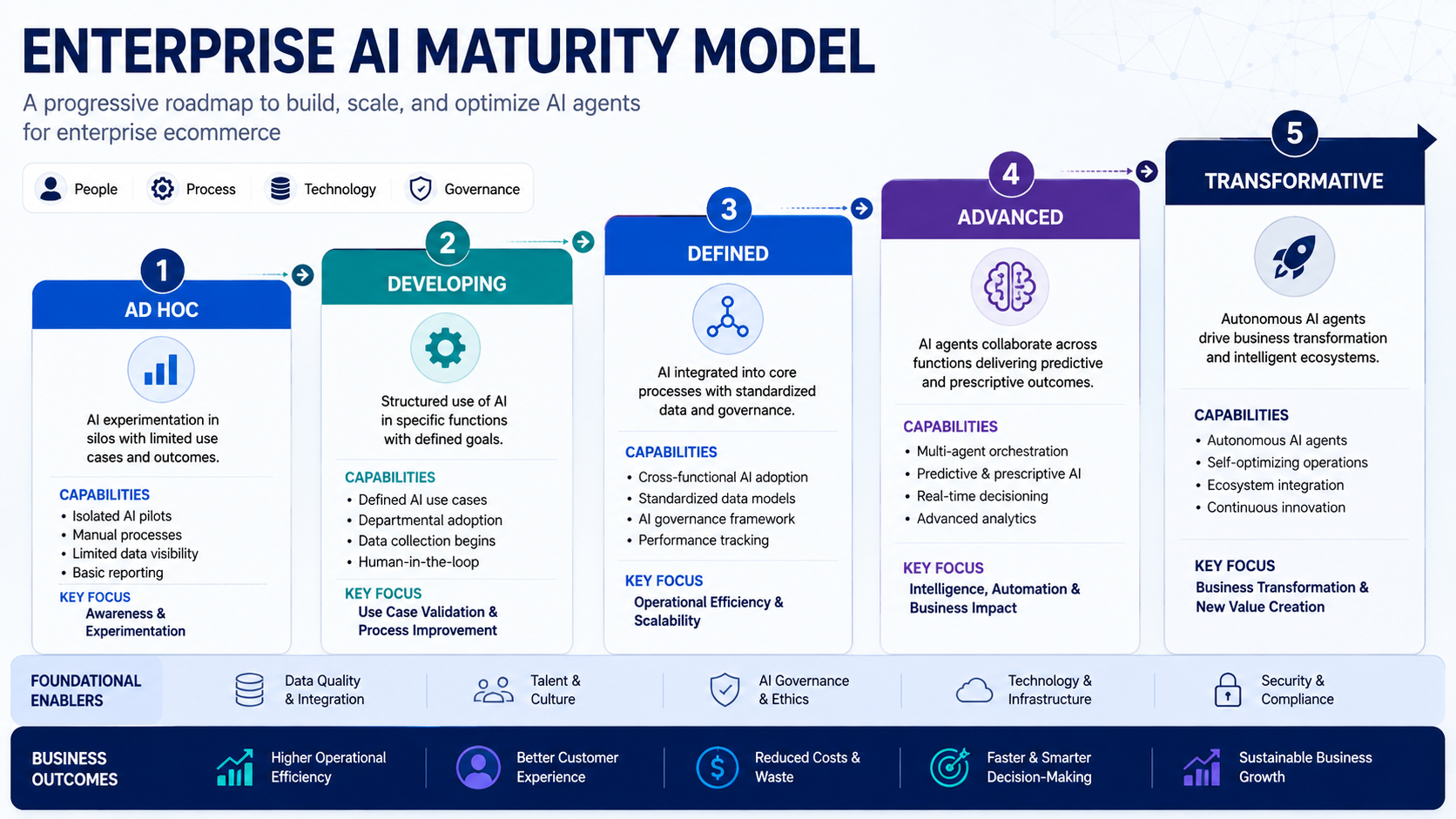
The maturity progression moves from full human oversight to selective oversight to exception-only oversight. Plan for 12 to 18 months before reaching exception-only oversight for any given agent.
Future of AI Agents in Enterprise Ecommerce
Three developments will define the next 24 months. First, agent-to-agent commerce. B2B transactions where a buyer’s procurement agent negotiates with a seller’s pricing agent, exchanging structured data and counter-offers without human involvement for routine purchases.
Second, multimodal agents that process documents, images, and structured data simultaneously. A product information agent that reads a supplier PDF, extracts specifications, validates against catalog records, and creates enriched listings without manual entry.
Third, vertical specialization. General-purpose agents will give way to industry-specific agents trained on domain data. Organizations building proprietary operational datasets will gain a sustained competitive advantage.
FAQs
AI agents for ecommerce are autonomous systems that perceive operational data, reason across enterprise platforms like ERP, PIM, and WooCommerce, and execute cross-system decisions for inventory, pricing, procurement, and customer operations.
Chatbots respond to conversational inputs within a single channel. AI agents reason across multiple enterprise systems, maintain operational context over time, and take autonomous actions within defined governance boundaries.
Implementation costs range from $150,000 to $500,000 for the first agent, including data preparation, integration, governance setup, and pilot deployment, with ongoing operational costs of 15 to 25 percent annually.
Organizations report a 30 to 50 percent reduction in quote turnaround, a 15 to 25 percent improvement in inventory turns, and a 10 to 20 percent reduction in procurement costs within the first 12 months.
Enterprise-grade agents require least-privilege access controls, action boundaries, immutable audit logs, prompt injection protection, and data isolation between business units or tenants.


 WooCommerce Solutions
 Solutions for WordPress