A manufacturer receives three supplier quotations in the same week, each priced differently, each with different lead times, and none of them tied to an approved budget line. Meanwhile, a production run stalls because raw materials that were “on order” were never formally confirmed with the supplier. This is not a technology failure. It is a governance failure.
Purchase orders are often treated as paperwork that follows a buying decision. In enterprise operations, they are something else entirely. A purchase order is a business control system. It confirms what was authorized, who approved it, what budget it draws from, and what the business is legally committed to pay. Without that structure, procurement becomes a series of informal agreements that finance, operations, and leadership cannot see or trust.
For enterprise WooCommerce businesses running B2B operations, purchase order management sits upstream of everything else. It determines whether inventory arrives on time, whether spend stays inside budget, and whether the business can defend its numbers during an audit. This guide focuses specifically on that layer of the business, the decisions and controls that happen before stock ever reaches a warehouse.
what is WooCommerce purchase order management
WooCommerce purchase order management is the structured process of creating, approving, tracking, and reconciling purchase orders issued to suppliers from a WooCommerce-based B2B operation. It connects procurement requests, budget approval, supplier communication, and ERP or accounting systems into one controlled workflow. Done correctly, it gives finance and operations leaders full visibility into committed spend before goods or invoices arrive.
Why Enterprise Businesses Need Purchase Order Management
Enterprise purchase order management exists to answer one question with certainty: Who authorized this spend and under what terms? Without that answer, a business cannot reconcile its books, forecast cash flow, or hold suppliers accountable to agreed pricing.
Supplier coordination benefits directly from formal purchase orders because they remove ambiguity from every transaction. A supplier working from a signed PO knows exact quantities, pricing, delivery expectations, and payment terms, which reduces disputes at receiving and invoicing.
Financial governance depends on purchase orders as the first checkpoint in the spend cycle. Every dollar committed to a supplier should trace back to an approved budget line, an authorized approver, and a documented business reason. This is what allows a CFO to trust monthly spend reports instead of reconciling them after the fact.
Procurement planning, inventory replenishment, and budget visibility all rely on the same underlying data. When purchase orders are structured and centralized, procurement teams can see open commitments, pending deliveries, and remaining budget in real time rather than discovering overspend at month-end.
Understanding the Enterprise Purchase Order Lifecycle
The enterprise purchase order lifecycle is the sequence of controlled steps a purchase moves through, from internal request to final payment reconciliation. Each stage exists to assign responsibility and reduce risk at a specific point in the process.
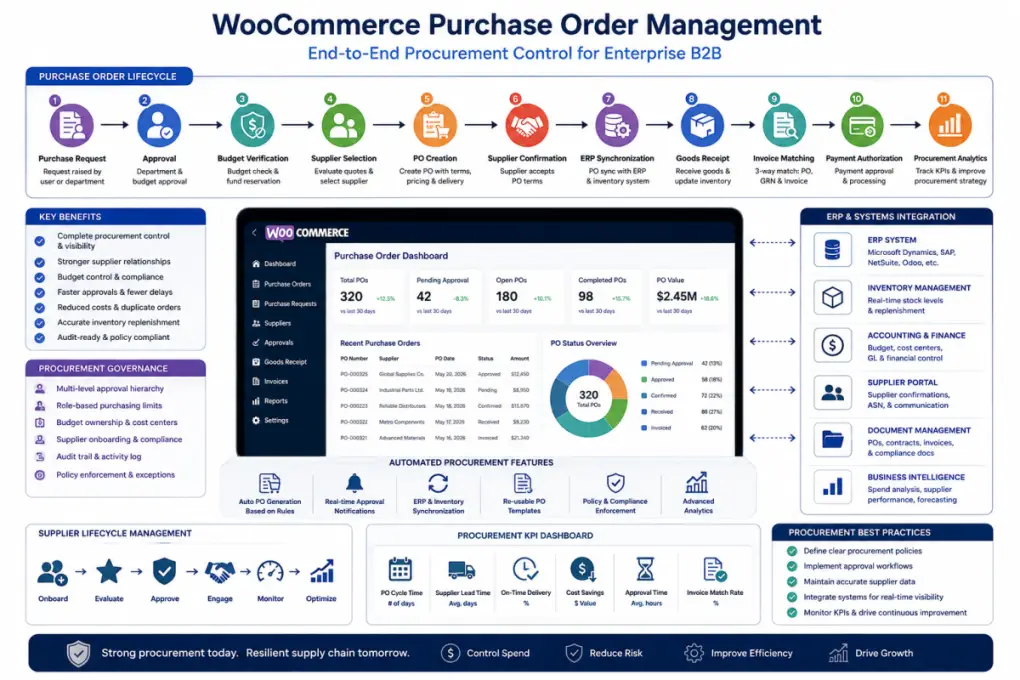
Purchase Request → Department Approval → Budget Verification → Supplier Selection → Purchase Order Creation → Supplier Acceptance → ERP Synchronization → Goods Receipt → Invoice Matching → Payment Authorization → Procurement Analytics
A purchase request originates the cycle, typically from a department that has identified a need, whether that is raw materials, MRO supplies, or finished goods for resale. This step should capture business justification, not just a product name and quantity.
Department approval assigns accountability to a named individual with authority over that budget line. Skipping this step is how maverick spending enters an organization, because purchases happen without anyone confirming they are necessary or affordable.
Budget verification checks the request against remaining allocation before a supplier is ever contacted. This prevents the common failure mode where a purchase is approved on merit but later discovered to exceed available funds.
Supplier selection and purchase order creation formalize the commercial agreement. Many enterprise buyers reach this stage after a formal quote request process, so the purchase order simply confirms terms that were already negotiated rather than reopening pricing discussions. Once accepted by the supplier, the order becomes a binding document that both sides can reference if quantities, pricing, or timelines are disputed later.
ERP synchronization pushes the purchase order into accounting and inventory systems so that committed spend, expected stock, and open liabilities are visible across the business, not isolated inside a single department’s records.
Goods receipt, invoice matching, and payment authorization form the closing sequence, where what was ordered is verified against what arrived and what was billed. Receiving accuracy at this stage also depends heavily on how well the business has planned its inbound logistics, which is a separate discipline covered in our B2B shipping setup guide. Procurement analytics closes the loop by feeding this data back into future sourcing and budgeting decisions. A weak link at any stage, particularly missing budget verification or receipt matching, is where enterprise procurement losses typically originate.
When Should Businesses Implement Purchase Order Management?
Formal purchase order management becomes necessary once a business can no longer rely on informal trust between departments and suppliers to control spend. This threshold arrives earlier than most operations leaders expect.
Manufacturing and industrial equipment companies need it as soon as raw material costs represent a meaningful share of production expense, since even small pricing errors compound across large volumes. Healthcare organizations require it for compliance and audit reasons, given the regulatory scrutiny around procurement documentation and supplier qualification.
Wholesale, food distribution, and chemical suppliers depend on structured purchase orders to manage supplier lead times against perishability, safety data, and regulatory traceability requirements. Automotive and construction businesses need it to coordinate purchasing across multiple job sites or production lines without duplicating orders.
Enterprise retail and wholesale organizations, particularly those already managing high-volume reorders through structured bulk ordering workflows, need purchase order management on the supply side to prevent buyers in different regions from competing against each other for the same supplier capacity. In each case, the trigger is not company size alone. It is the point where uncontrolled purchasing starts creating financial or operational risk that leadership can no longer absorb informally.
Designing Enterprise Procurement Governance
Procurement governance is the set of rules, roles, and limits that determine who can spend, how much, and under what conditions. It exists to protect the business from both fraud and well-intentioned but uncoordinated spending.
Approval hierarchy should scale with dollar value, not just department. A purchase under a defined threshold might need one manager’s sign-off, while anything above it should require finance or executive review. This tiered structure keeps small, routine purchases moving quickly while protecting the business on larger commitments.
Department ownership matters because procurement decisions made without the requesting department’s input often result in wrong specifications or missed deadlines. Budget limits, set at the department or project level, give approvers a clear ceiling to work within rather than relying on judgment alone. The same discipline applies on the sell side, where contract terms and negotiated rates are enforced through customer-specific pricing rather than manual discounting, and governance frameworks work best when both sides of the business apply this level of control.
Supplier onboarding and compliance should be treated as a gate, not a formality. Before any purchase order is issued, a supplier should be verified on insurance, tax documentation, and, where relevant, industry certifications. This protects the business legally and reduces disruption from suppliers who cannot deliver reliably.
Delegated approvals and emergency purchasing policies matter because rigid systems break down the first time a genuine urgent need arises. A well-designed governance framework includes a documented emergency path with retroactive review, rather than forcing staff to bypass the system entirely and undermine the audit trail.
Purchase Orders vs Purchase Requisitions
Purchase orders and purchase requisitions are frequently used interchangeably, but they represent different stages of financial commitment and carry different legal weight.
| Attribute |
Purchase Requisition |
Purchase Order |
| Purpose |
Internal request to buy |
Formal commitment to a supplier |
| Owner |
Requesting department |
Procurement or purchasing team |
| Approval |
Internal manager or budget holder |
Finance and procurement sign-off |
| Financial impact |
No binding liability yet |
Creates a binding financial obligation |
| Business use |
Captures need and justification |
Confirms price, quantity, and terms |
| ERP integration |
Often tracked as a pending request |
Synced as committed spend and expected inventory |
| Workflow stage |
Precedes supplier contact |
Precedes goods receipt and invoicing |
Understanding this distinction matters because businesses that skip the requisition stage lose the internal justification trail, while businesses that skip the purchase order stage have no enforceable agreement with the supplier.
ERP, Procurement, and WooCommerce Architecture
An enterprise procurement architecture connects WooCommerce, ERP, accounting, inventory, and supplier systems so that purchasing data flows automatically instead of being re-entered manually at each stage. This is the same principle behind a well-designed WooCommerce ERP integration, applied specifically to the procurement side of the business.
[Visual: ERP + Procurement + WooCommerce Architecture]
In this architecture, WooCommerce typically manages the customer-facing storefront and, for procurement purposes, the front end where purchase requests and internal approvals originate. The ERP system holds the financial source of truth, including budgets, general ledger codes, and vendor master data.
Accounting and finance systems consume purchase order data to track committed versus actual spend, which is different from tracking revenue and should never be conflated in reporting. Inventory systems use purchase order data to anticipate incoming stock, which directly affects replenishment planning and customer-facing availability.
Supplier portals, where implemented, allow vendors to acknowledge orders, update delivery timelines, and submit invoices directly into the workflow, reducing email-based coordination. Receiving, invoicing, and payment systems close the loop, and business intelligence tools sit on top of all of it, giving leadership visibility into spend trends, supplier performance, and cycle times.
The reason synchronization matters is simple. When these systems operate independently, the business ends up with three different versions of the truth: what was ordered, what the ERP thinks was ordered, and what accounting eventually pays. Reconciling those differences manually is expensive and error-prone at enterprise scale.
Common Procurement Mistakes
Most procurement failures are structural, not the result of any single bad decision. They accumulate from gaps in process design that only become visible once volume increases.
Manual approvals routed through email or verbal confirmation create no audit trail and slow decisions down precisely when speed matters most. The same problem shows up on the order side of the business when workflows are not automated, which is why many of the principles in our B2B ecommerce automation guide apply equally well to inbound procurement. Supplier dependency, where a business relies on a single vendor without qualified alternatives, leaves procurement exposed to price increases or delivery failures with no fallback.
Poor budgeting, meaning purchases approved without checking the remaining allocation, is one of the most common causes of quarter-end financial surprises. The absence of approval controls, where any employee can generate a purchase commitment, is how maverick spending becomes normalized inside an organization.
Duplicate purchasing happens when departments cannot see each other’s open orders, resulting in two teams ordering the same materials independently. Poor supplier visibility, a disconnected ERP, and a weak audit trail compound these problems, because by the time leadership notices the pattern, the financial impact has already occurred across multiple purchase cycles.
Procurement KPIs
Procurement performance should be measured with the same rigor applied to sales or operations because uncontrolled spend has a direct and measurable effect on margin, much like the discipline outlined in our B2B ecommerce ROI and KPI guide for the revenue side of the business.
Purchase order cycle time tracks how long it takes from request to supplier acceptance, revealing where approval bottlenecks are slowing the business down. Supplier lead time measures actual delivery reliability against quoted timelines, which is essential for inventory planning accuracy.
Cost savings and spend under management show how much of total procurement spend is actively governed through the formal process versus occurring outside it. Approval time isolates internal friction, separate from supplier performance, helping leadership see where their own process needs adjustment.
Supplier performance and procurement compliance rates indicate whether vendors are meeting agreed terms and whether internal teams are following the approved workflow rather than working around it. Purchase accuracy and invoice match rate close the loop, showing how often what was ordered, received, and billed actually agree with each other, which is a direct indicator of process health.
Enterprise Procurement Insights
Purchase orders are financial controls, not inventory documents. Treating a purchase order as simply a record of what to stock misses its real function. It is the mechanism that ties spend to authorization, which is why finance teams, not just operations, should have visibility into every open order.
Why procurement fails before technology. Most procurement breakdowns are not caused by missing software. They are caused by undefined ownership, where no one is clearly accountable for approvals, budgets, or supplier relationships before any system is introduced to manage them.
Supplier relationships versus lowest price. Chasing the lowest quoted price without evaluating reliability, quality consistency, and responsiveness often costs more over time through delays, rework, and emergency sourcing. Enterprise procurement teams typically weigh total cost of ownership rather than unit price alone.
Avoiding maverick spending. Maverick spending occurs when purchases happen outside approved channels, often because the formal process is too slow or too rigid for legitimate business needs. The fix is rarely stricter enforcement alone. It usually requires a faster, better-designed approval path so staff have no reason to bypass it.
Enterprise procurement maturity model. Organizations typically progress from ad hoc, email-based purchasing to departmental controls with basic approval steps, to centralized governance with budget enforcement, and finally to predictive procurement that anticipates need before a shortage occurs. Most mid-sized B2B businesses sit somewhere between the second and third stage, which is exactly where formal purchase order management delivers the most immediate value.
How Dazzlebirds Designs Enterprise Procurement Workflows
Designing a procurement workflow starts with understanding how a business actually buys today, not how it assumes it buys. Dazzlebirds begins every engagement with business discovery, sitting with procurement, finance, and operations stakeholders to map real purchasing behavior, including the informal workarounds teams have built to cope with a slow or missing process.
A procurement assessment follows, identifying where approval delays occur, which purchases lack budget checks, and where supplier communication breaks down. Workflow mapping translates those findings into a defined sequence of steps, approvers, and thresholds specific to the business, rather than a generic template.
An ERP assessment determines what the existing accounting and inventory systems can support and where integration work is needed to avoid duplicate data entry. Supplier analysis reviews current vendor relationships for reliability and consolidation opportunities before any new workflow is built around them.
Approval design and architecture planning bring the governance structure and technical integration together, followed by security review to ensure financial data and approval permissions are properly restricted. Testing and deployment happen in stages, allowing procurement teams to validate the workflow against real purchase cycles before full rollout, and optimization continues afterward as purchase volume and supplier relationships evolve.
Future of Procurement
Procurement is shifting from a reactive, request-driven function toward a predictive discipline supported by better data and, increasingly, AI-assisted tools. This shift changes what “good” procurement looks like over the next several years.
AI procurement assistants are beginning to flag anomalies in pricing, suggest alternate suppliers based on performance history, and draft purchase requests from historical consumption patterns. Predictive purchasing uses demand forecasting to trigger purchase requests before a shortage becomes urgent, reducing the emergency buying that typically costs more.
Supplier intelligence platforms are giving procurement teams visibility into vendor financial health, delivery consistency, and risk exposure that was previously invisible until a problem occurred. Automated approvals for low-risk, pre-authorized purchases are freeing procurement teams to focus review time on higher value or higher-risk decisions.
Spend analytics and real-time procurement insights are moving from quarterly reports to continuous dashboards, and composable commerce architectures are making it easier to connect WooCommerce, ERP, and supplier systems without the rigid, monolithic integrations of the past. None of this replaces governance. It makes governance faster and more precise.
Conclusion
Enterprise purchase order management is not a single feature to enable. It is a governance decision that determines whether a business can trust its own spending data. Businesses ready to formalize this process should start by mapping their current purchase lifecycle honestly, including the informal workarounds already in use, before selecting any technology.
A practical implementation roadmap follows a clear order: define approval hierarchy and budget thresholds first, document supplier onboarding requirements second, and only then design the technical integration between WooCommerce, ERP, and accounting systems. Best practice is to pilot the workflow with one department or product category before scaling it across the business, since early friction points are far cheaper to fix at a small scale.
The decision framework ultimately comes down to risk tolerance and growth stage. A business with rising purchase volume, multiple approvers, or audit exposure has already reached the point where informal procurement creates more risk than the effort of formalizing it. As predictive tools and supplier intelligence continue to mature, the businesses that benefit most will be the ones that already have disciplined governance in place to build on.
FAQs
WooCommerce purchase order management is a structured procurement process that helps B2B businesses create, approve, track, and synchronize purchase orders with ERP systems, improving supplier collaboration, financial control, and inventory replenishment across enterprise operations.
WooCommerce purchase order management improves procurement accuracy by automating approvals, reducing purchasing errors, controlling business spending, and providing better visibility into supplier performance, purchase requests, and inventory replenishment for growing B2B organizations.
Yes. WooCommerce purchase order management can integrate with ERP platforms to synchronize purchase orders, supplier information, inventory updates, invoices, and financial data, creating a centralized procurement workflow with real-time operational visibility.
Automating WooCommerce purchase order management reduces manual work, accelerates approval workflows, improves supplier communication, strengthens compliance, minimizes procurement errors, and provides real-time insights that support faster and more informed purchasing decisions.
WooCommerce purchase order management is ideal for manufacturers, wholesalers, distributors, healthcare suppliers, industrial companies, and enterprise B2B organizations that manage multiple suppliers, approval workflows, inventory replenishment, and high-volume procurement operations.



 WooCommerce Solutions
 Solutions for WordPress