A distributor with 40,000 SKUs, three warehouses, and an ERP that speaks a different language than its WooCommerce storefront. Purchase orders generated from yesterday’s spreadsheet. Customer-specific pricing locked inside one sales rep’s memory. Supplier lead times tracked in email threads nobody can find.
This is not a hypothetical. It is the operating reality for hundreds of enterprise B2B organizations running WooCommerce. The systems work, technically. But they do not work together. And the cost of that fragmentation, measured in late shipments, stockouts, margin erosion, and buyer frustration, compounds every quarter.
Artificial intelligence does not fix fragmentation by replacing systems. It sits between systems, learns from operational data, and makes the connections that manual processes cannot sustain at scale. This guide explains where AI creates measurable value across enterprise WooCommerce operations, where it falls short, and how to implement it responsibly.
What Is AI for Enterprise Ecommerce?
AI for enterprise ecommerce is the application of machine learning, natural language processing, and predictive analytics to automate, optimize, and connect the operational processes behind B2B and high-volume online commerce. It covers demand forecasting, procurement automation, dynamic pricing, product data enrichment, supplier evaluation, warehouse optimization, and customer support. Unlike consumer-facing personalization, enterprise AI focuses on operational throughput, data accuracy, and cross-system coordination across ERP, PIM, WMS, and ecommerce platforms.
Why Enterprise Ecommerce Needs Artificial Intelligence
The complexity gap is the core problem. As B2B organizations grow, the number of decisions per order increases: which warehouse ships, what price applies, whether stock is allocated, and how the order routes through approval workflows. Manual processes that worked at 500 orders per month collapse at 5,000.
Three forces are accelerating this pressure. First, B2B buyers now expect real-time inventory visibility, accurate delivery estimates, and self-service reordering. Second, supply chain volatility has become structural, not cyclical. Lead times fluctuate, supplier reliability varies, and demand signals shift faster than quarterly planning cycles can absorb. Third, margin pressure demands operational precision. When raw material costs rise, the only controllable variable is efficiency.
AI addresses these forces not through a single application but through a layer of intelligence that spans the value chain. The ROI is not in one dramatic improvement. It is in dozens of small, compounding efficiencies: 3% fewer stockouts, 12% faster order processing, an 8% reduction in dead stock, and a 15% improvement in quote turnaround.
When AI is not the answer: Organizations with fewer than 1,000 SKUs and a single warehouse rarely generate enough operational data for AI models to outperform well-structured rule-based automation. Start with clean data and B2B ecommerce automation before investing in AI.
AI Across the Enterprise Ecommerce Value Chain
AI touches nearly every node in a B2B e-commerce operation. Here is where it applies and where traditional automation still makes more sense.
| Area |
AI Application |
Traditional Automation |
| Customer |
Predictive segmentation, churn scoring |
Rule-based email triggers |
| Products |
Attribute enrichment, classification |
Bulk CSV imports |
| Inventory |
Demand-driven replenishment |
Fixed reorder points |
| Orders |
Anomaly detection, intelligent routing |
Status-based workflows |
| Suppliers |
Performance scoring, risk prediction |
Manual scorecards |
| Warehouses |
Pick path optimization, demand allocation |
Zone-based picking |
| Pricing |
Margin-optimized dynamic pricing |
Tiered price lists |
| Analytics |
Predictive insights, root cause analysis |
Scheduled dashboards |
| Support |
Intent classification, resolution routing |
Ticket queue assignment |
The distinction matters. Not every process benefits from AI. Rule-based automation handles predictable, binary decisions well. AI earns its cost when decisions involve multiple variables, historical patterns, or real-time adaptation.
AI + WooCommerce + ERP + Enterprise Architecture
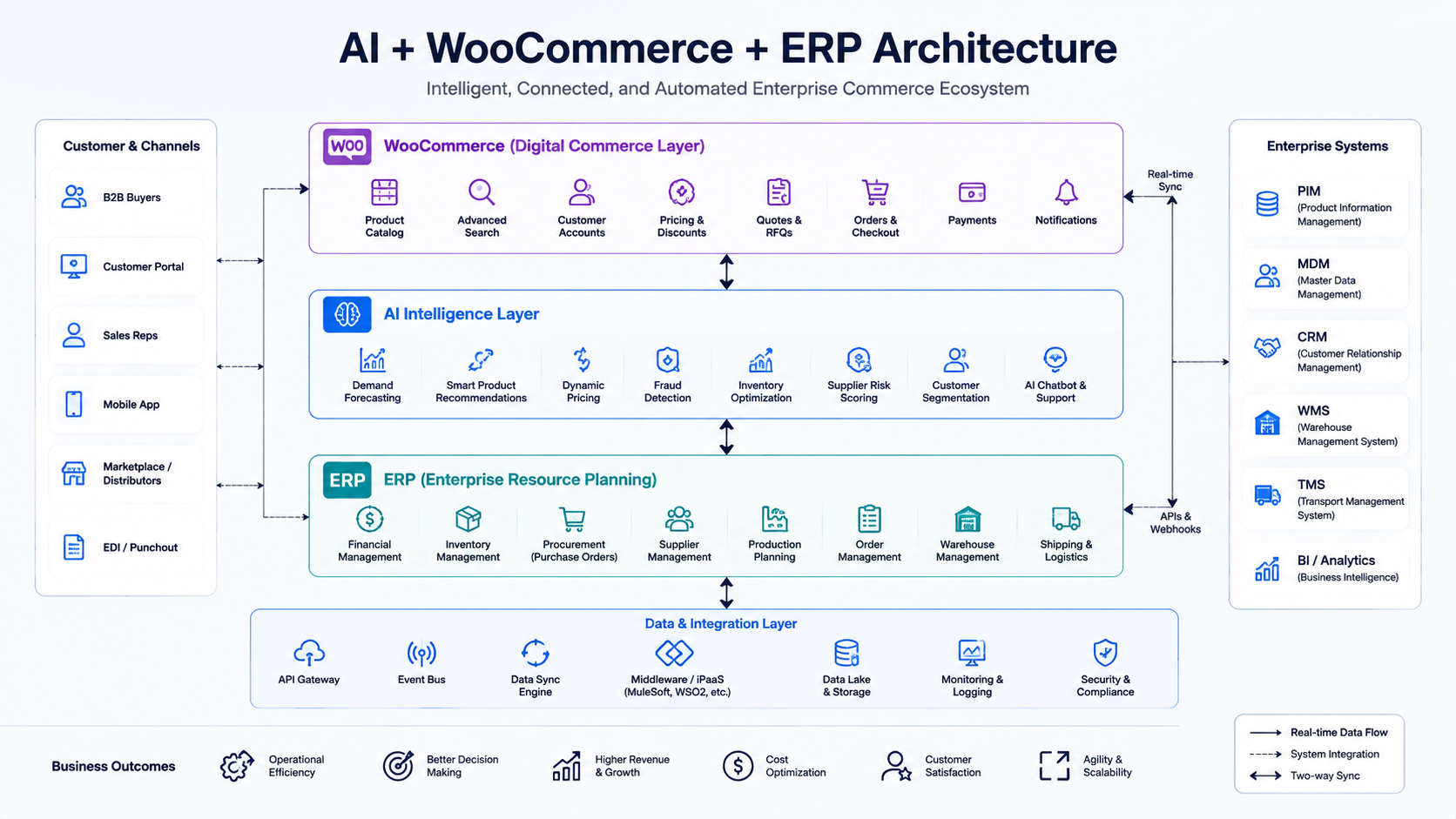
Enterprise AI does not operate inside WooCommerce alone. It sits as a middleware intelligence layer between WooCommerce, ERP, warehouse management, and supplier systems. The architecture typically involves three tiers:
Data layer. Operational data flows from WooCommerce (orders, products, customers), ERP (financials, procurement, inventory), and external sources (supplier feeds, market data) into a unified store.
Intelligence layer. AI models consume this data for forecasting, classification, anomaly detection, and optimization. Models run on scheduled intervals or trigger in real time based on events.
Action layer. Outputs route back into operational systems. A demand forecast triggers a purchase order in ERP. A pricing recommendation updates WooCommerce. A risk score flags a supplier for review.
A well-designed WooCommerce ERP integration is the prerequisite. Without reliable bidirectional data flow, AI models train on incomplete or stale data, and their outputs cannot reach the systems where decisions are executed.
AI for Inventory Management
WooCommerce inventory management becomes exponentially harder with multiple warehouses, long lead times, and seasonal demand curves. AI transforms inventory from a reactive counting exercise into a predictive allocation system.
Machine learning models analyze sales velocity, seasonality, supplier lead times, promotional calendars, and even external factors like weather or raw material pricing to recommend optimal stock levels per location. For organizations running multi-warehouse inventory, AI determines not just how much to stock, but where to position inventory to minimize shipping costs and delivery times.
Limitations. AI inventory models require 18 to 24 months of clean transactional data to produce reliable forecasts. New product launches, where no historical data exists, still require human judgment and analog estimation. Organizations should also monitor model drift, where changing market conditions make historical patterns less predictive.
AI for Demand Forecasting
Demand forecasting is where AI delivers its most measurable inventory ROI. Traditional inventory forecasting relies on moving averages and safety stock buffers. AI-based forecasting incorporates dozens of demand signals simultaneously.
Enterprise-grade forecasting models account for order frequency by customer segment, product lifecycle stage, promotional lift, supplier constraints, and macroeconomic indicators. The output is not a single demand number but a probability distribution, enabling operations teams to plan for best-case, likely, and worst-case scenarios.
Implementation challenge. Forecasting accuracy depends entirely on data quality. If historical order data includes duplicates, test orders, or returns not properly reconciled, the model learns from noise. Data preparation typically consumes 60 to 70 percent of the implementation timeline.
AI for Purchase Order Automation
AI transforms purchase order management from a reactive, threshold-based process into a predictive procurement workflow. Instead of generating purchase orders when stock hits a reorder point, AI anticipates when stock will reach critical levels and initiates procurement in advance, factoring in supplier lead times, order minimums, and volume discount thresholds.
The system can also consolidate orders across SKUs to meet minimum order quantities, suggest alternative suppliers when primary vendors show delivery risk, and flag pricing anomalies in supplier quotes.
When not to use AI for PO automation. Organizations with fewer than ten active suppliers and stable lead times may find rule-based reorder points sufficient. AI procurement adds value when supplier variability, SKU count, and order frequency create complexity that manual planning cannot absorb.
AI for Supplier Performance Analysis
Manual supplier performance management typically reduces to quarterly scorecards built from incomplete data. AI-driven supplier analysis ingests delivery timestamps, quality inspection results, pricing history, communication responsiveness, and external risk signals like financial health or geopolitical exposure.
The output is a continuously updated supplier risk score that identifies deteriorating performance before it impacts fulfillment. For organizations managing 50 or more active suppliers, this shifts procurement from relationship-based intuition to data-informed decision-making.
Governance consideration. Automated supplier scoring must be transparent. Suppliers should understand the criteria, and procurement teams should retain override authority. Opaque AI scoring erodes supplier relationships and creates compliance risk in regulated industries.
AI for Product Information Management
Product data is the foundation every other system depends on. Product information management at enterprise scale involves thousands of attributes across thousands of SKUs, often sourced from dozens of suppliers in inconsistent formats.
AI accelerates PIM through automated attribute extraction from supplier datasheets, intelligent product classification using natural language processing, duplicate detection across catalog entries, and quality scoring that flags incomplete or inconsistent records. For B2B catalogs with technical specifications, AI can parse PDF datasheets and map extracted values to structured product attributes.
Risk. Automated enrichment introduces errors if validation rules are not enforced. A human-in-the-loop review process is essential, particularly for safety-critical or compliance-sensitive product attributes.
AI for Master Data Management
Master data management ensures that product, customer, supplier, and location records remain consistent across every system in the enterprise. AI enhances MDM through entity resolution (identifying that “Acme Corp,” “ACME Corporation,” and “Acme Co.” are the same entity), automated data quality monitoring, and anomaly detection when records deviate from established patterns.
For enterprises where product, customer, and supplier data lives across WooCommerce, ERP, PIM, and warehouse systems, AI-driven MDM acts as a continuous reconciliation engine that catches discrepancies before they cascade into fulfillment errors or reporting inaccuracies.
AI for Product Lifecycle Management
Product lifecycle management tracks a product from introduction through growth, maturity, and eventual discontinuation. AI adds predictive capability to each stage: identifying which new products are likely to succeed based on attribute similarity to past performers, detecting when mature products enter decline, and recommending optimal timing for end-of-life transitions.
In B2B environments where product obsolescence affects contractual obligations and replacement part availability, AI-informed lifecycle decisions reduce write-offs and improve customer communication around product transitions.
AI for Customer-Specific Pricing
B2B pricing is inherently complex. Customer-specific pricing involves negotiated rates, volume tiers, contract terms, and account history. AI optimizes pricing by analyzing margin contribution per customer, price sensitivity by product category, competitive positioning, and order pattern changes that signal churn risk or expansion opportunity.
The result is not fully automated pricing but margin-aware recommendations that help sales teams negotiate with data rather than intuition. AI flags accounts where pricing is significantly below margin targets or where a modest discount could capture a larger share of wallet.
AI for Quote Management
The quote request workflow in B2B e-commerce is one of the most labor-intensive processes. AI reduces quote turnaround by pre-populating line items based on customer order history, suggesting pricing within approved margin bands, routing complex quotes to the appropriate sales specialist, and identifying cross-sell opportunities based on complementary purchase patterns.
For organizations processing more than 200 quotes per month, AI-assisted quoting can reduce response times by 40 to 60 percent while maintaining pricing discipline.
AI for Warehouse Operations
Warehouse AI extends beyond inventory counts into operational orchestration. Pick path optimization uses order clustering and layout data to reduce travel time per order. Demand-based labor allocation predicts volume by shift and recommends staffing levels. Receiving automation uses computer vision with exception detection to accelerate inbound processing.
For multi-warehouse operations, AI determines optimal fulfillment routing based on proximity, stock availability, shipping cost, and delivery SLA requirements.
AI for Customer Support
AI-powered B2B support goes beyond chatbots. Intent classification routes inquiries to the correct team before a human reviews them. Knowledge retrieval surfaces relevant product specs, order history, and account details before agents respond. Resolution prediction identifies which issues will escalate, enabling proactive outreach.
Limitation. Complex cases involving custom configurations, warranty disputes, or multi-party logistics rarely resolve without human expertise. AI should augment agents, not replace them for high-value accounts.
AI Agents vs. Traditional Automation
Traditional automation executes predefined rules. AI agents observe, reason, and act with limited supervision. A rule says “reorder when stock falls below 50 units.” An AI agent says, “The stock will fall below 50 units in nine days; the primary supplier’s lead time has increased to 14 days; and an alternative supplier can deliver in seven at a 4 percent premium.”
AI agents fit multi-step decisions with variable inputs. They do not fit compliance-mandated processes where auditability requires deterministic logic. The enterprise decision is not agents versus rules but which processes benefit from adaptive intelligence and which require predictable execution.
AI Governance Framework
Enterprise AI requires governance from day one, not as an afterthought.
AI Governance Checklist:
- Data lineage documented for every model input
- Model performance monitored with defined accuracy thresholds
- Bias testing conducted across customer segments and product categories
- Human override available for every AI-generated recommendation
- Decision audit trail maintained for compliance and dispute resolution
- Model retraining schedule defined and adhered to
- Vendor AI (third-party models) evaluated for data privacy and IP risk
- Incident response plan for AI failures or erroneous outputs
Enterprise AI KPIs
| KPI |
Measurement |
Target Benchmark |
| Forecast accuracy |
MAPE (Mean Absolute Percentage Error) |
Below 20% |
| Stockout rate |
Percentage of SKUs out of stock |
Below 2% |
| Order processing time |
Hours from order placed to shipped |
Under 4 hours |
| Quote turnaround |
Hours from request to response |
Under 8 hours |
| Data quality score |
Percentage of complete, accurate records |
Above 95% |
| AI recommendation adoption |
Percentage of AI suggestions acted upon |
Above 60% |
| Cost per order |
Fully loaded operational cost |
10-15% reduction |
Common AI Implementation Mistakes
Starting with the model instead of the data. Most failed AI projects invest in algorithms before ensuring data quality. Clean, connected data is the prerequisite.
Automating broken processes. AI applied to a dysfunctional workflow produces faster dysfunction. Fix the process logic first, then apply intelligence.
Underestimating change management. Operations teams distrust AI recommendations they do not understand. Training, transparency, and gradual adoption matter more than technical sophistication.
Ignoring total cost of ownership. AI infrastructure, model maintenance, data engineering, and governance are ongoing costs. Budget for operations, not just implementation.
Skipping the pilot. Enterprise-wide AI rollouts carry high risk. Start with a single use case, prove value, then expand.
Enterprise AI Readiness Checklist
- ERP and WooCommerce integration is stable and bidirectional
- Historical transactional data covers at least 18 months
- Product data is structured with consistent attributes and taxonomy
- WooCommerce order management processes are documented
- Data ownership and stewardship roles are assigned
- IT infrastructure supports API-based integrations
- Executive sponsorship is secured with defined success criteria
- Budget accounts for ongoing model maintenance and retraining
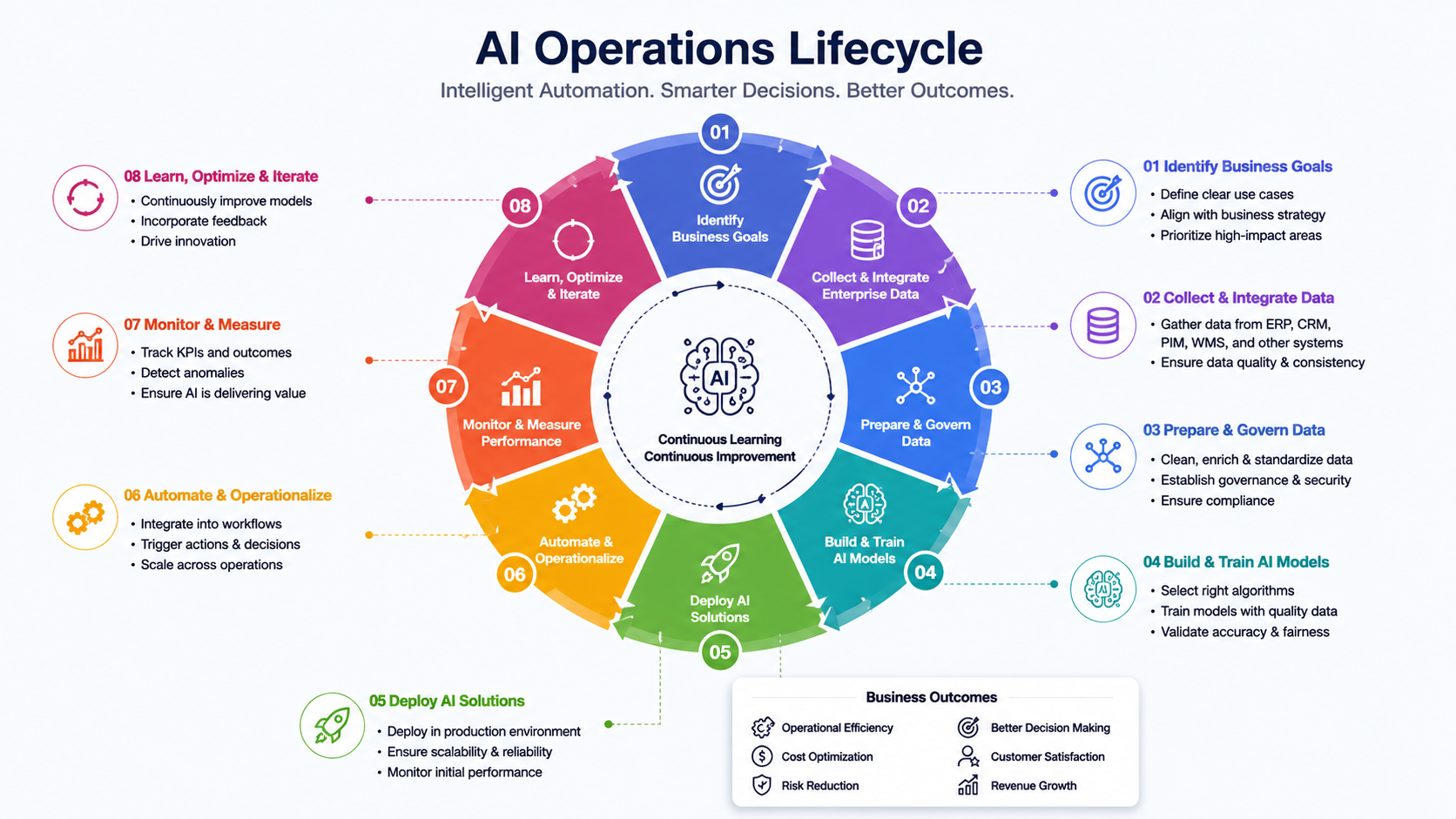
AI Implementation Roadmap
Phase 1: Foundation (Months 1 to 4). Data audit, system integration assessment, and governance framework. Clean historical data. Establish baseline KPIs.
Phase 2: Pilot (Months 5 to 8). Select one high-impact use case, typically demand forecasting or product data enrichment. Build, validate, and deploy a pilot model with human-in-the-loop review.
Phase 3: Expansion (Months 9 to 14). Add adjacent use cases. Connect AI outputs to operational workflows. Automate procurement recommendations, pricing suggestions, or supplier scoring.
Phase 4: Optimization (Months 15 and beyond). Continuous model improvement. Cross-functional AI adoption. Explore AI agents for multi-step operational decisions. Measure and report ROI quarterly.
AI Maturity Model
| Level |
Stage |
Characteristics |
| 1 |
Manual |
Spreadsheets, siloed data, no automation |
| 2 |
Automated |
Rule-based workflows, basic integrations |
| 3 |
Predictive |
ML-driven forecasting, data-informed decisions |
| 4 |
Adaptive |
AI agents, real-time optimization, cross-system intelligence |
| 5 |
Autonomous |
Self-correcting operations, minimal human intervention |
Most enterprise WooCommerce organizations operate between Level 1 and Level 2. The practical near-term goal for most is reaching Level 3 with selective Level 4 capabilities in high-value areas like demand forecasting and pricing.
Key Takeaways
- AI for enterprise e-commerce is an operational strategy, not a technology purchase. Value comes from connecting systems, not replacing them.
- Data quality is the single largest determinant of AI success. Budget 60 to 70 percent of preparation effort on data.
- Start with demand forecasting or product data enrichment. These deliver measurable ROI with manageable risk.
- AI governance is not optional. Establish audit trails, human override, and bias monitoring from day one.
- Use rules for deterministic processes and AI for variable, multi-factor decisions. They serve different purposes.
- Enterprise WooCommerce AI requires stable ERP integration as a foundation, not a parallel initiative.
- AI agents are production-ready for procurement and inventory, but compliance processes still need deterministic logic.
- Measure AI by operational KPIs (forecast accuracy, stockout rate, quote turnaround), not technology metrics.
- Change management determines adoption. Train teams, explain recommendations, and build trust incrementally.
- The competitive window is open. Most B2B e-commerce organizations remain at Level 1 or 2 of AI maturity.
Future of AI in Enterprise Ecommerce
Three developments will shape the next 24 months. First, AI agents will move from pilots to production in procurement and inventory. These agents will negotiate with supplier systems, adjust reorder quantities, and route orders across warehouses with minimal human input.
Second, multimodal AI will transform product data management. Models that process images, PDFs, and unstructured text simultaneously will automate catalog onboarding from supplier materials, reducing what currently takes weeks to hours.
Third, vertical AI models trained on industry-specific data (industrial distribution, healthcare supply, and automotive parts) will outperform general-purpose models for B2B applications. Organizations building proprietary training datasets from operational data will hold a durable competitive advantage.
FAQs
AI in enterprise ecommerce uses artificial intelligence to automate business processes, analyze large datasets, optimize inventory, improve pricing, enhance customer experiences, and support faster decision-making across WooCommerce, ERP, CRM, and other enterprise systems.
AI improves enterprise WooCommerce operations by automating order processing, forecasting demand, optimizing inventory, detecting fraud, personalizing customer experiences, and synchronizing data across ERP, CRM, PIM, and warehouse management systems.
The biggest benefits come from inventory management, demand forecasting, procurement, product information management, pricing optimization, supplier performance analysis, customer support, warehouse operations, and enterprise reporting through AI-driven automation and predictive analytics.
Yes. AI platforms can integrate with WooCommerce, ERP, CRM, PIM, MDM, WMS, and other enterprise applications using APIs, middleware, and event-driven architectures to enable real-time data synchronization and intelligent business automation.
Businesses should establish clean and governed data, integrate core enterprise systems, define measurable business objectives, strengthen data security, and identify high-impact AI use cases before deploying AI across enterprise ecommerce operations.


 WooCommerce Solutions
 Solutions for WordPress