APIs Are the Backbone of Modern Enterprise E-commerce
Every enterprise B2B store eventually hits the same wall. Orders arrive through WooCommerce, but the warehouse team manages fulfillment from a spreadsheet. The ERP holds one version of inventory while WooCommerce displays another. When a customer calls about their order status, three departments give three different answers.
This is not a WooCommerce problem—it is an integration problem. More precisely, it is an API strategy problem.
Modern enterprise ecommerce runs on APIs. Every business system from SAP to Salesforce, from NetSuite to your third-party logistics provider, exposes data through APIs. The question is not whether to use APIs, but whether your organization has designed an integration architecture that connects them predictably and scales reliably.
Understanding B2B WooCommerce challenges at scale reveals why API-first thinking is essential. Without deliberate architecture, enterprise WooCommerce scalability breaks under the weight of complex business logic. An enterprise API strategy is the difference between fragile point-to-point connections and a resilient, observable integration ecosystem.
What Is an Enterprise API Strategy?
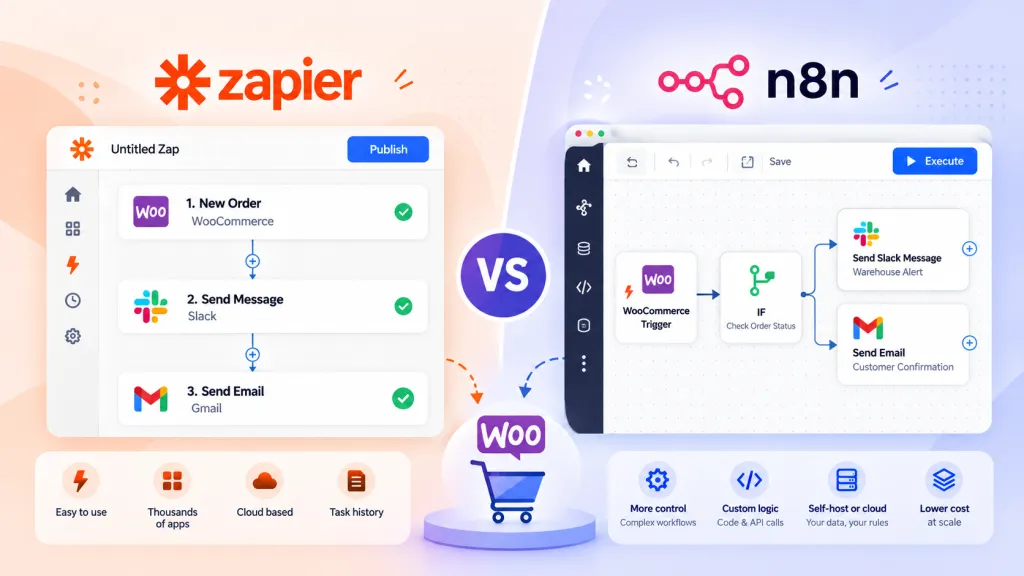
An enterprise API strategy is an organization-wide approach to how systems exchange data, how integrations are governed, and how technical architecture evolves. It is not a collection of plugins or Zapier workflows—it is an architectural decision framework covering authentication, error handling, versioning, and governance.
Simple Integration vs. Enterprise Strategy
| Dimension |
Simple Integration |
Enterprise Strategy |
| Architecture |
Point-to-point |
Hub-and-spoke or event-driven |
| Governance |
None |
API ownership, versioning, lifecycle |
| Error Handling |
Basic try/catch |
Retry logic, dead-letter queues, alerting |
| Security |
Shared API key |
OAuth 2.0, scoped tokens, secrets rotation |
| Observability |
Logs on one server |
Centralized monitoring, dashboards, SLAs |
| Scalability |
Works at low volume |
Designed for throughput spikes |
Enterprise strategy requires an integration architecture that maps all data flows, a synchronization model that defines when and how data moves between systems, and a governance layer specifying API ownership and change processes. The goal is predictability—enterprise businesses cannot afford integration surprises at 2:00 AM when a batch sync fails and orders are stuck.
Why B2B WooCommerce Requires API-First Architecture
B2B commerce is inherently more complex than D2C. You have negotiated pricing tiers, purchase order workflows, credit terms, multi-site order management, customer-specific catalogs, and approval chains varying by account. A B2B WooCommerce store handling this complexity with off-the-shelf plugins alone will break at scale.
API-first architecture means treating every integration as a contract between systems. A typical enterprise B2B WooCommerce ecosystem includes the following:
- ERP: SAP, Oracle, NetSuite, or Microsoft Dynamics holds pricing, inventory, credit limits, and invoices
- CRM: Salesforce or HubSpot maintains customer relationships and sales pipelines
- PIM: Akeneo or Pimcore manages thousands of product attributes and media
- WMS: Warehouse systems drive fulfillment and inventory
- Shipping and Logistics: Carriers and 3PLs need order data for labels and tracking
- Payments and Finance: Enterprise buyers pay on terms through specialized platforms
- Analytics and BI: Order and customer data flows to reporting systems
Each connection is a potential failure point. API-first architecture anticipates these and builds resilience from the start.
Core APIs Every Enterprise WooCommerce Store Needs
| API Layer |
Purpose |
Common Technologies |
| WooCommerce REST API |
Orders, products, customers, inventory |
Native WooCommerce endpoints |
| WooCommerce GraphQL |
Flexible product queries, headless front-ends |
WPGraphQL plugin |
| ERP API |
Pricing, inventory, invoicing, POs |
SAP OData, Oracle REST, NetSuite SuiteTalk |
| CRM API |
Customer profiles, deals, sync |
Salesforce REST, HubSpot API |
| PIM API |
Product data, attributes, media |
Akeneo API, Pimcore Data Hub |
| WMS API |
Order fulfillment, stock levels |
ShipBob, Fishbowl, custom APIs |
| Shipping API |
Rates, labels, tracking |
FedEx, UPS, EasyPost |
| Payment API |
Authorization, capture, refunds |
Stripe, TreviPay |
| Tax API |
Real-time tax calculation |
Avalara AvaTax, TaxJar |
This integration surface area represents what most enterprise B2B WooCommerce implementations need to address. Missing even one creates data silos that undermine customer experience.
Enterprise Integration Architecture
Understanding which APIs you need is only the first step. How those APIs connect matters just as much.
The most common mistake is building direct connections between systems—WooCommerce calls the ERP API directly, the CRM polls WooCommerce, and the WMS reads from the database directly. This works at a small scale and collapses under enterprise load. When one system changes its API, every dependent system breaks.
A production-grade enterprise architecture uses the following:
API Gateway: Centralizes authentication, enforces rate limiting, handles SSL termination, logs every request, and provides a single ingress point. Tools like Kong, AWS API Gateway, or Azure API Management are standard choices.
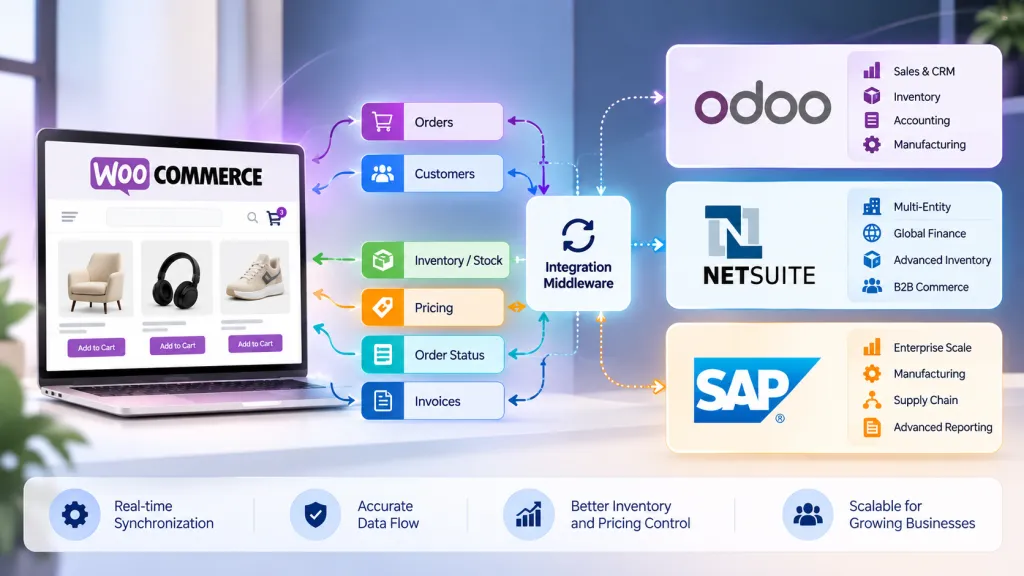
Middleware Layer: A platform like MuleSoft, Dell Boomi, or Apache Camel handles data transformation, orchestration, retry logic, and routing. This is where business logic that does not belong in any single system lives.
Message Queues: For asynchronous operations, RabbitMQ or Amazon SQS ensure that a temporarily unavailable downstream system does not cause orders to be lost. Events enter the queue and process when the target system is available.
Caching: Redis or similar in-memory stores reduce API calls to slow external systems. Product pricing, for example, can be cached for 15 minutes rather than fetched on every page load.
Monitoring and Alerting: Centralized logging through Datadog, New Relic, or the ELK stack gives teams visibility into integration health, failure rates, and latency.
REST API vs. GraphQL: Choosing the Right Approach
Quick Answer: WooCommerce supports both REST API and GraphQL via WPGraphQL. REST is better for standard CRUD operations, while GraphQL is ideal for headless front-ends needing flexible queries.
| Dimension |
REST API |
GraphQL |
| Data Fetching |
Fixed endpoints return fixed shapes |
The client specifies exactly what fields needed |
| Over-fetching |
Common—returns entire resource |
Eliminated—fetch only requested fields |
| Caching |
HTTP caching works natively |
Requires custom caching |
| Use Case |
ERP/CRM integrations, webhooks |
Headless storefronts, mobile apps, portals |
For ERP, WMS, and CRM integrations, REST API is typically correct—these systems consume REST natively, tooling is mature, and behavior is predictable.
For customer-facing applications—buyer portals, React storefronts, and mobile apps—GraphQL becomes compelling because it eliminates over-fetching. A product listing page might need a product name, price, thumbnail, and availability. A REST call to /products/ returns 40+ fields; a GraphQL query returns exactly four.
ERP Integration Strategy
ERP integration is typically the most complex and highest-stakes integration in a B2B WooCommerce ecosystem. The ERP is the system of record for pricing, inventory, customer credit, tax codes, and invoicing. If WooCommerce and ERP are out of sync, business consequences are immediate: wrong pricing, inventory overselling, and invoices mismatching orders.
Understanding WooCommerce ERP integration scope is essential before development begins.
What needs to synchronize:
- Inventory levels: Real-time or near-real-time stock updates, ideally triggered by ERP movements rather than batch polling
- Pricing: B2B pricing involves customer-specific lists, volume discounts, and contract pricing flowing from ERP into WooCommerce
- Customer accounts: Credit limits, payment terms, and status drive what a buyer can purchase
- Orders: Purchase orders placed in WooCommerce become sales orders in the ERP, triggering fulfillment
- Invoices: After shipment, ERP-generated invoice numbers and status should be visible to buyers
- Tax codes: Tax treatment varies by product, customer, and jurisdiction
ERP-specific approaches:
- SAP exposes data through OData APIs (S/4HANA); middleware is almost always necessary
- Oracle uses REST and SOAP services depending on the module
- NetSuite offers well-documented SuiteTalk REST API, making it straightforward for mid-market businesses
- Microsoft Dynamics 365 integrates through Business Central or F&O APIs with strong connector ecosystems
- Odoo is API-first by design with JSON-RPC and REST endpoints, making it one of the easiest to integrate
Warehouse and Inventory Synchronization
Real-time inventory accuracy is fundamental to customer trust in B2B e-commerce. When a buyer orders 500 units and receives a preventable backorder notification, you have a relationship problem.
WooCommerce inventory management at an enterprise scale is an architecture challenge requiring:
- Real-time stock updates: When WMS processes goods issues or receipts, WooCommerce inventory updates within seconds, not hours
- Multi-location inventory: Multiple warehouses require WooCommerce to reflect availability per location for optimal order routing
- Reservations: When orders are placed, inventory reserves immediately to prevent overselling
- Backorder logic: Integration respects ERP-defined rules—some customers allowed to backorder, others not
- Safety stock: Buffer thresholds are honored so WooCommerce does not expose designated safety stock
- Demand forecasting: Advanced implementations pass historical order data to trigger purchase orders before stockouts
Common API Integration Challenges
Every enterprise integration project encounters predictable problems. Knowing them in advance enables defensive design:
Duplicate Orders: If an order webhook delivers twice (retries after timeout) and your consumer lacks idempotency, you create duplicate ERP orders. Every write operation needs an idempotency key.
Version Conflicts: WooCommerce updates regularly. API response shape changes break consumers expecting old formats. Pin API versions and implement integration tests catching schema changes.
Authentication Errors: Token expiry, secret rotation, and misconfigured OAuth scopes cause failures. Implement token refresh logic and alert on 401/403 response codes.
Sync Delays: Eventual consistency is a feature of distributed systems. If the ERP updates inventory 60 seconds after fulfillment, design customer-facing experiences accounting for that delay.
Timeouts and Retries: External APIs will be slow or unavailable. Every API call needs a timeout and retry policy with exponential backoff.
Monitoring: Without centralized monitoring, you learn about failures from customers. Every integration needs health dashboards and alerting on failure rates, latency spikes, and queue depths.
Performance Optimization
Enterprise B2B WooCommerce faces different traffic patterns than D2C. Large batch orders, bulk pricing queries, and integration-driven API calls run concurrently with customer traffic.
Caching: Products, pricing, and category data should use Redis or Memcached. Cache invalidation strategy matters as much as caching itself—stale prices cause pricing errors.
Pagination: Never return unbounded result sets. Enforce server-side pagination and ensure consumers handle paginated responses correctly.
Background Jobs: Order confirmations, ERP order creation, and CRM updates can happen asynchronously after placement, improving checkout performance.
Webhooks over Polling: Use event-driven webhooks instead of polling. WooCommerce fires webhooks on order creation, status changes, and product updates. This is more efficient than frequent polling.
Batch APIs: For large data sets, batch APIs are more efficient than one-at-a-time calls. Support bulk operations in both custom endpoints and integration flows.
Asynchronous APIs: For long-running operations, implement async patterns: submit request, receive job ID, poll for completion, or receive a webhook when ready.
API Security Best Practices
Security is not a feature to add later. For B2B stores handling customer pricing, purchase histories, and credit information, a compromised API is a business-critical incident.
Essential controls:
- OAuth 2.0: Industry standard for delegated authorization. Service-to-service integrations use client credentials flow; avoid long-lived shared API keys
- JWT Tokens: Stateless tokens carrying claims about requesters. Validate signature, expiry, and issuer on every request
- API Keys: Still appropriate for some integrations but must be scoped to minimum necessary permissions, rotated regularly, and stored in secrets managers
- Rate Limiting: Enforce at API gateway level to prevent abuse
- TLS Encryption: All API traffic uses TLS 1.2 or higher—no exceptions
- Audit Logging: Every API call, especially writes, logs timestamp, requester identity, payload summary, and outcome
- OWASP API Security Top 10: Broken object-level authorization, excessive data exposure, and lack of rate limiting are common and damaging
Future Trends in Enterprise API Architecture (2026)
GraphQL Adoption: Accelerating as enterprises move toward headless and composable commerce. WPGraphQL and WooCommerce’s own GraphQL support make this viable for storefronts and spreading to backend integrations.
AI Agents and Agentic Commerce: Large language models increasingly act as autonomous agents querying APIs, placing orders, and managing procurement. Well-documented, machine-readable endpoints position platforms for this shift.
Model Context Protocol (MCP): An emerging standard providing structured context to AI agents, enabling consistent interaction with business systems. Enterprise WooCommerce platforms exposing MCP-compatible endpoints integrate more easily with next-generation AI tools.
Composable Commerce: Rather than monolithic installations, best-of-breed components—dedicated search (Algolia, Elasticsearch), headless CMS, PIM, checkout service—connect through APIs. WooCommerce functions as commerce engine, not entire platform.
Event-Driven Architecture: As complexity grows, event-driven systems using Apache Kafka or Amazon EventBridge replace direct API calls. Event streams of orders, inventory changes, and customer updates feed multiple downstream systems without tight coupling.
Conclusion: API Strategy Is a Business Decision
A well-designed enterprise API strategy for B2B WooCommerce is not a technical luxury—it is a prerequisite for operating at scale. Businesses treating integrations as afterthoughts accumulate technical debt showing up as operational failures, customer complaints, and expensive re-platforming projects.
Businesses investing in architecture early define integration patterns, select appropriate middleware, implement proper security and monitoring, and design for eventual consistency. They build platforms scaling with them. Teams spend time solving business problems rather than firefighting integration failures.
The return on investment is measurable: fewer errors, faster fulfillment, better customer data, more reliable inventory, and a platform your team maintains and extends with confidence. Enterprise API strategy comes down to foundational decisions about hub-and-spoke versus point-to-point architecture, REST versus GraphQL, authentication and secrets management, integration health monitoring, and API governance. Each has long-term consequences worth getting right from the start.
FAQs
An enterprise API strategy for B2B WooCommerce is a structured approach to connecting WooCommerce with ERP, CRM, PIM, WMS, payment, and shipping systems. It enables secure data exchange, automation, real-time synchronization, and scalable operations for growing enterprise businesses.
Yes. WooCommerce integrates with leading ERP and CRM platforms such as SAP, Oracle NetSuite, Microsoft Dynamics 365, Salesforce, HubSpot, and Zoho CRM using REST APIs, middleware, or custom integrations to automate orders, inventory, pricing, and customer data.
REST APIs are ideal for standard integrations and broad compatibility, while GraphQL is better for applications requiring flexible data retrieval and reduced payload sizes. Many enterprise WooCommerce projects use both technologies based on specific performance and integration requirements.
Businesses should secure WooCommerce APIs using OAuth or API keys, HTTPS encryption, authentication, rate limiting, IP restrictions, audit logging, and regular security monitoring. Following OWASP API security best practices helps protect sensitive customer and business data.
An API-first architecture allows B2B WooCommerce stores to integrate multiple business systems, automate workflows, improve real-time data synchronization, reduce manual processes, and scale efficiently as transaction volumes, products, and customer requirements continue to grow.



 WooCommerce Solutions
 Solutions for WordPress