Most enterprise fulfillment failures do not begin in the warehouse. They begin at the seams between systems. An order enters through a WooCommerce storefront, inventory lives in an ERP, availability is scattered across three or four warehouses, pricing sits in a CRM, and shipping logic is buried in a carrier portal. Each system is individually competent and collectively blind. The result is familiar to every operations leader: oversells against phantom stock, orders routed to the wrong facility, split shipments that erode margin, and customer service teams reconciling status by hand.
For B2B organizations, the cost compounds. A missed delivery window on a wholesale replenishment order does not just annoy a buyer; it threatens a contract. As order volume, SKU count, and channel complexity grow, the manual coordination that held things together at a smaller scale becomes the primary constraint on growth. This guide addresses that constraint directly. It is written for leaders responsible for the architecture, economics, and governance of enterprise fulfillment, not for teams learning e-commerce fundamentals.
Key Takeaways
- Enterprise order orchestration is a decision and coordination layer above systems of record, not a replacement for the ERP or WMS.
- Orchestration differs from order management by deciding and optimizing order flow across the network rather than merely recording it.
- Accurate, real-time inventory visibility is the foundation every routing and promising decision depends on.
- AI order routing optimizes across inventory, capacity, cost, speed, and customer priority simultaneously, beyond what static rules can encode.
- Multi-warehouse selection should minimize total landed cost and maximize reliability, not simply ship from the nearest location.
- Split orders, backorders, and returns are margin-sensitive decisions that mature orchestration governs explicitly.
- Most projects fail from poor data and weak governance, not from technology, so sequence data quality before automation.
- Perfect order rate and fill rate are the clearest indicators of orchestration health.
- The durable operating model divides decisions between AI for scale and humans for high-consequence judgment.
- WooCommerce is a strong enterprise front end because its open architecture keeps fulfillment logic out of a proprietary black box.
Quick Answer
Enterprise order orchestration is the centralized coordination layer that receives orders from every channel, validates inventory across all fulfillment locations in real time, and routes each order to the optimal warehouse using business rules and AI, while synchronizing state across ERP, WMS, CRM, and shipping systems. It converts disconnected fulfillment steps into one governed, observable, and continuously optimized process.
What is Enterprise Order Orchestration?
Order orchestration is the decision and coordination fabric that sits above transactional systems. It does not replace the ERP or the warehouse management system. It governs the flow of an order across all of them, deciding what happens, in what sequence, under which conditions, and with what fallback.
Consider a distributor selling industrial components to national accounts. A single purchase order may contain forty line items spanning three product categories stocked in different facilities. One line is on backorder, two lines carry a contract price specific to that buyer, and the customer requires consolidated shipping to a single dock. Order orchestration is the layer that reads all of these conditions, checks live availability across the network, applies the account’s negotiated terms, decides whether to split or hold the order, reserves stock, pushes the fulfillment instruction to the correct warehouses, and writes the resulting commitments back to the ERP without a person touching a spreadsheet.
This is fundamentally different from processing orders one system at a time. Orchestration treats fulfillment as a coordinated workflow with defined states, transitions, exceptions, and observability. For enterprises running WooCommerce order management at scale, orchestration is what turns a capable storefront into an operational backbone.
Why Enterprise Businesses Need Order Orchestration
Four pressures make orchestration a requirement rather than an optimization.
Operational complexity is the first. Every new channel, warehouse, carrier, and customer-specific rule multiplies the number of decisions per order. Manual routing that worked at 200 orders a day collapses at 2,000. The decision volume outpaces human capacity, and errors become systemic.
Customer expectations are the second. B2B buyers now expect the precision they experience as consumers: accurate promise dates, real-time status, and reliable delivery. A wholesale buyer planning a production run needs a dependable arrival date, not an estimate that shifts after they commit.
Inventory accuracy is the third. Without a single, reconciled view of stock, the business either oversells and disappoints customers or hoards safety stock and ties up capital. Neither outcome is acceptable at enterprise margins. Strong WooCommerce inventory management feeds orchestration the trustworthy signal it needs to promise accurately.
Fulfillment speed is the fourth. Delivery time is increasingly a competitive differentiator in B2B, and the fastest path to a customer is rarely the same warehouse for every order. Only automated routing can consistently select the location that minimizes time and cost per order.

Enterprise Order Orchestration vs Order Management
The two terms are often used interchangeably, which causes expensive scoping mistakes during vendor selection. Order management records and processes orders. Orchestration decides and coordinates them across the network.
| Dimension |
Order Management |
Enterprise Order Orchestration |
| Primary purpose |
Capture, record, and process orders |
Coordinate and optimize order flow across systems |
| Scope |
Usually single channel or single system |
Omnichannel and multi-system by design |
| Inventory view |
Location- or system-specific |
Unified, real-time across all locations |
| Routing |
Manual or fixed rules |
AI and rules-based dynamic routing |
| Decision logic |
Static status transitions |
Conditional business rules and exceptions |
| System role |
Transactional system of record |
Coordination and decision layer above systems |
| Failure handling |
Manual intervention |
Automated fallback and reroute |
| Optimization |
Limited |
Continuous, data-driven |
Order management is a component within orchestration, not a substitute for it.
Enterprise Order Orchestration Lifecycle
The lifecycle defines the states every order passes through and the decisions made at each. Treating it as an explicit, governed sequence is what makes fulfillment observable and improvable.
Customer Order. The order is captured from any channel, storefront, EDI, sales rep, or quote conversion and normalized into a single internal format regardless of source.
Inventory Validation. The orchestration layer checks live, network-wide availability, distinguishing on-hand, reserved, in-transit, and available-to-promise stock before making any commitment.
AI Order Routing. The engine evaluates every eligible fulfillment location against cost, speed, capacity, and customer priority, then selects the optimal source or sources.
Warehouse Selection. The routing decision resolves to specific facilities, accounting for consolidation preferences, hazmat restrictions, and dock or carrier constraints.
ERP Synchronization. Reservations, costs, and financial commitments write back to the ERP so finance and procurement operate on the same truth as operations. This is where a mature WooCommerce ERP integration determines whether the process is real-time or batch-delayed.
Order Fulfillment. Pick, pack, and ship instructions flow to the warehouse management system, and progress is tracked against service-level commitments.
Shipment Tracking. Carrier events feed back into the platform, updating order state and customer-facing status automatically.
Returns Management. Return authorizations, inspection, and disposition are handled as a governed reverse flow rather than an afterthought.
Performance Analytics. Every decision and outcome is measured, closing the loop so routing logic and inventory policy improve over time.
Core Components
An enterprise orchestration platform is assembled from distinct, interoperating capabilities.
Order Routing Engine. The decision core that selects fulfillment sources based on rules and optimization models.
Inventory Visibility. A reconciled, real-time view of stock across every location and state.
Distributed Order Management. The ability to split, hold, consolidate, and coordinate a single order across multiple facilities.
Warehouse Management. Integration with WMS platforms so decisions translate into physical execution.
ERP Integration. Bidirectional synchronization of inventory, cost, financial, and procurement data.
Customer Notifications. Automated, accurate status communication across the order lifecycle.
Analytics. Measurement of cost, speed, accuracy, and service performance per order and per node.
Business Rules. The governed logic that encodes enterprise policy, customer terms, and compliance constraints.
WooCommerce + ERP + Order Orchestration Architecture
WooCommerce is frequently underestimated in enterprise contexts. Its open architecture and API-first extensibility make it a strong front end for orchestration because it does not lock fulfillment logic inside a proprietary black box. The reference architecture positions WooCommerce as the commerce interface and orchestration as the coordination layer between it and the systems of record.
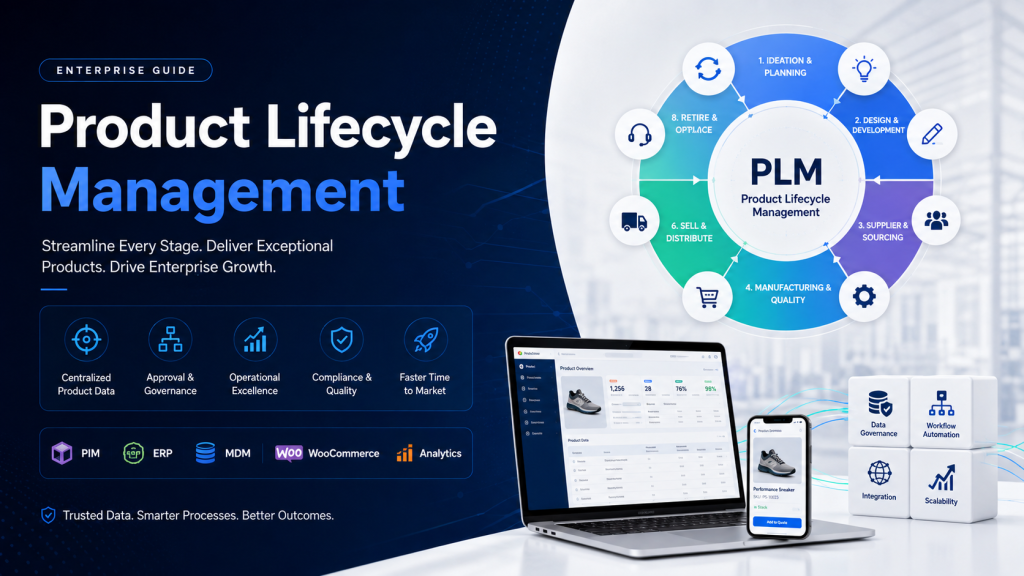
At the data layer, product content is governed by Product Information Management and enterprise identifiers are reconciled through master data management, ensuring that every system references the same SKUs, customers, and attributes. Product Lifecycle Management controls how items enter and exit the catalog, which prevents orders against discontinued or unreleased products.
At the transaction layer, WooCommerce captures the order and passes it to orchestration, which validates against inventory, applies customer-specific pricing and negotiated terms, and coordinates with the ERP, WMS, and PIM. Where B2B buyers negotiate before purchasing, the quote request workflow feeds approved quotes directly into the same orchestration pipeline, so a won quote becomes a fulfillable order without re-keying.
The AI and shipping layers sit alongside, with routing intelligence informed by AI for enterprise ecommerce and carrier selection automated against cost and speed constraints. The architectural principle is separation of concerns: WooCommerce owns the experience, systems of record own the data, and orchestration owns the decisions.

AI-Powered Order Routing
Rules-based routing answers known questions. AI routing answers questions the business did not know to ask. The distinction matters because enterprise fulfillment networks contain more variables than any static rule set can economically encode.
AI routing optimizes across six intersecting objectives. Inventory optimization selects sources that preserve network balance rather than depleting a single node. Warehouse optimization weighs current capacity and labor load so orders do not pile onto an already saturated facility. Delivery optimization models transit time realistically, including carrier performance history. Cost optimization evaluates the true landed cost of each fulfillment option, not just distance. Customer priority ensures strategic accounts receive the service level their contracts specify. Predictive routing anticipates demand and pre-positions decisions before volume spikes arrive.
| Routing Method |
How It Decides |
Best Suited For |
| Fixed rules |
Predefined source per condition |
Simple, stable networks |
| Nearest location |
Geographic proximity |
Speed-sensitive, uniform stock |
| Lowest cost |
Landed cost comparison |
Margin-sensitive fulfillment |
| Capacity-aware |
Current warehouse load |
High-volume, variable demand |
| AI optimization |
Multi-objective model |
Complex enterprise networks |
| Predictive |
Forecasted demand and risk |
Seasonal or volatile demand |
The most capable programs combine methods, using rules for hard constraints and AI for optimization within them.
Multi-Warehouse Fulfillment
Intelligent warehouse selection is where orchestration produces its most visible returns. The objective is not simply to ship from the closest facility but to select the location or combination of locations that satisfies the order at the lowest total cost and highest reliability.
| Selection Criterion |
Why It Matters |
| Stock availability |
Prevents allocation to locations that cannot fulfill |
| Proximity to destination |
Reduces transit time and shipping cost |
| Warehouse capacity |
Avoids overloading constrained facilities |
| Fulfillment cost |
Protects margin on every order |
| Carrier coverage |
Ensures the required service level is achievable |
| Customer SLA |
Honors contractual delivery commitments |
| Inventory balancing |
Preserves network-wide availability |
For organizations building this capability on open commerce, WooCommerce multi-warehouse inventory provides the location-level stock granularity orchestration requires to make these decisions accurately.
Inventory Visibility
Centralized inventory synchronization is the foundation every other capability depends on. If availability data is wrong, routing optimizes against fiction, and every downstream decision inherits the error. True enterprise visibility distinguishes between physical states rather than presenting a single number: on-hand, reserved, allocated, in-transit, and available-to-promise are different values with different operational meanings.
Synchronization must be near real-time and bidirectional. When a warehouse picks stock, availability updates before the next order can double-allocate it. When procurement receives a shipment, that stock becomes programmable immediately. Enterprises that pair live visibility with WooCommerce inventory forecasting move from reacting to stockouts to preventing them, positioning inventory ahead of demand rather than chasing it.
Split Orders and Backorders
Split orders and backorders are where naive systems create margin leakage and where mature orchestration protects it. A single order that cannot be fully sourced from one location presents a decision: split it across facilities and ship sooner at a higher freight cost, or consolidate and wait. The right answer depends on the customer’s SLA, the value of the order, and current network conditions. Orchestration makes this decision explicit and rule-governed rather than leaving it to whoever opens the order first.
Backorder handling deserves equal rigor. When stock is unavailable, orchestration should reserve against inbound supply, communicate a credible fulfillment date, and automatically release the order when stock arrives. Coordinating this with purchase order management means a backorder can trigger or link to replenishment, closing the gap between demand and supply within one governed flow.
Reverse Logistics
Returns are treated as a cost center in most enterprises and as a controllable process in mature ones. Return orchestration applies the same discipline to the reverse flow as to the forward one. It governs return authorization against policy and customer terms, routes the returned item to the appropriate facility for inspection, determines disposition (restock, refurbish, or scrap), and automates the refund or credit once conditions are met.
Refund automation is particularly valuable in B2B, where credit terms and partial returns are common and manual reconciliation is error-prone. A governed reverse process reduces dispute cycles, accelerates credit issuance, and recovers inventory value faster. Where returns correlate with supplier quality, feeding return data into supplier performance management turns reverse logistics into a source of procurement intelligence.
Enterprise KPIs
Orchestration is only as good as the metrics that govern it. These KPIs form the operational scorecard.
| KPI |
What It Measures |
Why It Matters |
| Order cycle time |
Order receipt to delivery |
Speed and competitiveness |
| Fill rate |
Orders filled from available stock |
Inventory and service health |
| Perfect order rate |
Orders delivered complete, on time, undamaged, accurate |
Overall fulfillment quality |
| Inventory accuracy |
System stock versus physical stock |
Trust in availability data |
| Warehouse efficiency |
Throughput per labor or cost unit |
Operational productivity |
| Fulfillment cost |
Total cost to fulfill per order |
Margin protection |
| Customer satisfaction |
Buyer-reported experience |
Retention and contract renewal |
Perfect order rate is the single most revealing metric because it captures the compound probability of getting everything right at once, which is precisely what orchestration is designed to maximize.
Why Enterprise Order Orchestration Projects Fail
Orchestration initiatives rarely fail for lack of technology. They fail for reasons that are predictable and preventable. The most common is starting with tooling before fixing data. Routing intelligence built on inaccurate inventory or inconsistent master data automates bad decisions faster. A second cause is treating orchestration as an IT project rather than a cross-functional operating change, which leaves finance, operations, and commercial teams working from different definitions of success.
A third failure mode is over-customization early. Encoding every existing manual exception into the platform recreates the complexity the project was meant to remove. A fourth is the absence of governance, so business rules proliferate without ownership until no one can explain why an order routed the way it did. The organizations that succeed sequence the work deliberately: data quality first, a governed rule set second, automation third, and AI optimization last, once the process is stable enough to learn from.
Order Orchestration Maturity Model
Assessing where an organization sits prevents both under-investment and premature ambition.
| Level |
Stage |
Characteristics |
| 1 |
Manual |
Human routing, spreadsheet reconciliation, frequent oversells |
| 2 |
Connected |
Systems integrated, basic status sync, fixed rules |
| 3 |
Automated |
Real-time inventory, rule-based routing, exception handling |
| 4 |
Intelligent |
AI routing, predictive inventory, continuous optimization |
| 5 |
Autonomous |
Self-adjusting rules, agentic decisioning, minimal intervention |
Most enterprises operate between Levels 2 and 3 and mistakenly benchmark themselves against Level 4 marketing. The value is in advancing one level with discipline, not in leaping to autonomy on an unstable foundation.
Human + AI Decision Framework
Autonomous routing does not mean unsupervised routing. The durable model divides decisions by reversibility and stakes. High-frequency, low-risk decisions, such as selecting a warehouse for a standard order, belong to the AI engine operating within guardrails. Low-frequency, high-consequence decisions, such as changing a strategic account’s fulfillment policy or overriding a routing rule during a supply disruption, belong to humans supported by AI recommendations.
The framework is not a compromise; it is a design principle. AI handles scale and consistency. Humans handle judgment, exceptions, and accountability. Systems built this way earn trust because operators understand where the machine acts autonomously and where it defers, and every autonomous decision remains auditable after the fact.

Common Challenges
Six obstacles recur across enterprise programs. Data silos keep inventory, order, and customer data trapped in systems that do not share a common language. Poor integrations create brittle point-to-point connections that break under load and volume. Legacy ERP platforms resist real-time interaction, forcing batch processing that undermines live promise. Inventory inconsistency between physical and system counts erodes trust in every downstream decision. Manual routing caps throughput at human capacity and injects error. Warehouse delays, when invisible to the orchestration layer, cascade into missed commitments the business only discovers after the customer does.
Best Practices
Enterprise governance comes first, with clear ownership of business rules and a single definition of fulfillment success across departments. Real-time APIs replace batch synchronization wherever a decision depends on current state. Workflow automation removes manual handoffs at every stage that does not require judgment. Data quality is treated as an ongoing discipline, not a one-time migration, because orchestration decisions are only as reliable as their inputs. Business rules are documented, versioned, and owned so logic remains explainable. AI optimization is applied after the process is stable, so the models learn from a clean signal. Continuous monitoring against the KPI scorecard closes the loop, turning every order into feedback that improves the next one.
Future Trends
The direction of travel is toward orchestration that acts, not just coordinates. AI agents are beginning to handle exception resolution end to end, negotiating reroutes and supply substitutions without human initiation. Predictive fulfillment prepositions inventory and pre-commits routing decisions based on forecasted demand. Autonomous warehouses integrate robotics and orchestration into a continuous physical-digital loop. Decision intelligence layers combine operational data with business context to recommend policy changes, not just execute existing ones. Agentic AI, explored further in AI agents for ecommerce, moves orchestration from real-time reaction toward anticipatory action, where the system resolves disruptions before they reach the customer.
Implementation Roadmap
| Phase |
Focus |
Outcome |
| 1. Foundation |
Data quality, master data, inventory accuracy |
Trustworthy operational signal |
| 2. Integration |
Connect WooCommerce, ERP, WMS, CRM via APIs |
Unified real-time state |
| 3. Rules |
Define governed business rules and exceptions |
Consistent, explainable routing |
| 4. Automation |
Automate routing, notifications, returns |
Reduced manual effort and error |
| 5. Intelligence |
Apply AI routing and predictive inventory |
Continuous optimization |
| 6. Optimization |
Monitor KPIs, refine, expand |
Compounding operational returns |
Benefits by Department
| Department |
Primary Benefit |
| IT and Architecture |
Fewer brittle integrations, one coordination layer |
| Operations |
Automated routing, fewer exceptions, higher throughput |
| Finance |
Accurate cost data, protected margin, faster credits |
| Supply Chain |
Balanced inventory, better supplier signal |
| Customer Service |
Reliable status, fewer escalations |
| Sales and Commercial |
Dependable promise dates, stronger account retention |
Business ROI Framework
ROI from orchestration accrues in four measurable pools. The first is cost reduction: lower fulfillment cost per order through optimized routing and fewer split shipments. The second is revenue protection: fewer oversells, fewer missed SLAs, and higher retention of contract accounts. The third is capital efficiency: reduced safety stock through accurate visibility and balanced inventory across the network. The fourth is labor productivity: automation of routing, status, and returns work that previously consumed skilled staff time.
A defensible business case quantifies each pool against a baseline. If overselling causes even a low single-digit percentage of orders to fail, the recovered revenue and retained accounts frequently justify the program on that pool alone. The strongest cases avoid inflated projections and instead model conservative improvements to fill rate, perfect order rate, and fulfillment cost, then compound them across annual order volume.
Enterprise Readiness Assessment
Before investing, evaluate honestly whether the foundation exists. Readiness is less about ambition and more about data integrity, integration maturity, and cross-functional alignment. The checklists below turn that assessment into concrete gates.
Enterprise Readiness Checklist
- Inventory accuracy is measured and consistently above target
- Master data is reconciled across ERP, commerce, and PIM
- Fulfillment locations and their capabilities are documented
- Customer SLAs and contract terms are captured in structured data
- Executive sponsorship spans IT, operations, and finance
- A single definition of fulfillment success is agreed across departments
Implementation Checklist
- APIs replace batch jobs for inventory and order state
- WooCommerce, ERP, WMS, and CRM are integrated and tested under load
- Business rules are documented, versioned, and assigned owners
- Exception and fallback paths are defined for every routing decision
- Returns and refund flows are configured, not deferred
- A rollback plan exists for each phase
Optimization Checklist
- KPI scorecard is live and reviewed on a fixed cadence
- Routing decisions are auditable and explainable
- AI models are monitored for drift against actual outcomes
- Inventory policy is adjusted from forecasting signal
- Split-order and backorder logic is tuned to margin and SLA
- The continuous improvement backlog is prioritized by ROI
Governance Checklist
- Every business rule has a named owner and change process
- Access to rule changes is controlled and logged
- AI autonomy boundaries are defined and documented
- Data quality standards are enforced with monitoring
- Cross-functional review governs major policy changes
- Compliance and audit requirements are built into the workflow
Conclusion
Enterprise fulfillment does not break because any single system is weak. It breaks at the seams, where disconnected systems make uncoordinated decisions at scale. Order orchestration closes those seams by installing one governed layer that sees inventory everywhere, decides where each order should be fulfilled, and keeps the ERP, warehouse, and customer in sync. For B2B organizations running WooCommerce, this is the difference between a storefront that takes orders and an operation that fulfills them reliably, profitably, and at scale.
The organizations that win with orchestration are not the ones that buy the most advanced AI first. They are the ones that fix their data, govern their rules, automate with discipline, and only then let intelligence optimize a process that already works. Approached that way, orchestration stops being an integration project and becomes a durable operational advantage that compounds with every order.
FAQs
Enterprise order orchestration is a centralized coordination layer that receives orders from every channel, validates inventory across all locations in real time, and routes each order to the optimal warehouse while synchronizing state across ERP, WMS, and shipping systems automatically.
Order management captures and records orders within a system. Order orchestration decides and coordinates order flow across the entire network, applying real-time inventory checks, AI routing, and business rules to optimize how and where each order is fulfilled.
Yes. WooCommerce is a strong enterprise front end because its open, API-first architecture integrates cleanly with ERP, WMS, CRM, and orchestration platforms, keeping fulfillment logic flexible rather than locked inside a proprietary, closed commerce system.
AI evaluates every order against inventory levels, warehouse capacity, shipping cost, delivery speed, and customer priority at once, then selects the optimal fulfillment source. It also predicts demand, enabling proactive routing decisions that static rule-based systems cannot make.
Most failures come from poor data quality, weak governance, and premature automation, not from technology. Building routing intelligence on inaccurate inventory automates bad decisions. Successful programs fix data first, then govern rules, then apply AI optimization last.


 WooCommerce Solutions
 Solutions for WordPress