Introduction
Today’s rapid-paced digital environment of 2025 sees companies not just competing against their services or products, but against user experience (UX). Consumers desire apps that launch fast, operate even offline, and are made as personal to their requirements. This is where Progressive Web Apps (PWAs) come into play. PWAs were originally developed to combine the best of apps and websites. They provided simple access, speed, and reliability reasonable, without the excessive cost of developing distinct Android & iOS applications.
Today, with PWA 2.0, the game has grown even more sophisticated. New PWAs introduced:
- Smarter offline capabilities
- Native-like experiences
- AI-powered personalization
- Background syncing
For sectors such as media, education, travel, e-commerce, and enterprise solutions, PWA 2.0 is not a decision anymore—it’s a need to remain viable.
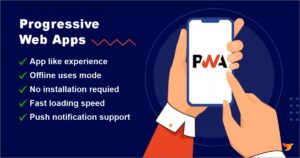
Must-Have Features for Offline-first UX PWA
- Robust Offline Support
Users today do not wish to view a plain “You’re offline” message. PWA 2.0 confirms applications function even in the absence of the internet.
- You can view stored articles, view travel passes offline, or read product catalogues.
- You can log in or work with the application in no network zones or low-network.
- Your form data and preferences are retained, even when you lose connectivity.
Example:A travel booking app allows you to plan your trip offline. When you are back online, it syncs automatically. That’s what PWA 2.0 can do.
- Improved Security and Background Sync
-
- With PWA 2.0, users never lose work when the internet drops out.
- Messages, orders, or form submissions are stored locally.
When the internet resumes, the app automatically sends them.
- No more clicking “retry” constantly
- Security is also greatly improved:
- All data is encrypted.
- Apps are secured against abuse.
- They adhere to worldwide privacy regulations such as CCPA & GDPR.
For business apps like healthcare, banking, and enterprise, this combination of offline sync + strong security is revolutionary.
- Native-Like Experience
. It is identical to a native app.
- scrolling and Smooth gestures.
- Branded install splash and icons screens.
- Same features and design everywhere.
For businesses, this means one app works everywhere (Android, iOS, & web) without the high cost of building separate apps.
- AI-powered PWA personalization
- AI is the big upgrade in PWA 2.0. Apps can now learn from users and give a personal experience.
- Online stores can show smart product recommendations.
- Apps can predict what you’ll do next and load content in advance.
- Blazingly Fast Loading with Pre-Caching
Speed is no longer a premium—it’s a requirement. With App Shell pre-caching and design, PWA 2.0 apps load in an instant, even on slow networks.
- Twitter Lite reduced data usage by 70% and loads virtually rapidly.
- Starbucks PWA had twice the daily active users since users were able to order quickly, even when offline.
- The takeaway: Quicker apps = more engaged users.
Real-World Use Cases of PWA 2.0 features
Progressive Web Apps (PWAs) have improved today. The latest version, PWA 2.0, contains a lot of handy features. They take the good from mobile apps & websites —they are fast, provide notifications, are offline-enabled, and have an app-like feel—but you do not have to download them from the app store.
Now, PWAs are transforming the way educators, businesses & developers provide digital services. Let’s see some examples in action.
- E-Commerce: Problem-Free Shopping
Losing customers due to bad internet is a major issue for online shops. PWA 2.0 fixes this with shopping carts offline.
Consider someone shopping on a metro where the internet is poor. A regular website could not load, and the cart may lose products.
With a PWA:
- The user can add items to the cart offline.
- When the internet returns, the cart syncs automatically, so it’s a direct checkout.
- Push notifications may remind users about their offers or cart items.
Examples:Alibaba and Flipkart use PWAS to enable rapid and more reliable purchases.
Benefits: Users are able to buy trouble free even when the Internet slows down.
- Education: Learn Anywhere
- Online learning sites & Educational institutions use PWA 2.0 to enable students to learn offline, particularly where the internet is poor.
- Lessons, Quizzes, and exercises function offline.
- Apps driven by AI can download course material to study offline.
- Progress automatically syncs when students regain connection.
Advantage: Instructors & Students can learn and teach at any time, and education becomes more accessible & flexible.
- Media & Entertainment
- PWAs are a good fit for podcasts, videos, and music, mainly when the internet connection is poor.
- Background caching minimizes buffering.
- Apps launch fast, even on older, slow or phone connections.
- Apps can offline cache content online to be accessed offline.
Example: YouTube and Spotify Music enable users to play music or videos and music offline using their PWAs.
Benefit: Users can access content whenever they want, which makes them happy and active.
- Other Applications
PWAs find applications in other fields as well:
- : Telemedicine apps can retrieve patient data offline in remote clinics.
- Finance & Banking: Banking apps on mobile phones allow users to view balances, and pay bills offline, monitor transactions then synchronize later.
- Travel & Tourism: City guides & Offline itineraries for travelers can be offered by apps.
- Business Tools: Work Off Wi-Fi
- PWAs benefit businesses, too. Businesses that operate apps for logistics, or fieldwork can gain a lot.
- Inventory systems function in warehouses or places with no Wi-Fi.
- Workers can scan barcodes or QR codes offline and get updates afterwards.
- Downtime & Offline PWAs minimize errors.
Example: Logistics firms and Retail chains apply PWAs for inventory management to confirm work continues continuously.
Benefit: Companies remain productive even under poor internet.
UX Best Practices for PWA 2.0
- Function Properly on All Devices
Ensure the app appears nice and functions well on tablets, phones & computers.
- Simple & Secure Offline Login
Allow users to log in offline securely and smoothly without issue.
Provide simple-to-understand prompts so users can install the utilize & app as a native app.
Advanced Caching Strategies
In addition to simple caching, there are stylish techniques to handle various classes of data so that the app remains speedy without compromising on fresh content.
- Stale-While-Revalidate: The app renders cached content upfront for responsiveness but concurrently retrieves the latest copy from the web in the background. The cache is refreshed for the next session. This is suitable for frequently changing content such as news blogs and headlines.
- Network-First: The application efforts to retrieve the latest content from the web, but if the network is unavailable, it falls back to the cached version. This is best for content that must be up to date, such as user messages, social media posts and comments.
- Cache-First: The application loads content from the cache and goes online only if the resource cannot be loaded. It is best for content that does not change often, icons, fonts, such as app layouts, or JavaScript files.
The Future of PWA 2.0 in 2025 and Beyond
PWAs will continue to get better in the future. Some of the new trends we can already see are:
- Web XR: Virtual reality and enhanced reality that works directly in web browsers.
- IOT-ready PWAS: Apps that can connect and communicate with smart devices, such as fridge, home gadgets or industrial machines.
- Blockchain Login: Safe and secure ID verification without using middlemen, thanks to decentralised technology.
Progressive Web Apps are much better now than they used to be, and the latest version, PWA 2.0, is predicted to revolutionize the digital landscape by 2025 and beyond. In contrast to traditional apps, which can be costly and take weeks or even months to develop, PWAs are less costly, more maintainable, and function on all devices—tablets, phones, and computers—without requiring download from an app store. With background syncing, content & data automatically get updated when the internet reconnects, and users always have access to the most current information. By 2025, PWAs will have AI as a standard feature. AI can assist apps in providing users with recommendations, personalized suggestions, or displaying content that users prefer. Chatbots and virtual assistants can respond to queries immediately, while automatic functionality such as offline data syncing makes apps faster and smarter. PWA 2.0 will not only react to the user – it will guess what they want, providing the more good-looking experience. Companies are using PWA fast as they load quickly, operate offline, send push notifications, and are individual from native apps, provide users an easy and reliable experience even when the Internet is slow.
From Classic PWAs to PWA 2.0
When Installable web apps originally debuted, they granted sites some awesome new skills, including:
- Service Workers – allowing sites to function even without the internet.
- Web App Manifests – enabling apps to be installed on phones and computers.
- Add-to-Home-Screen (A2HS) – so sites could behave and appear like mobile apps.
These capabilities make it operate more reliably, apps load faster, and feel additional fluid on mobile.
But originally, PWAs did have their limitations. Offline use of most things worked only for cached pages, and they did not provide much personalization.
Today in 2025, PWA 2.0 has made an important leap forward. It introduces:
- Playlists, Shopping carts or dashboards that remain functional offline.
- Background real-time syncing with improved security.
- Intelligent, more personalized experiences through machine learning & AI.
- Secure apps that are easy to install and behave exactly like native apps.
These updates make PWA 2.0 smarter, quicker, and more consistent than ever.
The advantages of PWA 2.0 are evident:
- Another distinguishing characteristic of PWA 2.0 is offline-first design. This enables users to use content & key features even where there is no stable connection to the internet. It is highly beneficial for educational websites, online shops, streaming applications, and business applications, particularly in regions with poor internet connectivity. By 2025 and beyond, applying Progressive Web Apps will no longer be a choice—it will be a wise choice for every company that wishes to remain modest in a connected world.
Conculsion
Progressive Web Apps 2.0 are changing the way we use the internet. They combine the best features of apps and websites, work fast, can be used offline, and run on any device without needing to download anything. Schools, Businesses, and developers are already using PWAs to make shopping, learning, entertainment, & work easier. With AI, offline access, background syncing, and app-like performance, PWA 2.0 makes online services more personal, consistent, & easy to use. By 2025 and beyond, PWAs won’t just be extra, they will be necessary for any company that wants to give users a modern, smooth, & simple online experience.
FAQs
Ans: A Progressive Web App is an app that mixes the best features of websites & mobile performance. PWAs load fast, work even without internet, send alerts, and can be used on any device without installing from an app store.
Ans: PWAs store content on your device using service workers & caching. This lets you read content, important features, & work offline. When your internet is back, any changes you made are updated repeatedly.
Ans: Yes. PWA 2.0 has strong security. Your data is encrypted, apps follow the privacy rules like apps CCPA, GDPR, and offline syncing is coherent and safe.
Ans :
E-commerce: Flipkart, Alibaba,
Media and Entertainment: Spotify, YouTube,
Food and retail: Starbucks
Tourism and Khan Academy: Offline city guide apps
Education: Duolingo, Khan Academy,


 WooCommerce Solutions
 Solutions for WordPress