Most B2B e-commerce integration projects start with a lot of confidence. The ERP has a solid API, the e-commerce platform is flexible, and the integration partner has done this before. Yet a surprising number of these projects stall or break down after go-live, and the API is rarely the reason.
The real culprit is usually something far less glamorous: data mapping. When product, customer, pricing, inventory, or order data doesn’t translate cleanly between systems, the consequences show up fast. Orders sync with the wrong tax class. Stock levels don’t match across warehouses. Customer-specific pricing disappears somewhere between the ERP and the storefront.
These aren’t API failures. They’re mapping failures, and they’re often invisible until they’ve already caused a shipping error, an overcharged invoice, or a frustrated buyer.
This guide breaks down what ERP data mapping actually is, why it matters more than most teams realize, where it typically goes wrong, and how to build a mapping strategy that holds up under real operational pressure. Whether you’re planning a new WooCommerce ERP integration or troubleshooting one that’s already live, this is the layer of the project that deserves far more attention than it usually gets.
What Is ERP Data Mapping?
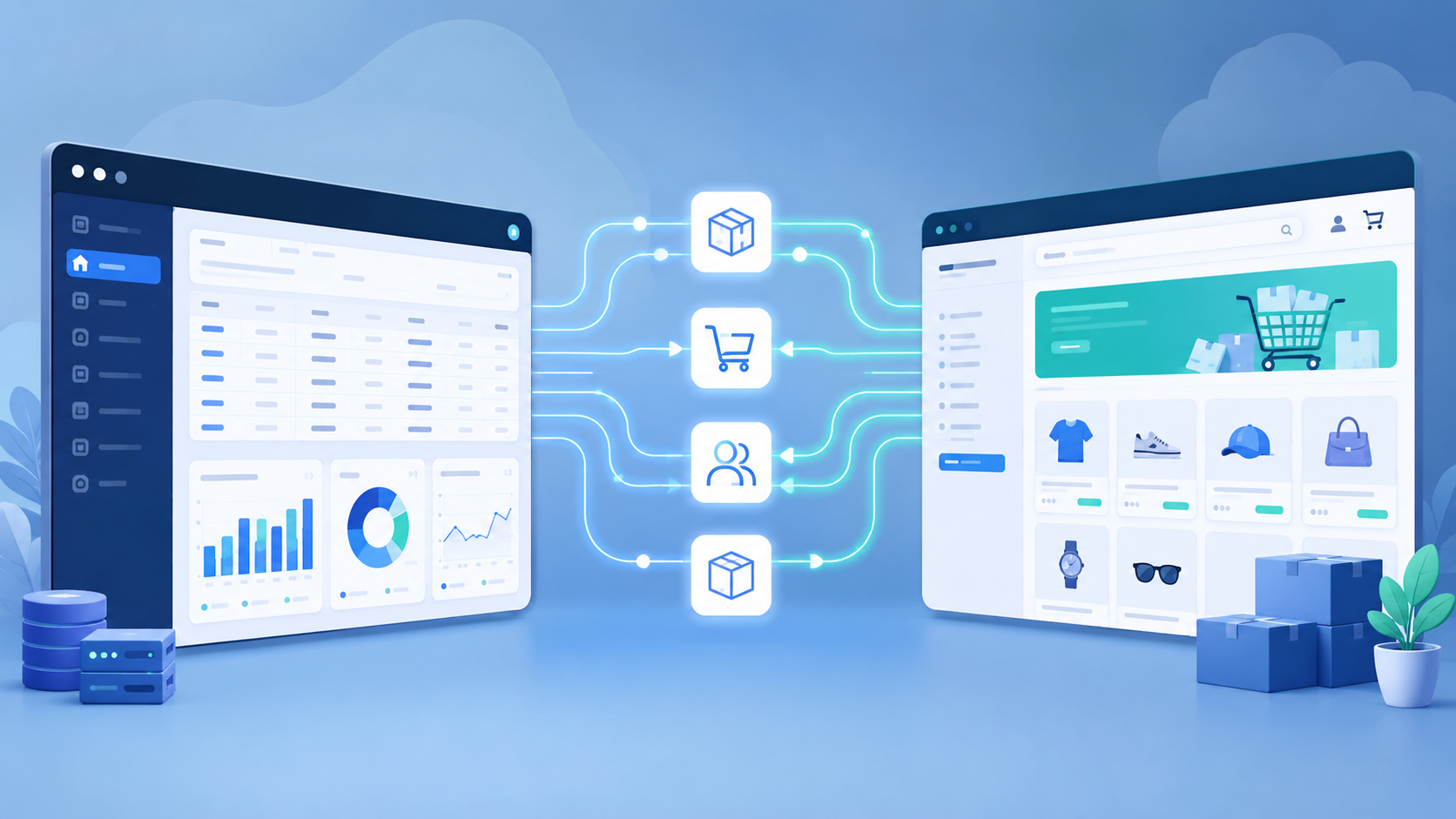
ERP data mapping is the process of defining how data fields in one system correspond to data fields in another so that information moves between them accurately and consistently.
In a WooCommerce and ERP integration, this means establishing clear rules for how a field like SKU in WooCommerce relates to the matching item code in the ERP, how stock quantity fields align, and how customer records, order numbers, and tax classes are translated between the two platforms.
At its core, ERP data mapping involves four things:
- Source and destination systems. Every mapping has a starting point (where the data lives) and an endpoint (where it needs to go).
- Field relationships. Which field in system A corresponds to which field in system B, and whether that relationship is one-to-one, one-to-many, or conditional.
- Data transformation. Converting formats, units, or values so both systems interpret the data the same way.
- Validation rules. Checks that catch missing, malformed, or inconsistent data before it causes problems downstream.
Mapping has to happen before synchronization begins, not after. Without it, even the most well-built API integration is just moving raw, unstructured data back and forth with no guarantee it means the same thing on both ends.
Here’s a simplified example of what a WooCommerce-to-ERP field mapping might look like:
| WooCommerce Field |
ERP Field |
Data Type |
Transformation Needed |
| SKU |
Item Code |
Text |
Format standardization |
| Product Name |
Item Description |
Text |
Character limit truncation |
| Stock Quantity |
Available Qty |
Integer |
Warehouse-level aggregation |
| Customer ID |
Account Number |
Text |
ID cross-reference lookup |
| Order Number |
Sales Order ID |
Text |
Prefix/suffix formatting |
| Tax Class |
Tax Code |
Text |
Value mapping table |
Even in this small example, none of the fields are a perfect one-to-one match. That’s the norm, not the exception, in enterprise environments.
Why ERP Data Mapping Matters in B2B Ecommerce
B2B e-commerce runs on accuracy. Buyers expect correct pricing, accurate stock availability, and orders that process without manual intervention. All of that depends on how well the underlying data mapping was designed.
When ERP data mapping is done properly, it directly supports:
- Accurate inventory synchronization across warehouses, so buyers never order stock that isn’t actually available.
- Faster order processing, because orders don’t get stuck in exception queues waiting for someone to fix a mismatched field.
- Customer-specific pricing, which is often tied to contract terms, customer groups, or negotiated rates stored in the ERP.
- Reliable financial reporting, since incorrect tax codes or order totals eventually surface as accounting discrepancies.
- Smoother procurement workflows, particularly for buyers using purchase order numbers that must match ERP records exactly.
- Cleaner warehouse operations, where inaccurate stock data leads to picking errors and fulfillment delays.
- Less manual cleanup work for the operations team, who otherwise spend hours reconciling spreadsheets.
- A better customer experience, because none of the above problems are visible to buyers when the mapping works.
In short, data mapping is the difference between an integration that quietly works in the background and one that generates a steady stream of support tickets. Teams dealing with recurring fulfillment issues often find the root cause buried here; see our guide on WooCommerce Order Fulfillment Problems for related patterns.
Common ERP Data Mapping Challenges
Every B2B e-commerce data mapping project runs into friction in a few predictable areas. Understanding them ahead of time makes it much easier to plan for them.
Product Data Mapping
Product data mapping is often where projects hit their first real obstacle.
SKU mismatches are extremely common, especially when the ERP and WooCommerce use different naming conventions or when SKUs were entered manually over the years with inconsistent formatting. Product IDs can also diverge if one system relies on auto-generated internal IDs that were never intended to be customer-facing or cross-referenced.
Category structures rarely align cleanly either, since ERPs often organize products by accounting or procurement logic rather than the customer-facing categories used in WooCommerce. Variants and attributes (size, color, packaging unit) add another layer of complexity, particularly when the ERP treats variants as separate line items rather than child records. Units of measure are a frequent silent error source: a case of 12 in the ERP might be mapped as a single unit in WooCommerce, which throws off both pricing and stock counts.
Customer Data Mapping
Customer data mapping tends to be more sensitive because it touches billing, credit, and compliance.
Customer IDs need a reliable cross-reference system, since ERPs and ecommerce platforms rarely use the same ID format. Billing information and shipping addresses must map correctly, including support for multiple ship-to locations per account, which is standard in B2B. Customer groups (used for pricing tiers or access restrictions) need to translate accurately, as do credit limits, which directly affect whether an order can be placed at all.
Tax IDs and contract pricing round out the list. Getting these wrong doesn’t just create friction; it can create compliance and billing issues that are costly to unwind after the fact.
Order Data Mapping
Order data mapping involves the widest range of fields and the highest volume of transactions, so small errors compound quickly.
Order numbers, payment methods, and shipping methods all need consistent mapping logic. Taxes and discounts must calculate the same way in both systems, or financial reports won’t reconcile. Purchase order numbers matter enormously in B2B, since many buyers require their PO number to appear correctly on invoices. Status mapping, such as translating “processing” in WooCommerce to the right corresponding status in the ERP, is often overlooked until orders appear stuck or duplicated.
Inventory Data Mapping
Inventory data mapping challenges usually emerge as a business scales beyond a single warehouse.
Multiple warehouse locations require logic for how stock is aggregated or split. Reserved stock (allocated to open orders) and available stock (what can actually be sold) need to be tracked separately, or overselling becomes a real risk. Safety stock and reorder levels, often managed entirely within the ERP, also need to be reflected in a way that supports accurate availability messaging on the storefront. Our guide on WooCommerce Inventory Management covers this in more depth.
Pricing Data Mapping
Pricing is frequently the most complex mapping category in B2B e-commerce, because pricing logic in ERPs is rarely simple.
Tier pricing based on volume, contract pricing negotiated per customer, regional pricing tied to territory or currency, promotional pricing with time-based rules, and currency mapping for international accounts all need to be reflected accurately. A mapping error here doesn’t just look bad; it can mean charging or undercharging a customer without anyone noticing until reconciliation.
Common ERP Data Mapping Errors
Beyond the challenges tied to specific data types, certain mapping errors show up again and again across projects.
Duplicate records. Usually caused by inconsistent unique identifiers across systems. The business impact ranges from inflated inventory counts to confused customer histories. Prevention comes down to enforcing a single reliable identifier per record type.
Missing required fields. Happens when source data was never fully populated or when a field required by one system doesn’t exist in the other. This can halt synchronization entirely. Validation rules that flag incomplete records before they sync are the best prevention.
Incorrect field types. For example, a text field being sent where a numeric field is expected. This often causes silent failures or corrupted data. Strong schema validation at the mapping layer catches this early.
Invalid references. Occurs when a mapped field points to a record that doesn’t exist, such as an order referencing a customer ID that hasn’t synced yet. This breaks order processing. Sequencing and dependency checks in the sync logic help prevent it.
Null values. Often the result of incomplete source records or fields that weren’t included in the original mapping. Left unhandled, they cause downstream errors or blank fields on customer-facing pages. Default value rules and mandatory field checks reduce this risk significantly.
SKU inconsistencies. A recurring issue tied to manual data entry or legacy naming conventions. It leads to failed inventory matches and duplicate product listings. Standardizing SKU formatting before mapping begins is the most effective fix.
Manual spreadsheet errors. Common in businesses still relying on manual exports and imports rather than automated synchronization. These errors are hard to trace and easy to repeat. Automating the transformation process removes this risk almost entirely.
Best Practices for ERP Data Mapping
Getting ERP data mapping right isn’t about finding a perfect tool; it’s about disciplined process. A few practices consistently separate stable integrations from fragile ones:
- Standardize master data before mapping begins. Clean, consistent source data makes every step afterward easier.
- Create a formal mapping document that records every field relationship, transformation rule, and edge case. This becomes essential during troubleshooting and future upgrades.
- Use unique identifiers consistently across systems rather than relying on names or descriptions that can change.
- Validate mandatory fields at the point of data entry, not just during synchronization.
- Automate transformations wherever possible to eliminate manual spreadsheet handling.
- Maintain audit logs so every sync event can be traced back to its source and outcome.
- Test incrementally, starting with a small data set before scaling to full catalog or customer volume.
- Review mappings after ERP upgrades, since version changes frequently alter field structures or APIs.
- Establish clear governance and ownership, so one team or role is accountable for maintaining the mapping over time.
Businesses scaling past a certain transaction volume often find that mapping discipline is what determines whether the platform holds up. For a broader look at scaling risk, see Why B2B WooCommerce Stores Break at Scale.
The Role of Middleware in ERP Data Mapping
Middleware sits between WooCommerce and the ERP, handling the translation work that direct point-to-point integrations struggle to manage at scale.
Rather than hardcoding field relationships into a single script, middleware typically provides a structured layer for data transformation, validation, and error handling. APIs handle the actual data transfer, while the middleware layer applies the mapping logic, converts formats, and checks for errors before data reaches its destination.
Message queues are often used within middleware to manage timing and sequencing, ensuring that dependent records (such as customers before their orders) sync in the correct order. Retry mechanisms handle temporary failures, such as a brief API timeout, without requiring manual intervention. Good middleware also logs every transaction, which becomes invaluable when diagnosing a mapping issue after the fact.
Regardless of which middleware or API integration approach a business chooses, the underlying principle stays the same: mapping logic should live in a maintainable, visible layer rather than being buried inside custom code that only one developer understands.
How to Test ERP Data Mapping Before Go-Live
Testing is where mapping assumptions either get validated or exposed. A thorough testing process typically includes:
- Unit testing individual field mappings in isolation to confirm each transformation behaves as expected.
- Integration testing to verify that connected fields (such as order status and inventory deduction) behave correctly together.
- Bulk testing using realistic data volumes, since some mapping errors only appear at scale.
- Exception handling tests, deliberately introducing bad data to confirm the system flags or rejects it appropriately.
- User Acceptance Testing (UAT), where actual business users confirm that orders, pricing, and customer data look correct from their perspective.
- A documented rollback strategy, in case a mapping issue is discovered after deployment.
A simple production readiness checklist before go-live should confirm that all mandatory fields are validated, error logging is active, rollback steps are documented, and a small pilot group of orders or customers has been tested end-to-end.
Real-World Example
Consider a mid-sized B2B distributor managing more than 20,000 SKUs across three regional warehouses, with WooCommerce as the customer-facing storefront and an ERP handling inventory, pricing, and fulfillment.
In the initial integration, the mapping was built quickly to hit a launch deadline. SKUs were matched using product names rather than unique identifiers, and stock levels were synced without separating reserved and available inventory. Within weeks, customers were placing orders for stock that had already been allocated elsewhere, and pricing for contract customers occasionally reverted to standard list pricing due to a mapping gap in the customer group field.
The operations team found itself manually correcting dozens of orders per week, and warehouse staff lost confidence in the stock numbers shown online.
The redesign started with a full mapping audit. Unique SKU-based identifiers replaced name-based matching. Inventory mapping was rebuilt to reflect reserved versus available stock per warehouse. Customer group and contract pricing fields were remapped with explicit fallback rules instead of silent defaults.
After the redesign, order accuracy improved significantly, manual correction volume dropped, and warehouse teams regained trust in the synced inventory data. The business didn’t need a new ERP or a new e-commerce platform; it needed a mapping structure that matched how the business actually operated.
How Dazzlebirds Supports Reliable Data Synchronization
Solving ERP data mapping challenges usually comes down to having the right tools to define, automate, and monitor field relationships without relying on manual processes.
Dazzlebirds‘ WooCommerce import and export automation is built around this exact need. It supports detailed field mapping so businesses can define exactly how product, customer, order, and inventory fields correspond between WooCommerce and their ERP or other connected systems.
Scheduled synchronization keeps data current without requiring someone to manually trigger updates, while support for CSV and XML formats makes it easier to work with the file structures many ERPs already export. For teams that rely on spreadsheets during transition periods, Google Sheets integration bridges the gap between manual processes and full automation. FTP and SFTP automation supports secure, scheduled file transfers for businesses with established data pipelines.
Logging throughout the sync process gives teams visibility into what happened during each transformation, which matters when diagnosing a mapping issue rather than guessing at the cause. Together, these capabilities are designed to support the kind of enterprise workflows described throughout this guide, not as a replacement for good mapping design but as the infrastructure that makes it sustainable.
Businesses evaluating whether their current setup can support this level of automation may benefit from an enterprise WooCommerce technical audit guide before making changes.
Conclusion
ERP data mapping rarely gets the attention it deserves, largely because it’s invisible when it’s working correctly. But it’s the layer that determines whether an integration actually holds up under real business volume or quietly generates errors that surface weeks later as pricing disputes, stock discrepancies, or fulfillment delays.
APIs move data. Mapping determines whether that data means the same thing on both ends. Getting it right requires standardized master data, clear documentation, thoughtful testing, and ongoing governance, not just at launch but through every ERP upgrade and business change that follows.
Businesses planning a new integration, or troubleshooting one that isn’t performing as expected, should treat mapping as a core part of the technical strategy from day one. For teams planning a broader rollout, our guide on WooCommerce Deployment Strategies for Enterprise Teams covers how mapping fits into the larger implementation timeline.
FAQs
ERP data mapping is the process of defining how product, customer, order, and inventory fields in an ERP system correspond to matching fields in an e-commerce platform like WooCommerce. It ensures data transfers accurately and consistently between systems during synchronization.
Without accurate ERP data mapping, WooCommerce integrations can produce incorrect pricing, inventory mismatches, and order errors. Proper mapping ensures inventory synchronization, order synchronization, and customer data stay consistent, directly supporting operational efficiency and customer trust.
Common mistakes include SKU inconsistencies, duplicate records, missing required fields, invalid references, and manual spreadsheet errors. These typically stem from inconsistent identifiers, incomplete source data, or reliance on manual processes instead of automated data transformation.
Testing typically involves unit testing individual field mappings, integration testing across connected workflows, bulk testing with realistic data volumes, exception handling tests, and user acceptance testing. A documented rollback strategy should also be in place before go-live.
Yes. Middleware provides a structured layer for data transformation, validation, and error handling between systems. It works alongside APIs to manage field mapping, retry failed transactions, and log synchronization activity, making the overall integration easier to maintain.


 WooCommerce Solutions
 Solutions for WordPress