Introduction
These applications were designed as a single, large application, where in all are closely interwoven. In DazzleBirds, we assist B2B customers in transforming their inheritance platforms using the modern, flexible structure fueled by Node.js and Laravel. Through monolith to microservices we segment great applications into smaller units that operate self-sufficiently. As an important thing, they are difficult to keep, slow to become unsafe and grow, and slow to adapt. For any company that wishes to remain and expand,
updating these systems is no longer an option, it’s a need.
In this blog, we will tell you about what microservices are, how they differ from columns, and how our rebuild process, step-by-step, contributes to your company being future-ready. If you are preparing to update your existing system, you will learn through this guide the advantages and why DazzleBirds is the perfect team to assist you in doing so.
What Is a Monolithic Application?
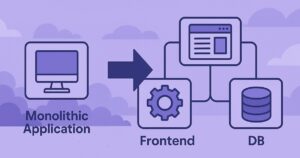
A monolith is an old kind of web application where all aspects, such as business design, database and logic, and operations, are created together in a single system. This configuration is humbler to construct originally, but as your app becomes larger, it’s harder to update and maintain.
Monolithic app issues:
- You can not scale one feature without touching the whole system
- It’s harder for big teams to work on the app at the same time
- Deploying updates is unsafe and slow
- Small changes can cause surprising bugs
- Adding new features takes longer
If you are facing these issues, it may be a good time to switch to a linked rebuild using microservices. This method breaks your app into smaller, additional, easily scalable parts that are easier to scale and update.
Monolith vs. Microservices: What’s Right for You?
It’s also classy and difficult to scale only a single part of the app because everything is packaged together. You are characteristically stuck with one tech stack, and the more people on your team, the more difficult it is to cooperate on the same code.
With microservices architecture, the app is separated into minute, independent parts (services) that operate distinctly. Each service performs one function and can be maintained, developed, and scaled self-sufficiently. Microservices are an appropriate choice for expanding and large apps that must be simple and flexible to work with. You can even develop one with different programming languages or tools. This allows teams to work on different features of the app in parallel, so projects progress even faster.
What Are Microservices?
Microservices are a fresher method to application development that involves rotting your application into separate, independent pieces that can be arranged together. These services talk to one another via APIs, but each can update, scale, and run self-sufficiently without affecting the others. One service may be for user logins, another for payments, and a third for a list of products. Rather than a single large codebase like a microservices split, a monolithic app your app into single services, respectively, with an exact business capability
This architecture provides great benefits for B2B companies that must expand, be alert, and support complex systems. With microservices, your developers are talented enough to ship and build new features much earlier because each service is independent and can be built and deployed distinctly. If some component of the app must serve additional users, such as the reporting system and checkout, you can scale only that specific service without scaling the whole application.
Microservices do not bind you to only using one language or framework. You can use Laravel for a particular service, Node.js for another, and apply the best tool for the task. You can thus develop wiser, cheaper, and faster. It also facilitates teamwork. Numerous developers or groups of developers can work on many services concurrently without interfering with each other. This accelerates and minimizes development delays. Since services are updated, distinct, and changes are less risky.
How We Modernize Legacy Web Apps at DazzleBirds
At DazzleBirds, we contribute companies transform their outdated applications on the web using a origan original, flexible system known as microservices architecture. It separates big apps into tiny, wieldy pieces that are simpler to maintain and scale. We power robust tools such as
Node.js—ideal for real-time APIs, fast
React/Vue.js—best for developing modern, user-centred front ends
Laravel—ideal for developing safe and healthy backend services using PHP
Here’s how we refactor inheritance apps step by step:
1. Modular Rebuild Plan
We develop a conclusive plan to segment your app into bite-sized services, each dedicated to a separate business function.
2. Testing and Security
We develop a responsive service with healthy security and test it exactly to safeguard against any issues later.
3. Tech Stack Reference
According to your needs, we propose the proper tools, Laravel for organized Node.js backends, for fast APIs, and so on.
4. API-First Development
Each of our services is developed as an independent API which can be easily integrated and extended later on.
5. Gradual Relocation
Rather than revising everything at once, we travel one feature at a time. Your app continues to function easily this way.
6. Legacy App Audit
We begin by checking your existing app, its database, code, and configuration to determine what needs renewal or overhaul.
7. Cloud-Natural Deployment
We host your applications on cutting-edge cloud platforms such as Docker, AWS, or Kubernetes to make your app reliable and rapid.
By doing this, your company receives a future-proof application that’s additionally secure, faster, and simpler to continue.
Why B2B Clients Choose DazzleBirds
We understand that B2B companies have exclusive products. Our customers are not essentially looking for bleeding-edge technology; instead, they need proven solutions that function for their day-to-day use.
That includes:
- Healthy security to keep valued business information safe
- A healthy system that can achieve huge, complex workflows
- A flexible setup that can scale with the business over time
- Custom features that align with how their teams really work
- Fast performance for high-traffic apps or websites
Whether you operate an ERP system, a retailer gateway, or a SaaS offering to your customers, we assist you in building your application with clean planning, the correct tools, and confidence for the long draw.
Why do we use Node.js and Laravel?
Node.js
- Fast and Lightweight
- Perfect for developing real-time APIs and features
- Compatible with the latest front-end values like Vue or React Simple to scale with tools such as Kubernetes and Docker
- By employing both Node.js and Laravel, we found a robust and flexible configuration that transforms outdated systems into up-to-date, linked web applications that are simpler to scale and maintain.
Laravel
- Implements a structured and clean pattern
Includes built-in functionality for caching, login, and routing
Excellent choice for microservices development using PHP
Good and Big community for long-term use
Ready to Rebuild Your Legacy Web App?
Switching from a monolith to microservices is not just a technical change; this is a smart move for your entire business. If your current app is slowing down your team, it is time to reconstruct important features or be very expensive to manage.
On Dazzlebirds, we have helped businesses in finance, healthcare, and logistics, and mother-in-law has rebuilt her old system using largest, node.js, and modular microservices – Easy to update her apps and ready to update and grow for growth.
Conclusion
If your existing web application is old, hard to maintain, or clogging up your business, it may be time for a promotion. Migrating away from a monolith installation to a microservices architecture can speed up your app, make it more alert, and make it far simpler to scale as your business increases. Our phased build methodology keeps your platform operating easily while rebuilding it into a state-of-the-art, safe, and linked system. At DazzleBirds, we are experts in rebuilding B2B businesses‘ infrastructure systems with high-performance technologies such as Node.js and Laravel.
If you operate a complex ERP, a high-traffic SaaS site, or a complex seller entrance, we can assist you in transitioning positively and smoothly.
Are you ready to level up your inheritance app?
Visit dazzlebirds.com or contact us today to start your digital change journey.


 WooCommerce Solutions
 Solutions for WordPress