An operational reality that most B2B businesses discover too late
All B2B businesses that grow have a moment when it takes too much effort to keep things simple in the customer portal.
You remember when it started. You were smaller. The idea was clear. Like, launch a spot where your best customers can order without you answering. Allow visibility into their own account. Show them their pricing. Make life easier for everyone.
At first, it worked beautifully.
You had maybe ten customers. Then twenty. They all had similar needs. The portal felt elegant. Fast to manage. Your team could handle everything. Updates were quick. Support was straightforward. Life was good.
Your business may have started scaling up after that.
You had maybe ten customers. Then twenty. They all had similar needs. The portal felt elegant. Fast to manage. Your team could handle everything. Updates were quick. Support was straightforward. Life was good.
Your business may have started scaling up after that.
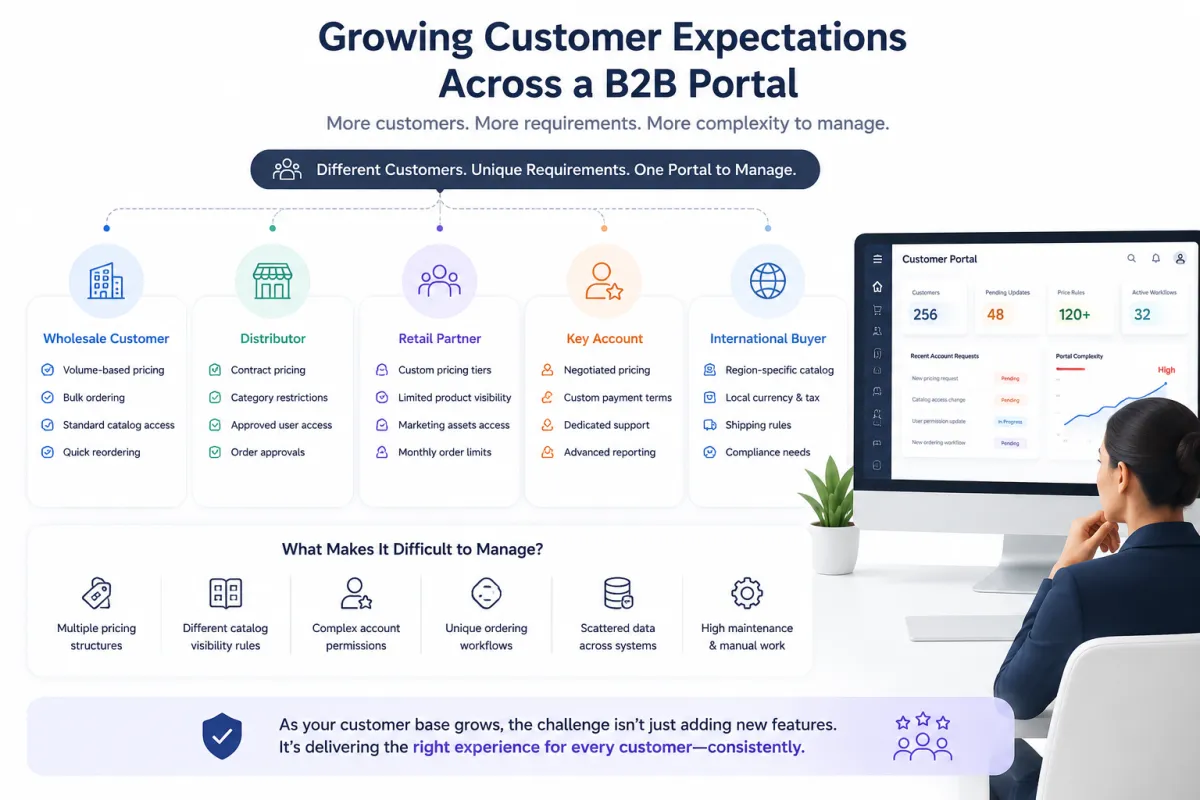
New customer segments arrived. Major accounts with unique requirements. Some customers who required some sort of product visibility. People who wanted their own pricing schemes. Others requested custom ordering workflows. Some required specific account permissions.
Your portal, the one that felt so simple before, started to feel like it was getting away from you.
If you were adding features for one customer, you would be worried that it would break something else for another. Your never-ending portal updates left your team little time for all else. Something that used to take an hour to manage now took a day. Then a week. By then, customer requests had begun piling up.
This is not a failure. That is not a technical issue. It is the story of every B2B business when it gets to a certain level.
Building a B2B customer portal is complicated, but that really isn’t the challenge. The challenge is more delivering a simpler customer experience, even while everything in the world has gotten increasingly complex around it.

Why Customer Portals Become More Important as B2B Businesses Grow
Customer portals feel like a nice-to-have when you are small. They are the infrastructure you need to survive when you’re growing.
Here is why. Your customers are able to find a means of self-service. They want to order without contacting you. They want to know how much they paid the last time and how much they are going to pay this time around. They’re asking what products are available to them. They want faster ordering. They want convenience.
This expectation is not new. This was figured out years ago by consumer businesses. B2B customers have seen how Uber and Amazon work. And every app they use. Now they want that from you. They want a portal that functions as planned. They expect self-service.
You can get away without this in a small business. Everything can be handled by your sales team. Every customer is known by name to your account managers. Orders are personal. But this does not scale. And you know it does not scale.
Once you start adding customers, your team cannot manage the human touch for every interaction. You have your salespeople spend less time on order entry. Your account managers are inundated. Something has to break, and often it is customer experience.
An effective B2B customer portal changes this. This enables your customers to help themselves. They take the load off your team. It speeds up ordering. It creates efficiency.
But the challenge that no one tells you about is that as your customers increase, instead of managing your portal getting easier, it gets complicated.
More Customers Usually Means More Custom Requirements
Here is a pattern that no one tells you about when creating your first customer portal. Customer A example: He just has the default price on all of his products. Customer B has a tiered pricing schedule based on the number of orders placed. Customer C signed up for special prices on three product groups. The same customer, D, wants the three categories again, but now with different pricing.
You add those. And then there is an entirely different business model, Customer E. They want to see some products that others never need to know about. They have a particular ordering workflow they desire. They want a co-branded experience. It’s not them being difficult. This is not bad negotiation. This is business reality.
Every customer is unique in B2B commerce customer-specific pricing, at least to some degree. Every account has different requirements. There are different needs in every segment of the customer base. And now, your portal needs to handle all of this at once. You are building more than just a portal. It seems like you have dozens of portals on top of each other, all drawing from the same infrastructure.
You are taking care of the company’s particular prices. You are already taking care of customer-specific product catalogs. You are handling customer-specific permissions. You are handling customer-specific ordering workflows. A customer buys from you because you have a need that is at a price point they can pay. But the cost could vary by customer.
They can, however, see dissimilar products. They might even have a tailored way of placing orders. This is what your B2B customer portal needs to deliver, all at once. For now, most businesses deal with this manually. You track pricing on an Excel sheet. You control who can access the catalog in another spreadsheet.
You have written some notes regarding which customer needs what. Your team handles updates over email and through meetings. This works when you have 20 customers. It does not work when you have 200.
Why Managing Customer Experiences Becomes More Difficult Over Time
Here is an actual example, because this is where the pressure really enters your business. We have three years of loyalty for a customer. They have a factored rate pricing. Their account is tied to various product categories. Their ordering frequency is predictable. Your support team knows how to help them. Everything runs smoothly.
Then you go get yourself a new account manager. They are not aware of the special pricing terms for this customer. But they are not aware of the product restrictions. This customer might not even know the brand even exists. A purchase order comes in. Your new team member processes it at retail pricing. Your customer receives a bill that does not match the terms negotiated. Now you have a problem. A relationship problem. A trust problem.
This is because, when it comes to scaling customer experience management, orchestration always proves helpful. It requires documentation. It needs systems that truly enforce these rules to make sure a human error doesn’t destroy the customer relationship. Fewer B2B businesses at the moment have systems like this. They have Excel spreadsheets and good intentions.
They also have experienced personnel who recall details. They have notes and emails, memories. Memories alone are not going to be enough as you scale. Your customers have different expectations. Some want simplicity. Some want customization. Some want constant communication. Some want to be left alone.
Some need educational support. Deep integrations that require advanced features, and executing all of this consistently is what becomes the unsung work in your business. Not managing a portal anymore. You are juggling more than one customer experience at once, and every time you update anything for one of them, there is a concern that something else will break somewhere.
The Hidden Work Behind Customer-Specific Experiences
This is the part that doesn’t get showcased in any software demo. Behind the scenes of every catalog, specific to a customer, is work that needs to be done by hand. Somebody has to decide which products this customer gets served up. Someone has to document why. Someone has to install it in your system. Someone has to test it. When the catalog changes, someone needs to change it back.
When it comes to customer-related pricing agreements, coordination is behind the scenes. Customer A was promised something by sales, and finance has to fulfill that promise. It is enforced by the portal. You should get it clarified with your order fulfillment team. Then someone has to go update it everywhere at once whenever that pricing expires or changes.
There is a decision behind every customer-specific ordering workflow. Different customers need different steps. Some customers need approval workflows. Some need to bypass them. While some require integration in their own systems. Others require special fields in the order form. All of this transpires behind the scenes where your customers don’t see a thing. But all this is visible to your team.
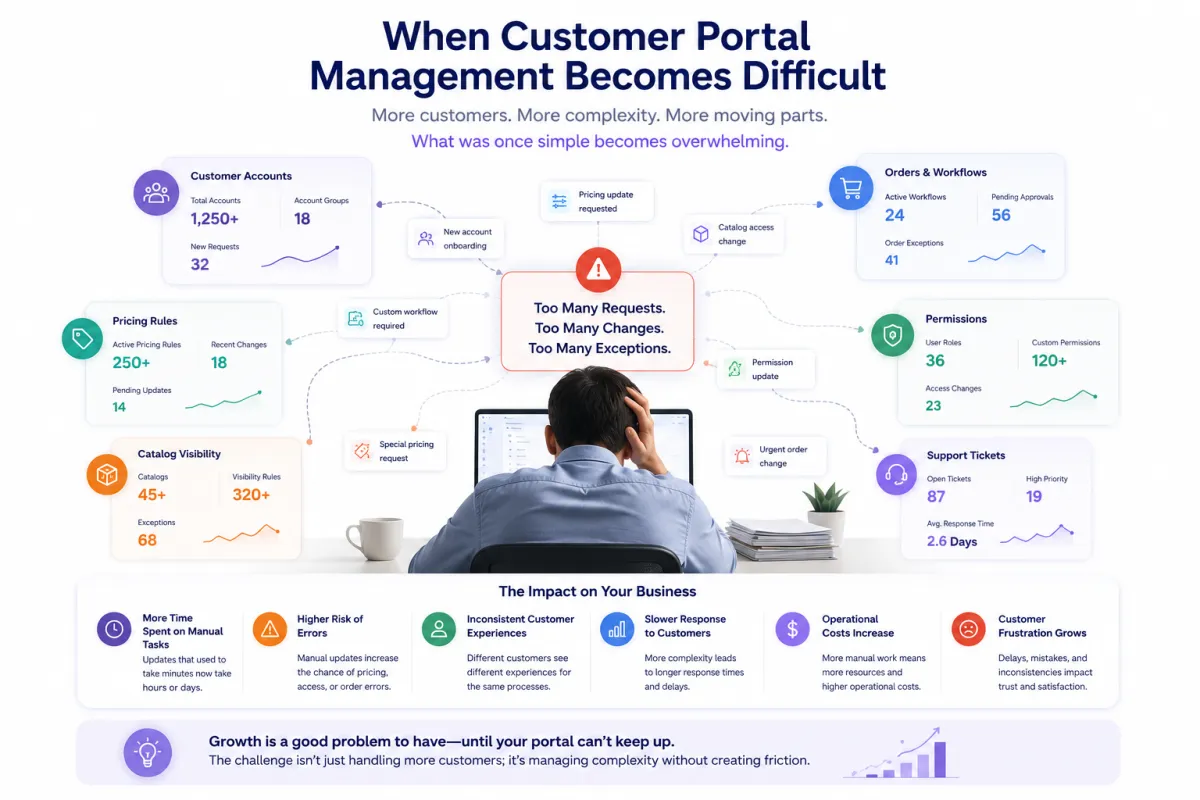
Importantly, this is where managing customer portals becomes a tiring exercise. It is not one decision. It is hundreds of decisions. It is not one setup. It is hundreds of setups. It is not one update. Hundreds of updates that are continually updated. You are keeping orders by account specifically. You are keeping account-specific pricing visible to your team.
Your team keeps catalog access. Your team is running a customer self-service portal but is very busy managing all the exceptions and special cases, as with real customers. It is these operational burdens that accumulate in B2B customer portals as they grow.
Why Manual Management Stops Working at Scale
Here is when everything switched: Your team can start manually managing everything at first. Your Account Managers Know Their Customers. Your ops team knows the rules. Updates are infrequent. Life is manageable. Then requests start coming faster. The pricing for Customer A needs to be changed. Product Addition: Customer B wants the newly introduced products to show up in their visible list.
Creating Customer D that requested a new user on their account. Workflow Adjustment for Customer D: Your team works on them as they come in. No problem. Sure, except this time they arrive on us quicker than last time. Pricing updates pile up. Catalog changes stack up. Account requests queue up. Well, your operations team has also lost its focus on what it does.
They are firefighting requests. They are managing exceptions. They are coordinating changes. Your team starts making mistakes because they have too much on their plate. Pricing does not update correctly. A customer views products they should not have access to. A workflow breaks. A permission is set incorrectly. These mistakes create more work.
And now someone has to repair the broken thing. Explain to the customer what happened; someone has to do it. Job has the stomach to make sure it never happens again. And the requests keep coming. This is when you come to know that manual management has failed. You cannot just put your best people to work harder.
You need to fundamentally change your approach to the way you handle the portal. For most B2B businesses, they run into this wall somewhere between the 50 and 200 customer marks. Some hit it faster. It always comes; the thing is. Your team feels it first. They feel the pressure. They feel the growing complexity. They ask for help. They ask for better tools. They wonder if there is a different way. There usually is.
But you have to be willing to admit that manual management stopped working and that you need a different approach.
What Successful B2B Customer Portals Have in Common
Looking at businesses that can effectively oversee these types of customer portals on a large scale, you can spot various qualities they share. First, they have clear rules. They document how things work. They have a source of record for customer accounts, prices, and permissions. Everyone on the team knows where to get this information. If something has to be changed, there is a way.
Second, they enforce consistency. They employ their system to stop themselves from making errors. They get their team to forget the rules. The rules are baked into the system that they construct. So whenever a new team member comes in, the system guides them on what to do. This means a customer could not see the products you do not want them to, and that also means it’s because of the system excluding them rather than someone remembering it.
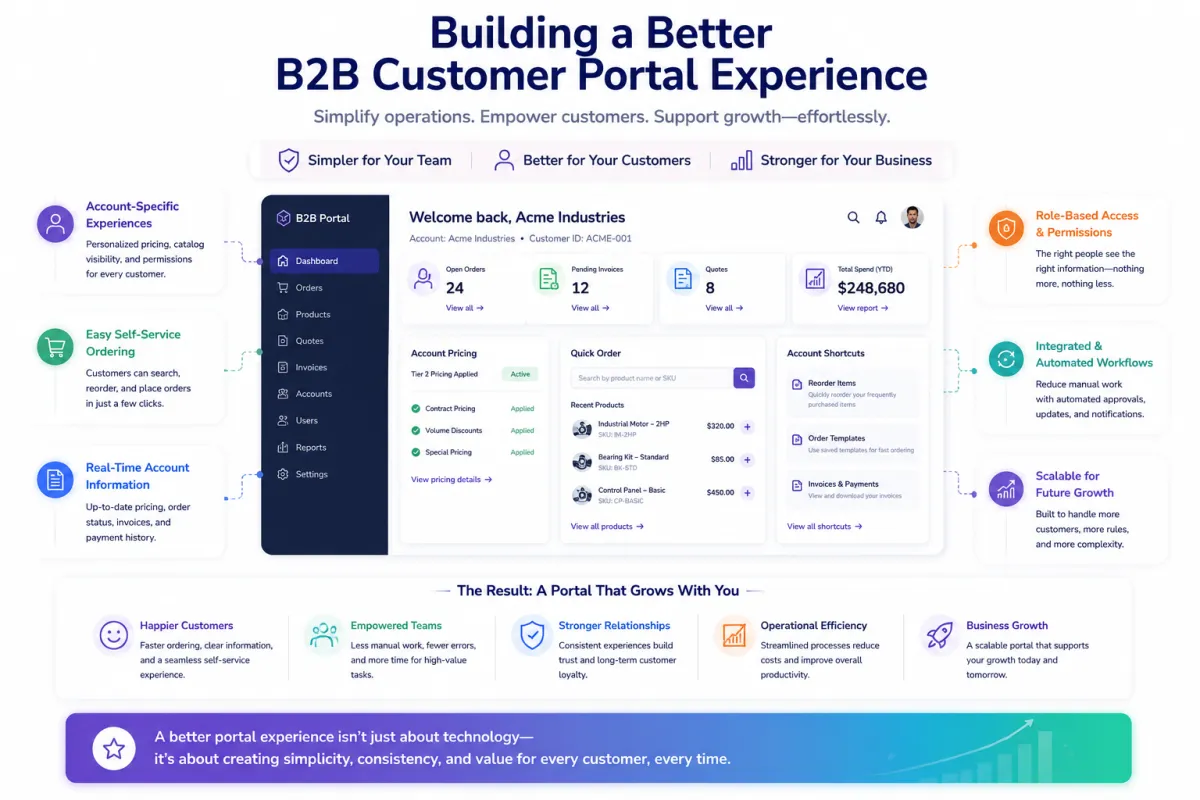
Third, they simplify ordering for customers. And it is this complexity that happens behind the scenes while your customer experience remains super simple. Customers log in and see their products. They see their pricing. They place an order. That is it. Complexity is not felt by the customer.
Fourth, they provide good support to their customers. They quickly remedy what goes wrong. They have a process for answering when the customer has an inquiry. They are unapologetic about their system. They handle the system so they can give their customers a better support experience.
None of these businesses are doing anything particularly magical. No, they are not employing spy-tech. They are simply being intentional about their portal management. They kind of decided early that consistency is key. They deemed that their system should be programmed to follow the rules, not humans. That a complicated backend should appear simple to the customer.
In other words, they committed to the infrastructure that would make this possible. The majority of these decisions take place only when a business has already grown past the manual management point. The businesses that do the best are those who make these decisions before it actually hurts too much.
The Future of B2B Customer Portals Is About Simplicity
Disruption of mindset around customer portals for B2B is coming. All these years, the SDK has been all about creating more features. More customization. More options. More settings. But with customer expectations increasing and complexity on the rise, it is simplicity that provides the true competitive edge. Your customers don’t want a complicated portal. They want a simple experience.
They want to just get logged in quickly and go do whatever they need to. They want their order to be made in just two clicks. They want to get instant pricing from you. They are curious about their account position. Your portal may be managing dozens of customer segments, hundreds of pricing rules, and thousands of products for you in the background. But it should all be simple enough on the surface.
Now, here is where it gets tricky: hiding the complexity but not removing it completely. You need to support all those customer segments without making your customers feel the burden of that support. Intentionality when it comes to directing customers in the right direction is what makes successful B2B customer portals. They surface what matters. They hide what does not. They facilitate the most common actions and make potentially less common practices occur.
They also reduce friction. They remove unnecessary steps. They do not ask customers to take an action on things they have already told you. They would not do anything that makes users have to input information your system has already captured. They make every interaction count. When you have a mindset for simplicity, three things happen.
To begin with, customers are excited to use your portal. They place more orders. They use it for more of their requirements. You get additional revenue without incurring sales overhead. Secondly, your team will not have as many questions to tackle. Customers solve it on their own. It reduces email messages to your support team. Your account managers are spending less time explaining how stuff works.
Third, your business becomes more productive. You are not managing complexity. You are selling a simple experience that is easy to scale. That is how the future will look. Not more features. Simpler experiences. Better customer journeys. Less friction.
Bringing This All Together
What you are going through is real. It is not unique to you. This is literally a problem faced by almost every growing B2B business. The population of your portal was small to start out and therefore could have been reasonably simple. Your customer base was small. Your requirements were uniform. Managing it manually was fine. Yet as your mini-business expanded, everything shifted.
Your customer base diversified. Your requirements multiplied. And when people got dragged in other directions, you could not even maintain your team’s capacity. What had felt simple became somewhat complex. It used to take an hour; then it took a week. Something that seemed manageable spiraled out of control.
This is the time when most of them in B2B understand that a new strategy is needed. They can’t keep handling customer portals on a manual basis anymore. They cannot continue on the path of scaling with greater headcount. They can no longer rely on the hope that some spreadsheet or good intentions will hold it all together.
Building a better customer portal is not the answer. You already know you have a relatively good portal. The real answer is to accept it and find a way that will actually scale. This means that we invest in clear rules and documentation. This is to say that your system should enforce the policies that will reduce reliance on your team. That means keeping it simple for the customer (while you handle complexity internally).
This is being strategic with customer experiences rather than letting them occur by chance. This is the difference between a B2B business that discovers success with customer portals and one that struggles. The successful businesses also consciously opted to manage their portals. So, they have made investments in the infrastructure to make that happen. They have established scalable processes and systems.
And for those of you who are suffering with managing customer portals at this time, be assured—it is a passing pain. It shows that your business is expanding. Until recently, that growth did not justify a bad customer experience. Growth is a chance to create something better. The problem lies not in creating a B2B customer portal.
The same simple customer experience as your customer accounts begins to outgrow sheer numbers as your ordering requirements become more complex and the organization scales. That is where you will discover the true dividing line between thriving and surviving.
About DazzleBirds
DazzleBirds helps growth businesses that want B2B WooCommerce solutions. We understand the operational pain points in creating customer-specific experiences at scale. Whether it is enterprise WooCommerce integrations or managing complex B2B WooCommerce pricing structures, we help businesses offer the seamless customer experience their growth requires.
You are struggling with managing a B2B customer portal across multiple regions, but you are not the only one. The experience you need as your business grows—allow us to help.
FAQs
As customer numbers grow, portal complexity multiplies. Different customers demand unique pricing, product visibility, and ordering workflows. Manual management cannot scale beyond 50 to 200 customers. Your team shifts from strategy to firefighting requests. Inconsistencies emerge. Customer relationships risk damage.
Customer-specific experiences mean each buyer sees different products, pricing, and ordering rules based on their account. Customer A gets tiered pricing. Customer B sees restricted catalogs. Customer C requires approval workflows. This customization drives sales but creates operational burden behind the scenes.
Invest when manual management stops working, typically between 50 and 200 customers. Signs include growing request backlogs, pricing errors, product visibility mistakes, and team burnout. Early investment prevents relationship damage and customer experience decline. Waiting until crisis point costs more.
They enforce rules through systems, not humans. They document everything. They hide backend complexity while surfacing what customers need. They remove friction. They prevent mistakes through automation. Consistency flows from infrastructure, not memory. Customer experience remains simple despite operational complexity.
Building takes weeks. Managing takes years. Management means maintaining customer-specific pricing, catalogs, permissions, and workflows. It requires documentation, coordination, and consistency across accounts. Most B2B businesses underestimate ongoing management work when they launch portals.



 WooCommerce Solutions
 Solutions for WordPress